
Archive
- Abandoned
- Alabama
- Arizona
- Bahamas
- Books
- California
- Cemetery
- Climate
- Colombia
- Connecticut
- Diner
- Egypt
- Feature
- Florida
- Friday Fun
- Georgia
- Holidays
- Illinois
- Iowa
- Italy
- Kentucky
- Louisiana
- Maryland
- Massachusetts
- Mississippi
- New Jersey
- New Mexico
- New York
- North Carolina
- Novelty Architecture
- Ohio
- Pennsylvania
- Personal
- Peru
- Project 365
- Protest
- Rhode Island
- Roadside Attraction
- South Carolina
- Tennessee
- Texas
- Travel Guide
- Virginia
- Walks
- Washington DC
- West Virginia
- Wisconsin

Abu Simbel

Our day trip to Abu Simbel came at the tail end of our two-week Egypt tour, and despite the early morning wake-up call, three-hour bus ride and inevitable temple fatigue, the site still managed to thrill. Built between 1264 BCE and 1244 BCE by the master builder, Rameses II (aka Rameses The Great), Abu Simbel comprises two huge temples carved out of the mountainside.


The main temple is dedicated to the gods Amun, Ra-Horakhty, and Ptah, alongside Rameses himself. Humility was not one of Rameses’s strengths, and the entrance is guarded by four, 65-foot-tall statues of the pharaoh. The statues, while all depicting Rameses, differ ever so slightly and the second from the left was damaged by an earthquake in antiquity—its head and torso remain at its feet (I love that ear!).


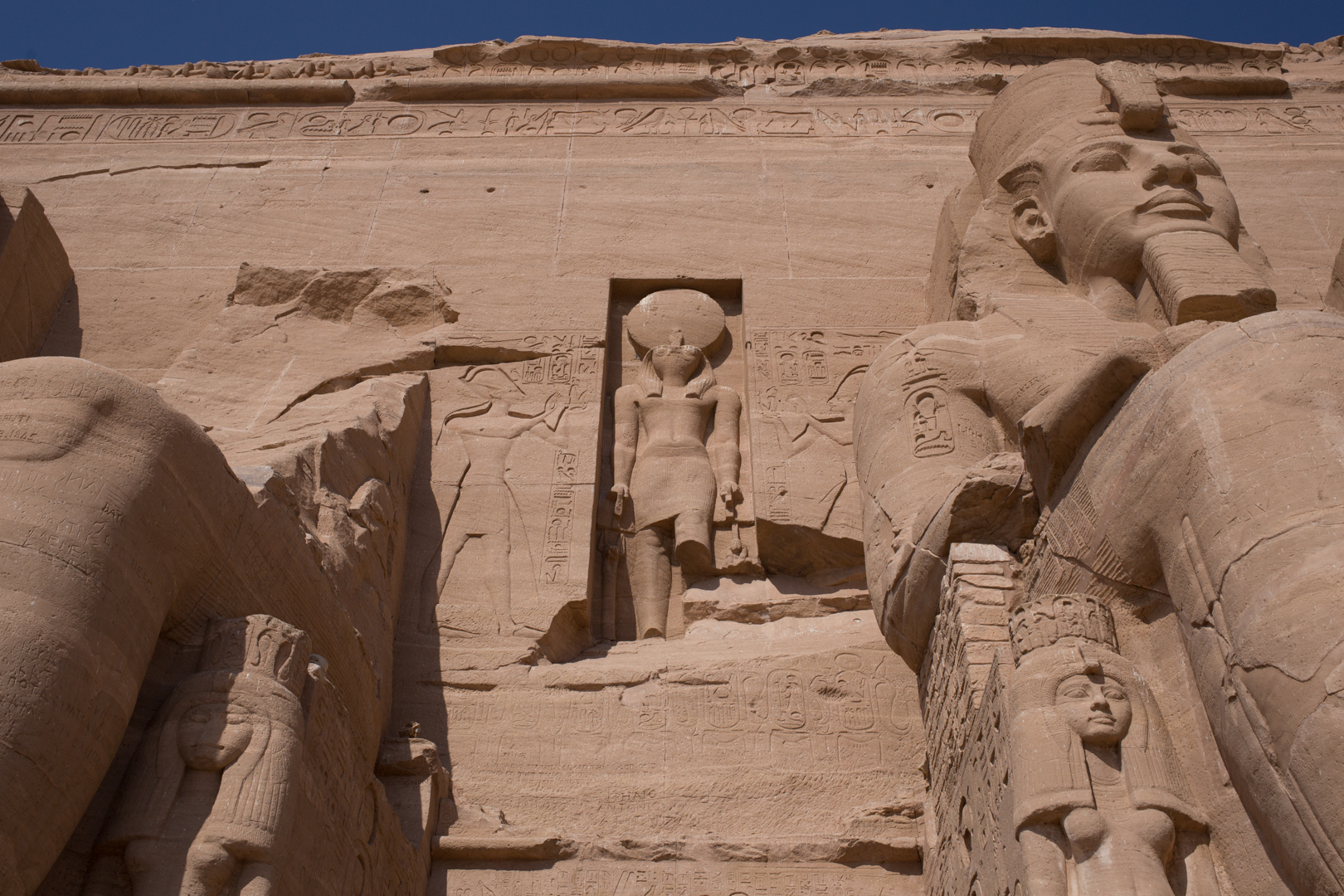


The 115-foot-wide facade is topped by a frieze originally made up of 22 baboons and smaller statues positioned at the base of the larger four depict Nefertari—Rameses's favorite wife—queen mother Mut-Tuy, Rameses’s first two sons and first six daughters. Immediately upon entering the main temple, you’re greeted by eight huge pillars, once again fashioned after Rameses himself (the guy was not shy).

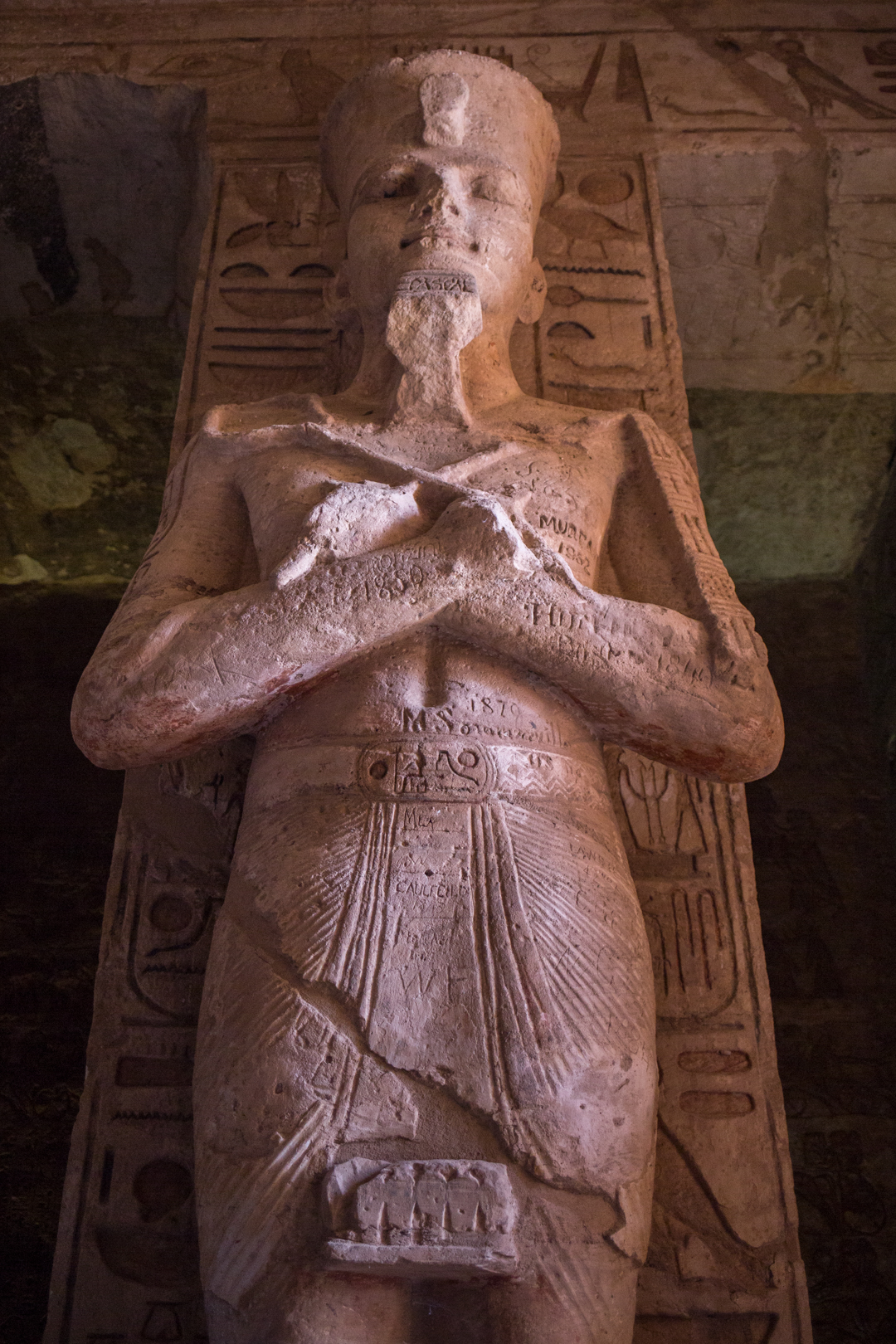


The sanctuary is the holiest part of a temple and the one at Abu Simbel is undeniably the best one we saw on our trip. On a back wall sits four, rock cut sculptures—one of Rameses (of course) along with the gods Ra-Horakhty, Amun Ra and Ptah. The Egyptians were so precise that they aligned this sanctuary in such a way that on two days during the year, October 22 and February 22, all of the statues except for Ptah—associated with the underworld—are illuminated by sunlight. We missed the October date by just a few weeks, but the chilling effect is recreated artificially for visitors year-round.
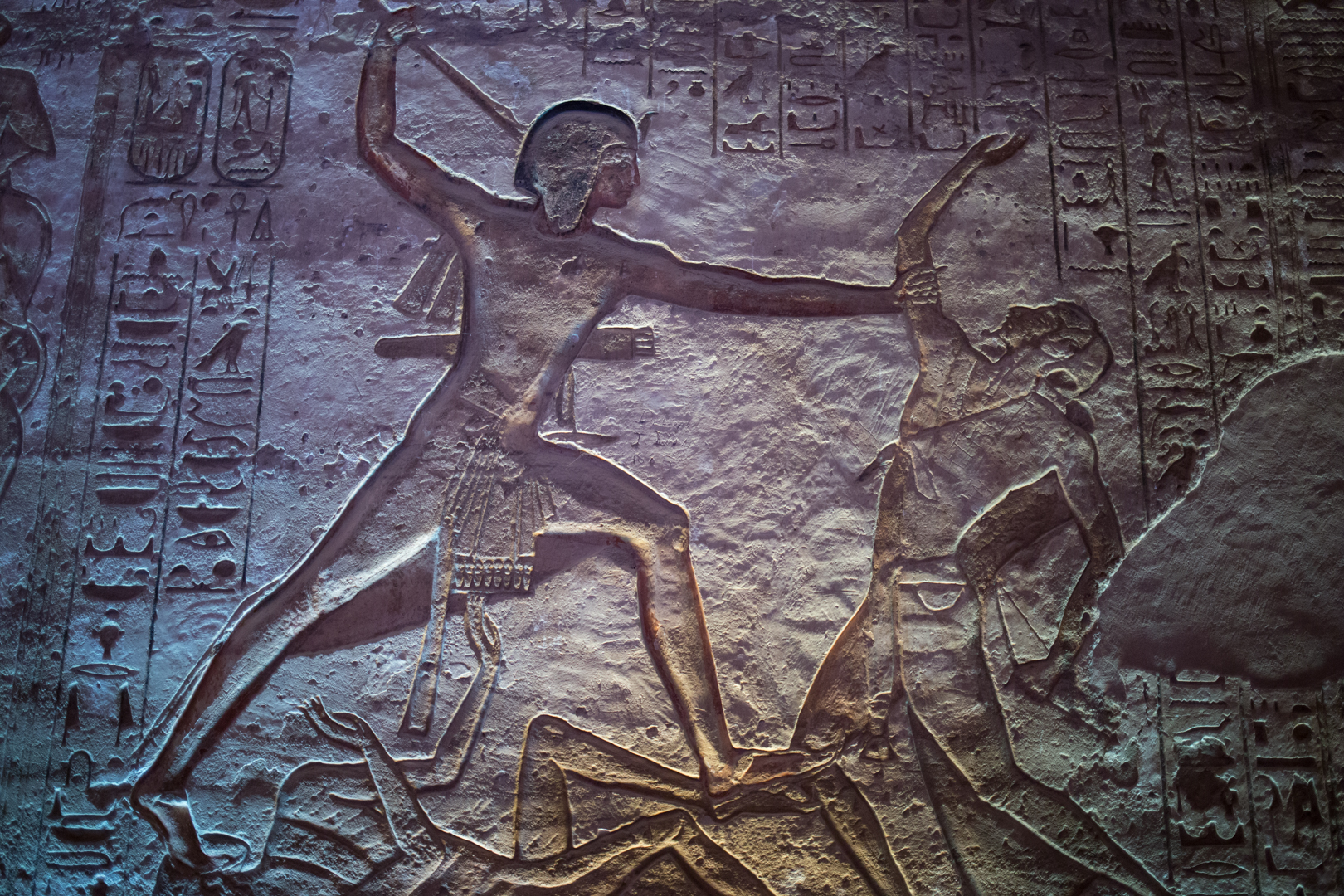

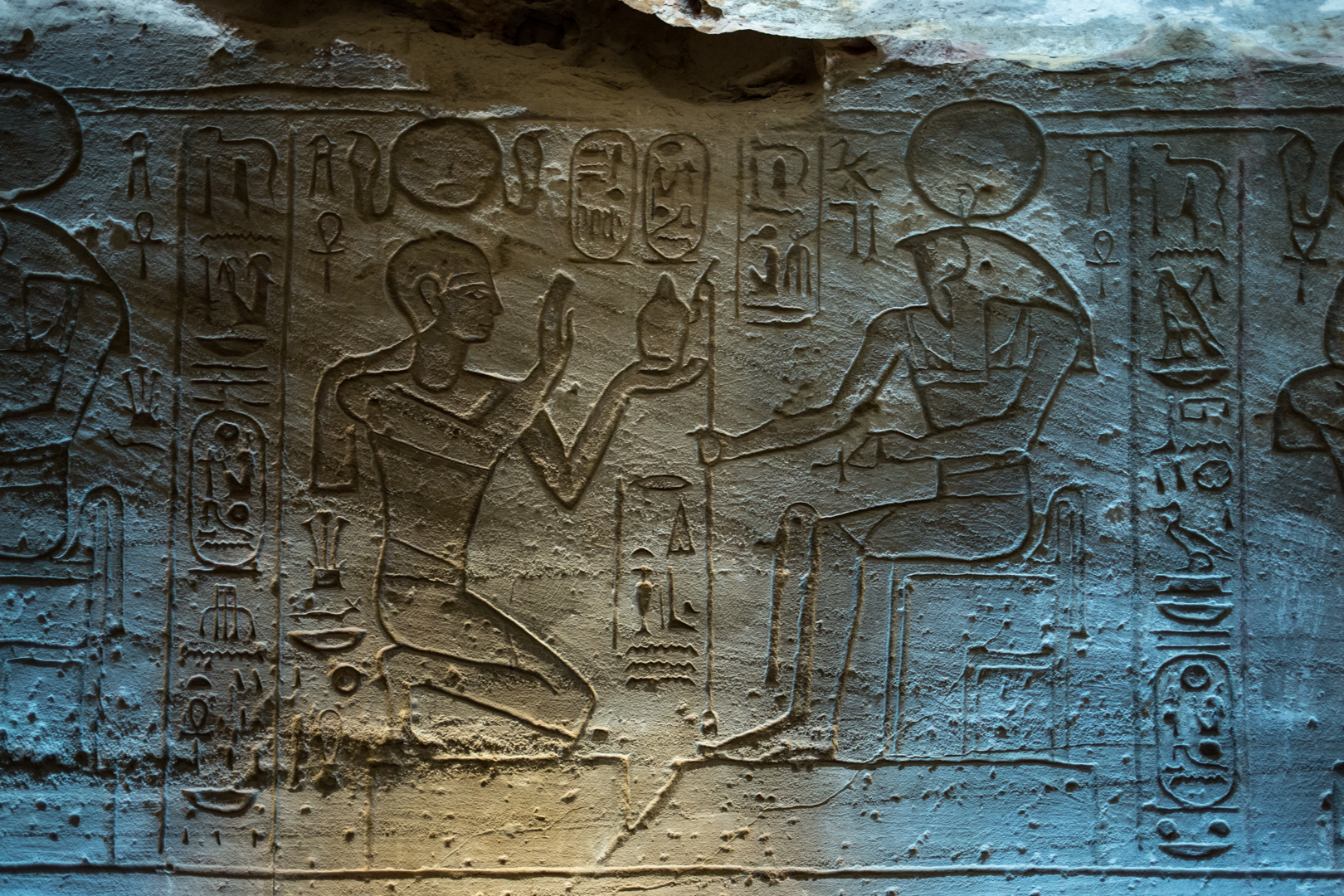
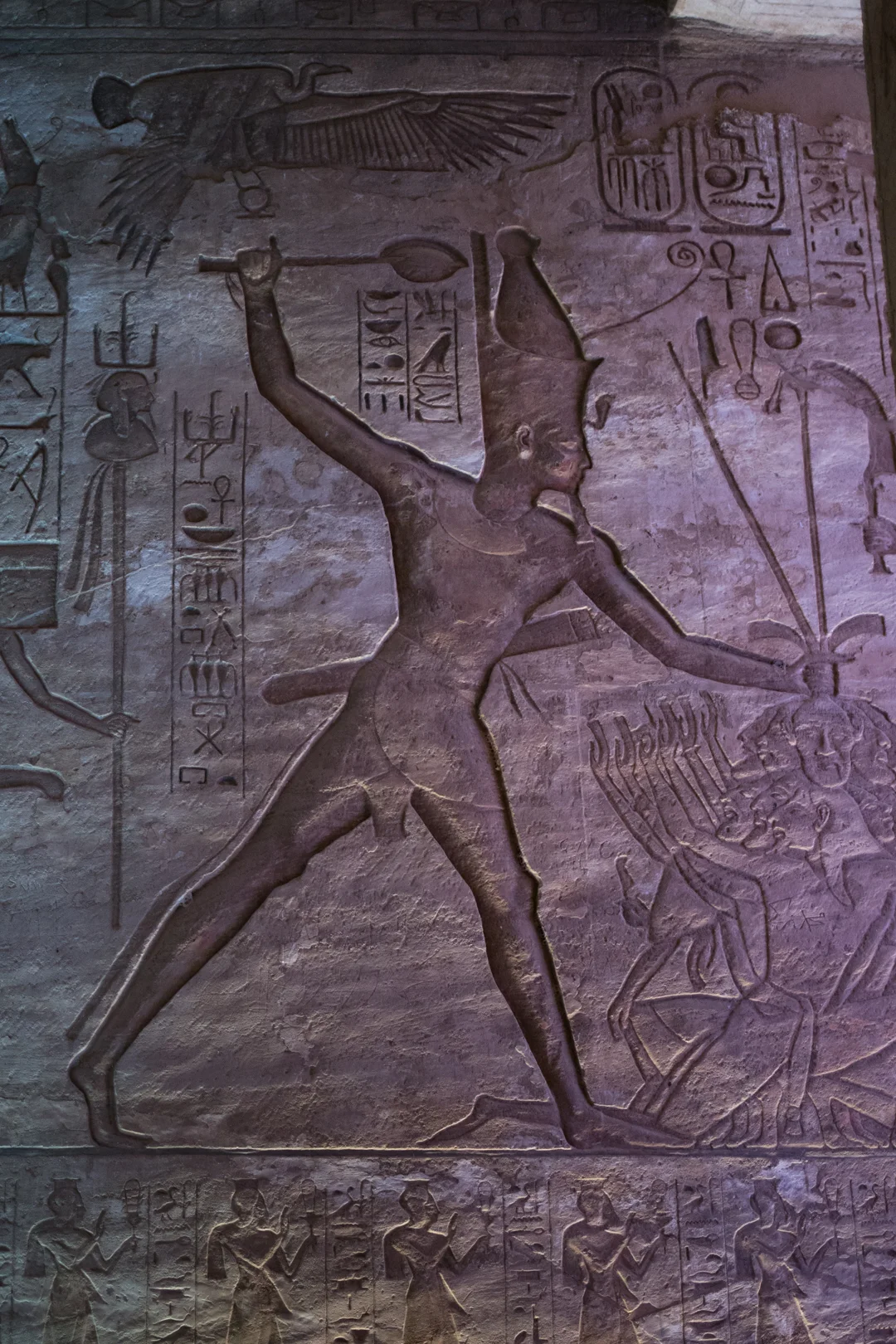


In 1959, with the construction of the Aswan High Dam imminent, a campaign was launched to save the monuments of Nubia that would be threatened by the rising waters of the Nile. Despite one well-received plan to build a dam around the submerged temples complete with underwater viewing chambers (can you imagine this??), beginning in 1964, the temples of Abu Simbel were cut into pieces and moved to a new location 200 feet higher and safely set back from the water.

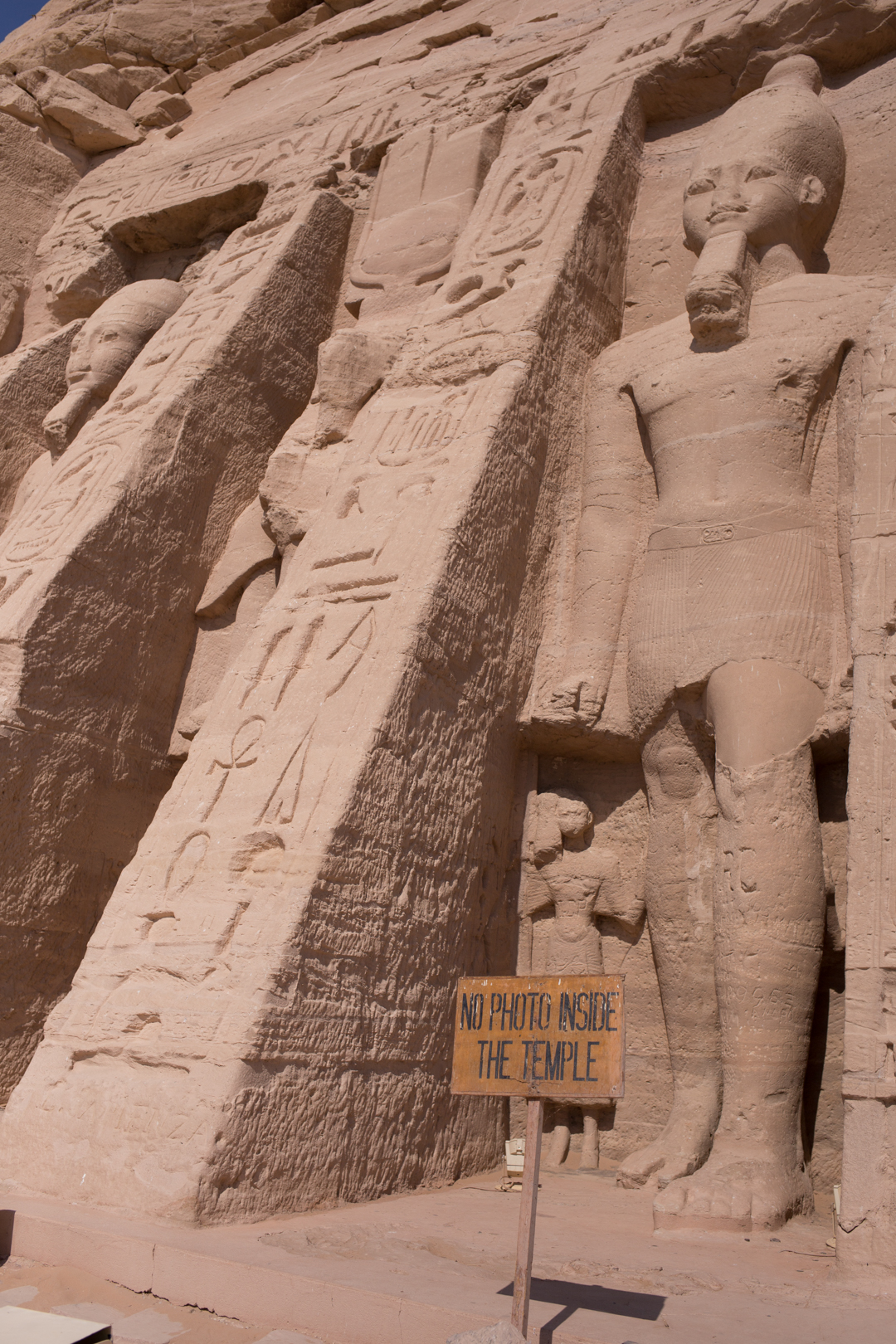


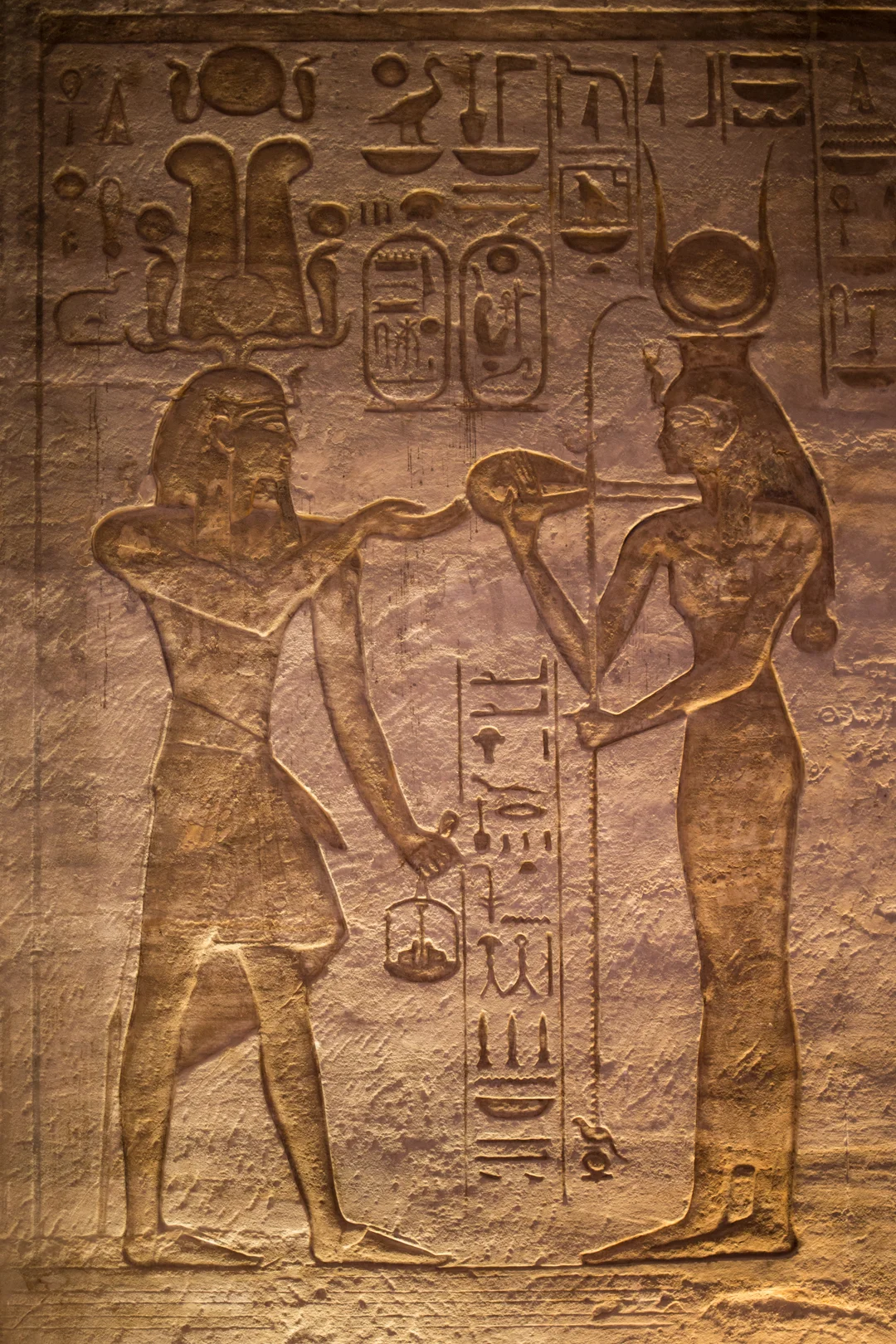

The smaller temple is dedicated to Hathor and Rameses’s chief wife, Nefertari. This marks only the second time in ancient Egyptian history that a pharaoh dedicated a temple to his queen, but don’t give Ramses too much credit—he couldn’t resist carving himself into the facade alongside Nefertari. The interior of this temple is also lined with columns, but here they are topped with the face of the goddess Hathor.

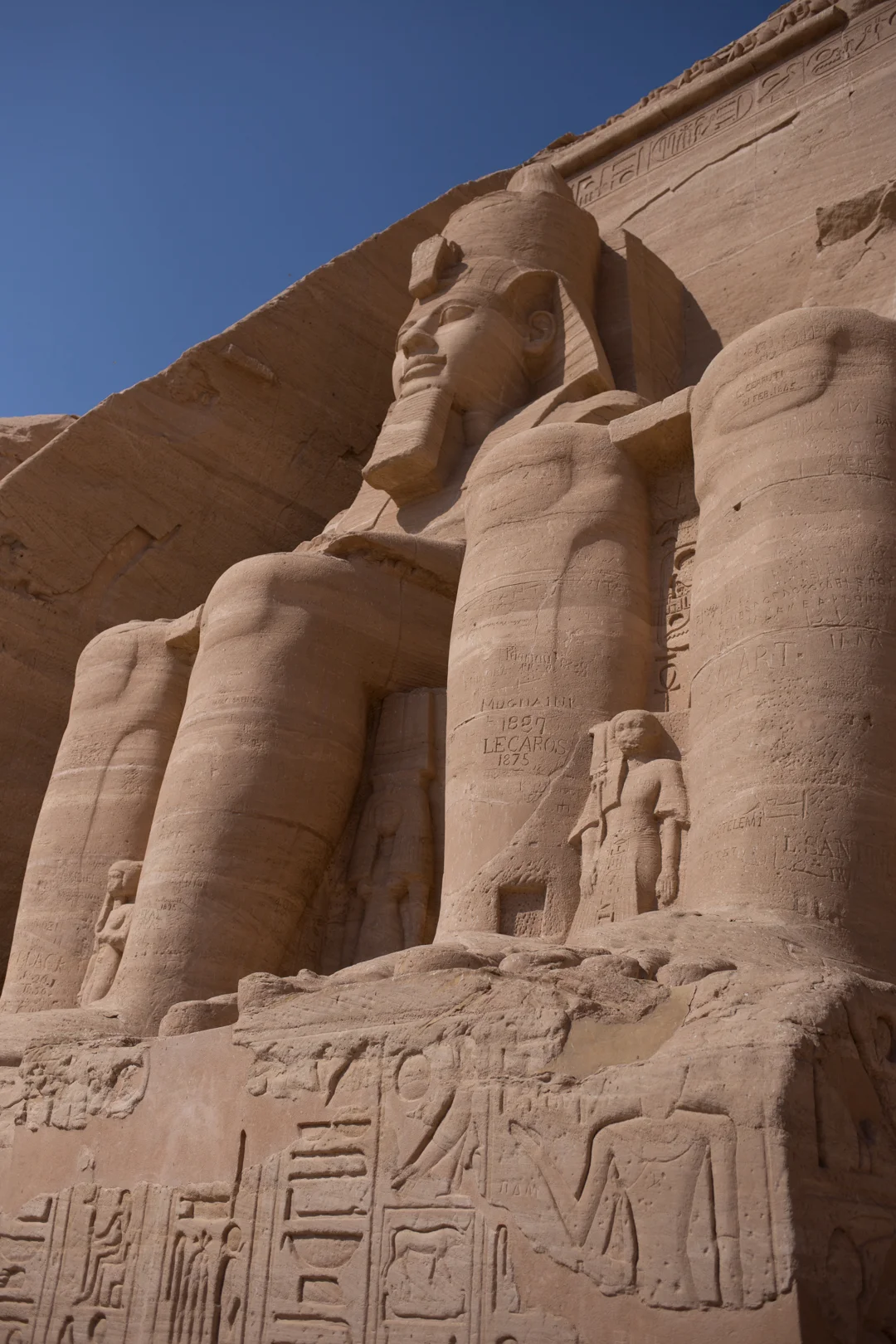


By the 6th century BCE the statues of the main temple were covered up to their knees in sand. In 1817, my favorite circus-strongman-turned-archeologist, Belzoni, was able to enter the main temple, but it remained partially buried for several decades. This didn’t deter visitors from carving their name into the face of the temple to prove they had made it all the way to Nubia, and like most of the monuments we visited, Abu Simbel has its fair share of historic graffiti.
Nubia is a region of southern Egypt near the Sudan border, and Abu Simbel sits on the western bank of Lake Nasser. Words can’t describe what it’s like to turn the corner and catch your first glimpse of the four towering pharaohs, looking as if they could rise from the seats they’ve occupied for more than 3,000 years and walk right out of the mountainside.
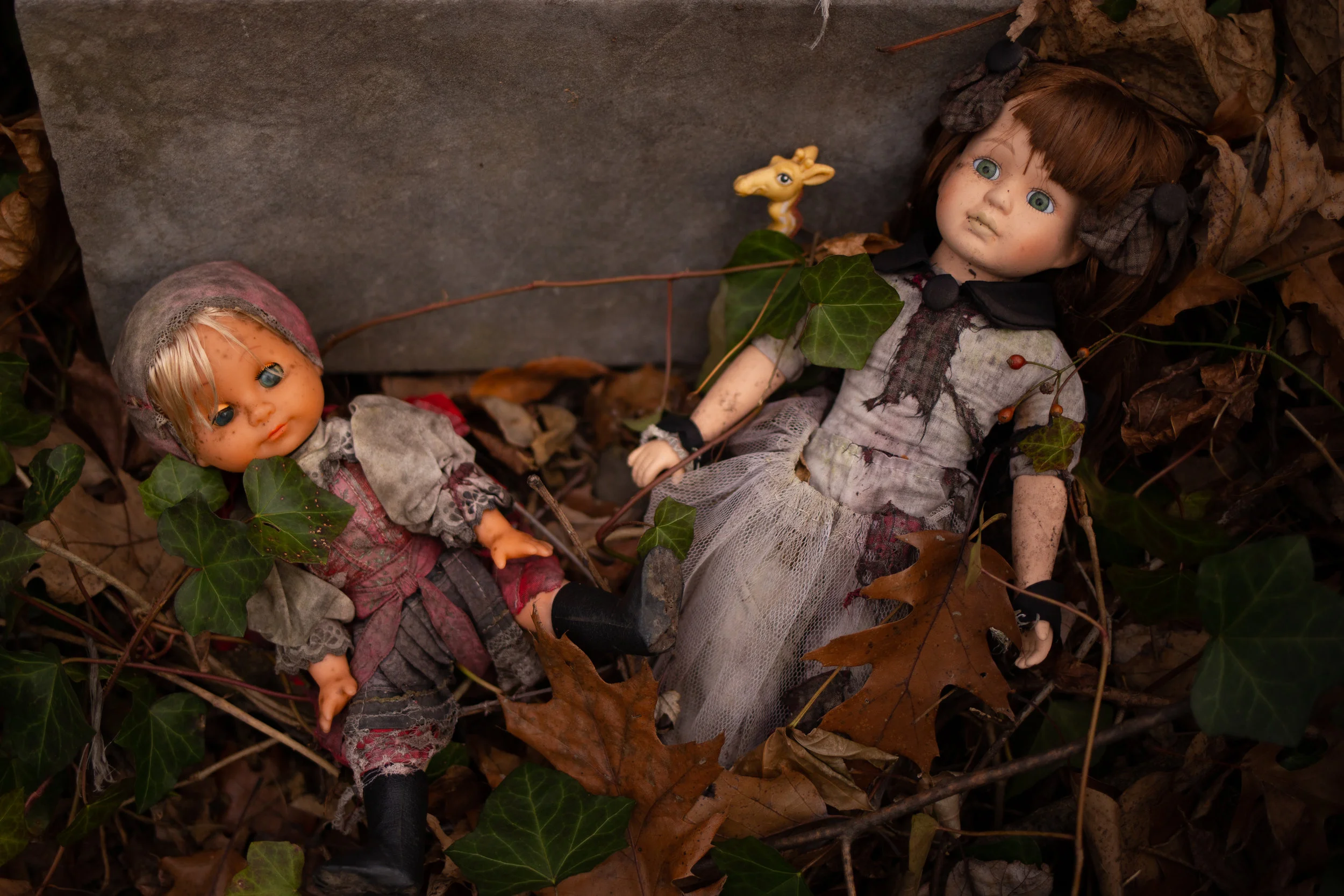
Woodland Cemetery

I love exploring abandoned or forgotten places, but they’re hard to come by in New York City. Land is such a premium that nothing sits empty for too long and almost nothing about the city feels like a secret. As I was watching the (excellent) documentary, The World Before Your Feet, I was surprised to see Matt Green—who is in the process of walking every single street, park, bridge and cemetery in the five boroughs—walking through what appeared to be an abandoned cemetery. Luckily, it was identified in the film and I made a note in my phone, knowing that I had to see it for myself as soon as I could.
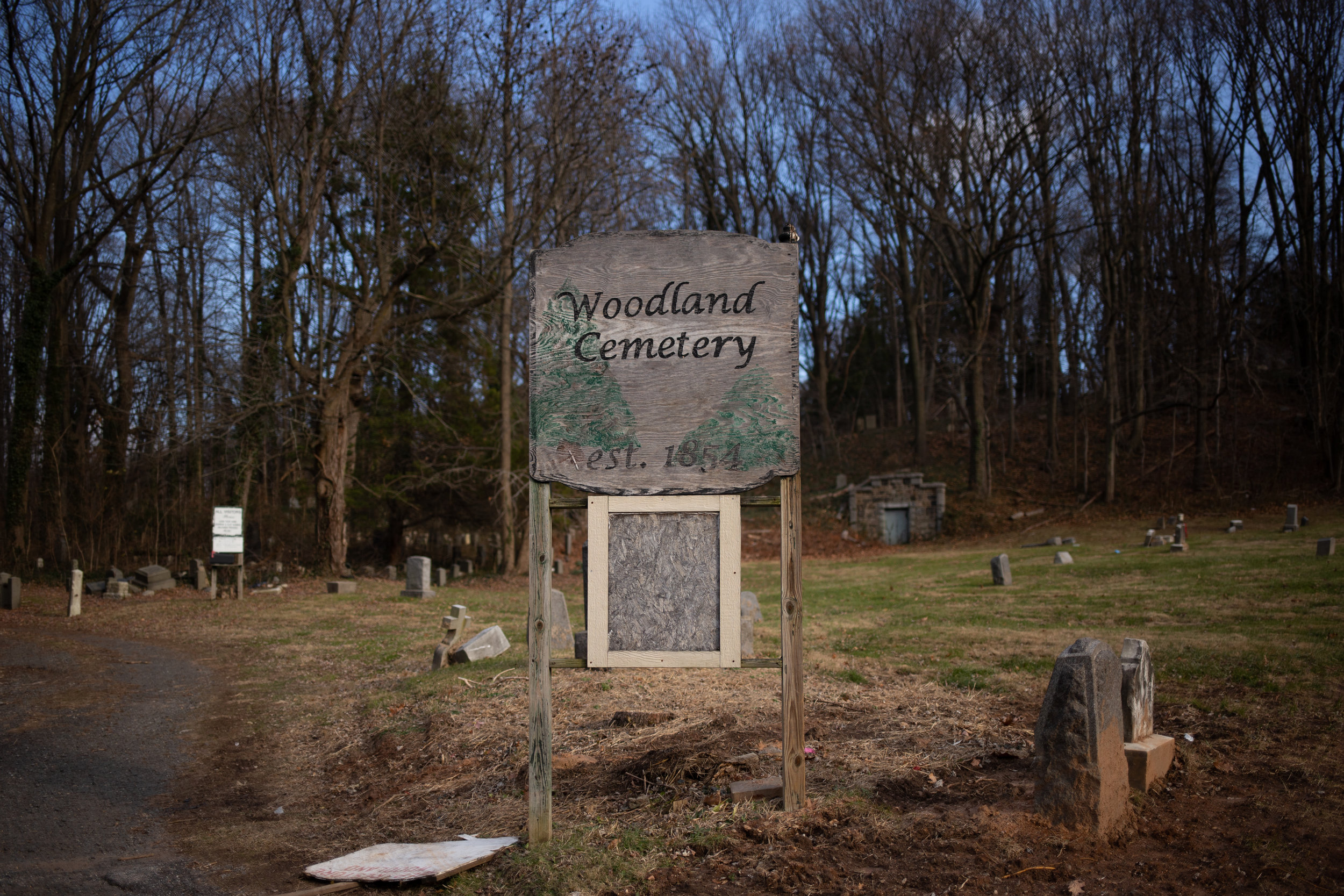


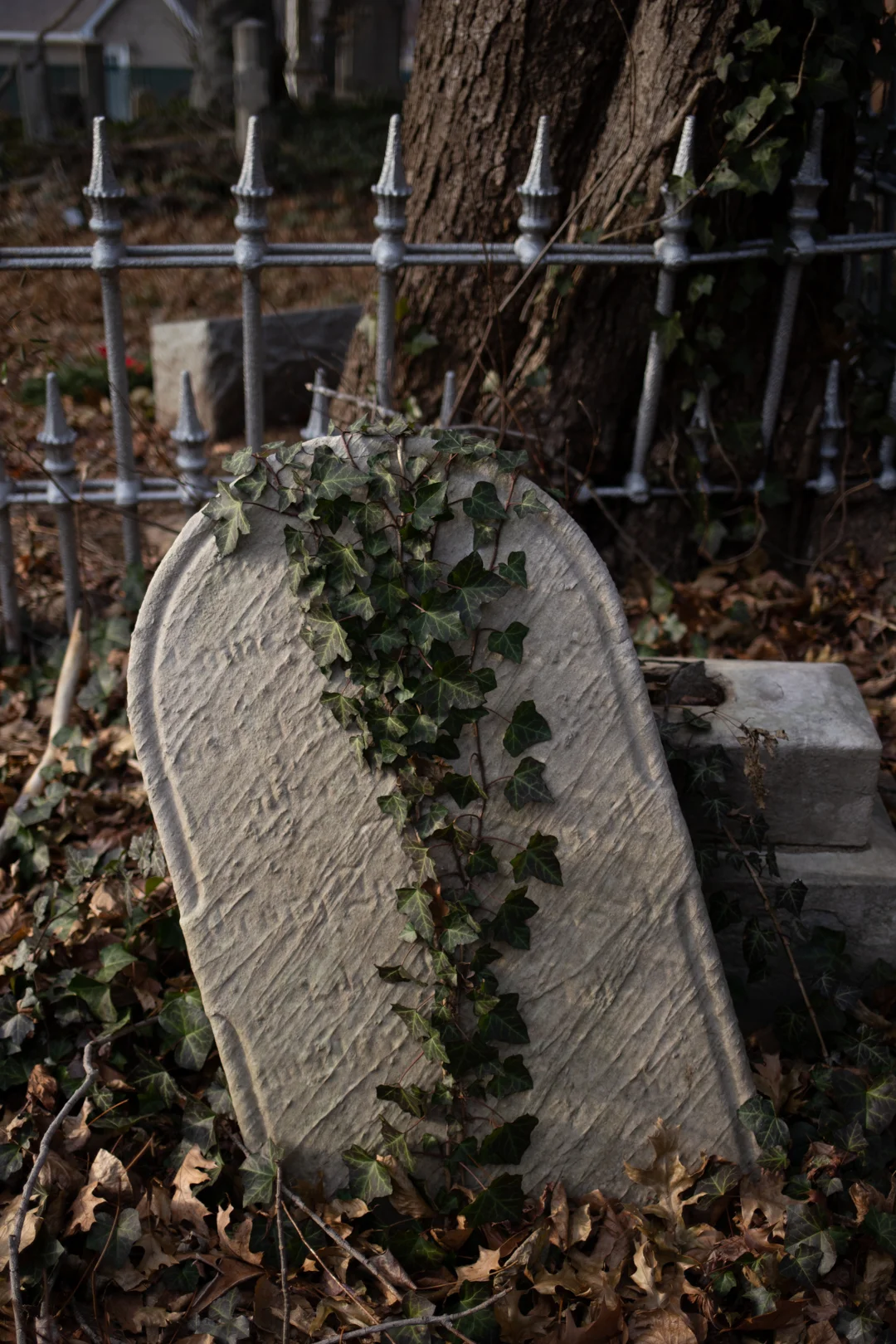
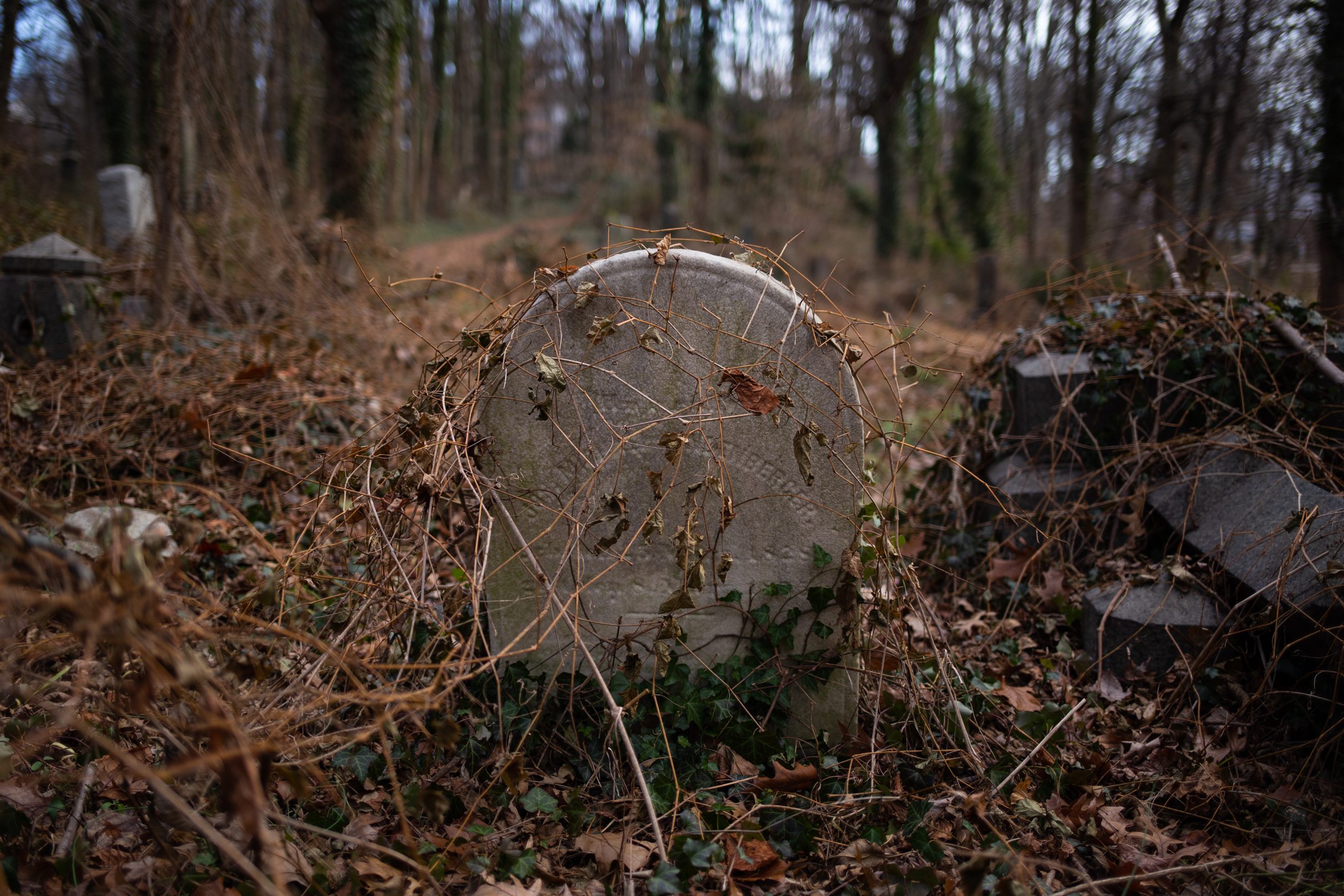
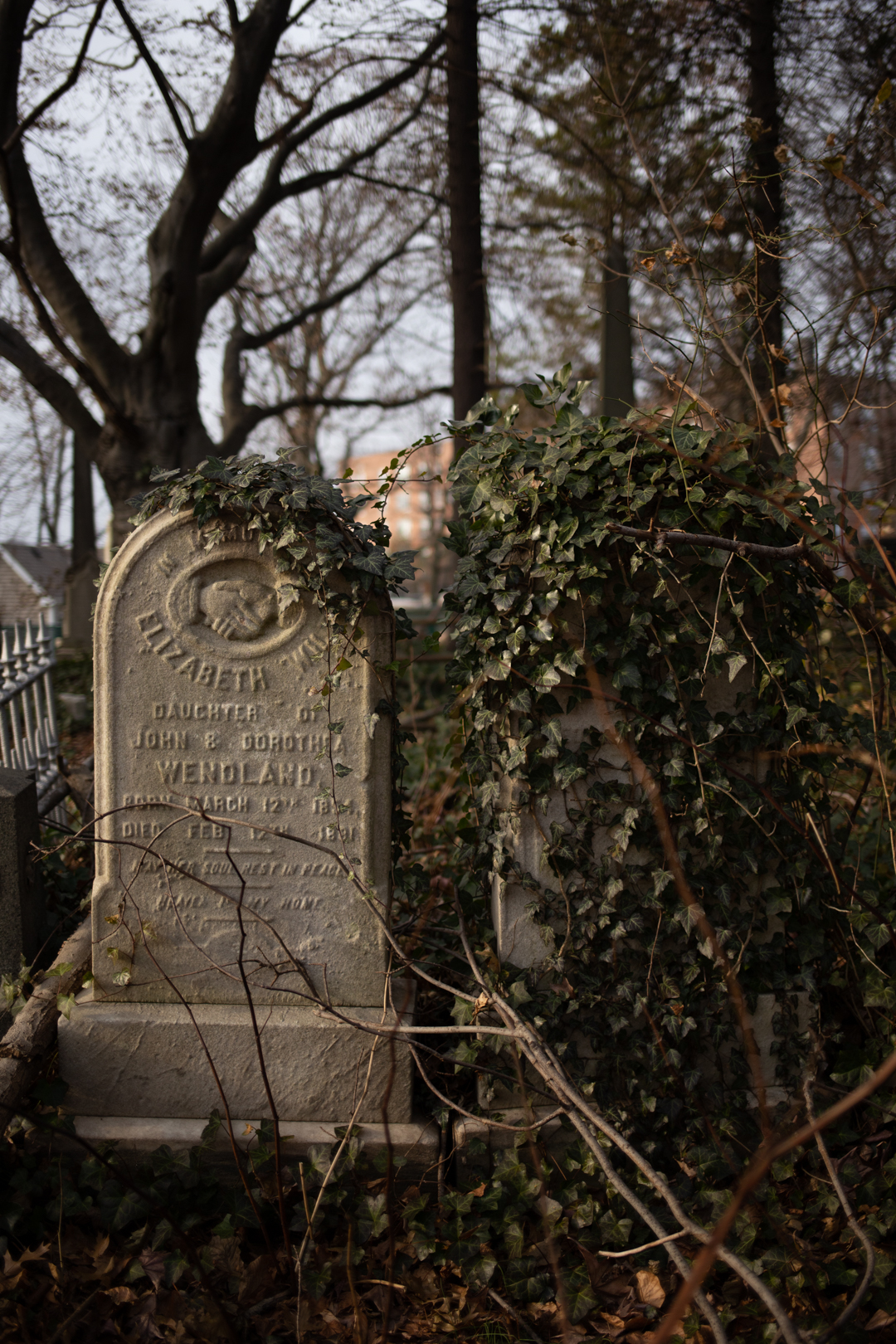


Woodland Cemetery is located just off of Victory Blvd in the Silver Lake neighborhood of Staten Island. It’s only a 20-minute bus ride from the St. George ferry terminal, but inspired by Green, I decided to walk. This turned out to be a mistake because—as I always seem to forget until it’s too late—Staten Island is very hilly. I’m not exaggerating when I say that almost all of the hour-long walk to the cemetery was uphill. I did take the bus back to the ferry terminal, but in the future I’ll do the opposite (bus there, walk back).


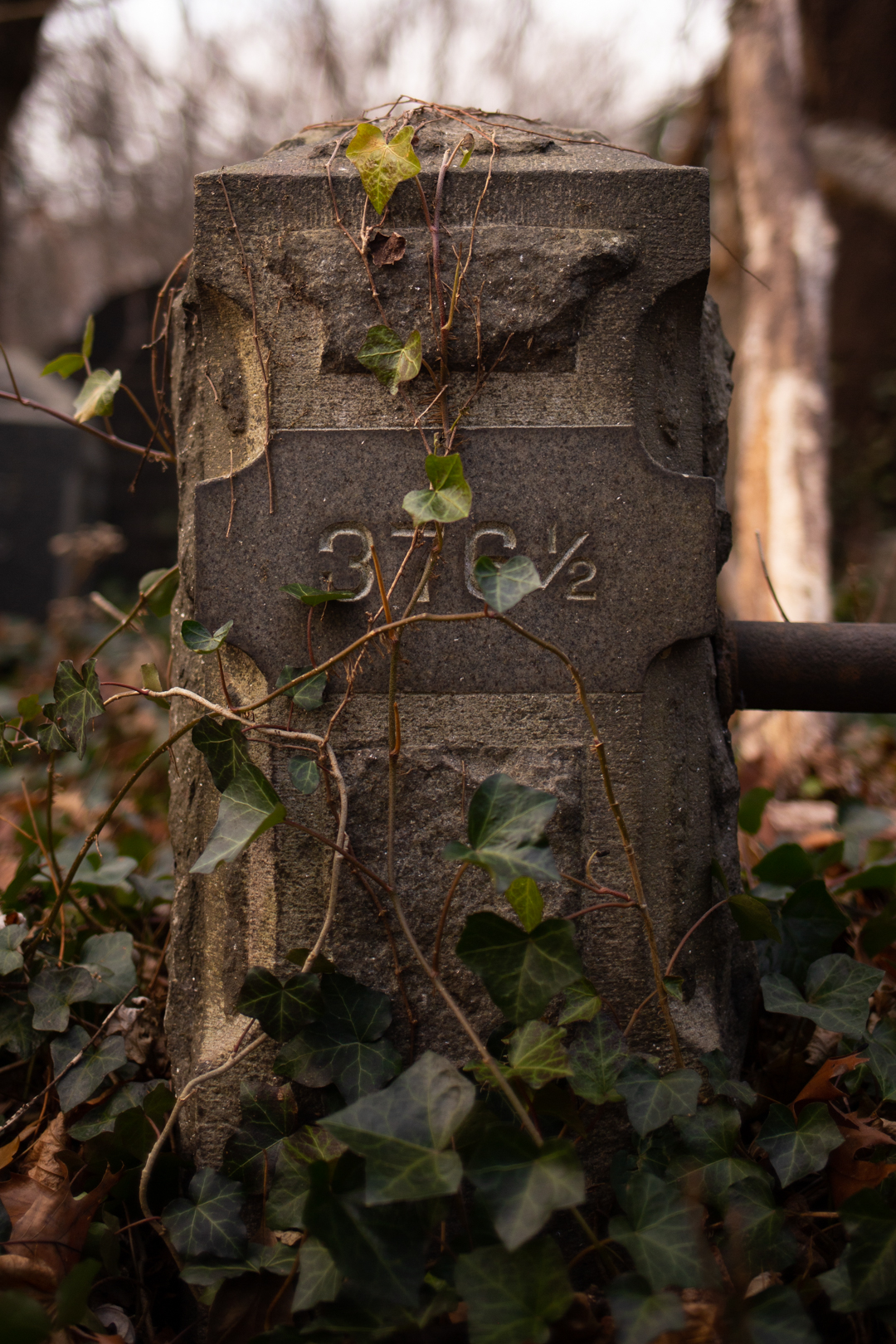


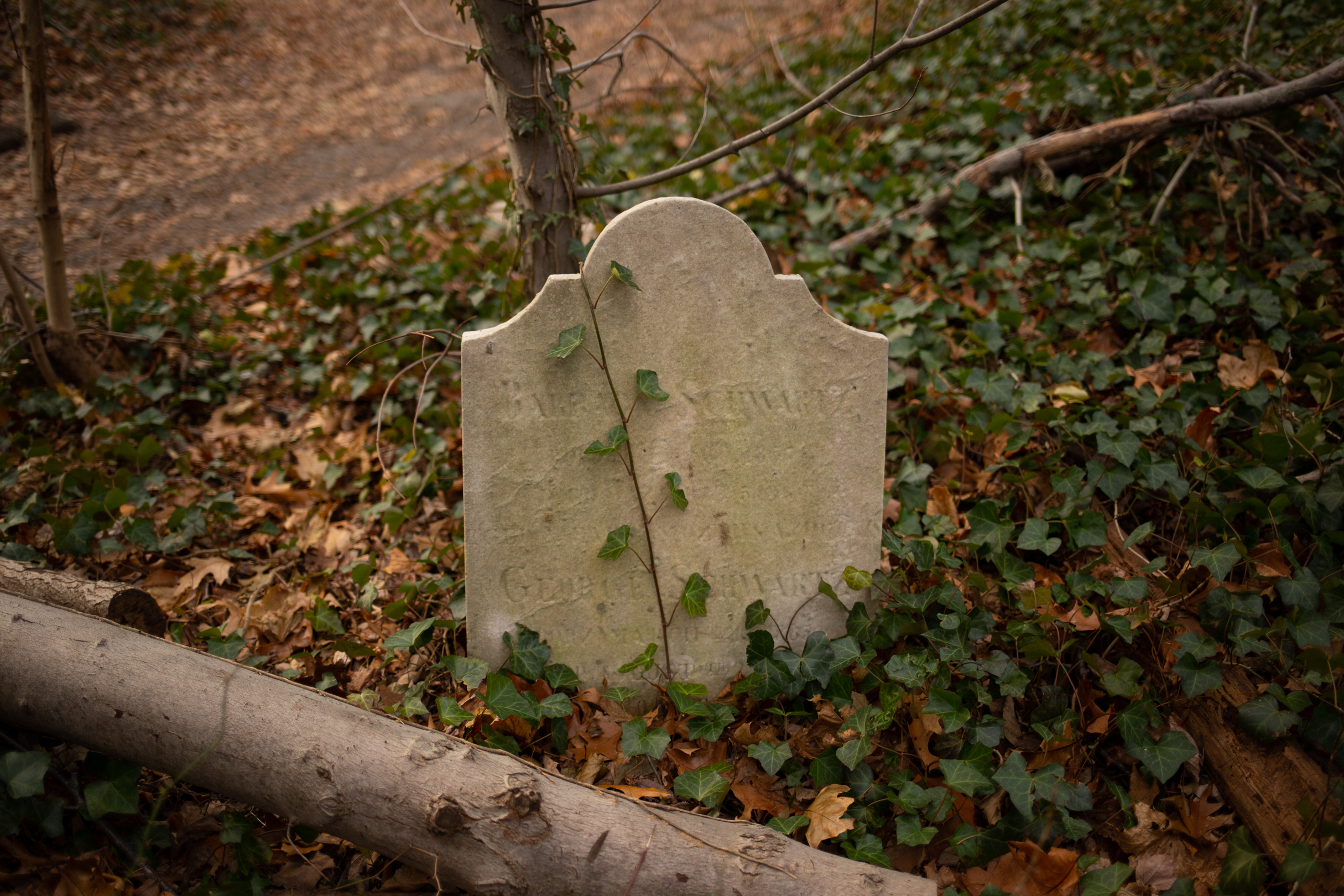
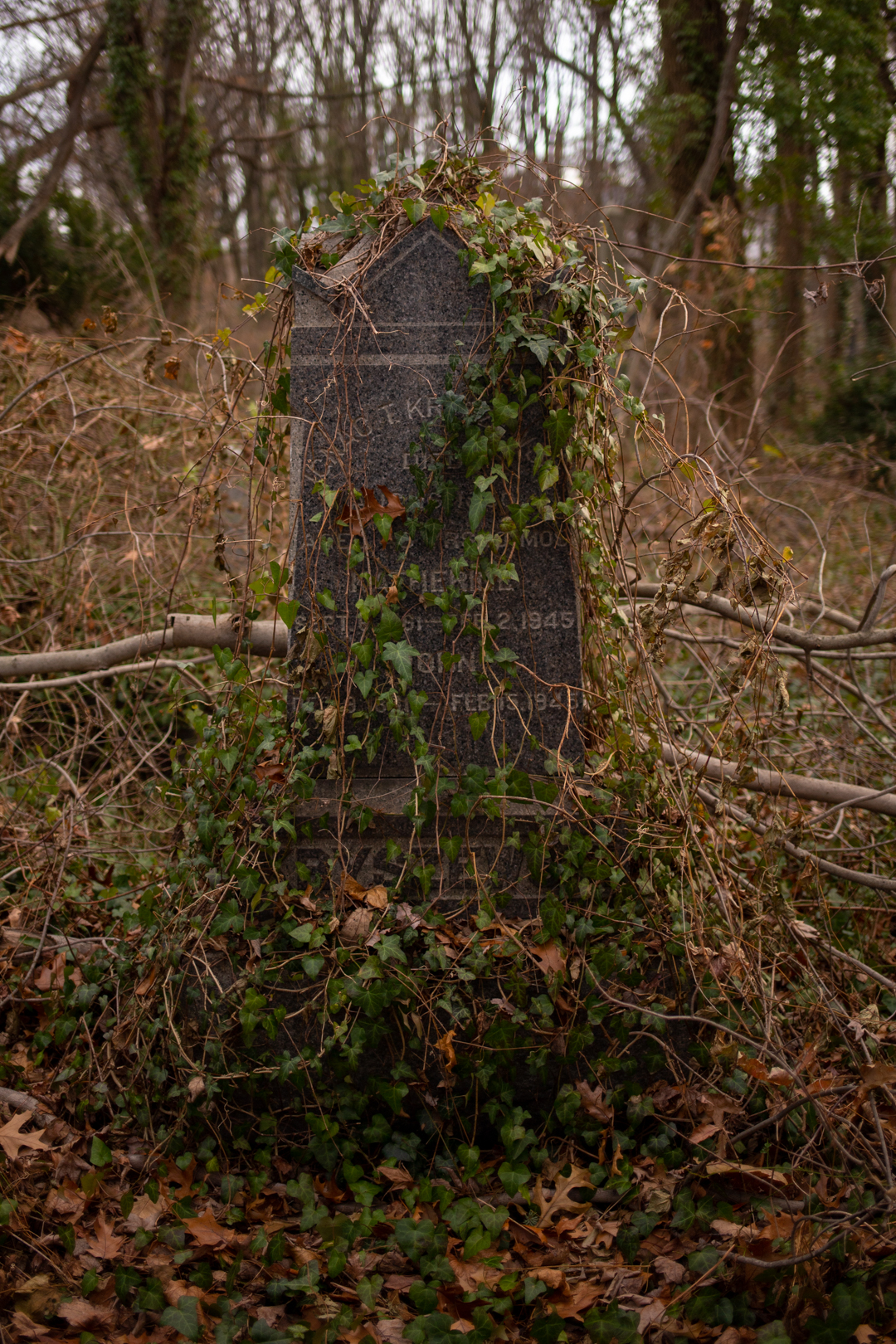

Woodland was established in 1854 by John King Vanderbilt, first cousin of Cornelius Vanderbilt. John King is buried at Woodland, while Cornelius is buried four miles away in the Vanderbilt Family Cemetery and Mausoleum, a private cemetery located within Moravian Cemetery and not regularly open to the public.
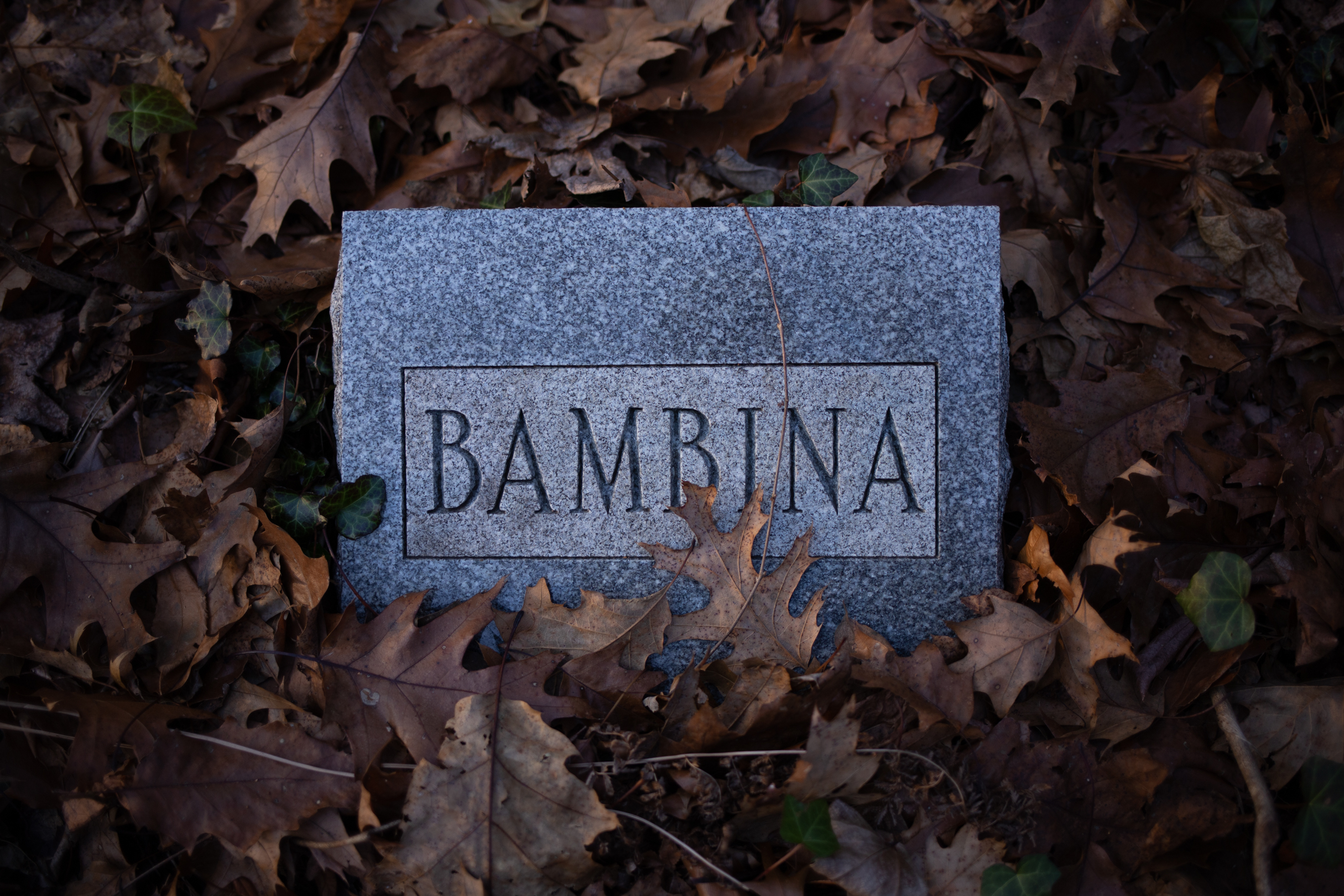
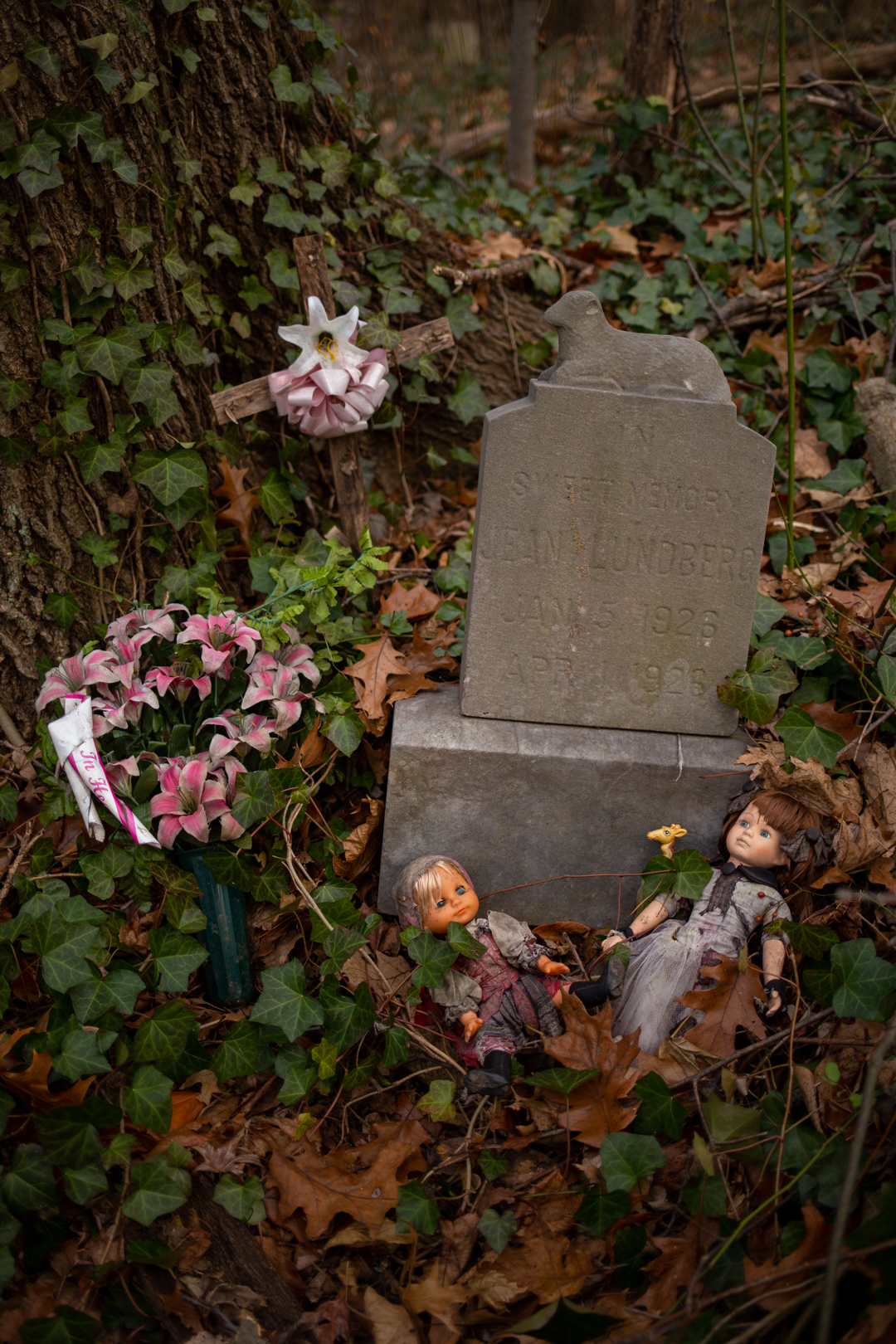


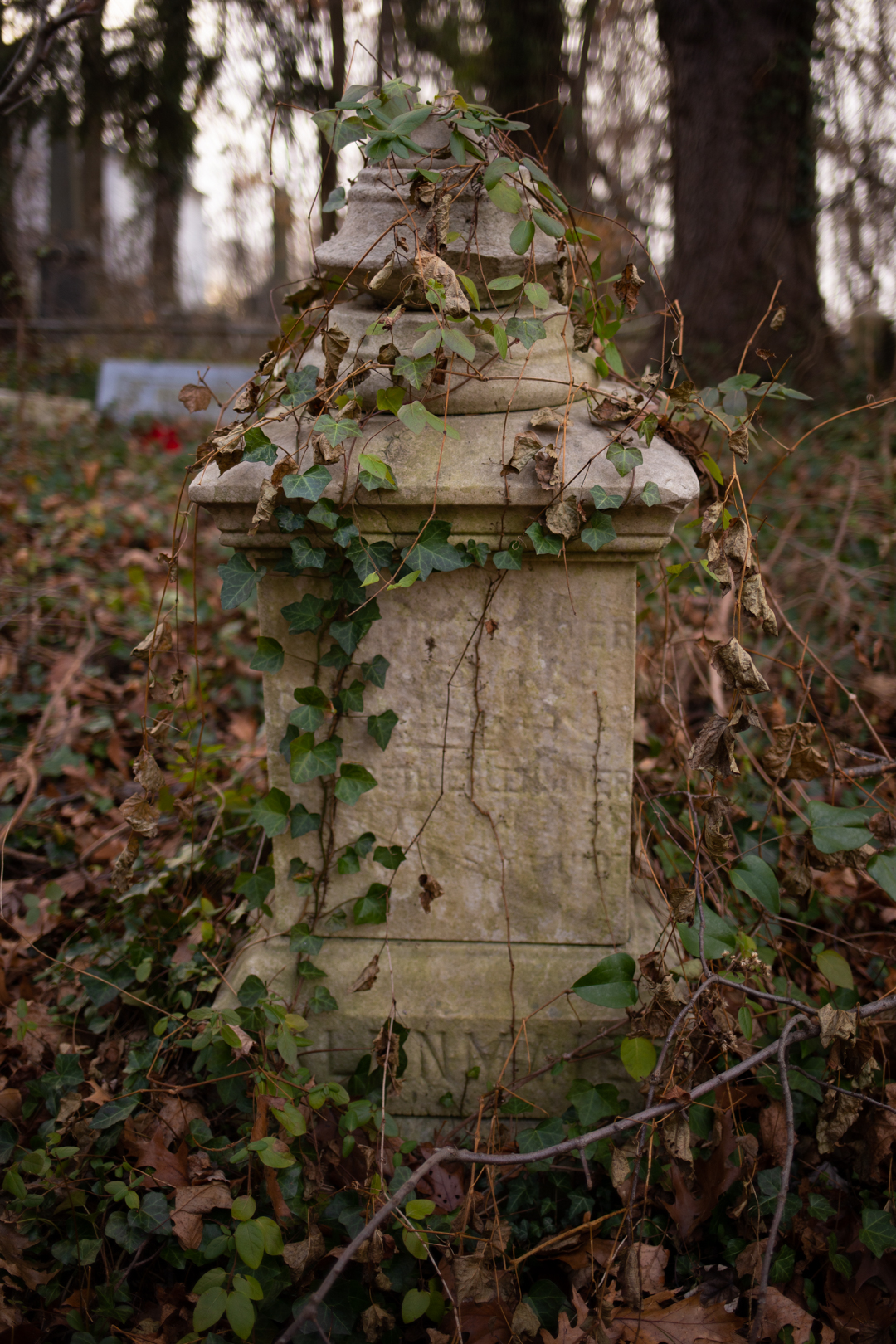


The ten-acre cemetery is still technically active, and there have been more than 22,000 recorded burials. While not considered abandoned, the grounds are definitely overgrown and in desperate need of attention. A group of volunteers is currently working to help preserve the historic cemetery but it’s a big, never-ending job.
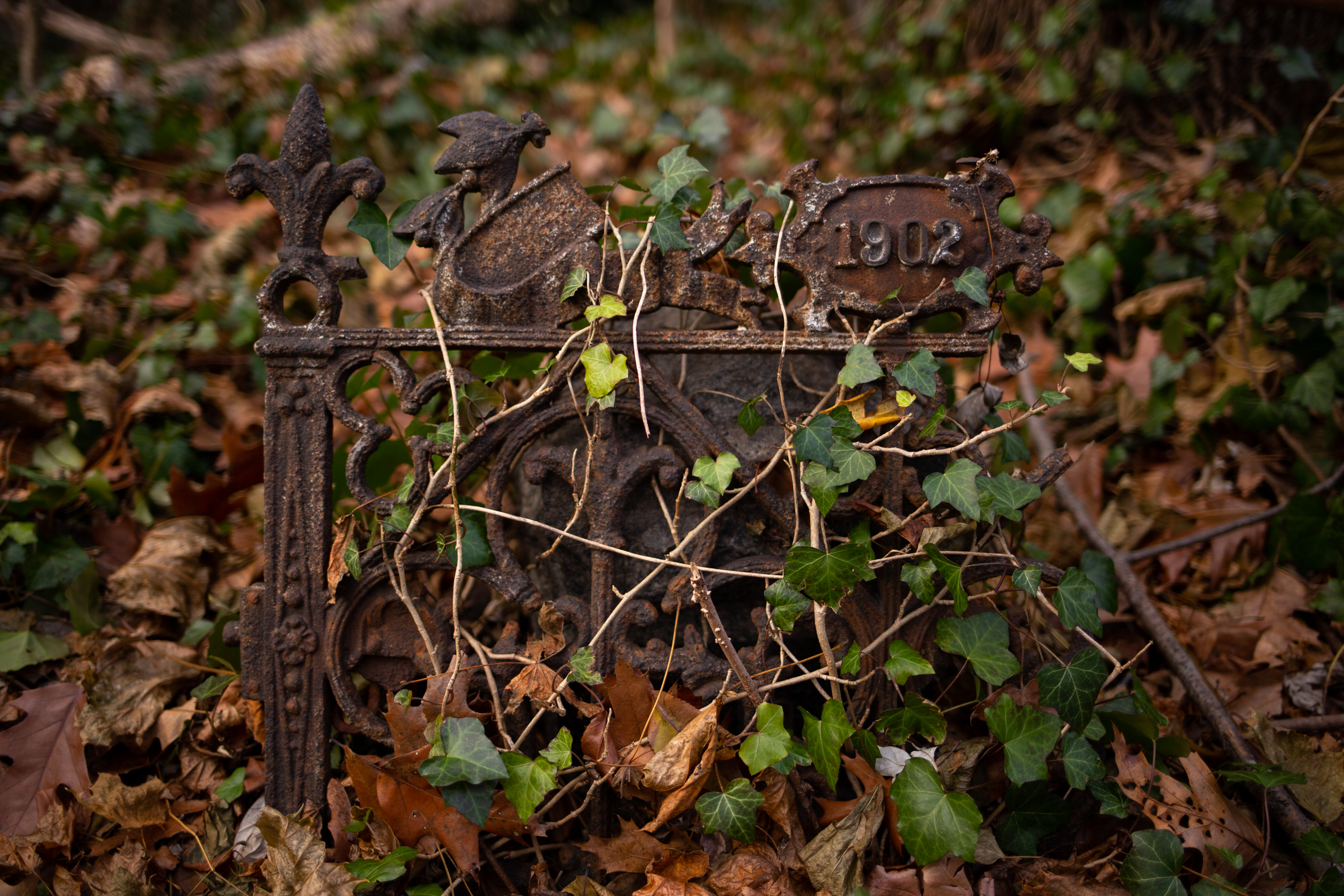


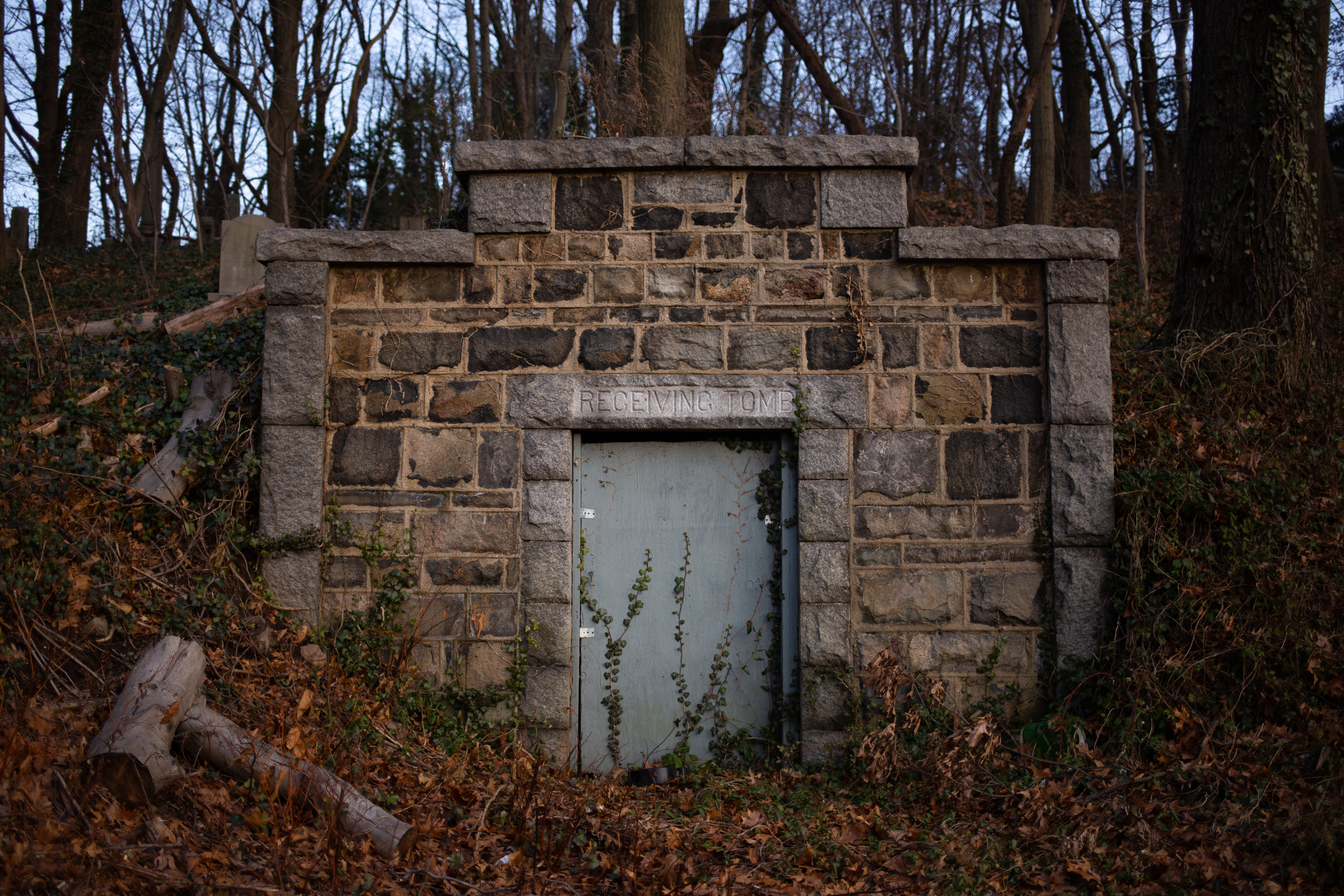


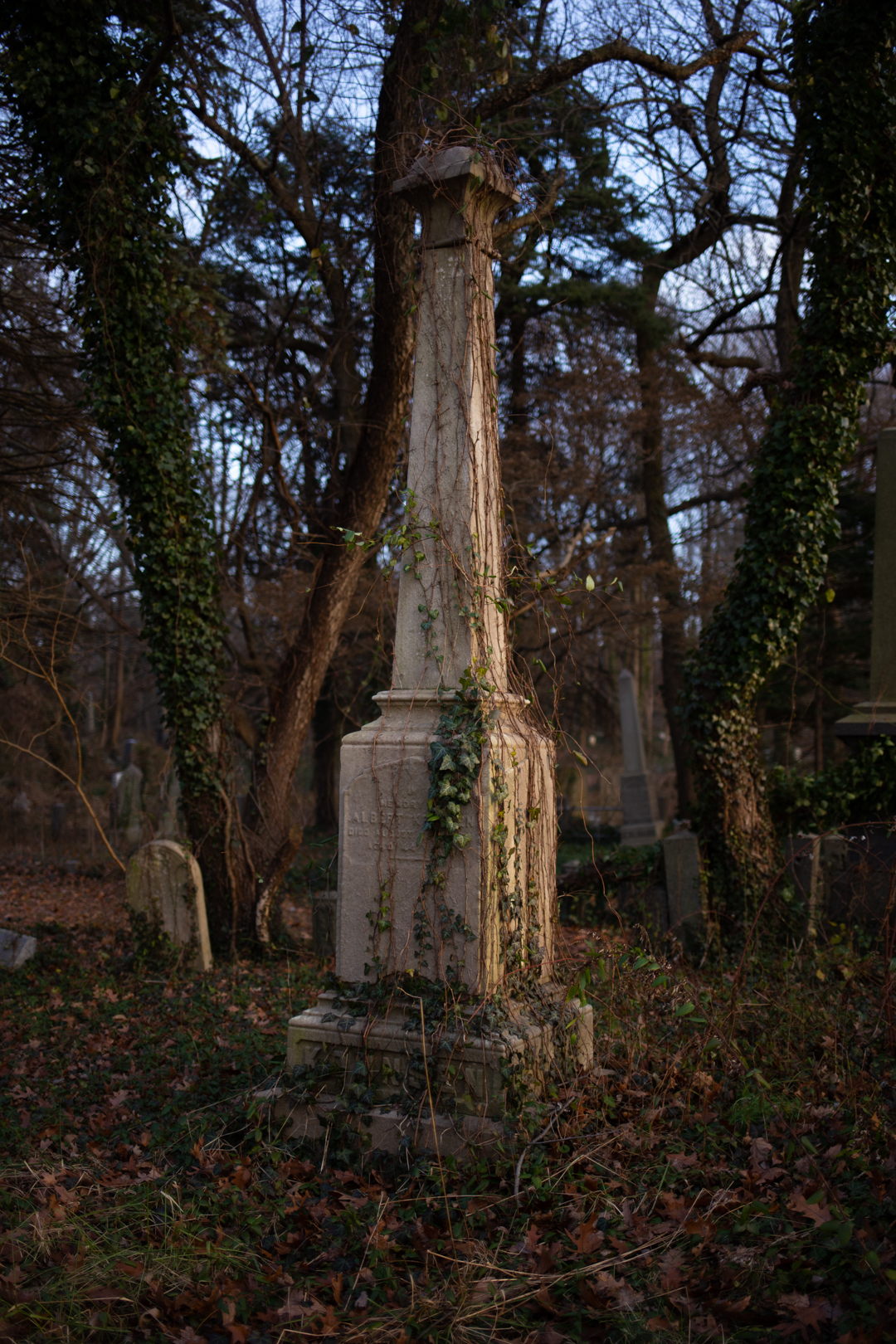
Bayside Cemetery is a more notorious abandoned cemetery within city limits but I think Woodland is even better than Bayside. You also get three cemeteries for the price of one—adjacent to Woodland is the similarly shabby Jewish burial ground, Silver Lake Cemetery (1893), and next to Silver Lake is the well-maintained Silver Mount Cemetery (1866).
Woodland Cemetery
24-32 Highland Avenue
Staten Island, NY
Join me as I attempt to visit every cemetery located within the five boroughs.

Holiday Windows 2018: Bloomingdale's

This was my sixth year viewing (and photographing) the holiday windows at several of the major department stores in midtown. It’s become an after-Thanksgiving tradition for my mom and I to grab breakfast at Neil’s Coffee Shop (Gene’s Coffee Shop was closer, but unfortunately it has closed) and go see the windows at Bloomingdale’s, Bergdorf Goodman, Tiffany & Co. and Saks.

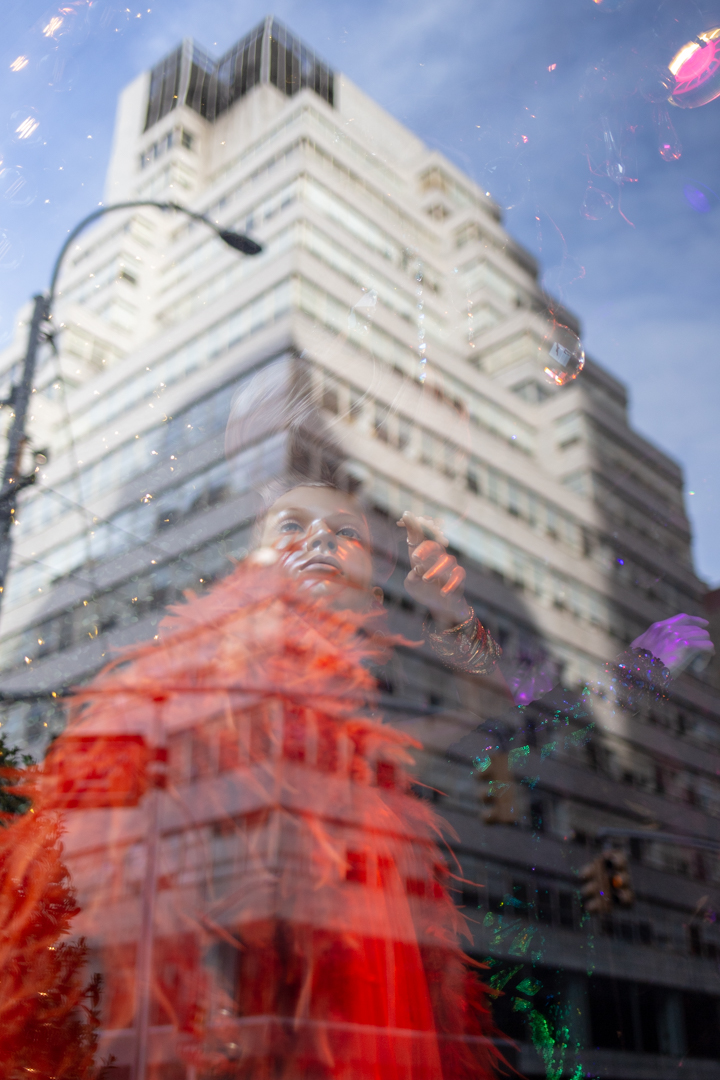


This year, we both agreed that the windows at all four stores weren’t as good as they have been in past years. Bloomingdale’s has never had my favorite windows, but this year their Grinch-themed displays were a bit better than some of their previous installations. I’m not intrinsically against corporate partnerships, and I think that while sometimes they can feel forced, they can also be done thoughtfully and artfully. The Grinch is an appropriate muse not only for its holiday themes, but for its well-established, rich visual language.


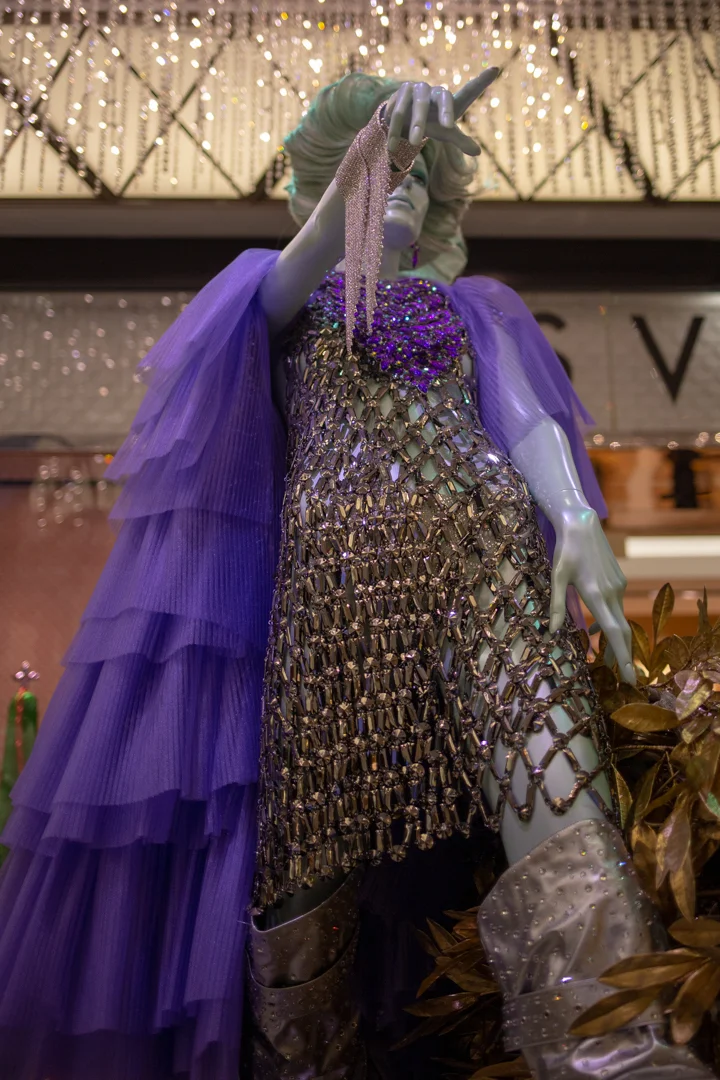
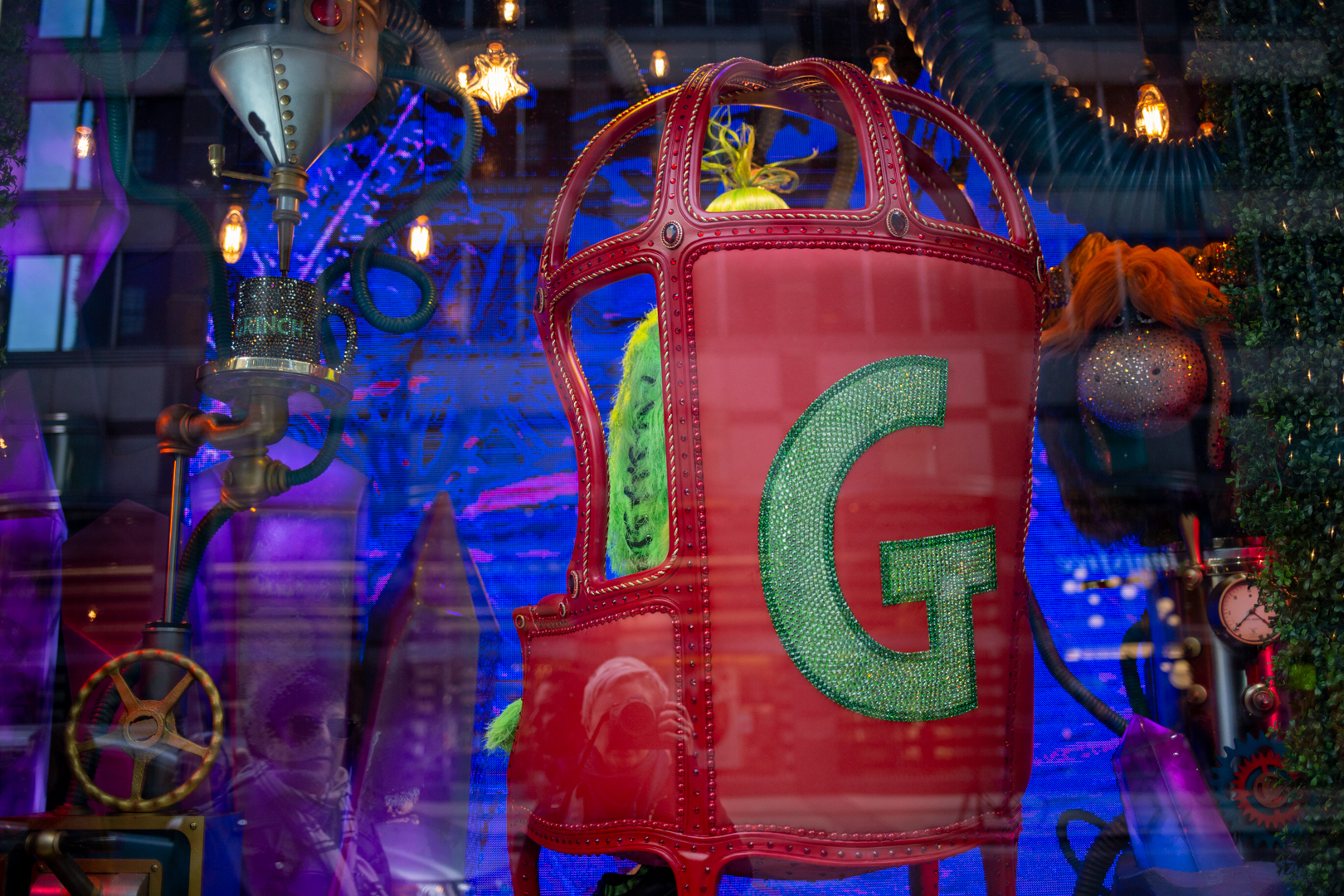
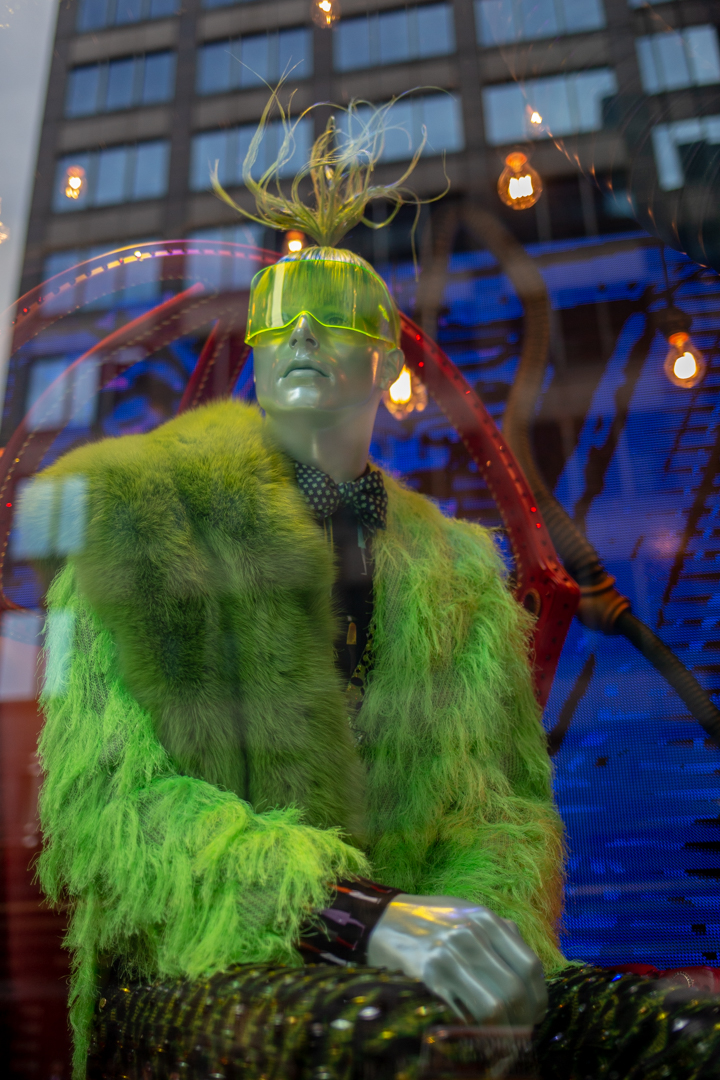

The grand New York City department store unfortunately feels endangered—Henri Bendel will close in January after 123 years in business, and Lord and Taylor will also be leaving its flagship Fifth Avenue store after spending just under 105 years in that location. Fewer department stores means fewer window displays, so I’m trying to cherish this holiday tradition while it still exists.


What I don’t love so much about this year’s Bloomingdale’s windows (and as a trend in general), is their interactive element. I always feel like a total grandma complaining about new-fangled technologies and complicated whiz-bang, but I don’t need selfie stations or karaoke machines to get me into the holiday spirit.
Bloomingdale’s
59th Street and Lexington Avenue
New York, NY
Gift Guide: Cemetery Lovers

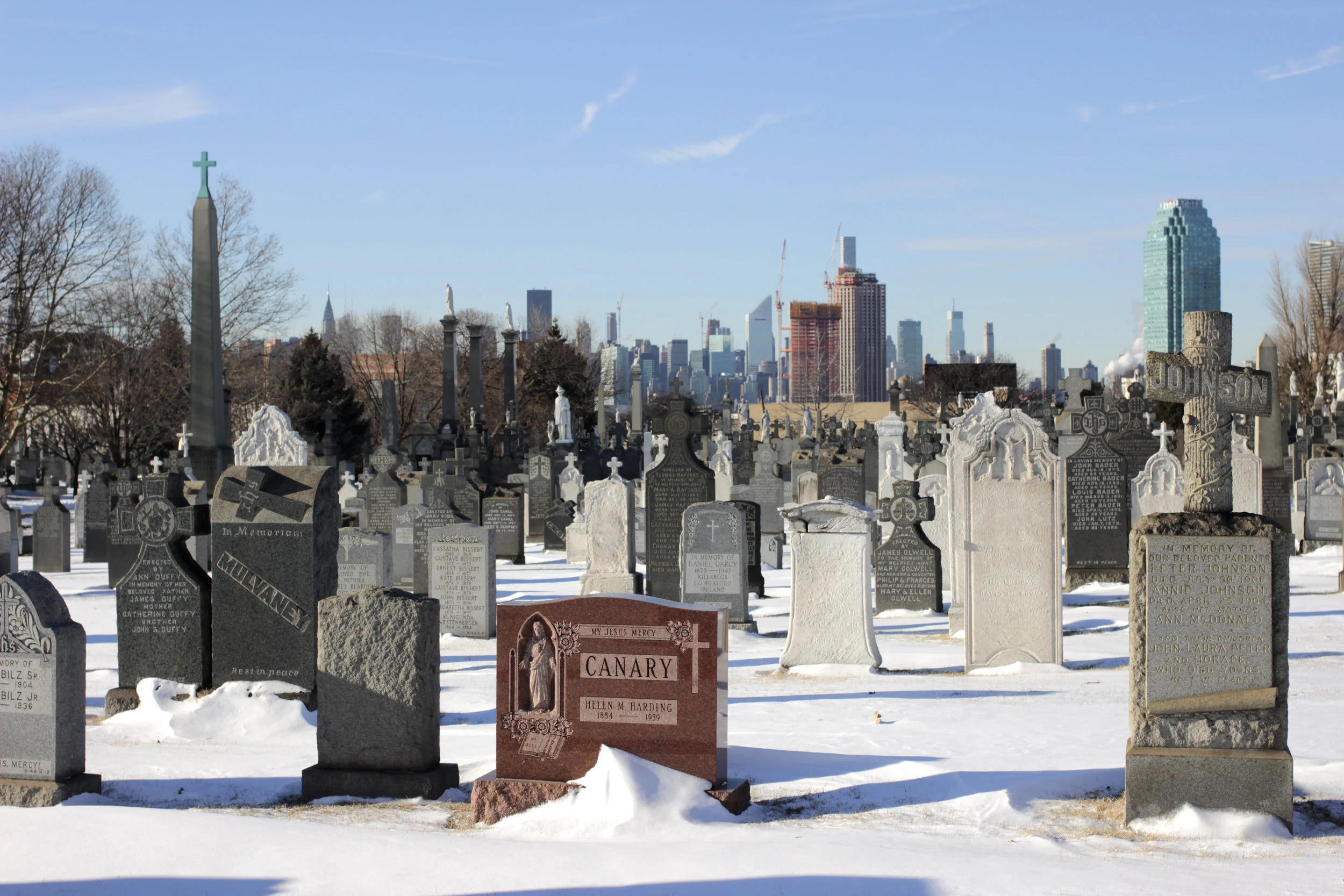
I love wandering around cemeteries for many reasons—they’re quiet, peaceful, uncrowded (with the living, anyway) places full of beautiful imagery, typography and history. You can learn a lot about a city by visiting its cemeteries, and I try to seek them out whenever I can. Although cemetery tourism might seem like an oddball hobby, I’m not alone in my macabre interests. So grab some flowers or stones and browse this gift guide for the living who feel at home among the dead.
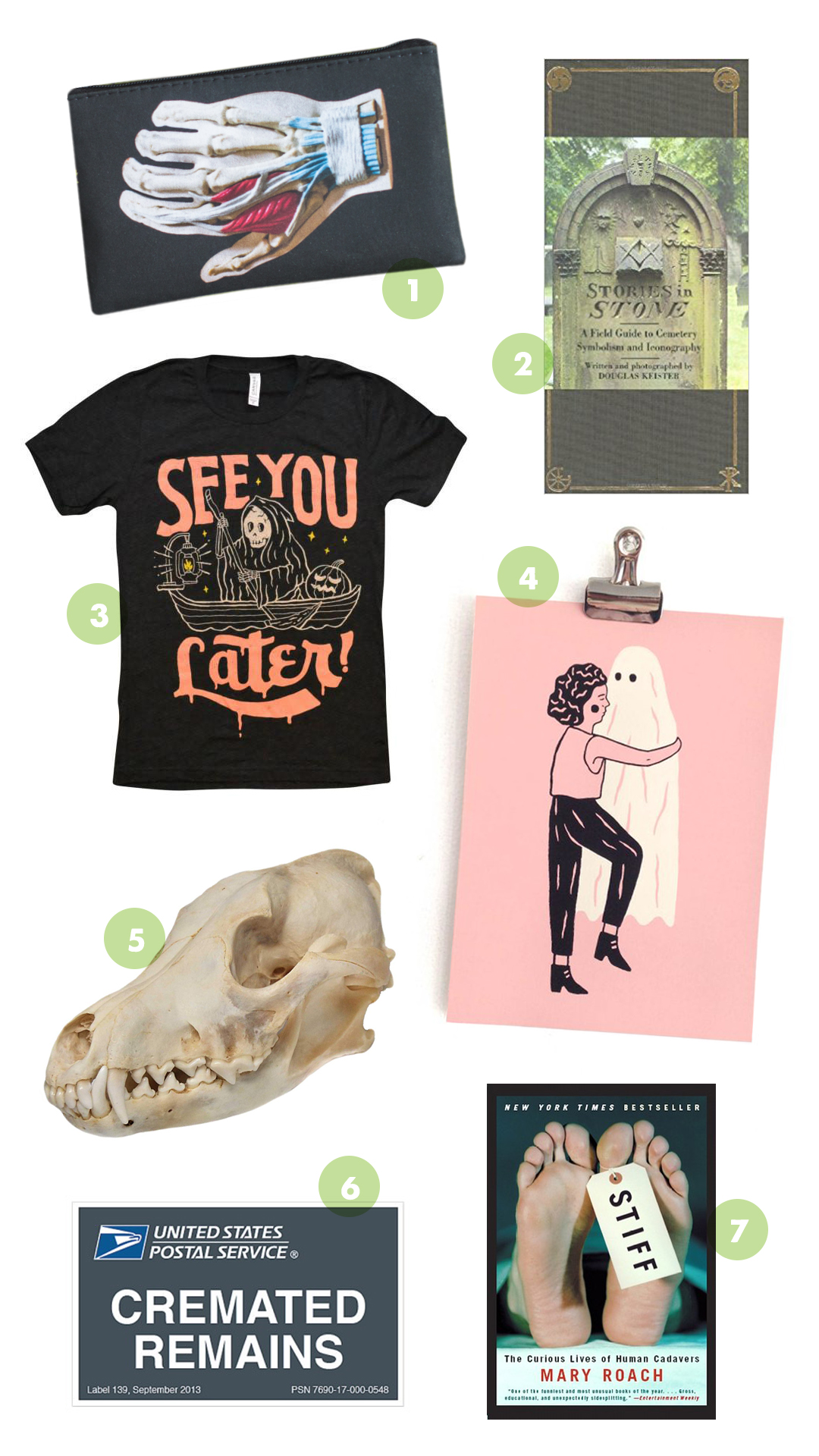
1 / Kaylah was nice enough to send me one of these pouches a few years ago, and I still use it every day as my makeup bag.
2 / Stories in Stone: A Field Guide to Cemetery Symbolism and Iconography is great little book to take with you on your cemetery strolls to help identify what you see along the way.
3 / Wicked Clothes has several t-shirt designs that I love, but this one is my current favorite.
4 / Show your love for the paranormal with this cute 5” x 7” screen print.
5 / BoneBox is the gift that keeps giving—each box includes various osteological specimens such as skulls, claws, teeth and baculum—all year long.
6 / These cremated remains labels are free from the USPS, but I’ve ordered them twice now and never received them. Maybe the third time will be the charm, or maybe they know that I’m not actually affiliated with a funeral home.
7 / Stiff: The Curious Lives of Human Cadavers was one of the first death-related books I ever read, and I loved it so much I read it twice.

1 / I’m always surprised that you can find cheap medical models on Amazon, and this numbered skull is under $30.
2 / I saw this pouch in person last weekend at the Oddities Flea Market, and I was delighted to find that it had a black-and-white striped interior and looked/felt even better in person.
3 / If you’ve ever wondered what happens to our some of our most famous dead, Dead Presidents: An American Adventure into the Strange Deaths and Surprising Afterlives of Our Nations Leaders is entertaining, informative and might make you want to plan a trip to visit the graves of our departed leaders.
4 / George Saunders’s Lincoln in the Bardo takes place mostly in a cemetery and is a moving and imaginative novel about grief and the meaning of a life.
5 / 6 / 7 / 8 / 9 / Creepy Co. has too many great pins to choose just one from their Macabre collection, including classic winged skulls, “Just Buried”, All Men Are Cremated Equal, Funeral No Parking and Yearn for the Urn.
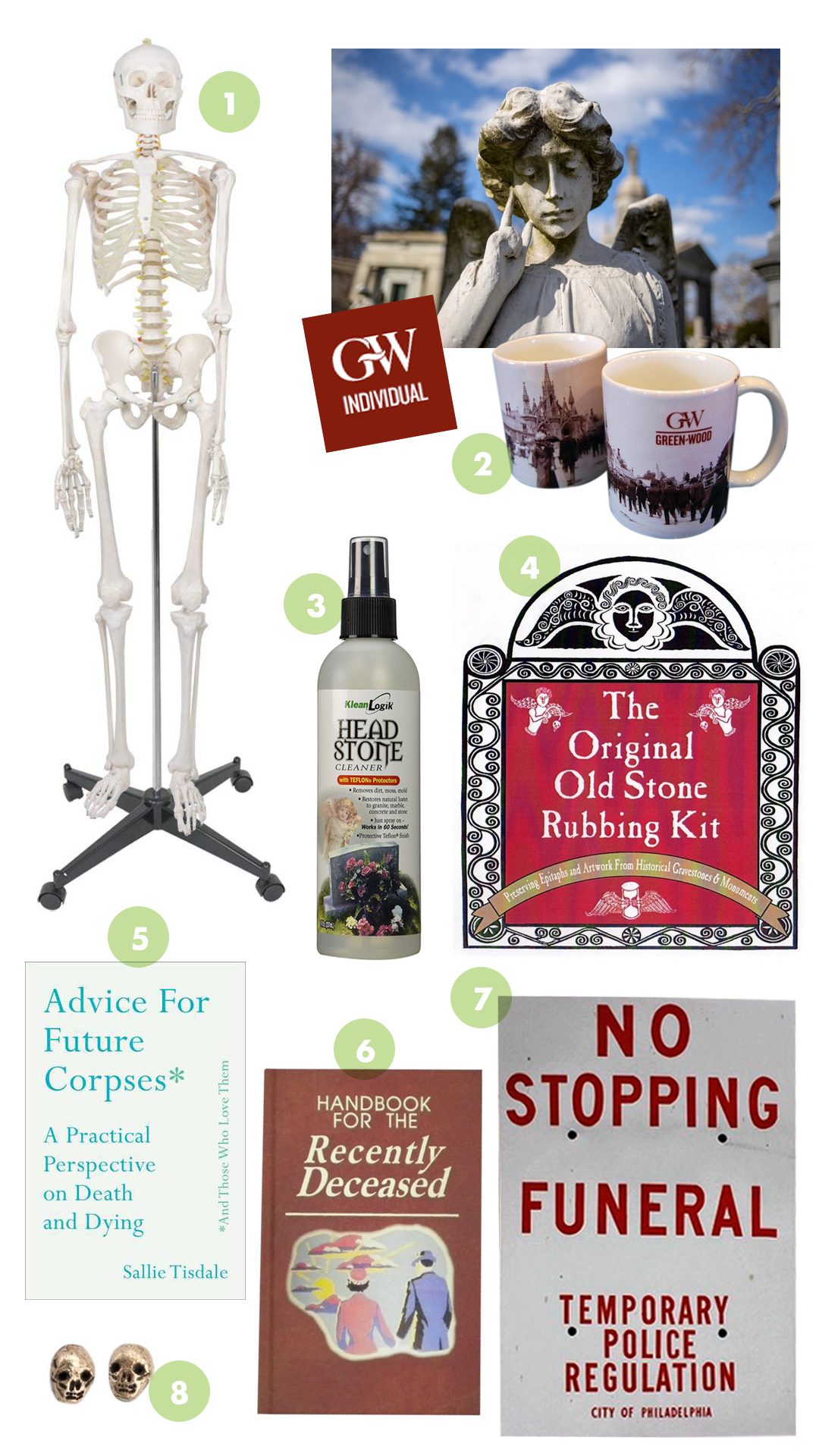
1 / I don’t have the space for a full-sized skeleton, but that hasn’t stopped me from putting it on my wishlist for the future.
2 / When I lived in Brooklyn, I was a member of Green-Wood Cemetery and it was great. Individual memberships are only $50 a year and include free tickets and discounts on talks and events. Also, nothing says Good Morning! like a cemetery mug.
3 / Carry around a bottle of this cleaner to tidy up some headstones while you’re exploring.
4 / I’ve never done gravestone rubbing, but this kit looks like it has everything you need to get started.
5 / Advice for Future Corpses (and Those Who Love Them): A Practical Perspective on Death and Dying is a great book to help you prepare for the inevitable death of you and everyone you love (Merry Christmas!)
6 / This Handbook for the Recently Deceased is actually a blank journal.
7 / I have one of these cardboard funeral signs and I love how simple (and cheap) it is.
8 / I’m always wondering if I should start wearing earrings again and these little skull studs are tempting me.

If you’re really in the giving mood, buy your cemetery-loving friend an actual burial plot! Space is limited in New York City cemeteries, but plots can still be had at Green-Wood starting at around $21,000 (holds three burials, what a deal!). Chances are, if you or someone you know enjoys wandering around cemeteries, they will also like this gift guide for your weird friend or be interested in following along as I attempt to visit every cemetery in the five boroughs.
Some of my favorite cemeteries: Valley of the Kings / Woodlawn / Rehoboth Mission / First Calvary / Old Burying Ground / Letchworth Village Cemetery / Cementerio De Santa Cruz

Jim Gray's Petrified Wood Co.
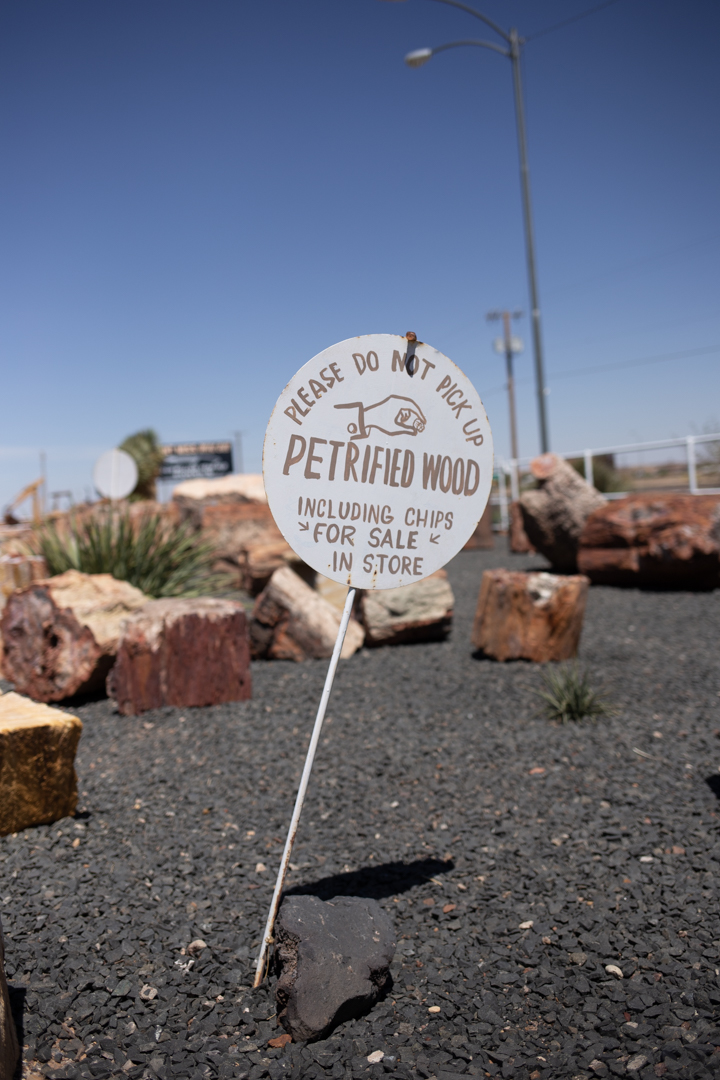
After striking out at the Rainbow Rock Shop and before we toured the Petrified Forest National Park, we stopped at Jim Gray’s Petrified Wood Company. Jim Gray’s, started by Jim and Cathy Gray nearly 50 years ago, is located just south of downtown Holbrook, Arizona on US-180. It’s 1.5 miles from the Wigwam Motel, and about 30 miles from the National Park.

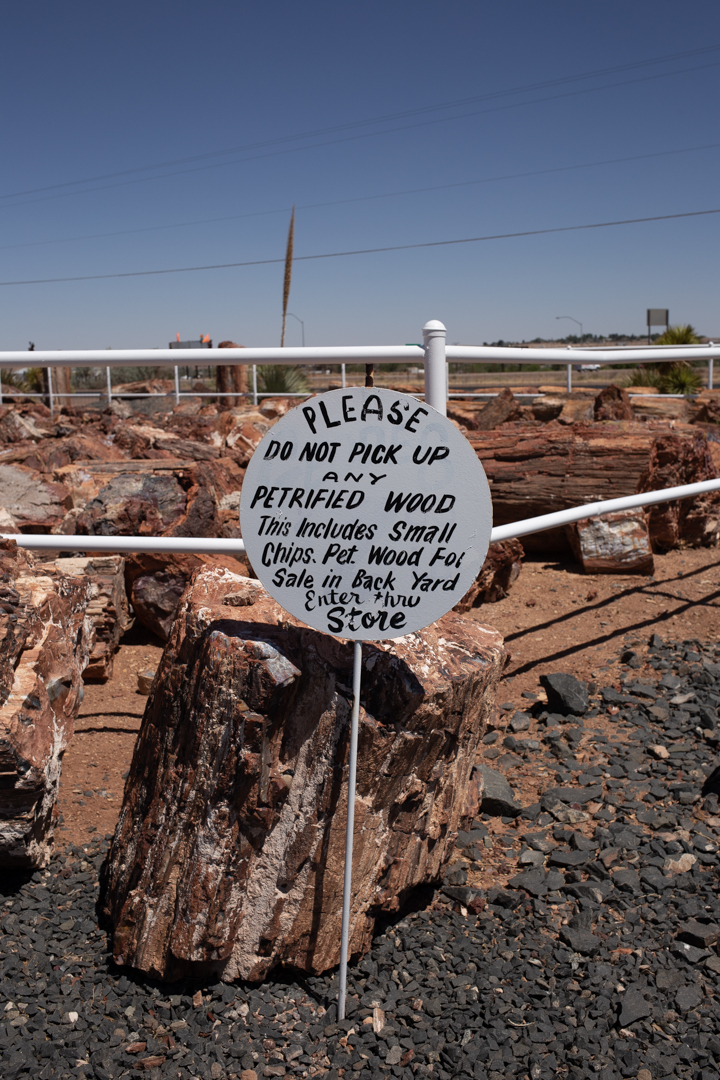
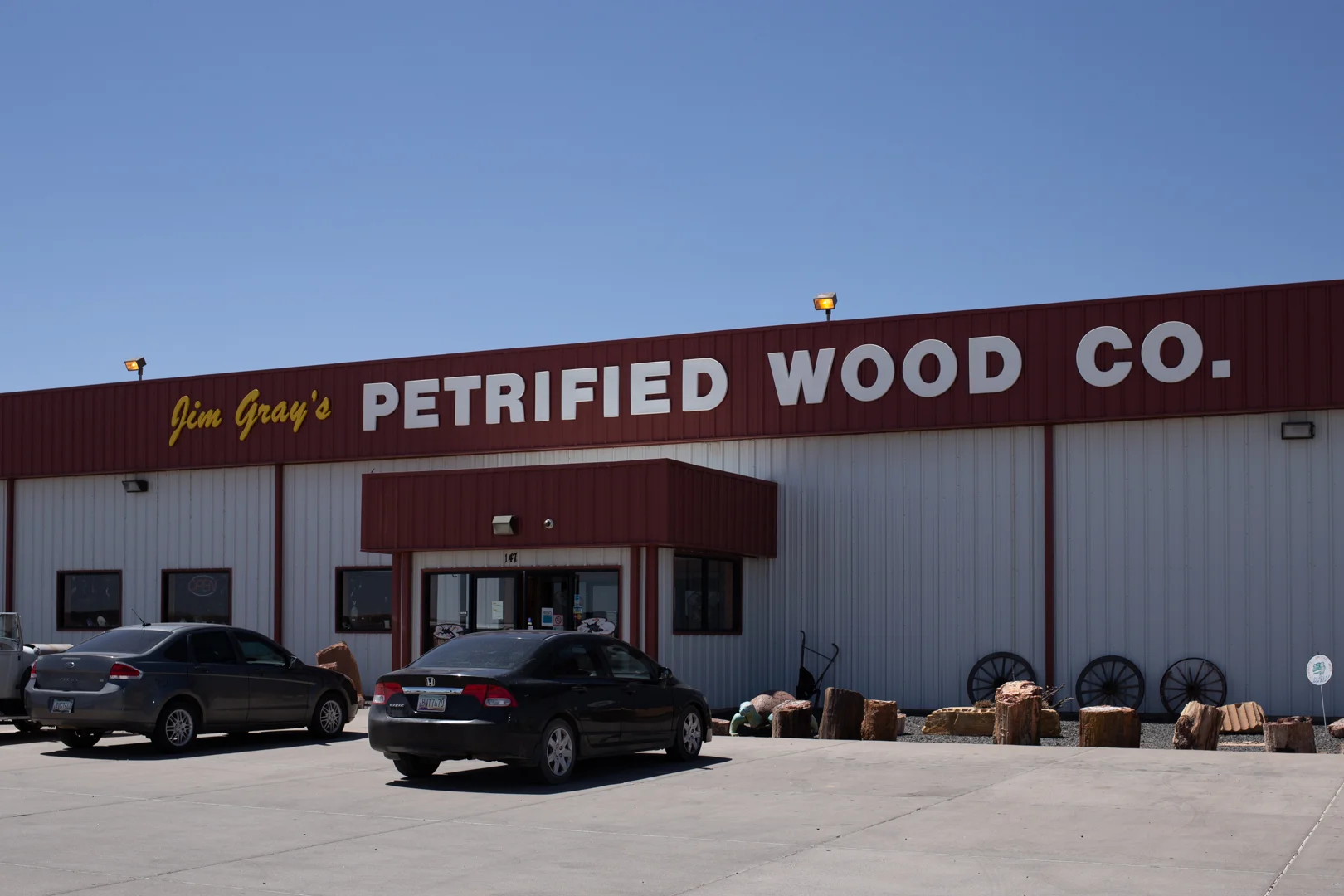


Jim Gray’s is still family operated and owned. They were originally known as the Holbrook Rock Shop, but have since become “the worldwide premier dealer of Arizona Rainbow Petrified Wood.” Wood from Jim Gray’s has found its way into the Smithsonian, the White House, and museums all over the world. We stopped at several rock shops and trading posts along old Route 66, but Jim Gray’s has the largest collection of petrified wood, by far.
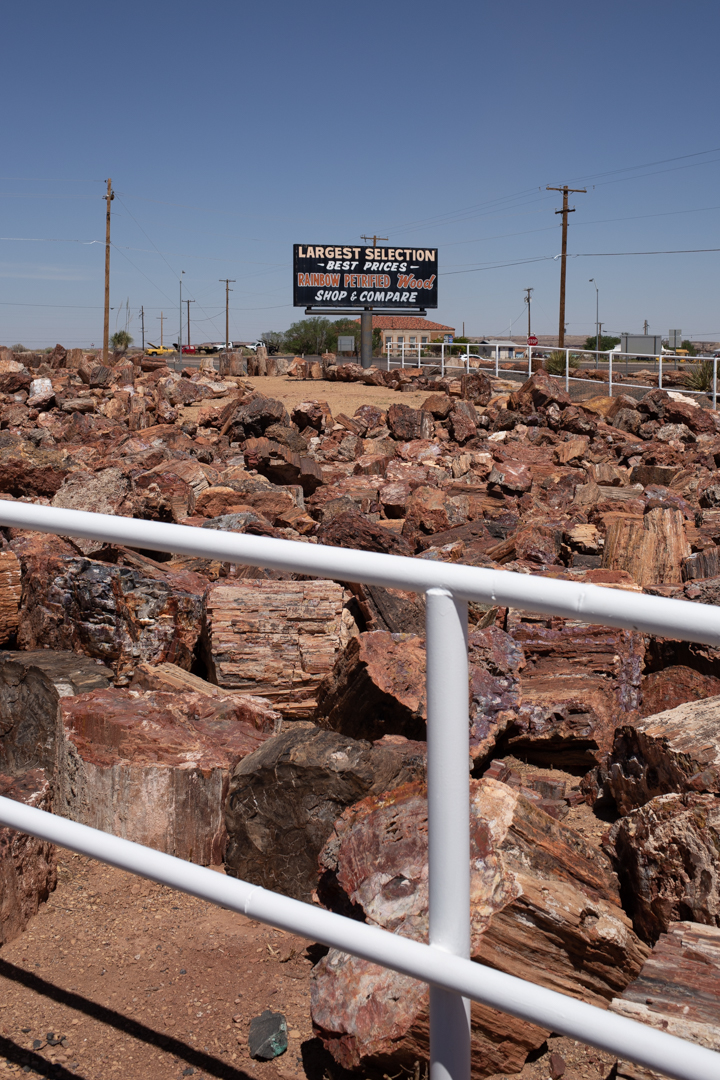
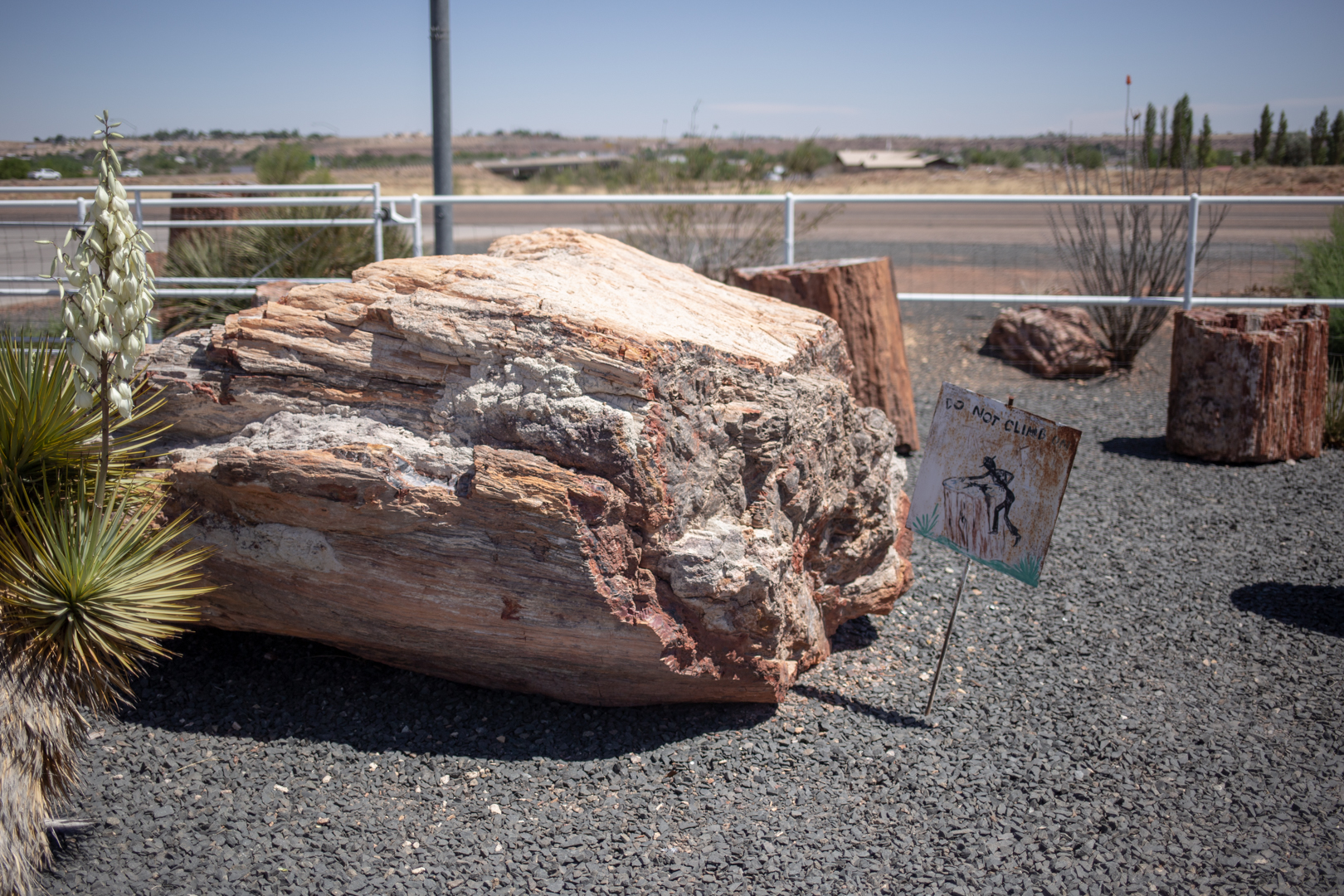
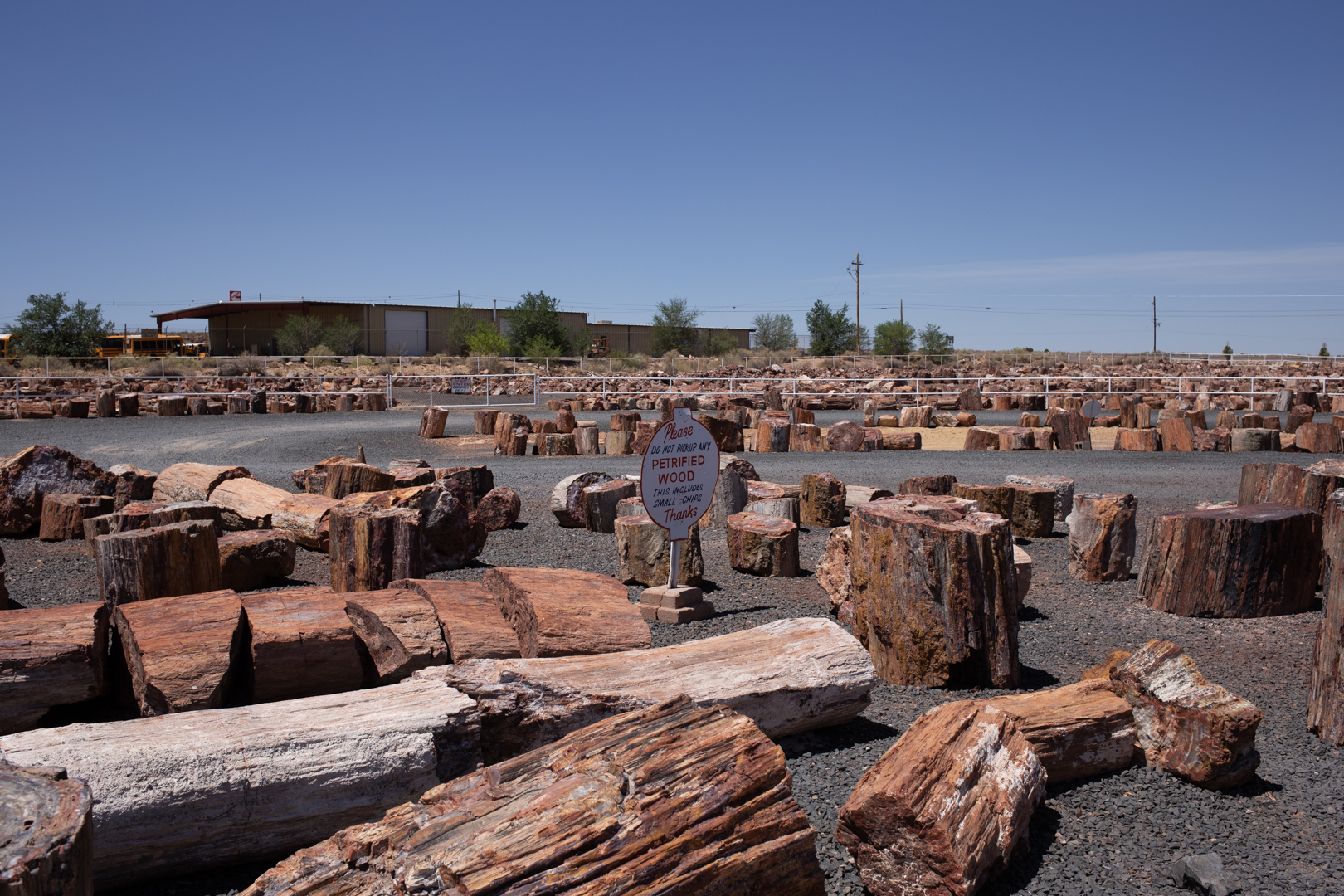

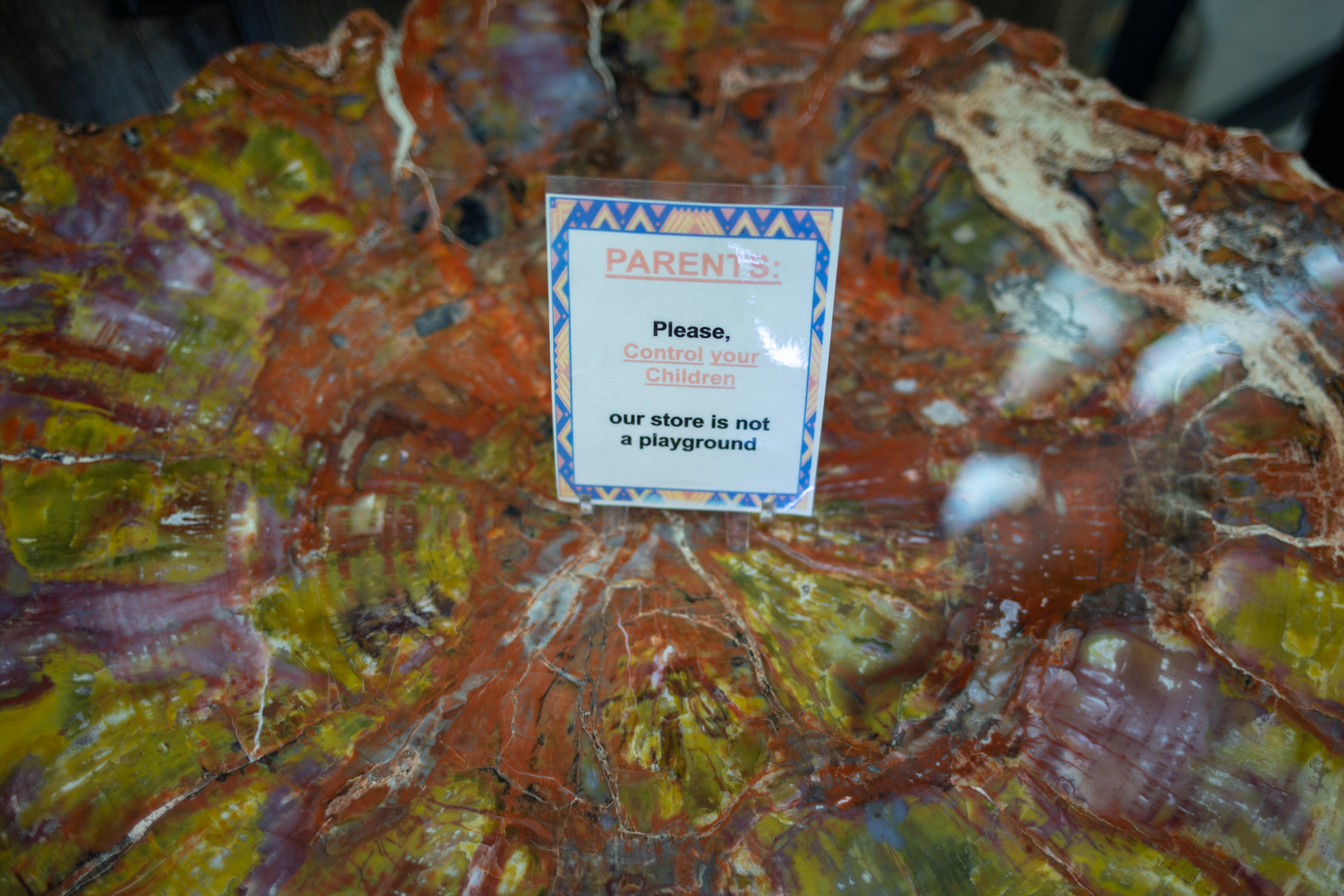
Taking specimens out of the National Park is illegal, and the park is monitored on the ground and from the air to prevent theft. Luckily for the Gray’s, they insist that "there's more petrified wood outside the park than in it," and they own the mineral rights to several pieces of land nearby. They do their own digging, cutting and polishing, turning the raw fossilized wood into polished rounds, clocks, bowls, paperweights, tabletops, bookends and other souvenirs.


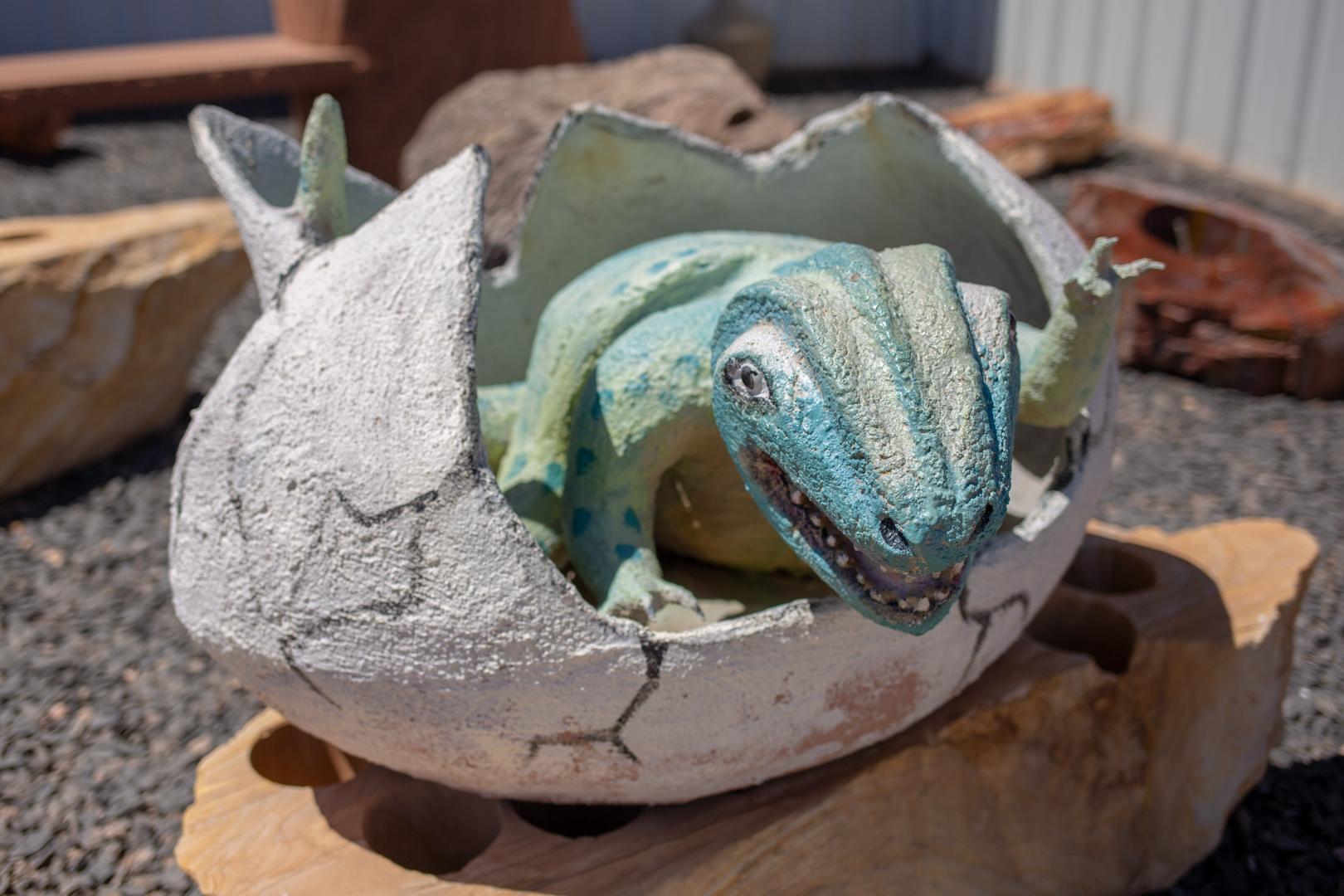
The shop is a bonafide tourist destination on its own, and it beckons visitors with painted billboards advertising its large selection of rocks, gems, minerals, fossils, souvenirs, Indian crafts, and rainbow petrified wood. It also has a squished penny machine, several large dinosaur statues and restrooms.
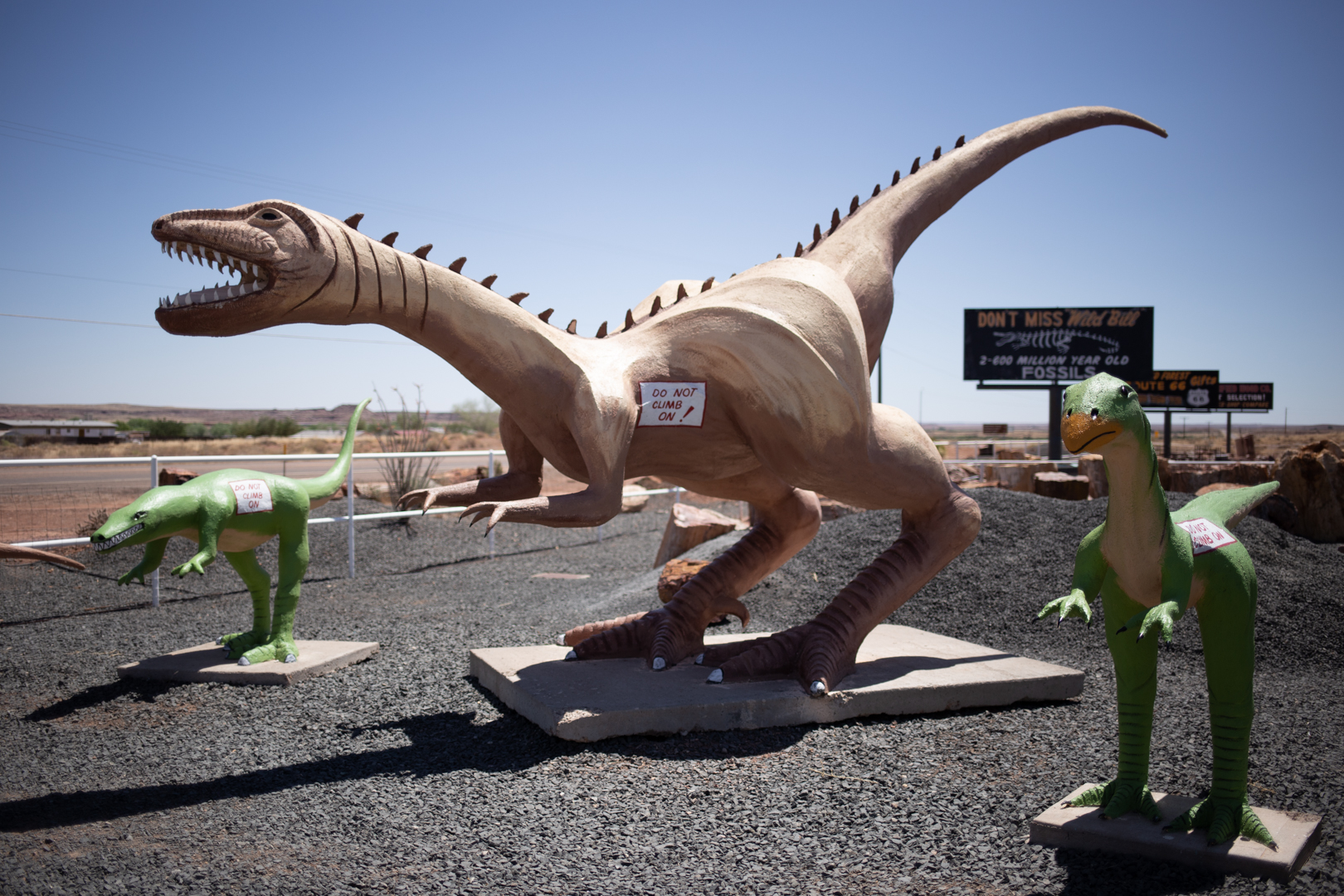


The most famous of its attractions is Wild Bill, a 2.9 million year old alligator. Wild Bill, bought by the Grays in Florida and named for a family friend, is exhibited for free alongside an extensive collection of polished wood and rock specimens from around the world.
Jim Gray’s Petrified Wood Company
147 US-180
Holbrook, AZ
Open 7 days a week, 8 am-6:30 pm

Recent Reads

I’m happy to report that I have officially completed my 2018 Goodreads Reading Challenge an entire month early! The Museum of Extraordinary Things was the 60th book I read this year, but I think I can squeeze in a few more before the year ends. Every time I post about finishing yet another book, I feel kind of strange for “bragging” but I really just love talking about, looking at, shopping for and reading books (I work at Penguin Random House and I’m still not sick of books).
I frequently get asked how I find the time to read so much, but here’s the thing: I just love reading, so I make time for it. Things I don’t make time for: real exercise, clothes shopping, working overtime or cooking. In fact, the night that I finished my 60th book, I had a bowl of cereal and a bowl of chips for dinner. We’re all doing the best we can with the time we’re given, and I personally feel bad when I see people running marathons, so whether you’ve read one book or 100 this year, you do you (but really, reading is awesome I promise).
The Mummy Case: An Amelia Peabody Novel of Suspense, by Elizabeth Peters
I saw this book at a gift shop on our last night in Cairo and I put it on my library hold list as soon as we returned. Amelia Peabody is a thinly veiled parody of famous Egyptologist (and author of the excellent travelogue A Thousand Miles Up the Nile) Amelia B. Edwards, so The Mummy Case was an especially fun read because I had just finished A Thousand Miles. This is the third in the series of Peters’s Peabody novels, but I didn’t feel at a disadvantage having not read the others.
The Mummy Case follows Peabody and her husband, a fellow archeologist, as they travel back to Egypt with their young son, Ramses, in tow. When they’re denied permission to dig at the pyramids of Dahshur, they think their excavations in the middle of nowhere will yield nothing. But when an antiques dealer is murdered, Peabody and her (reluctant) husband begin to investigate. Mystery books are like brain candy to me—a palette cleanser in between all of the medical, poison and death industry books that I usually gravitate towards—and this one was even more fun now that I’ve actually been to some of the places Peters writes about.
The Poison Squad: One Chemist's Single-Minded Crusade for Food Safety at the Turn of the Twentieth Century, by Deborah Blum
I had loved Blum’s previous book in the “poison” genre, The Poisoner’s Handbook, so I was excited about her new book about food safety. Half of the book I loved—her descriptions of unsanitary factory conditions and suspicious food ingredients are not for the squeamish—and half of the book was a bit of a slog through the government bureaucracy of legislation and the battle with food industry lobbyists. I don’t read food labels as much as I should, but I was shocked at how dangerous and unregulated foods used to be—and at how far we still are from winning the battle for transparency and consumer safety in the food industry.
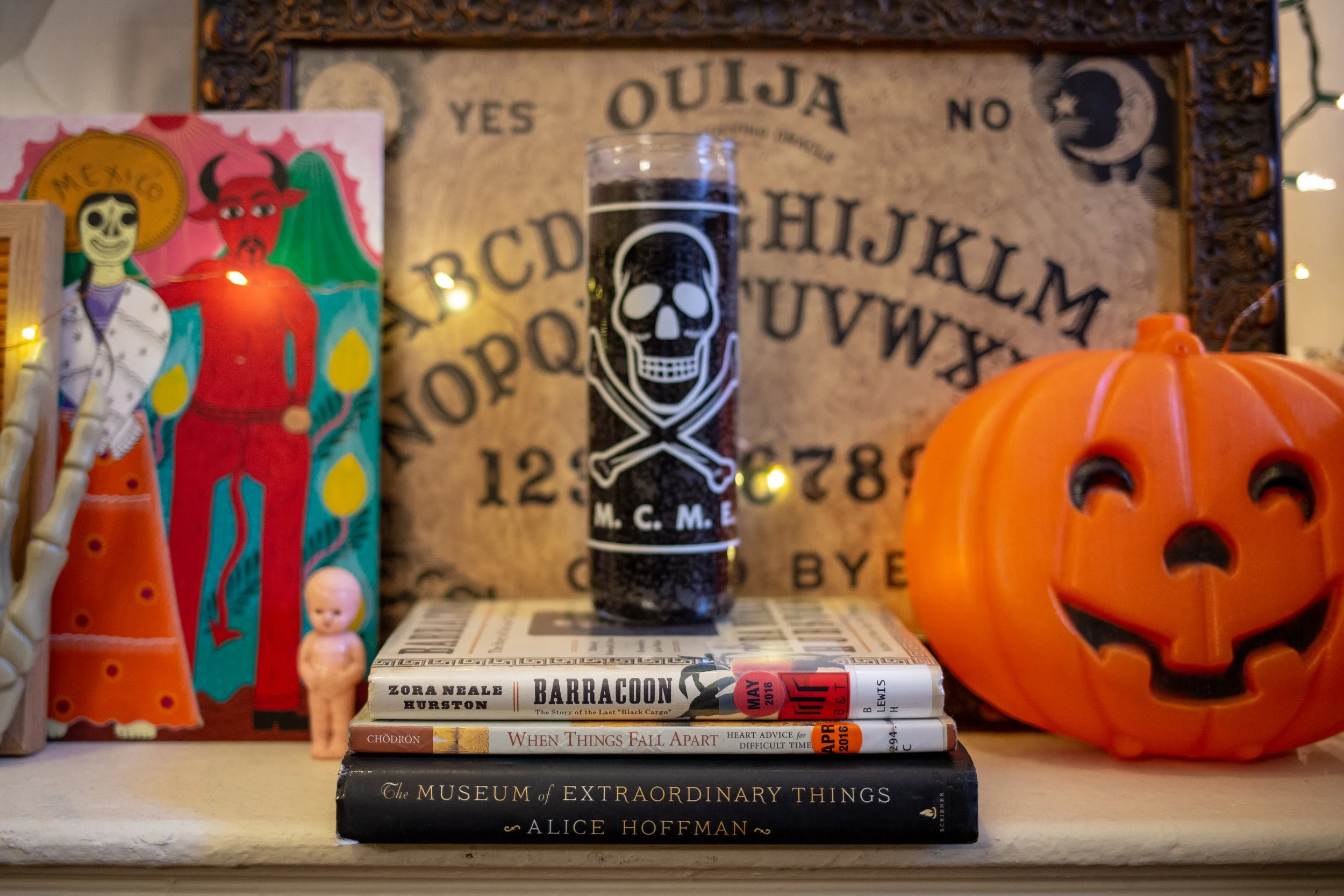
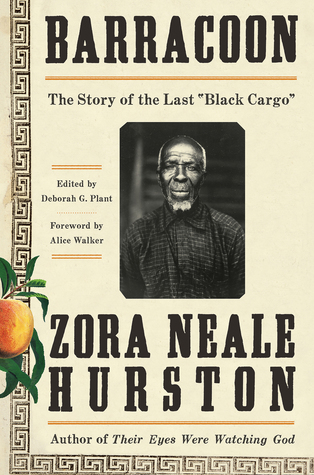
Barracoon: The Story of the Last "Black Cargo," by Zora Neale Hurston
Barracoon was published this year, 87 years after Hurston conducted her interviews with then 86-year-old Cudjo Lewis, who at the time was the last surviving African to come to America on a slave ship. Lewis was captured and brought to America when he was 19, just before the Civil War. He relays the story of his journey, from carefree boy to his capture, from his time as a slave to his life as a free man in the post-Civil War South. His story is told simply and in his own words, but it’s a heartbreakingly complex commentary on the African (and African-American) experience in America and it’s just a relevant today as it was then.
When Things Fall Apart: Heart Advice for Difficult Times, by Pema Chödrön
The universe has a way of giving you what you need sometimes, and this book became available at the library exactly when I needed it most. I wouldn’t call myself a Buddhist, but the more I read about Buddhist philosophies, the more I feel that they align with how I’m already trying to see the world. This book is at times a bit cultish for my tastes—and heavily pushes meditation, which I don’t do but could probably benefit from—but there is a lot of valuable wisdom packed in between. Chödrön emphasizes the benefits of embracing change, not running from groundlessness and advises that instead of avoiding pain, we should “lean into the sharp points.”
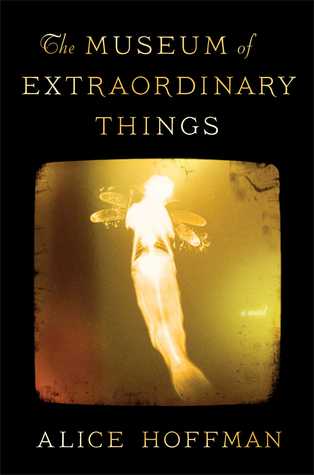
The Museum of Extraordinary Things, by Alice Hoffman
I bought this book at a thrift store and then actually read it not too shortly afterwards, which is surely some sort of record for me. I usually buy used books only to get distracted by my library list, but I’m so glad I didn’t let this one languish on my shelf. I picked up The Museum of Extraordinary Things because it hit on so many of my interests: turn of the century New York, Coney Island, curiosity museums, photography, etc.—in fact, this book seemed tailor made for my interests. It also turned out to be a beautifully written story about love, obligation and finding your place in the world. I loved every second of Hoffman’s gorgeous prose—even unspeakable tragedies like the Triangle Shirtwaist Factory fire, the Dreamland fire and sexual abuse are described vividly but respectfully.



Holidays in New York
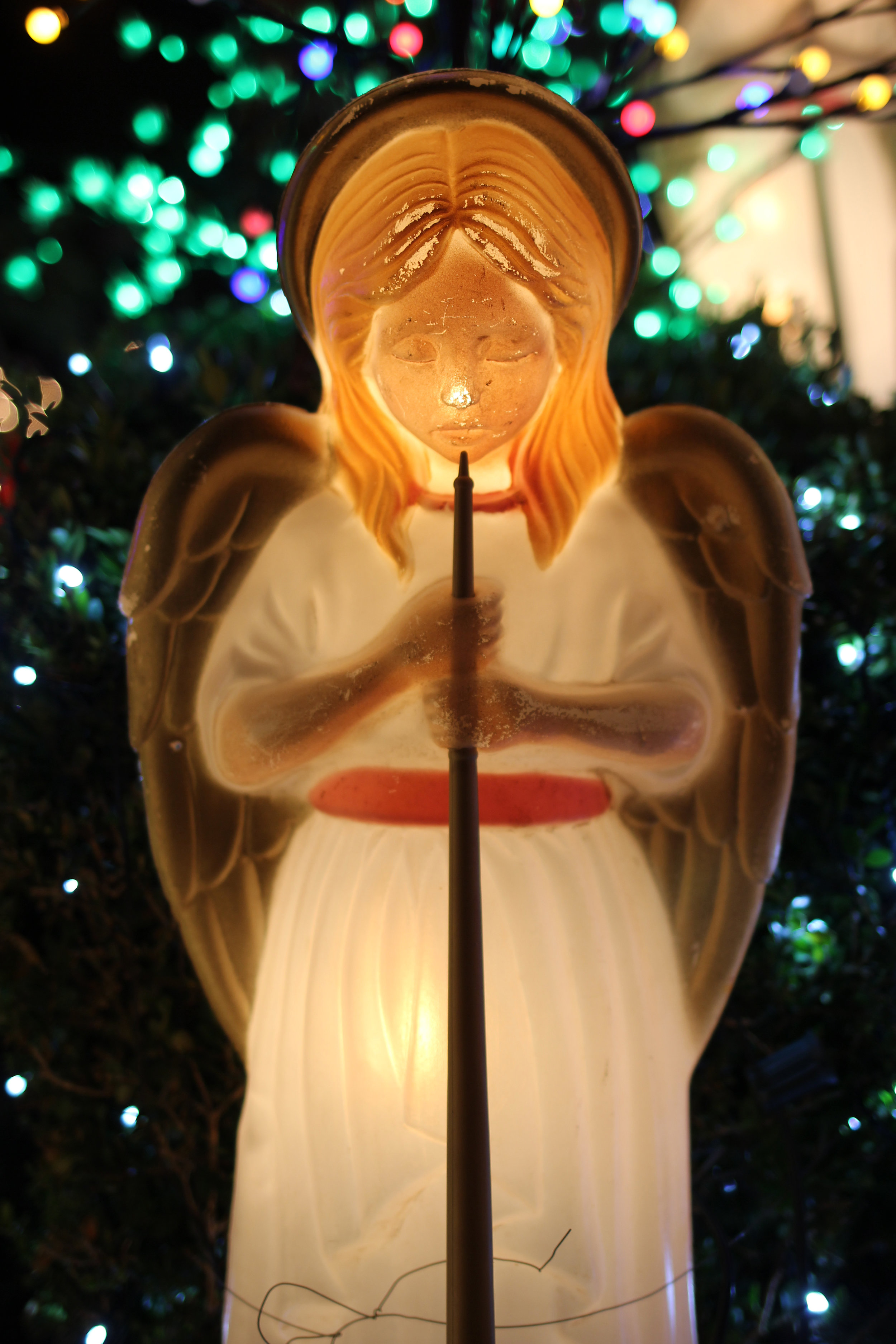
New York is crowded year round, but it feels especially packed during the holidays. I can’t be too mad about the hordes of tourists though, because I get it—New York during late November and the month of December is downright magical. So much so that in the five years that I’ve lived here, I’ve only traveled back home to my family in Ohio once over Christmas, and it was such a travel nightmare that I vowed to never do it again. Luckily, I don’t think I’ll ever tire of all of the holiday delights available in the city—here are some of my favorites:


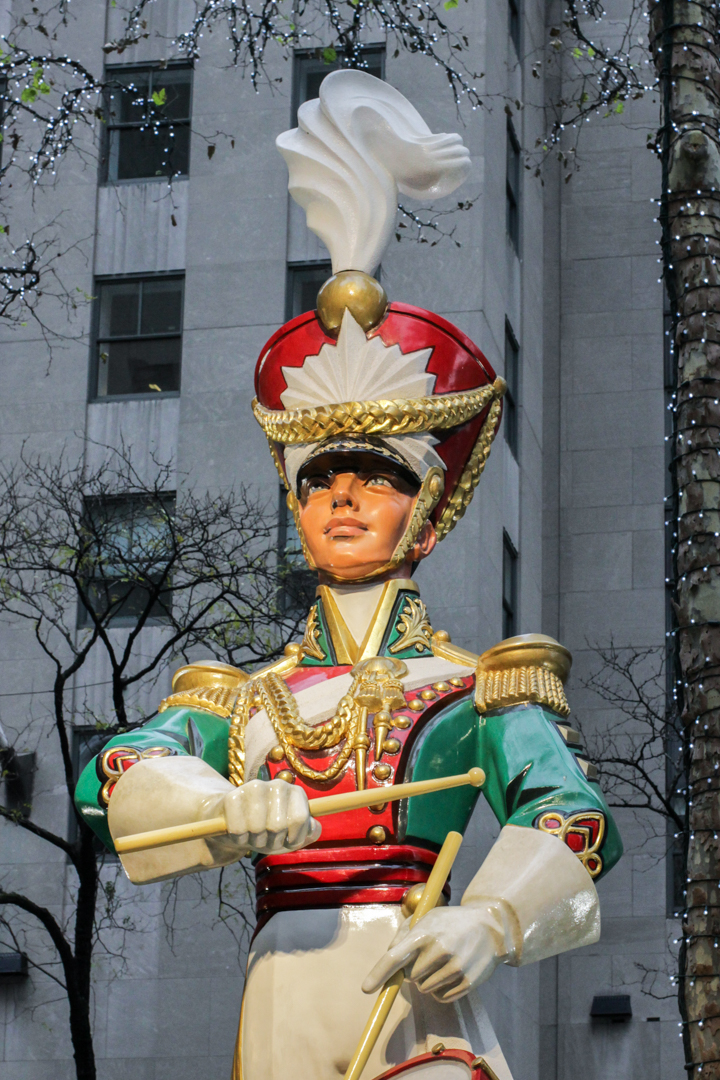

I try to avoid this area of the city as much as I can during the holidays because it’s just so packed with tourists, but for good reason: it’s the epicenter of Christmas in New York. In addition to the famous tree (always slightly smaller than I imagine it to be), the entire complex is decked out with nutcrackers, toy soldiers, angels and thousands of lights. If you don’t want to wait to skate on the famous ice rink, you can make a reservation to watch other people exercise while you eat lunch or dinner in the Rock Center Café.
Christmas Trees
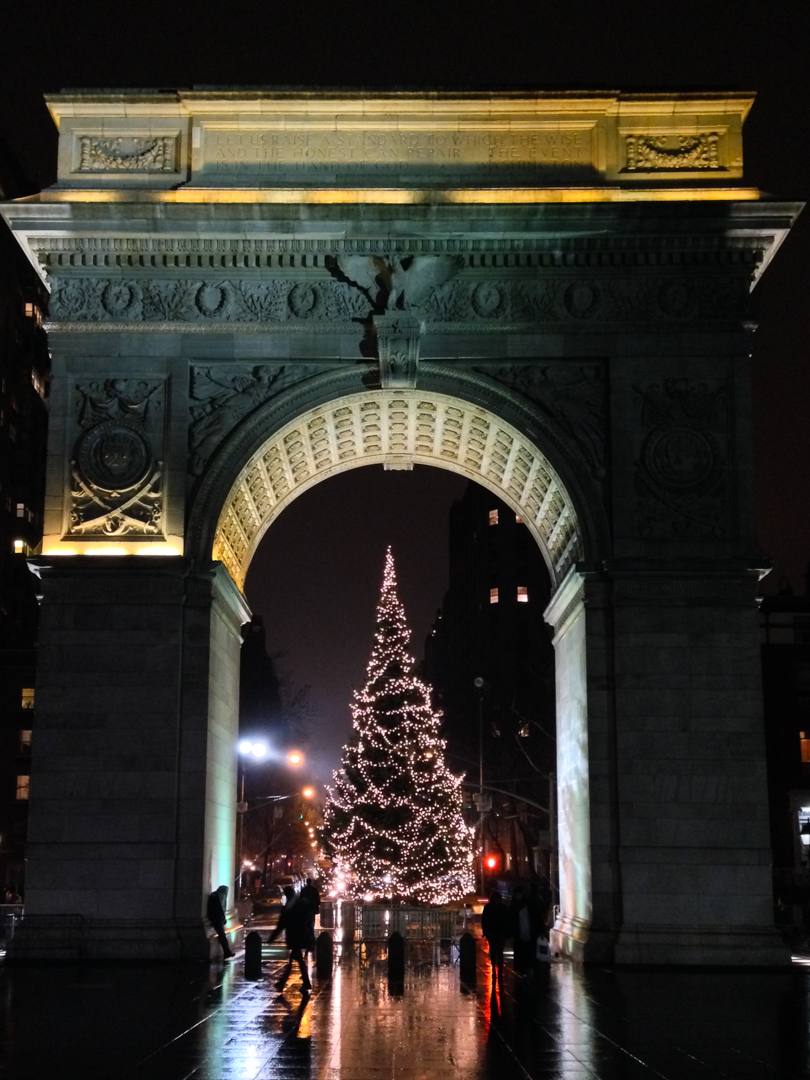


Pretty much every New York cultural institution and park puts up a decorated tree during the holidays. The American Museum of Natural History has an origami tree every year with a different theme (this year’s is “Oceans of Origami”) and the World’s Largest Menorah is lit in Brooklyn’s Grand Army Plaza during Hanukkah.


My mom and I finally saw the Christmas Spectacular last year on Christmas Eve, and it was every bit as magical as I wanted it to be. I could have done without the modern digital elements and the outdated gender roles, but the famous Rockettes kick line (and the Toy Soldier scene) is something everyone should see in person at least once in their life. Bonus: the Art Deco bathrooms at Radio City Music Hall are worth the price of admission on their own.
You can find discount Broadway tickets, including for the Christmas Spectacular, with TodayTix, a great place to find deals and an easy way to enter ticket lotteries.
Radio City Music Hall, between W. 51st and W. 50th Streets at 6th Avenue.

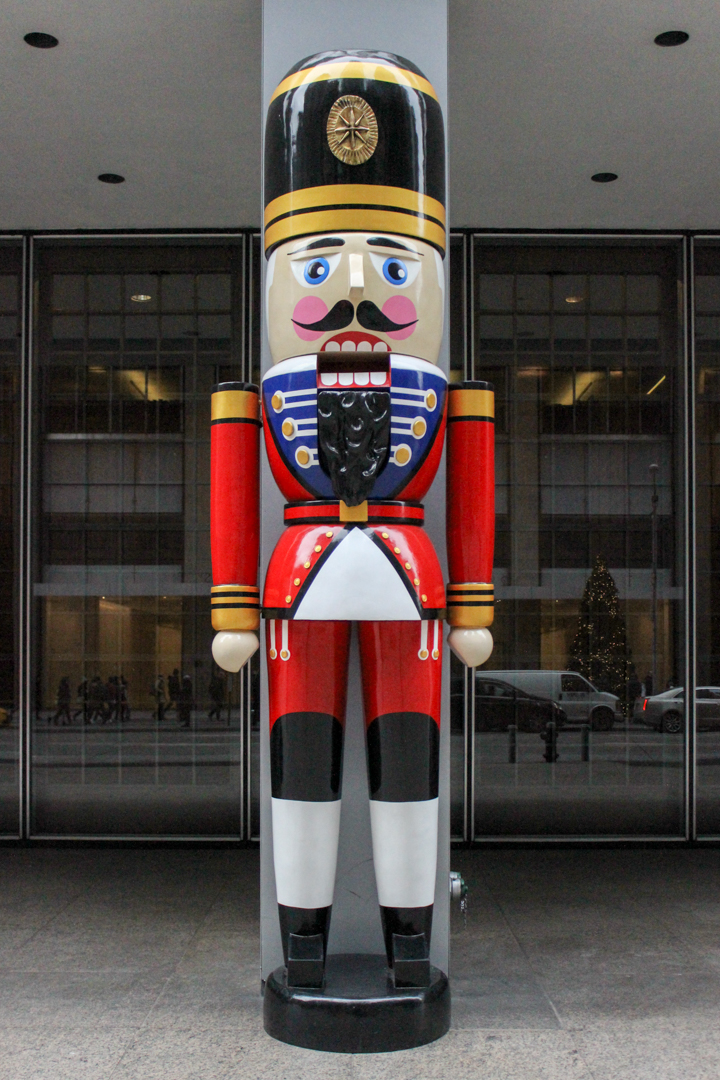
I’ve never seen the New York City’s production of George Balanchine's The Nutcracker, but it’s a Christmas classic. Preformed at the David H. Koch Theater at Lincoln Center, The Nutcracker premiered on February 2, 1954 at the New York City Ballet, and is on stage now through December 30th.
Ice Skating
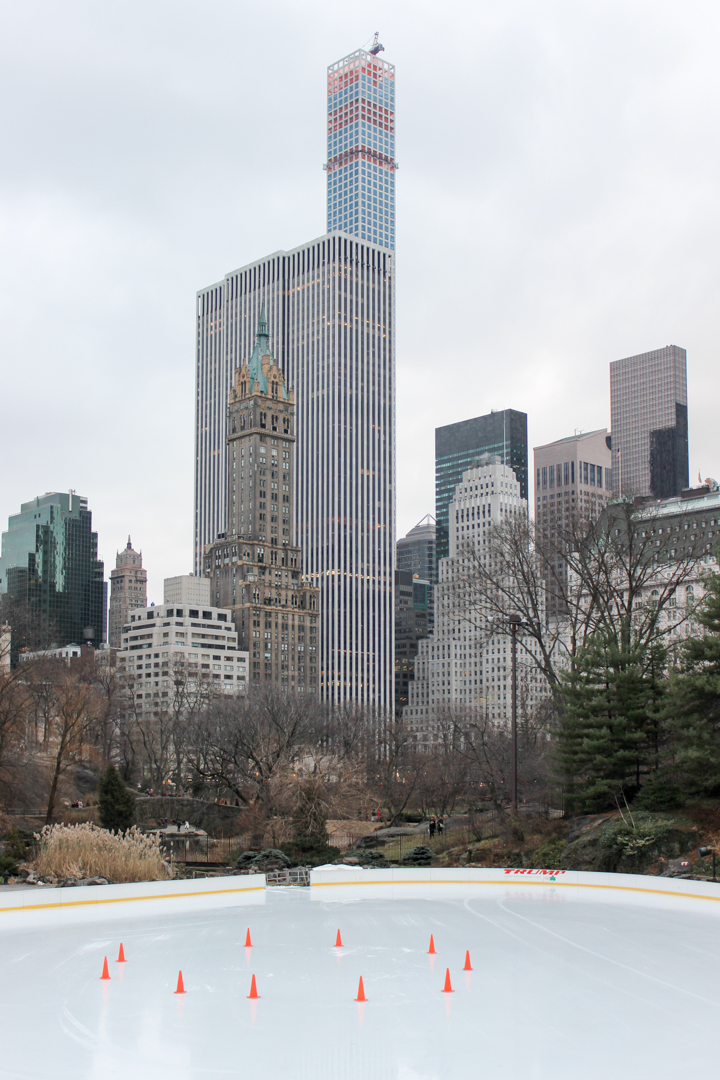

There are several ice skating rinks outside of Rockefeller Center, including two in Central Park, one in Bryant Park and one in Prospect Park. There are smaller rinks located at Brookfield Place downtown, at the Standard Hotel and indoors at Chelsea Piers.

Every year for a few hours, peasants without keys are allowed into Gramercy Park for caroling on Christmas Eve. It’s dark by 6pm, so you can’t see much of the park, but it’s still a thrill to step inside of the usually off-limits space. My mom and I have plans to go this year with reservations nearby at the festive (and historic) Pete’s Tavern afterward.
Save yourself some grief and skip Rolf’s, a German restaurant nearby known for its Christmas decorations. It’s notoriously crowded around the holidays, the food is overpriced and reservations aren’t easy to come by.
December 24th, 6pm, between E. 20th and E. 21st Streets, Park and 3rd Avenues.
Holiday Windows
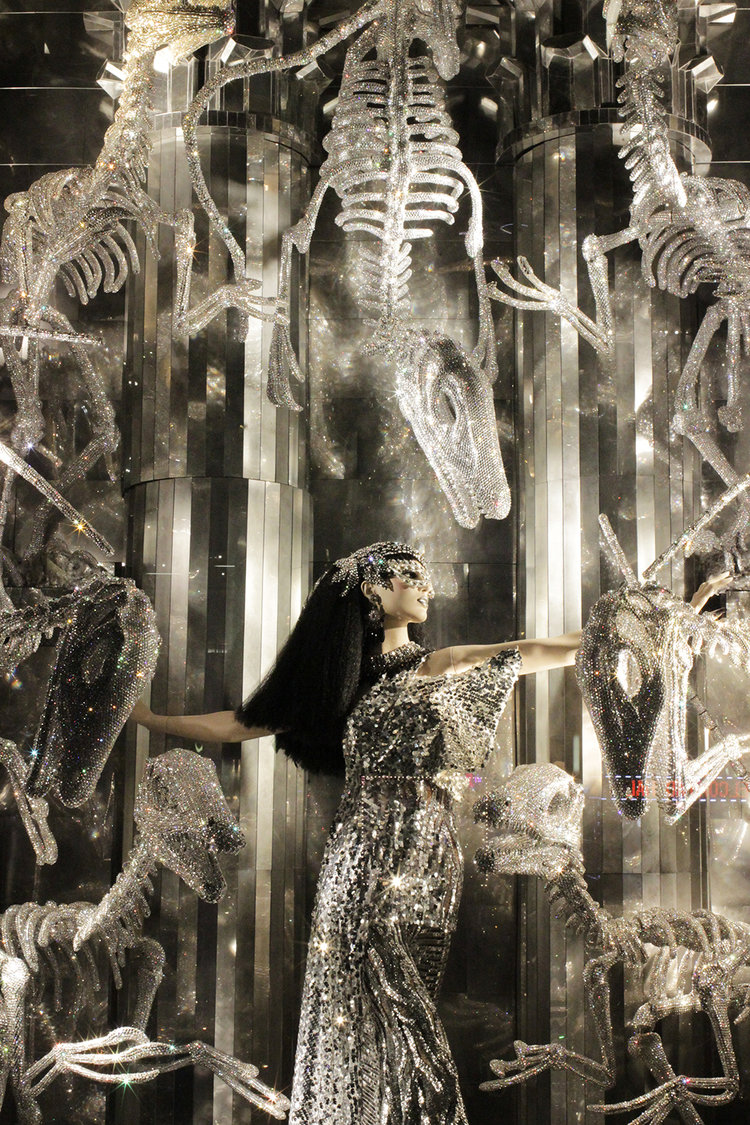
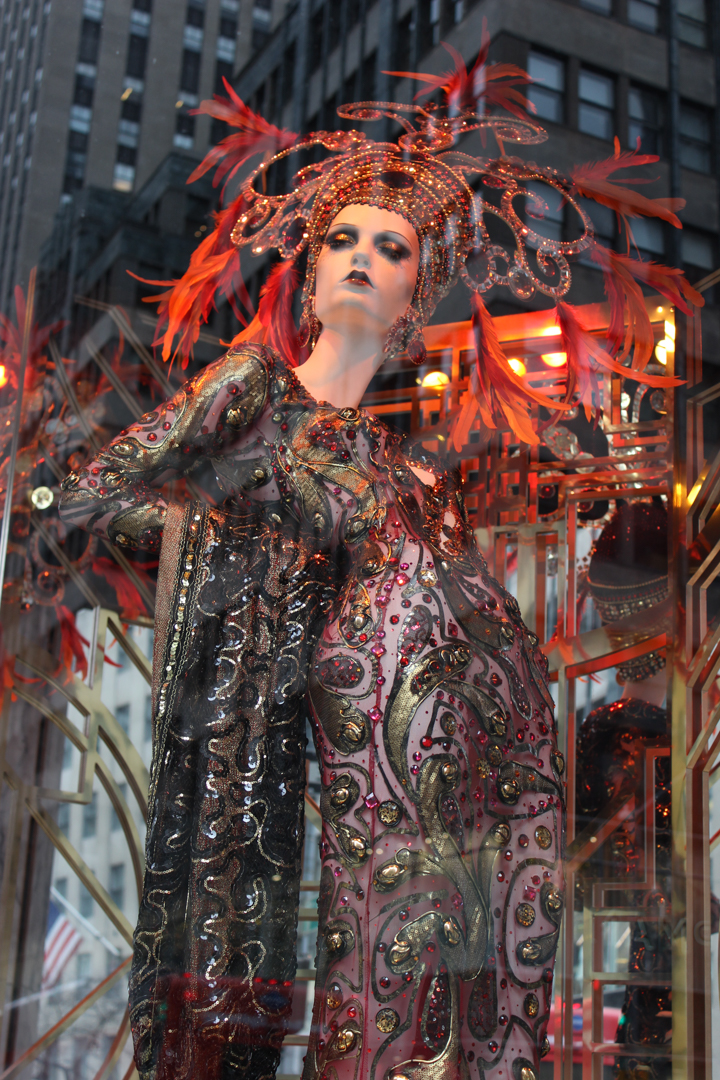


It’s become an annual tradition that my mom and I—after breakfast at Neil’s Coffee Shop—see the holiday windows at Bloomingdale’s, Bergdorf Goodman, Tiffany’s and Saks Fifth Avenue. There are additional window displays around the city (the Macy’s windows are usually a little childish for me), but these are the big ones and they’re all pretty close to one another. Bergdorf Goodman is always the clear winner, but it’s fun to see what each store comes up with from year to year.
Bloomingdale’s: E 59th Street and Lexington Avenue
Bergdorf Goodman: E 58th Street and Fifth Avenue
Tiffany & Co.: E. 57th and Fifth Avenue
Saks Fifth Avenue: E. 548th and Fifth Avenue
Dyker Heights Lights

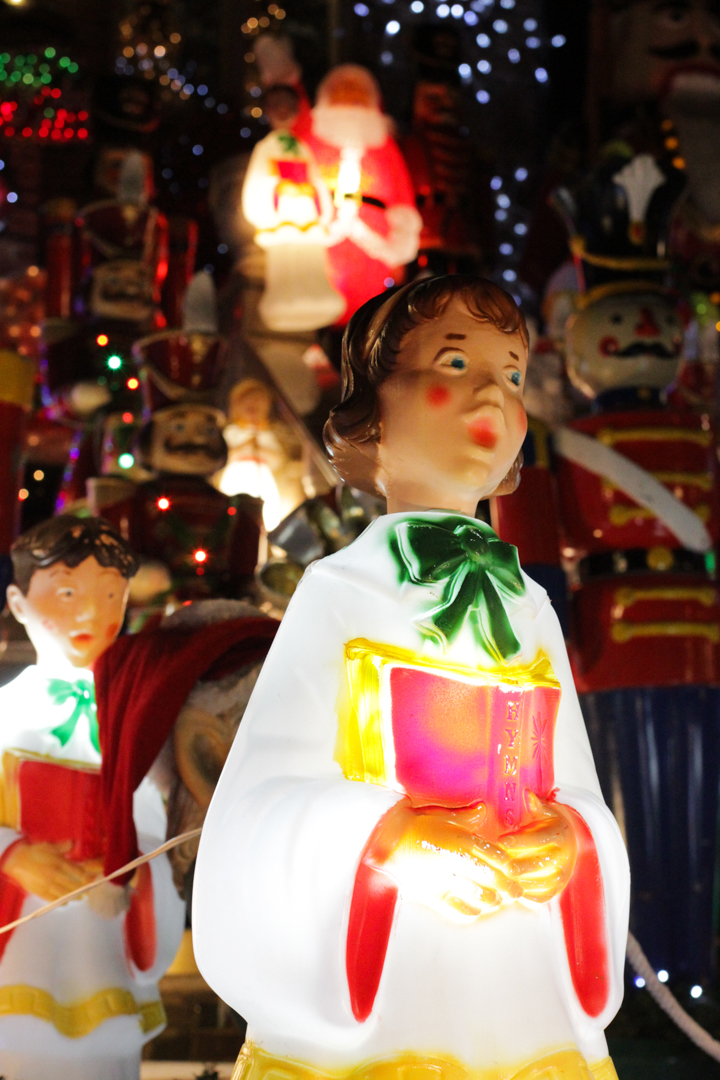


Dyker Heights, a neighborhood in south Brooklyn, first became famous for its elaborate Christmas lights displays about 30 years ago and has only grown since then—the displays now attract 100,000 people a year. If you go on a weekend night close to Christmas, it can feel like all 100,000 people are there in one night, but some of the streets are closed to car traffic, which helps a little with the crowding. I’ve been all five years that I’ve lived in New York and the displays don’t change much from year to year but that’s part of the fun of traditions.
Most of the biggest displays are between 11th and 13th Avenues from 83rd to 86th streets.


Sure, Home Alone is one of the greatest Christmas movies ever made, but I’ll argue that its sequel, Home Alone 2: Lost in New York is even better. Why? It’s the exact same plot as the first movie (sometimes they just changed one letter of line of dialogue) but it takes place in New York. One of the most popular posts I ever did was this list of the movie’s filming locations, most of which are still around so you too can get Lost in New York.
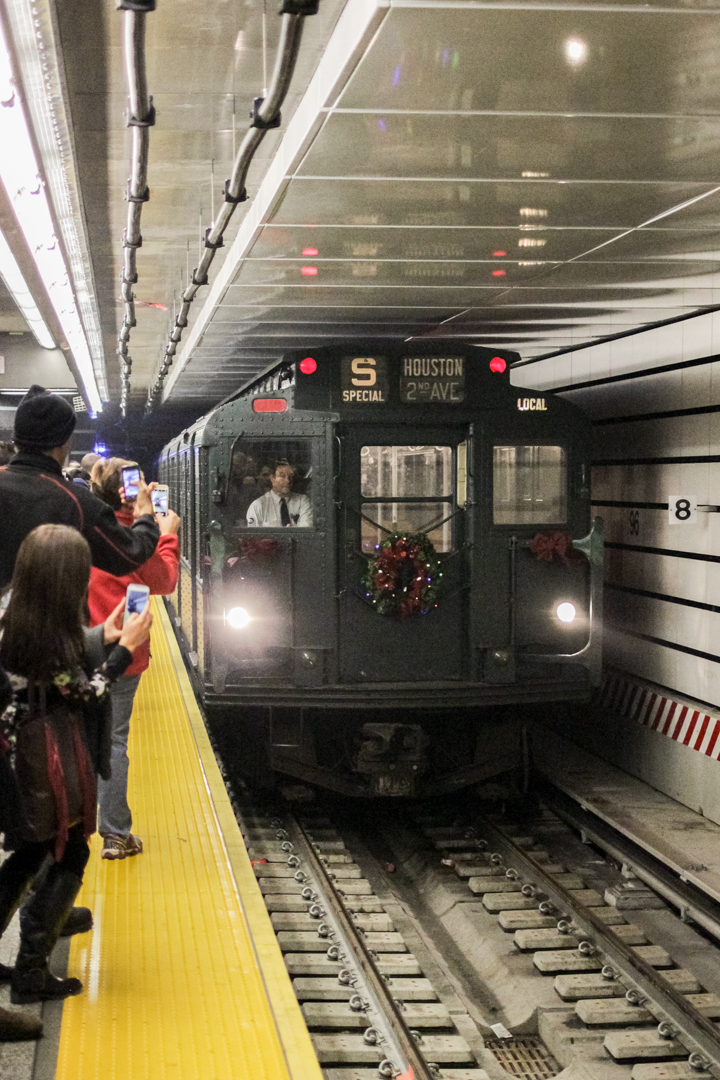
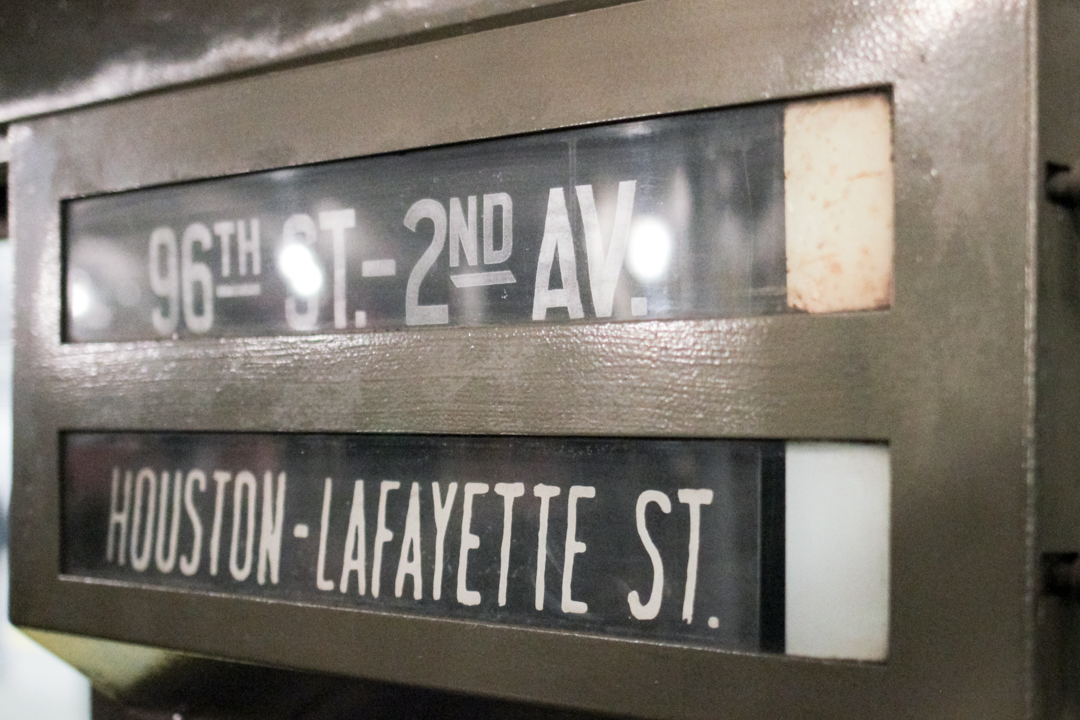


Every Sunday between Thanksgiving and New Year’s Day, the New York Transit Museum puts one of their vintage trains back into service. This year the Nostalgia Train, a vintage 1930s R1-9, will depart from the Second Avenue F train station at 10 am, 12 pm, 2 pm and 4 pm and from the 125th Street A/C/D station at 11 am, 1 pm, 3 pm and 5 pm. This seems to get more and more popular each year, so expect rush hour-level crowds (and watch out for those overhead fans).
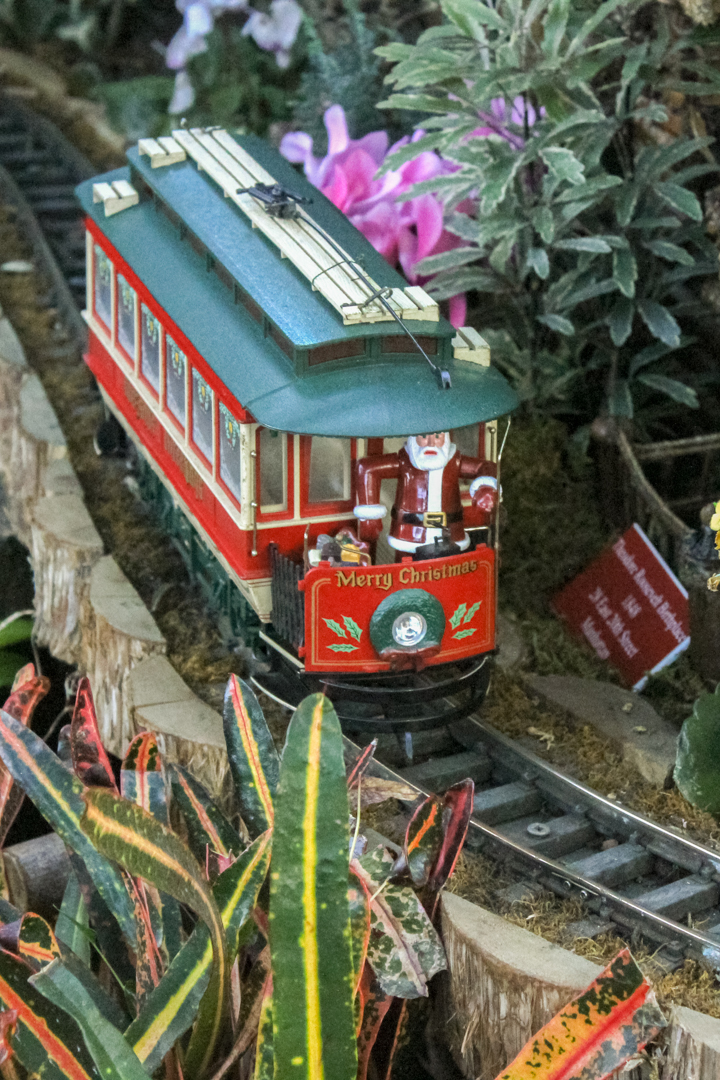
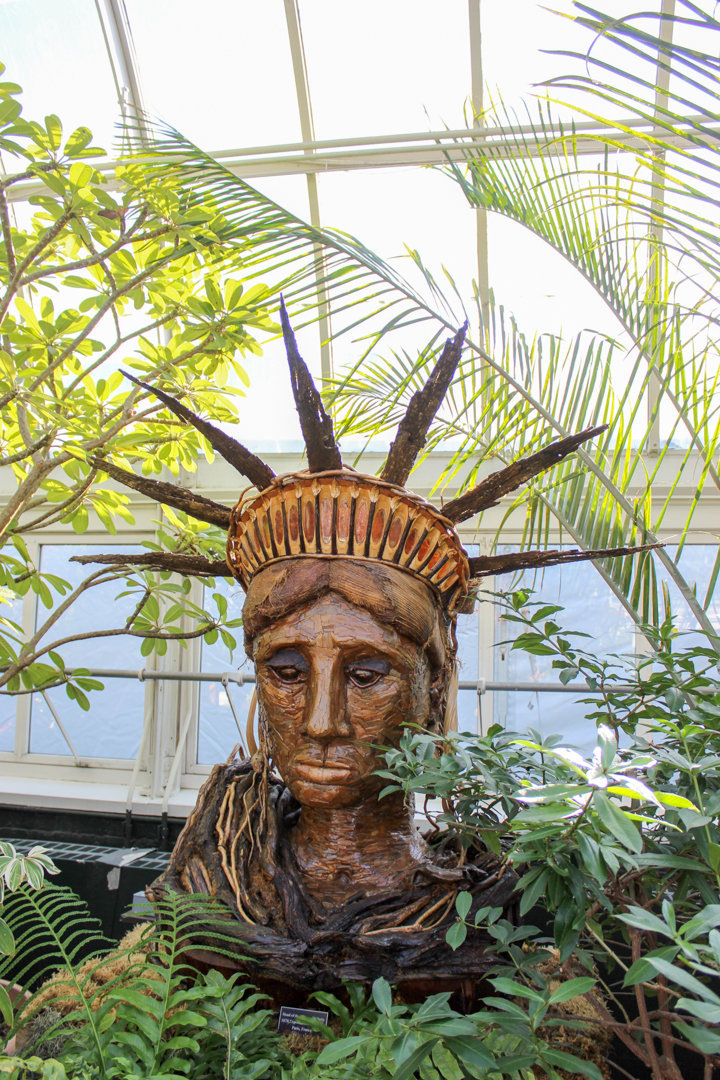

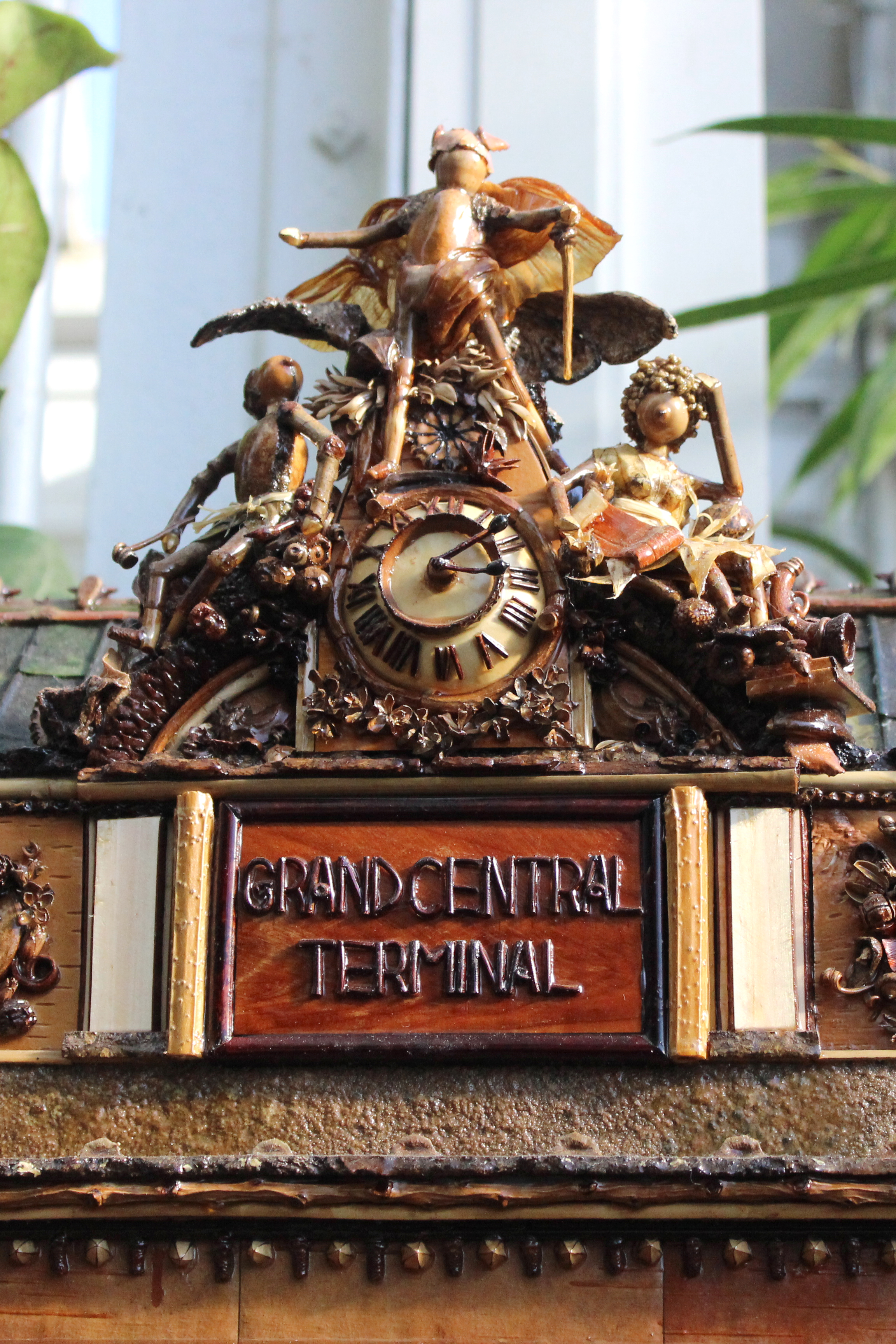
The Holiday Train Show at the New York Botanical Garden contains more than 175 New York landmarks made entirely with bark, leaves and other natural materials. Trains zip around the Conservatory and everything is cuter in miniature. If crowds of screaming children aren’t your thing, they have special bar car nights on select Fridays and Saturdays exclusively for adults 21 and over.
Now through January 21st, Tuesday-Sunday 10am-6pm.
There is also a free holiday train show in the New York Transit Museum Gallery and Store located in the Shuttle Passage of Grand Central Terminal, on display until February 24, 2019.
A special thanks to TodayTix for sponsoring this post—the app is super easy to use and it’s how I win Shakespeare in the Park tickets while sitting at my desk nearly every summer. Of course all opinions and commentary on holiday delights is my own.

Gift Guide: Road Trip Lovers

I’m never happier than when I’m planning or taking a road trip. International travel has its advantages, but the US is so big and diverse that I love nothing more than hitting the road and seeing strange and unusual corners of the country. In my daily life, I love not having to drive or maneuver a car into tight spaces, but I love the freedom of driving on road trips. So grab an atlas and put on a ‘90s playlist while you browse this gift guide for road trip lovers.

1 / Sometimes I forget I own an instant film camera, but when I do remember to bring it on road trips I’m always grateful to have physical photographs to look through when I get back.
2 / Learn from my mistake and don’t wait until the last minute to buy your film. It’s reasonably priced on Amazon, but almost double the price if you buy it the day before you leave at Urban Outfitters.
3 / This has been my go-to camera case for years—it’s sturdy, padded and might get you some strange looks (something I’m very used to).
4 / I upgraded my camera body this year to a full-frame and I love it so much (perfect for getting those big roadside attractions in the frame).
5 / I sold off all my other lenses after I realized I was only using this 35 mm, and I’ve never regretted it.
6 / There’s a reason these backpacks are so popular—they’re lightweight, comfortable, durable and are surprisingly roomy. I have the black/red version (thanks, Jim!) but I saw someone with this striped version recently and wondered if I could possibly justify buying a second.
7 / Never underestimate the value of extra memory cards. I prefer the 32gb size because I find that I fill up 16gb cards too quickly. Luckily, these are available at most drug stores around the country if you forget to bring multiples.
8 / This isn’t the most sturdy tripod on the market, but it is incredibly light, compact and fits in a backpack. I actually broke the first one I owned when it fell out of the case (my fault), left it in an abandoned building and immediately bought a replacement.
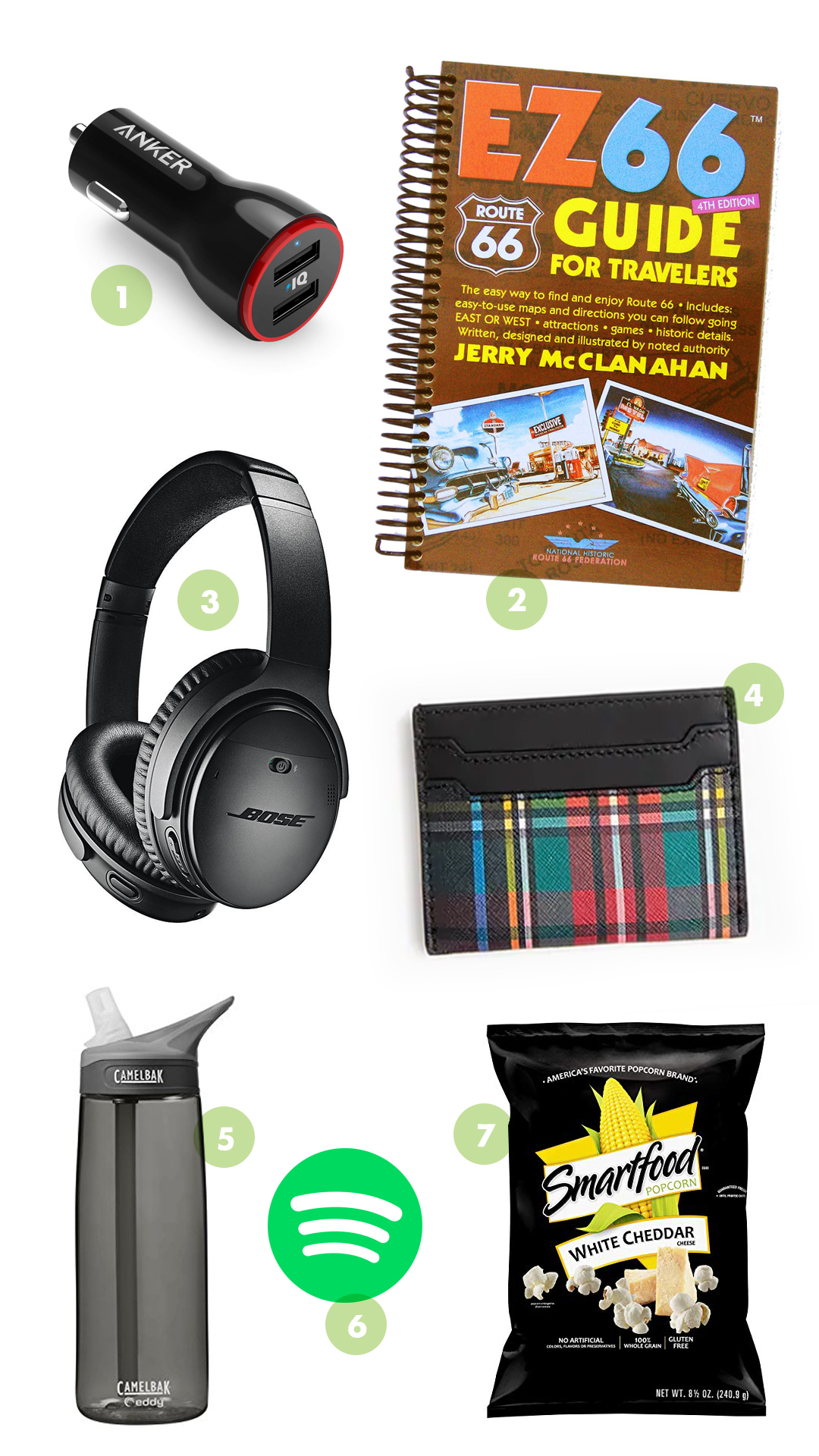
1 / Most rental cars will have built in USB ports, but bring a car charger just incase (with two ports so your passenger can use it too).
2 / I have this book and tragically forgot to bring it with me on my most recent Route 66 road trip. I won’t be making that mistake on the next one, but it’s fun to flip through even when you’re not using it to navigate on the Mother Road.
3 / I bought the wired version of these noise-cancelling headphones for my Egypt trip, and I wouldn’t have survived my snoring Uncle without them. They’re great for plane rides, noisy hotel neighbors, or for zoning out in the passenger seat.
4 / I don’t need a huge wallet when I go on trips (I leave all of my store/club cards at home), so this card case is perfect for just the essentials.
5 / After what seemed like a lifelong search for a waterbottle that doesn’t leak, I’ve been happy with this Camelbak version. I can throw it in my backpack with my camera and not worry about a catastrophe.
6 / No commercials and the ability to download epic road trip playlists to your phone are reason enough to buy a monthly Spotify subscription (a 3-month subscription is only 99 cents a month until December 31st).
7 / The perfect road trip food.

1 / I bought this Route 66 towel from the Standin’ on the Corner shop in Winslow, AZ, but luckily it’s available online, along with a lot of other great road trip-themed designs (free shipping for Christmas orders).
2 / I’ve been collecting squished pennies since I was a kid, and while the machines are getting harder to find, I still come home from my road trips with a few new ones to add to my collection. I’ve filled several of these souvenir penny books over the years and I think I actually need a new one, if anyone is looking for a last-minute gift for me.
3 / A friend once brought this toilet spray on a road trip with us and ever since I’ve realized what a great (and considerate) idea it is to have this on hand when you’re sharing a tiny hotel bathroom with someone.
4 / Stamps might not seem like a sexy gift, but I’m notorious for not having stamps with me on trips when I’d like to send postcards. A roll of Forever stamps would be handy, but there are always several fun designs available like dragons, Disney Villains or The Art of Magic. Side note: when did stamps become 50 cents??
5 / I can’t stop singing the praises of these waterproof high tops from Keds. They feel like a sneaker but keep your feet dry without the bulkiness (or sweatiness) of traditional rain boots. Most of my road trip stops are outside, and these shoes are great to pack for all weather conditions.
6 / A bunch of my favorite roadside attraction photos are currently available as prints in my Society 6 shop, but if there’s ever a specific photo you’d like me to upload just let me know! Also, Society 6 is literally always having a sale so you can usually get things a bit cheaper than the list price if you’re patient.
7 / I have this album for my Instax prints and it’s great to have them stored safely and in one place. These albums are cheap, come in various colors and I love the bizarre phrase “Pieces of Moment” and random numbers on the front.

The perfect gift for a road trip lover might just be to plan a road trip with them! I always have several road trip ideas floating around in my head at any one time and I’m always looking for people to actually just take them with me. The older I get, the more I value experiences over things, and my most cherished memories are of trips taken with good friends. So if you have a friend that loves the road as much as I do, gift them a few essentials and then promise to help them use their gifts and make some memories out on the open road.
Some of my favorite road trip destinations: South of the Border / Farnham Colossi / Cave City / Pioneertown / Roswell / Twin Arrows / Coon Dog Cemetery / Roadside America
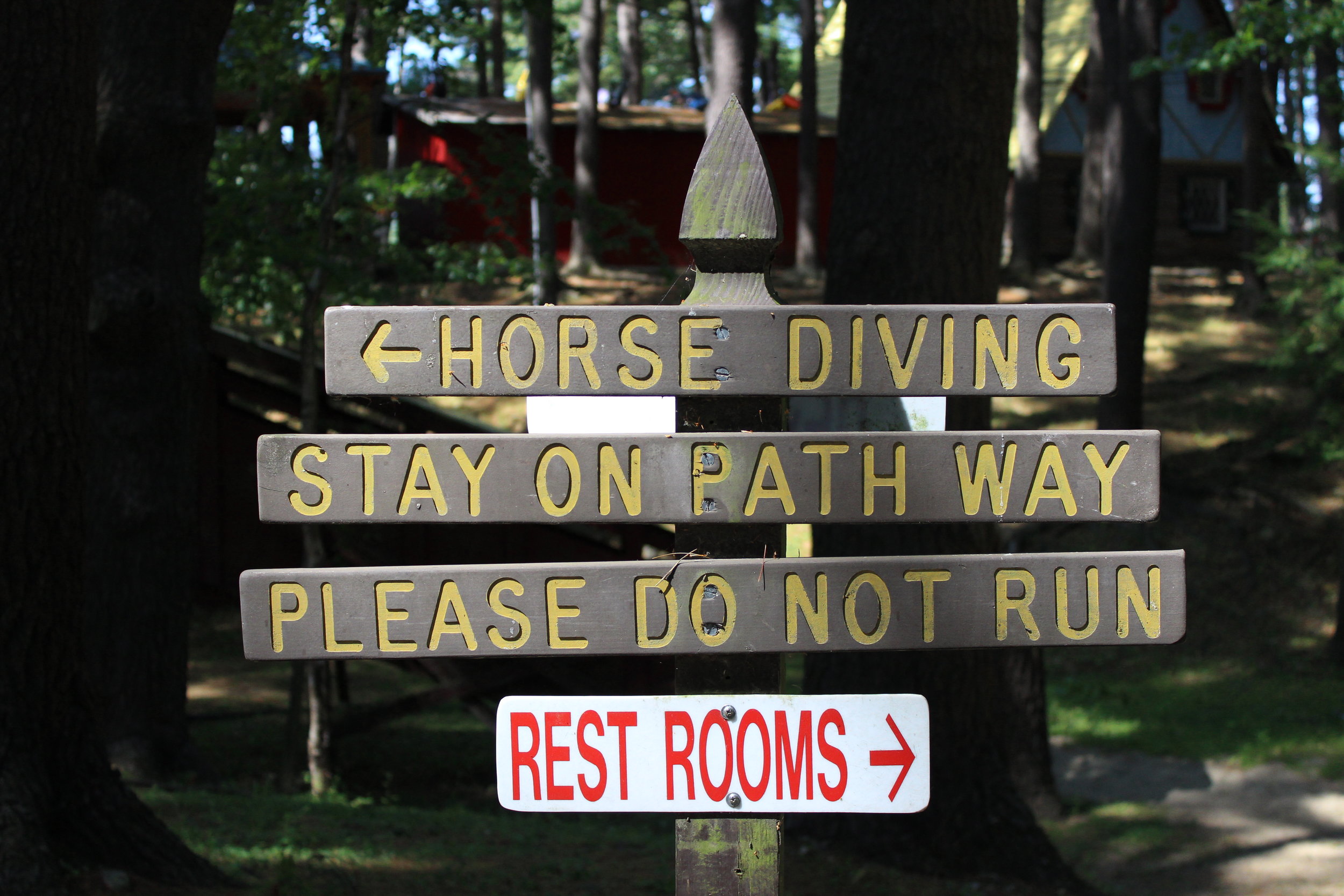
RIP Magic Forest

I recently found out that the Magic Forest—my heaven on Earth, a fairytale/Christmas/safari park, mecca for fiberglass statues and home of the last diving horse attraction in the country—has closed.


I went to the Magic Forest, located in Lake George, New York, twice, but only once when it was actually open. On our visit in September of 2015, we spent the entire day walking the grounds, watching the shows and riding the five rides that were accessible to adults. The front desk employee actually tried to dissuade us from even entering the park when she saw that we didn’t have any children with us, but she relented once she realized that we actually knew what we were getting ourselves into.


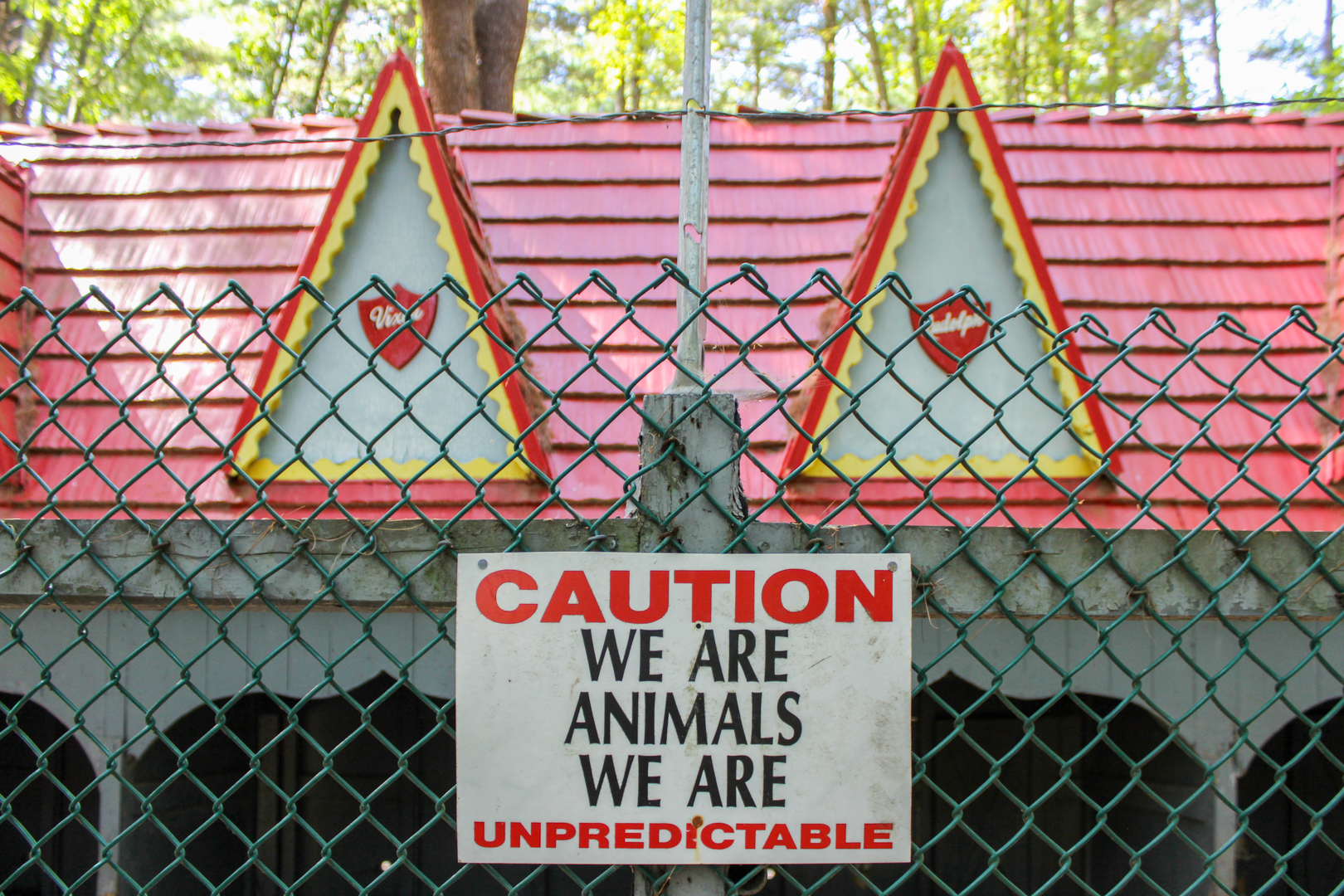


The ladies at the snack bar were putting together a puzzle in between filling orders; I put a quarter in a prize machine in the arcade, and received no prize; we tried to play ski ball but the machines were too jammed with quarters to accept ours; the gift shop closed before the park did, but they let us come back the next day to pick up some souvenirs; the magician doubled as the emcee for the diving horse, and made balloon animals in between shows to give to the children—for $2 a piece.


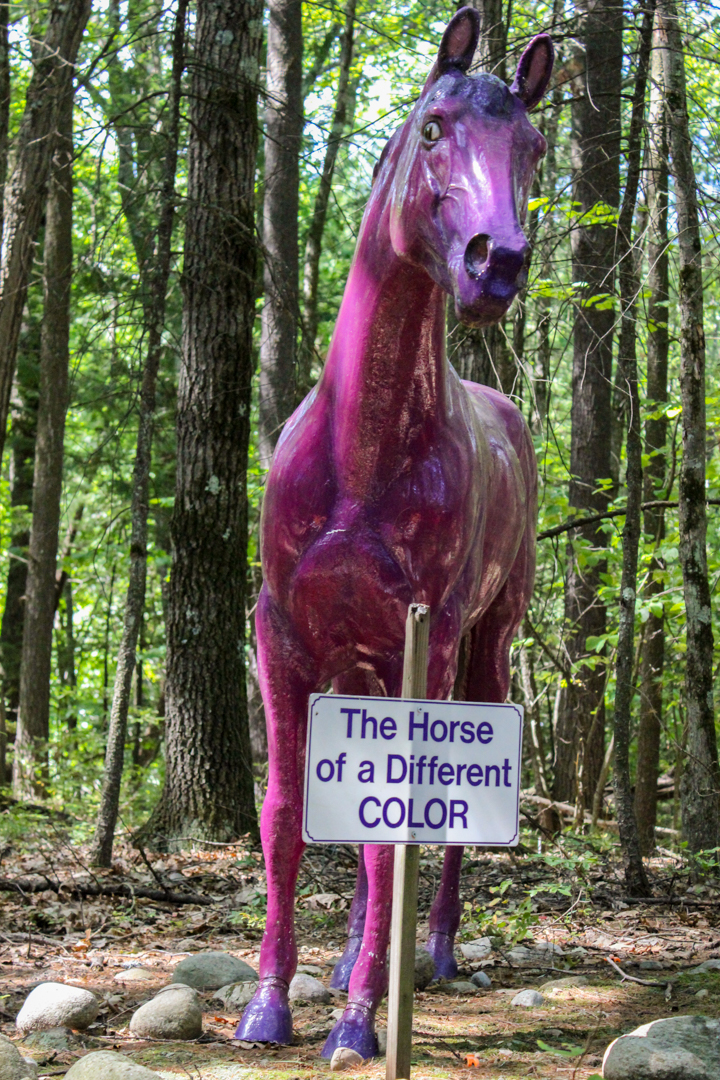


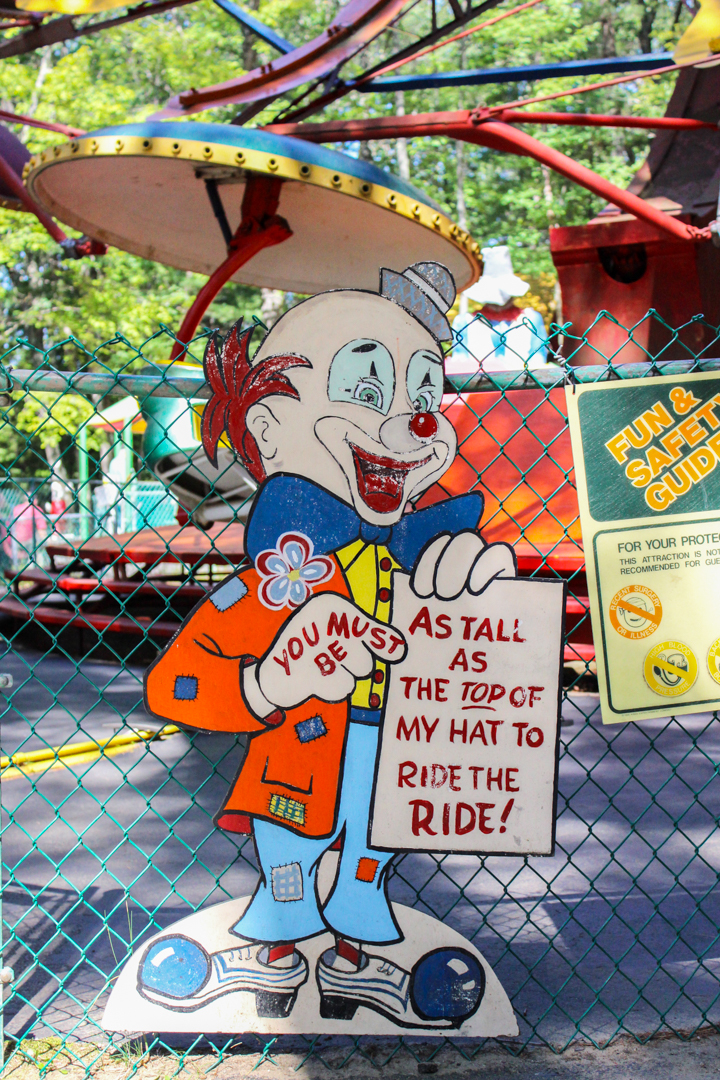
In one of my many recap posts about our visit, I wrote that the Magic Forest was “a theme park that has remained untouched by time, become abandoned while it's still in business and is completely unaware of how cool and marketable it actually is—and I hope it continues to forget that it should have closed years ago and remains in Lake George forever.” But, of course, nothing lasts forever and the Magic Forest was recently sold to someone who plans to “take the park in a different direction.”


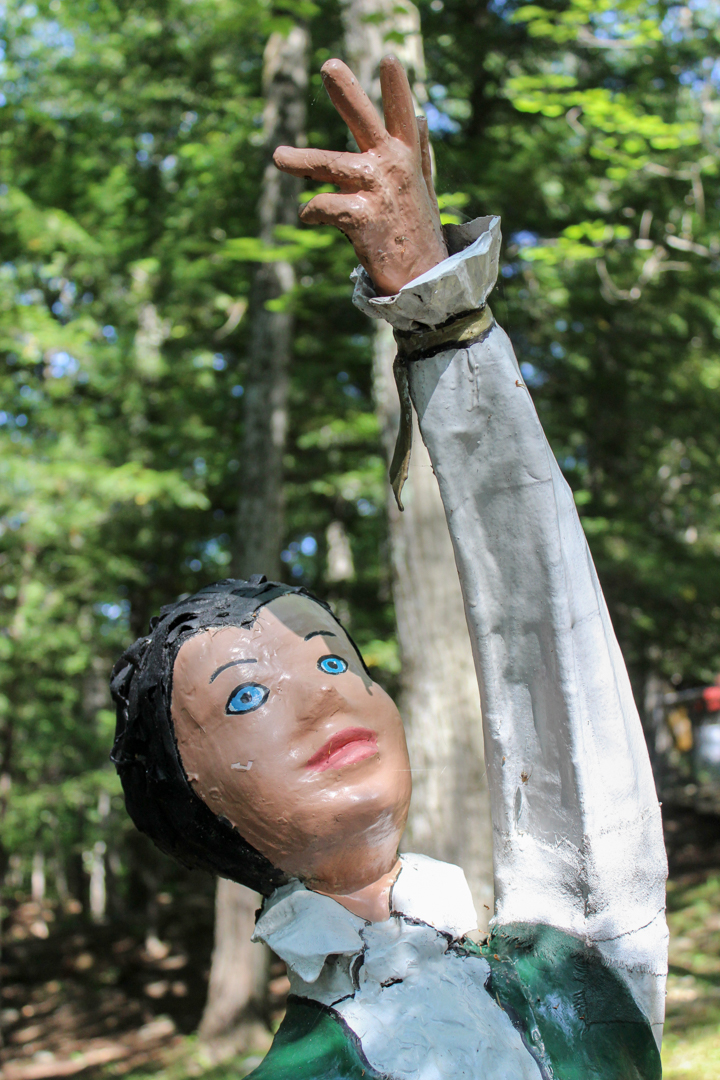

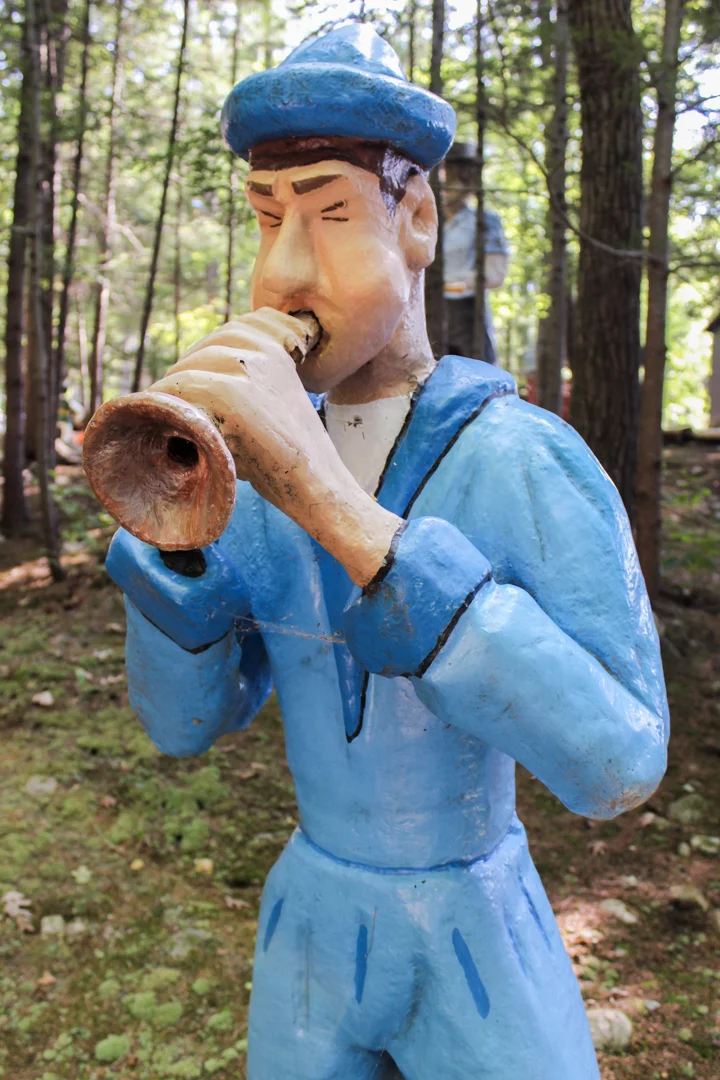
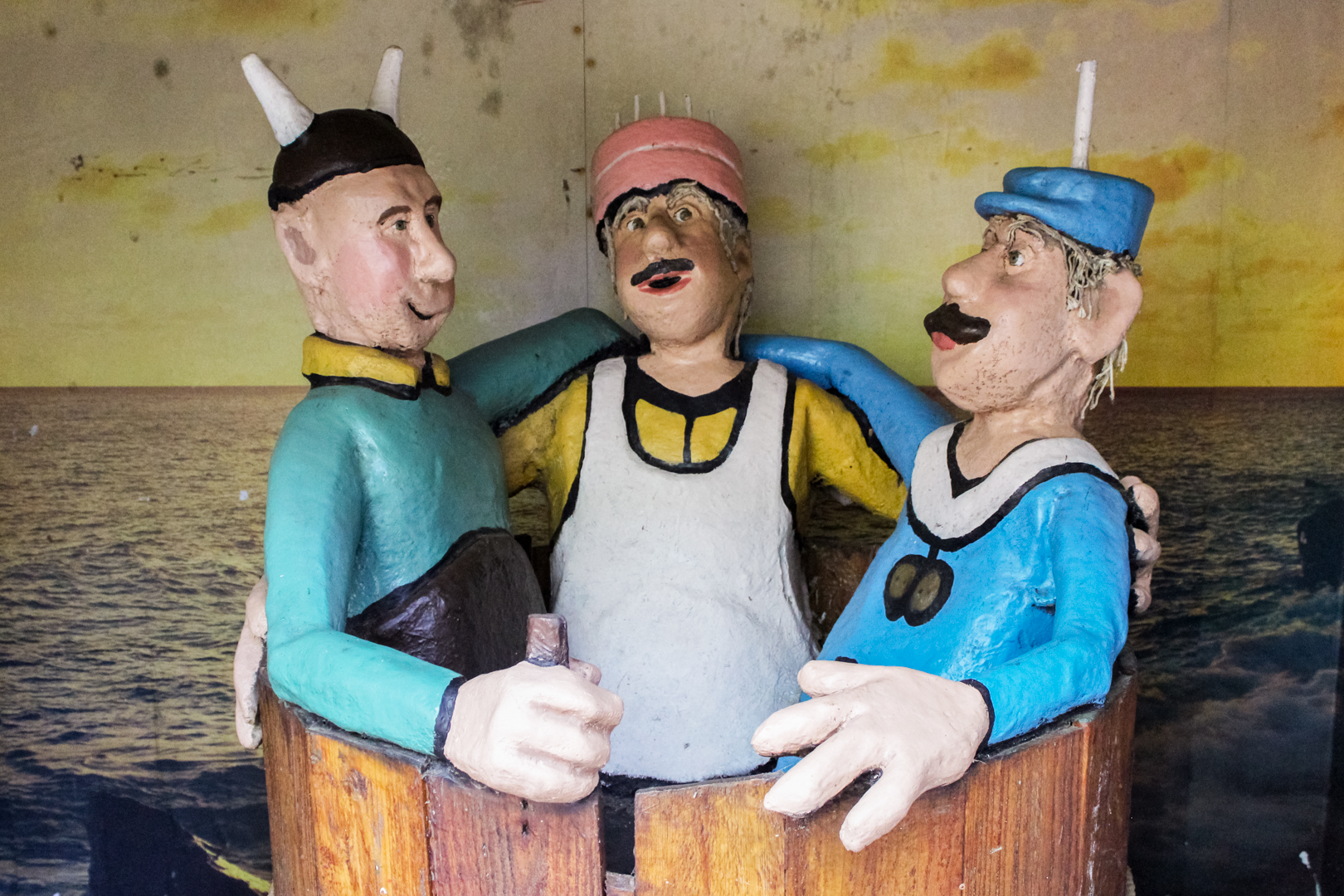
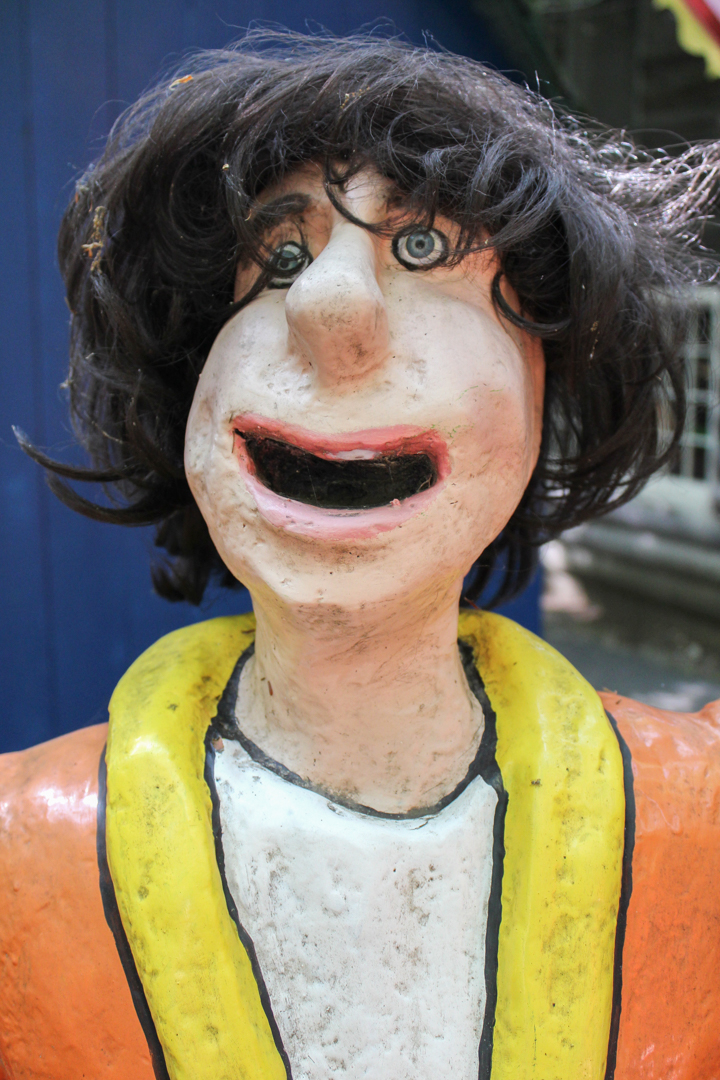
American Giants, champions of Muffler Men and other large fiberglass statues, are facilitating the sale of the Magic Forest’s impressive collection—a lot of the more famous pieces have already sold, but you can check out the online auction here. I don’t have the money or the storage space to purchase anything—for just $12,000 my dream of becoming the old lady who lives in a shoe could become a reality—but I do have photos of pretty much everything since I was obsessive about documenting our visit (this is just 81 of the 521 photos I took).

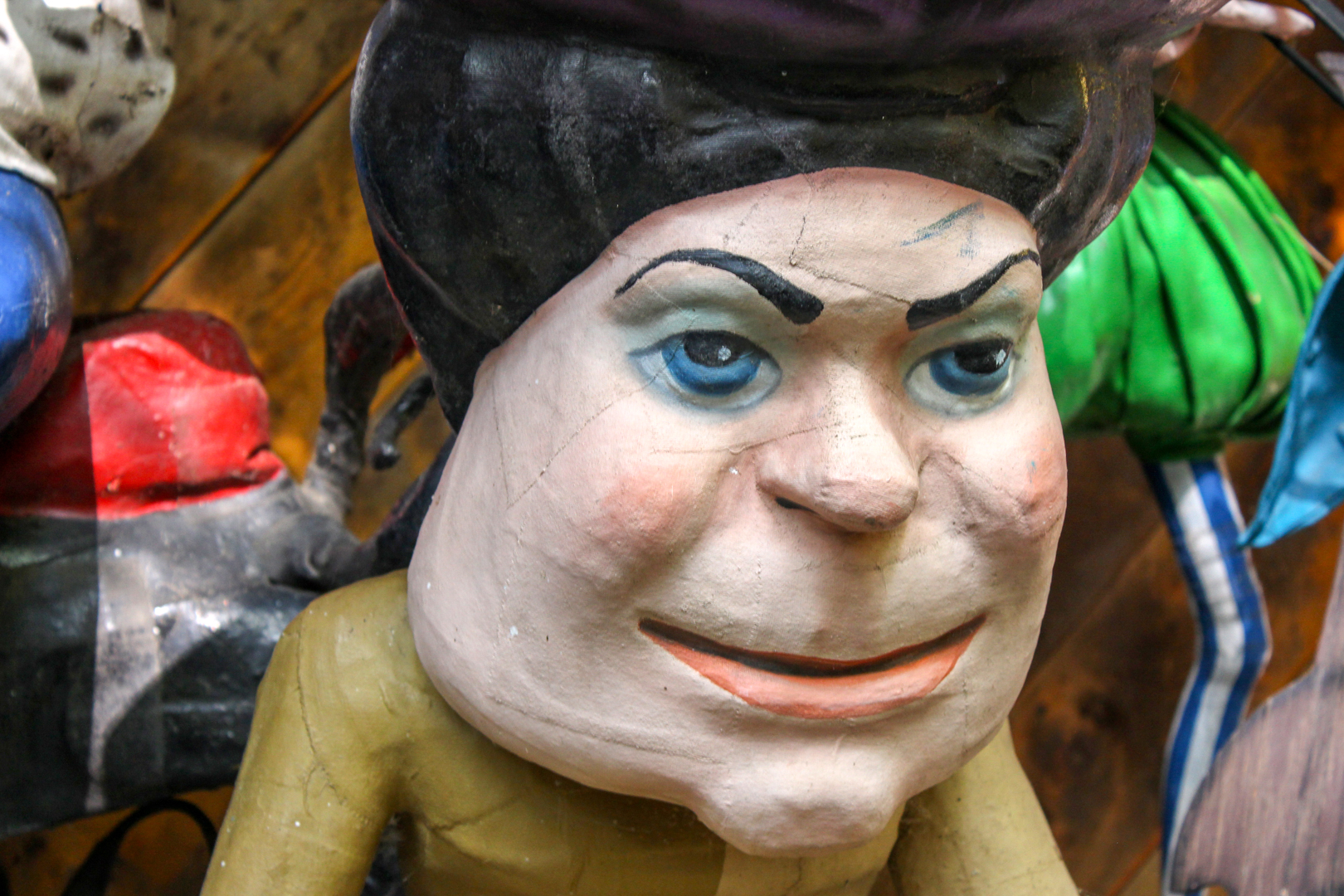


I also, like countless people who have visited the park since it opened in 1963, have the memories. Nothing stays the same forever, and this fact of life is equal parts comforting and terrifying. But no matter how much we may try to, we can’t actually stop things from changing. People die, businesses close, relationships end. But still, we dive again and again—like Lightning the diving horse—hoping somehow this time it will be different. Secretly knowing all along that when we cease to change, we cease to live.


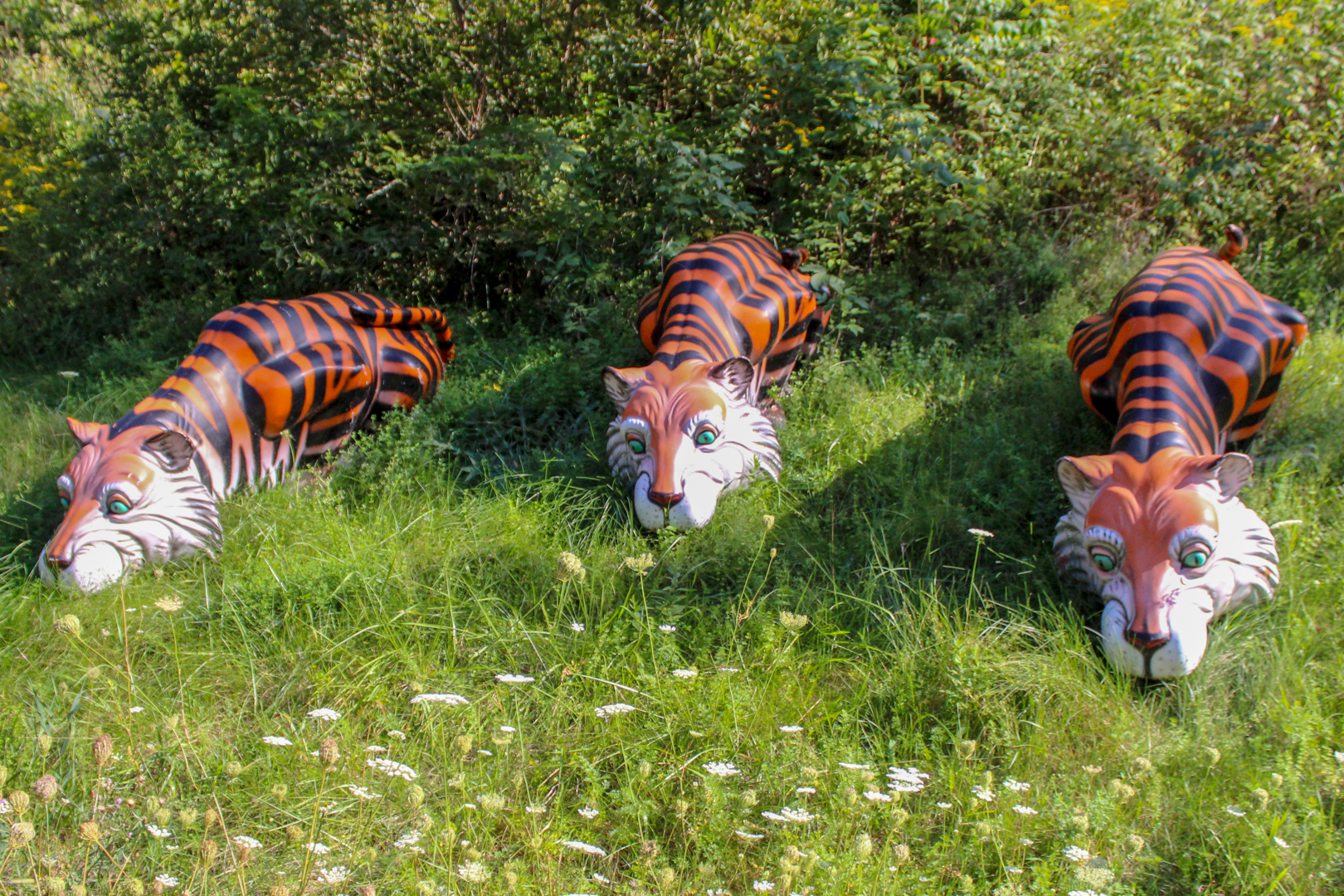


The morning before we went to the Magic Forest, we ate breakfast at a diner nearby. David took a photo of me, sipping my coffee and I remember saying “I don't think I can be any happier than I am right now.” I was being dramatic, of course, and if I’m really keeping score I can think of several other moments where I felt just as happy—if not happier—than I did right then. But would I have been so happy if I didn’t feel as if we were about to cheat time by finally exploring the Magic Forest, a park that by all logic should have closed decades ago?


I’m not exactly sure how or why most of my interests are endangered in some way—diners and outdated roadside attractions and abandoned buildings on the verge of being destroyed completely—but perhaps it is their precarious nature that draws me to them. The urgent need to experience, to document, to be able to say I was there, I am here.


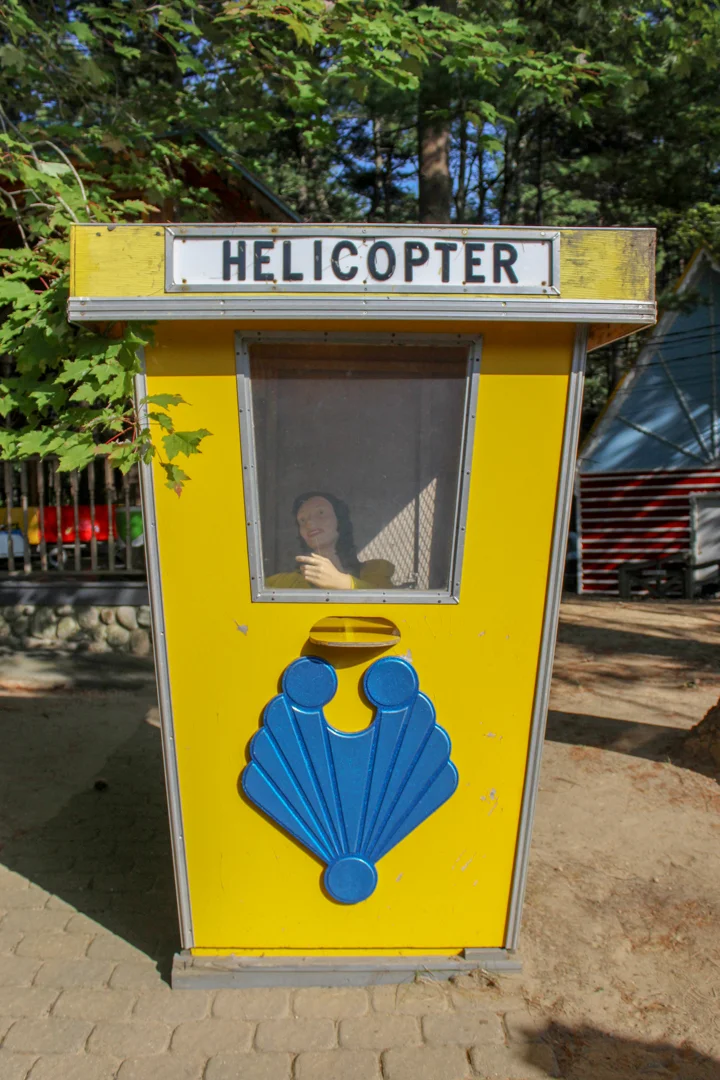

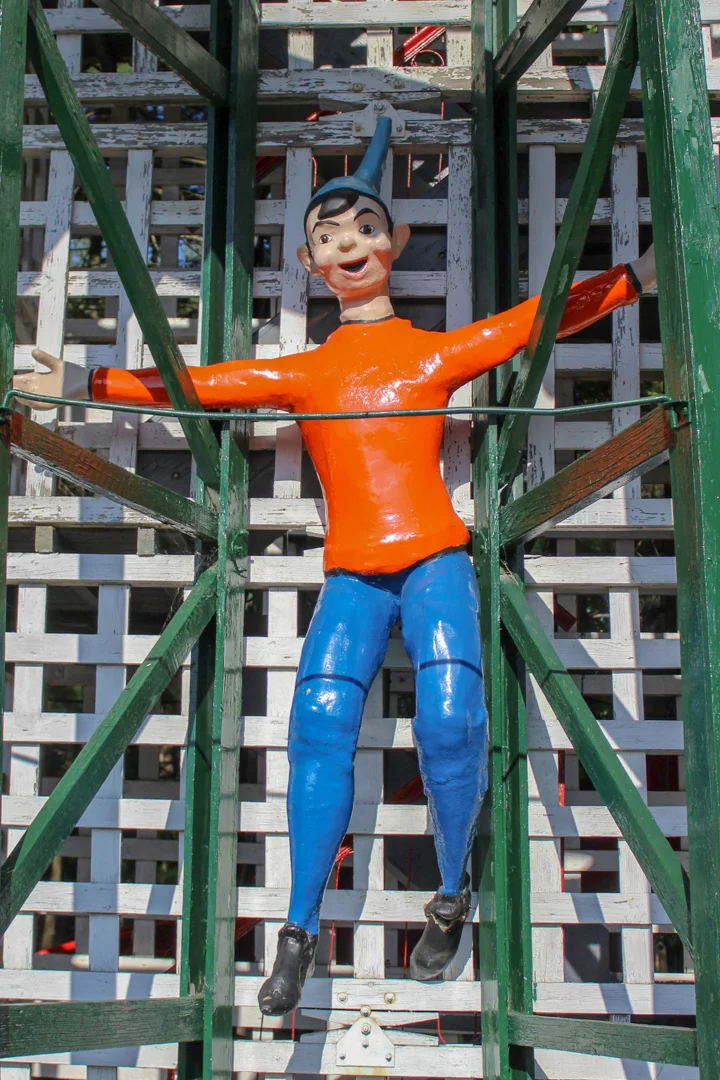


“Relaxing with the present moment, relaxing with hopelessness, relaxing with death, not resisting the fact that things end, that things pass, that things have no lasting substance, that everything is changing all the time—that is the basic message.” ― When Things Fall Apart: Heart Advice for Difficult Times
Want more? See all of my Magic Forest posts here.

Travel Guide: Roosevelt Island
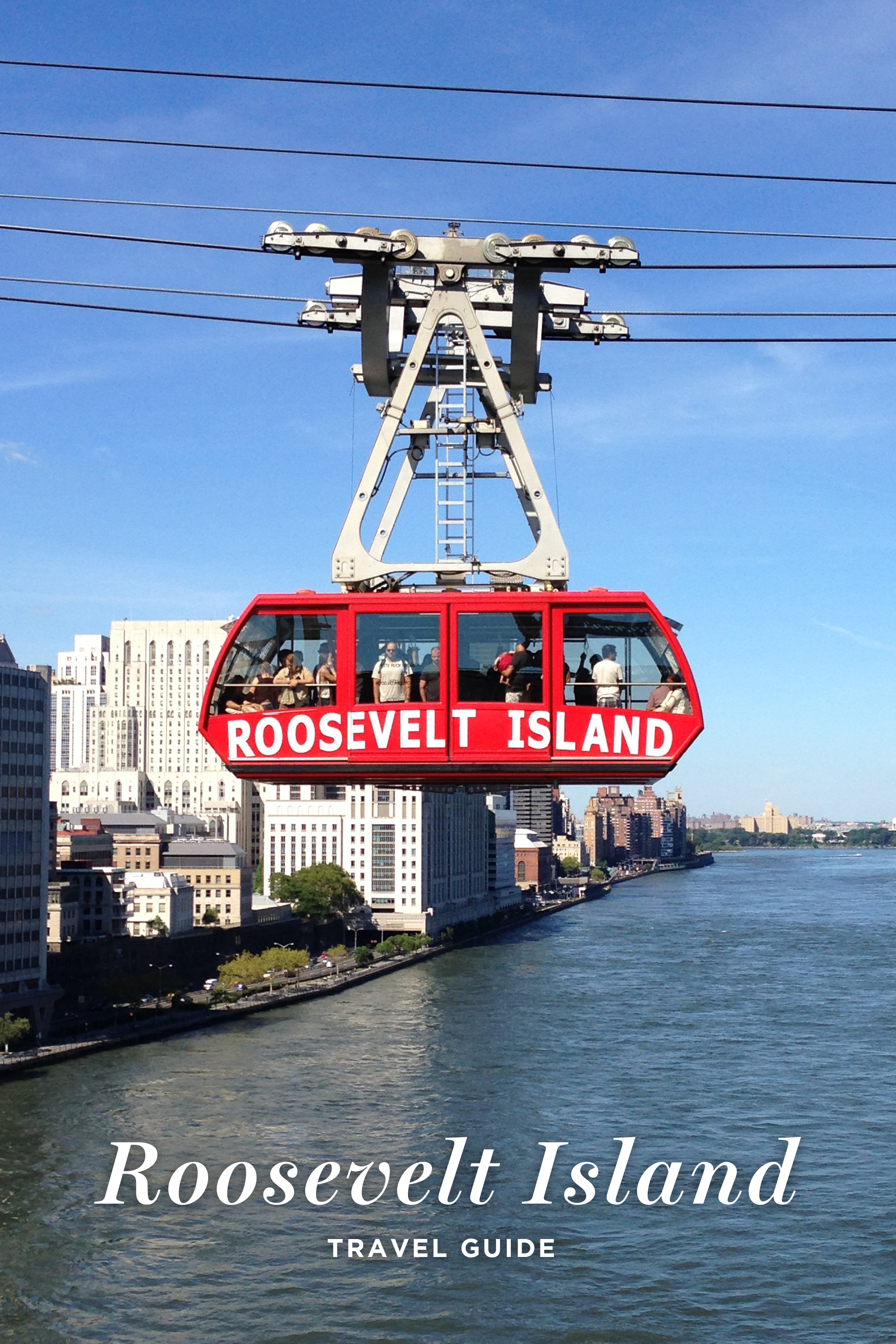
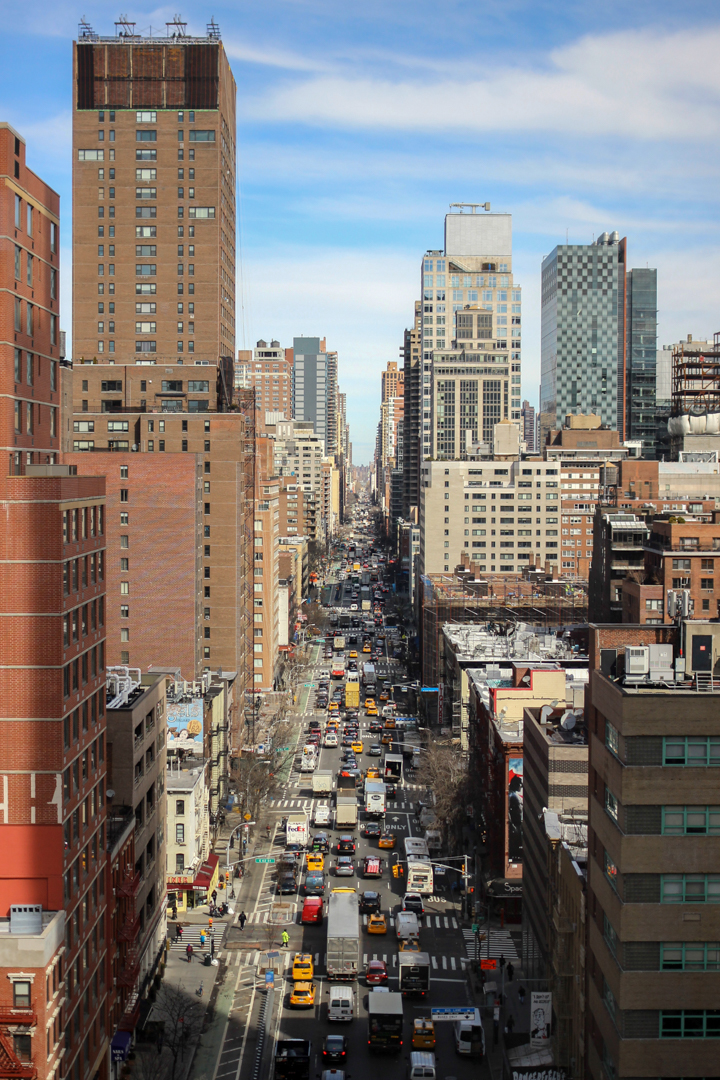
To say that I love Roosevelt Island would be an understatement. Whenever I’m feeling down, a walk around the sometimes strange, mostly peaceful island with a sordid history always sets me right. If you don’t know much about the island’s history, I recommend that you read this book before you go, and keep your eye open for hidden bits of the island’s various lives.
GETTING THERE:


The best part of visiting Roosevelt Island might just be getting there—the fastest and most whimsical way is to ride the Roosevelt Island tram. For the cost of a Metrocard swipe (currently $2.75), you can ride the first commuter aerial tramway in North America. Open in 1976, the tram isn’t operated by the MTA, and it runs every 7-15 minutes from 6am-3:30am on the weekends and until 2am on weekdays from Tramway Plaza at 59th Street and Second Avenue.
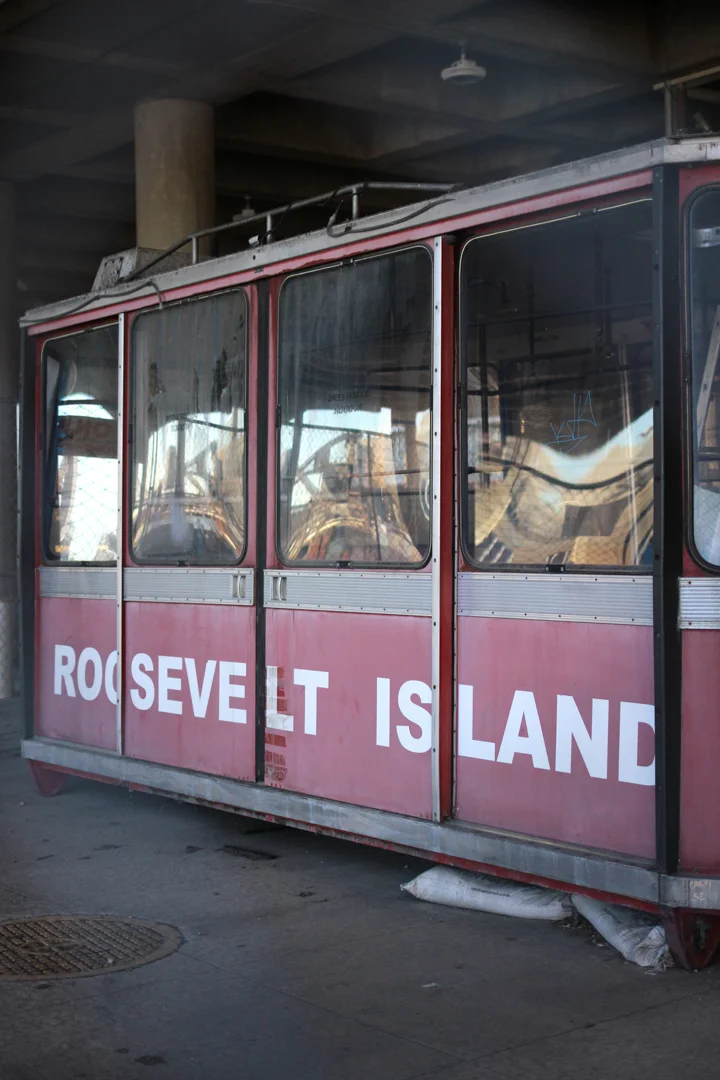

On the east side of the island, right beneath the parking garage, you can see a few of the old tram cars. They were upgraded during renovations in 2010, and may one day be preserved in a museum, but they’re currently sitting partially covered by a tarp (and recently, some uninspired graffiti).
Subway / Bridge / Ferry / Bus


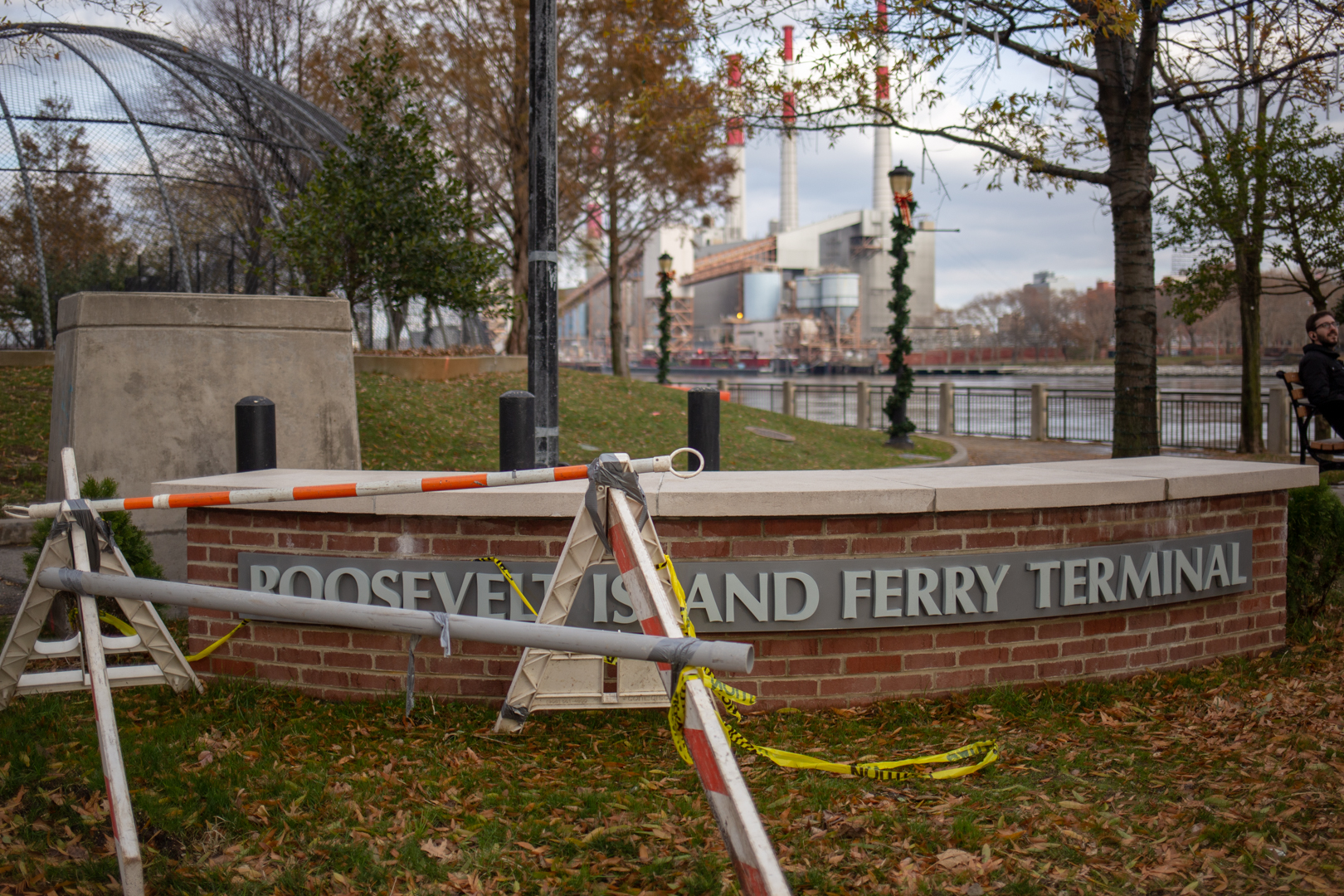
Roosevelt Island is also accessible by the F train via one of the deepest stations (100 feet below ground) in the subway system. Additionally, you can walk or drive to RI from Astoria via the Roosevelt Island bridge (and park in the huge Motorgate garage), or take the new Astoria Ferry.


Once you’re on the island, I recommend walking, but the Red Bus, operated by the RIOC, is free and makes frequent stops. The Q102 bus also circles the island, and connects RI to Queens.
WHAT TO DO:
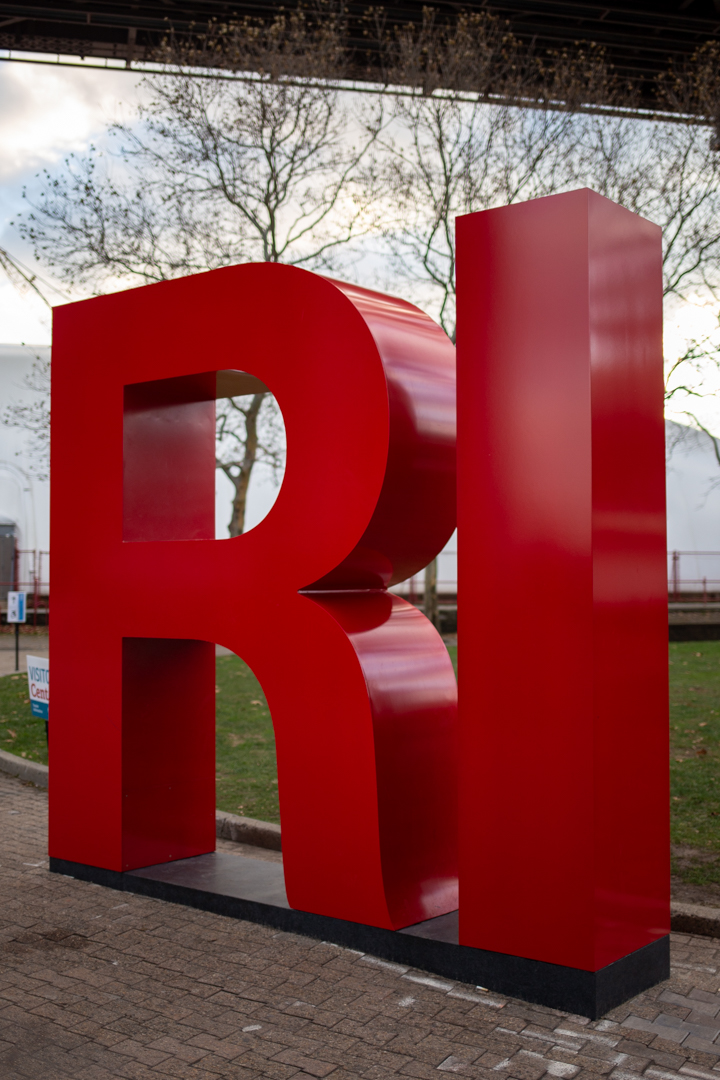

Located in a retired street car kiosk right near the tram stop and operated by the Roosevelt Island Historical Society, the Visitor Center is a good place to start your journey. Stop here for quirky RI and New York City-themed souvenirs and books or for a map of the island.
Open Wednesday-Monday, 12-5pm.
Take a walk


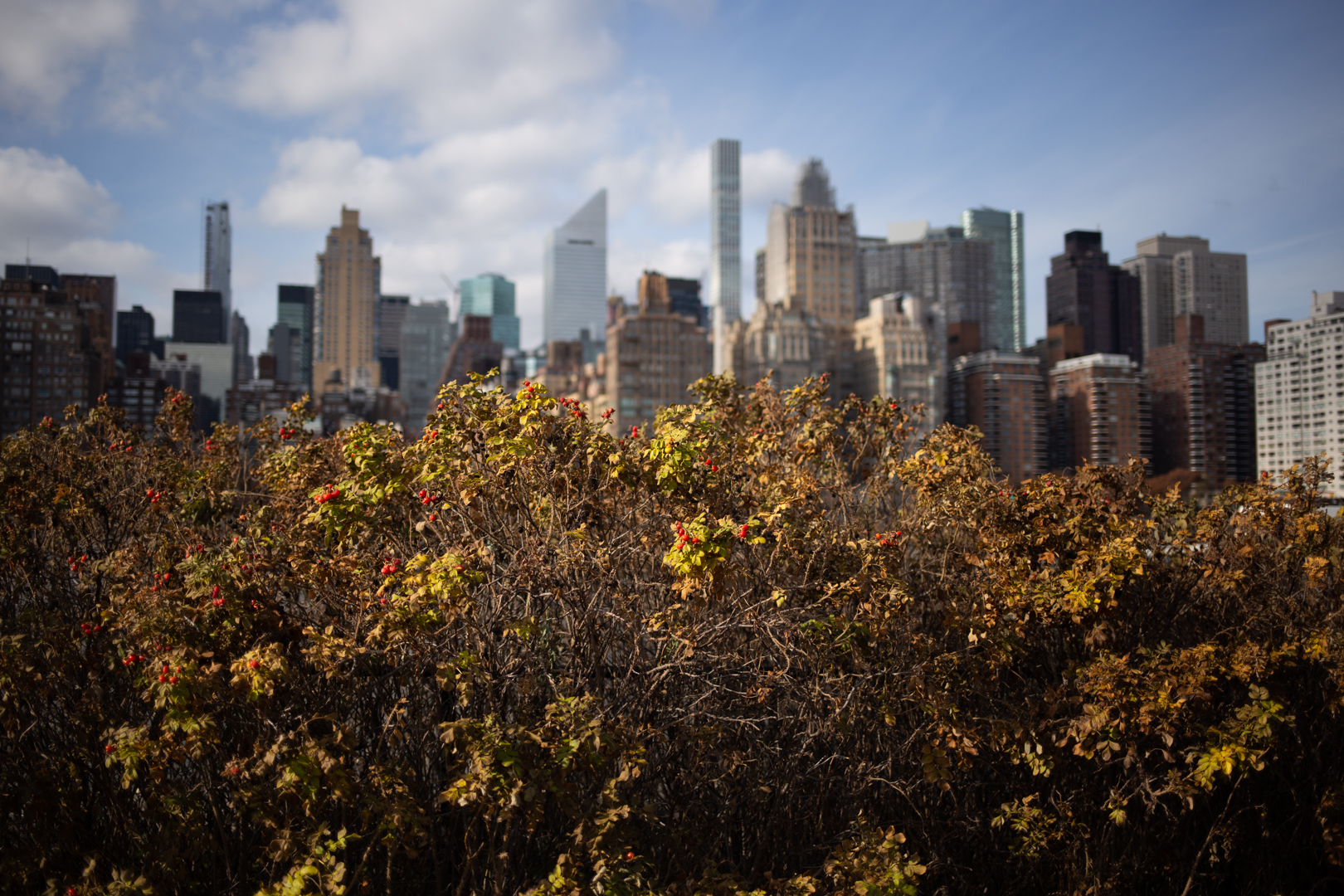

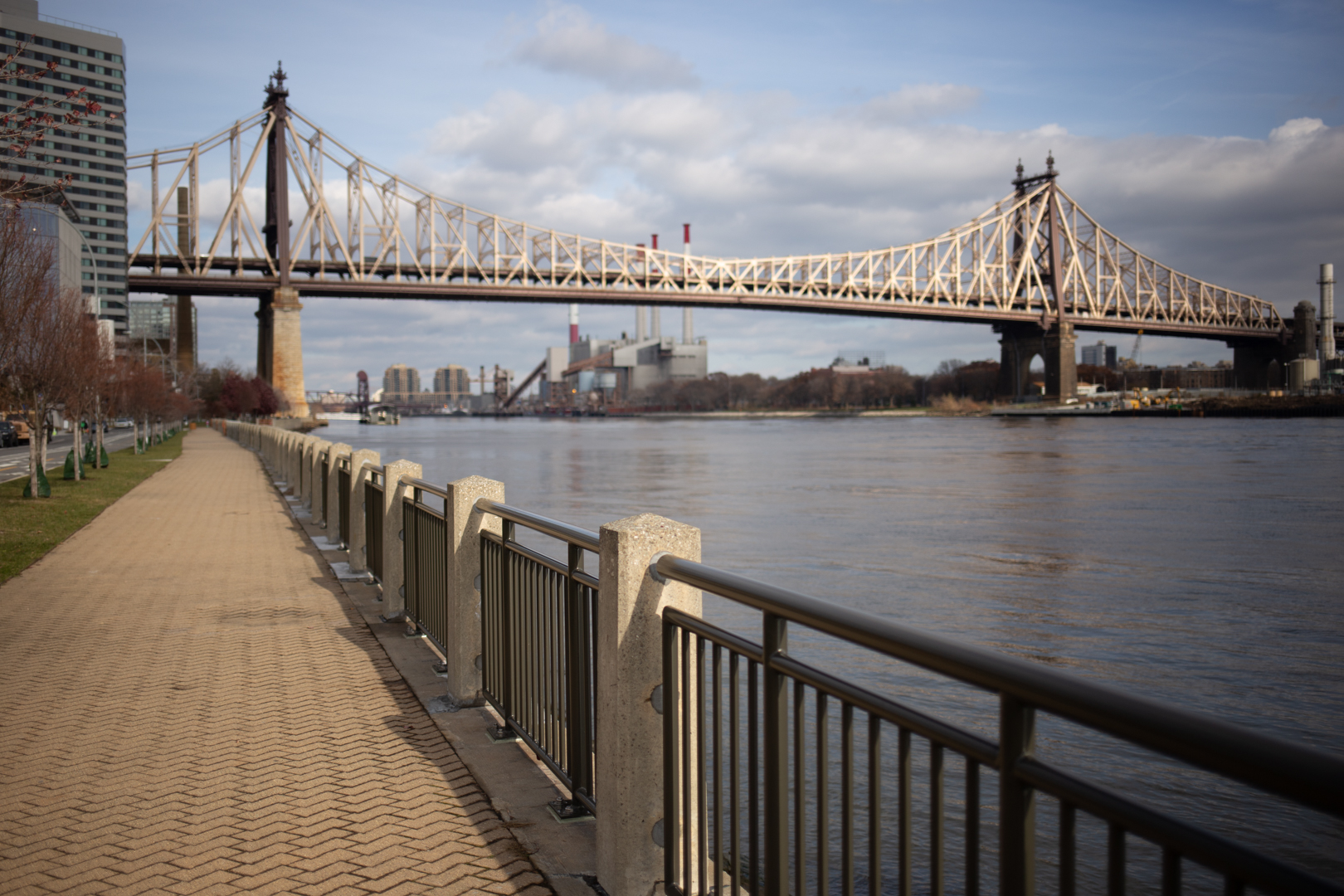
Roosevelt island is two miles long and .15 miles wide, and I recommend walking from one end to the other. With views of the Manhattan skyline on one side and Long Island City on the other, the walkways are every bit as scenic as the Brooklyn Heights Promenade but much more peaceful. The west side is lined with cherry trees that are beautiful all year round, and the east side has a good view of the Queensboro and Roosevelt Island bridges.


Roosevelt Island is part of New York City with about 14,000 permanent residents but it still feels like a completely different world. They have a post office, library, public school, two churches and a few stores on Main Street. There is also a rehab hospital, a brand new Cornell Tech campus and a tiny cat sanctuary.


But the most fascinating thing about Roosevelt Island that you might not notice is how they dispose of their trash—by an underground pneumatic tube system. Installed in 1975, when the only other pneumatic garbage system in the US was at Disney World, the system allows residents to throw their trash down chutes where it piles up until it's whisked away—by an AVAC system that sucks up about six tons of trash a day.
Smallpox Hospital


Designed by James Renwick Jr. and opened in 1856, the Smallpox Hospital is currently the only ruin within city limits to have been designated a New York City Landmark (it's also on the National Register of Historic Places). There have been plans to further stabilize the Smallpox Hospital and open it to the public, but for now it just sits in ruin, a reminder of Roosevelt Island’s history as a receptacle for all of the city's undesirables. In the fall, the climbing ivy turns brilliant shades of red, and at night the dramatic lighting manages to make the site seem even more sinister.

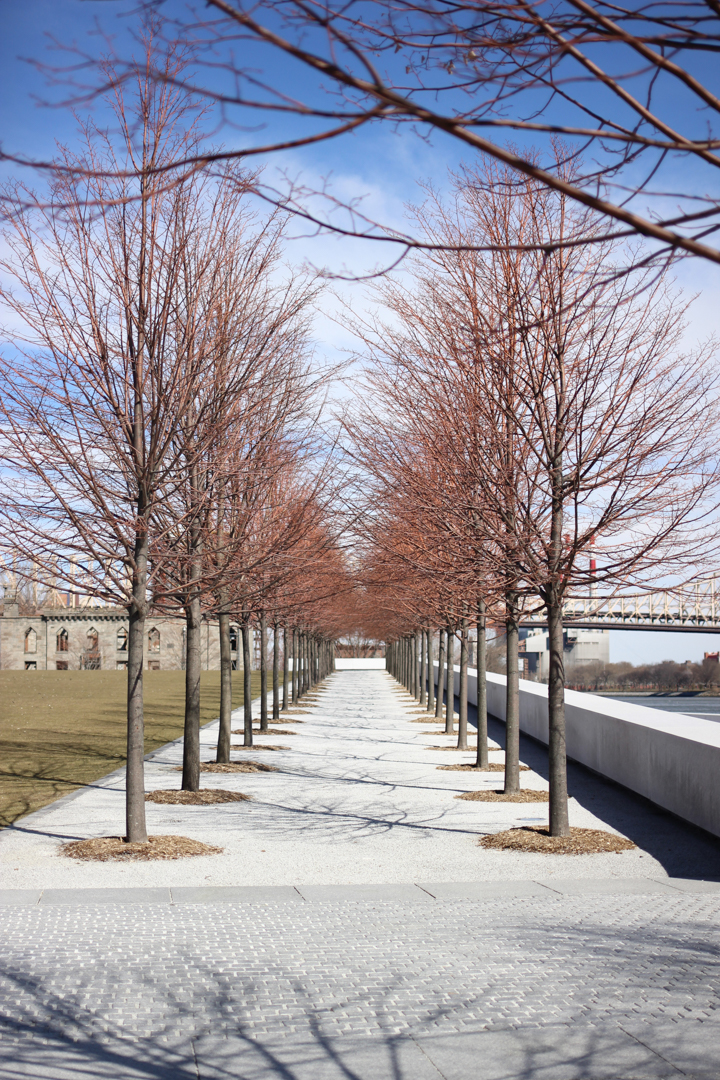


Four Freedoms is a four-acre park located on the southern tip of the island, dedicated to the 32nd President (and the island’s namesake). Franklin D. Roosevelt delivered his eighth State of the Union address, known as the Four Freedoms speech on January 6, 1941, and a portion of the that famous speech is etched on a granite block in the park. The memorial is a procession of open-air spaces, culminating in a 3,600-square-foot plaza surrounded by 28 blocks of North Carolina granite, and a bust of Roosevelt, sculpted in 1933 by Jo Davidson.
Open October 1 - March 31, 9am-5pm; April 1 - September 30, 9am-7pm; closed Tuesdays, free.
The Strecker Laboratory


Built in 1892, the Strecker Laboratory was the first laboratory in the country devoted exclusively to pathological and bacteriological research for the nearby City Hospital. In 1972, it was added to the National Register of Historic Places, and in 1976 it was designated a New York City landmark. The MTA refurbished the building's exterior and it has housed a power conversion substation powering the subway trains that run underneath Roosevelt Island since 2000.
The Blackwell House
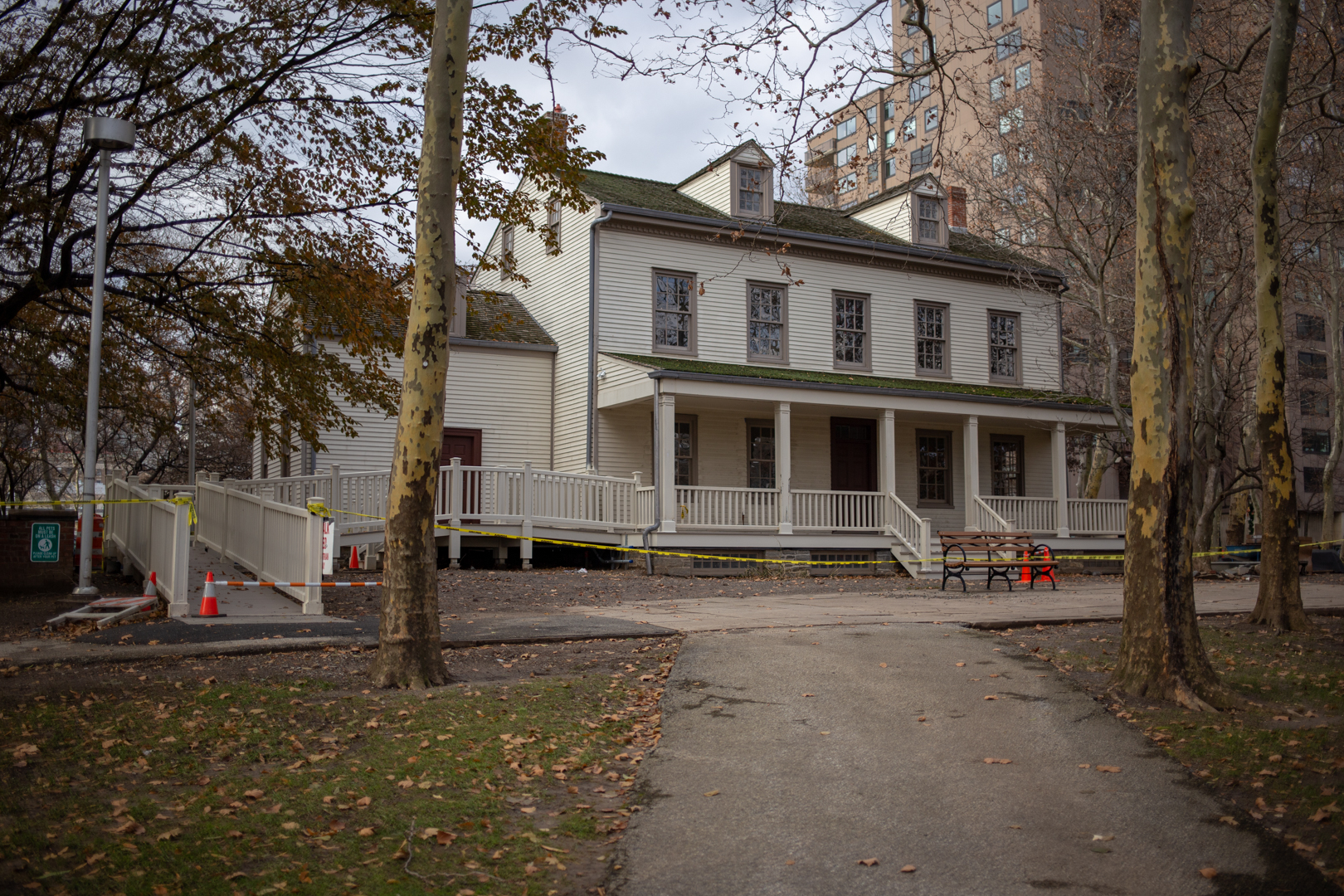
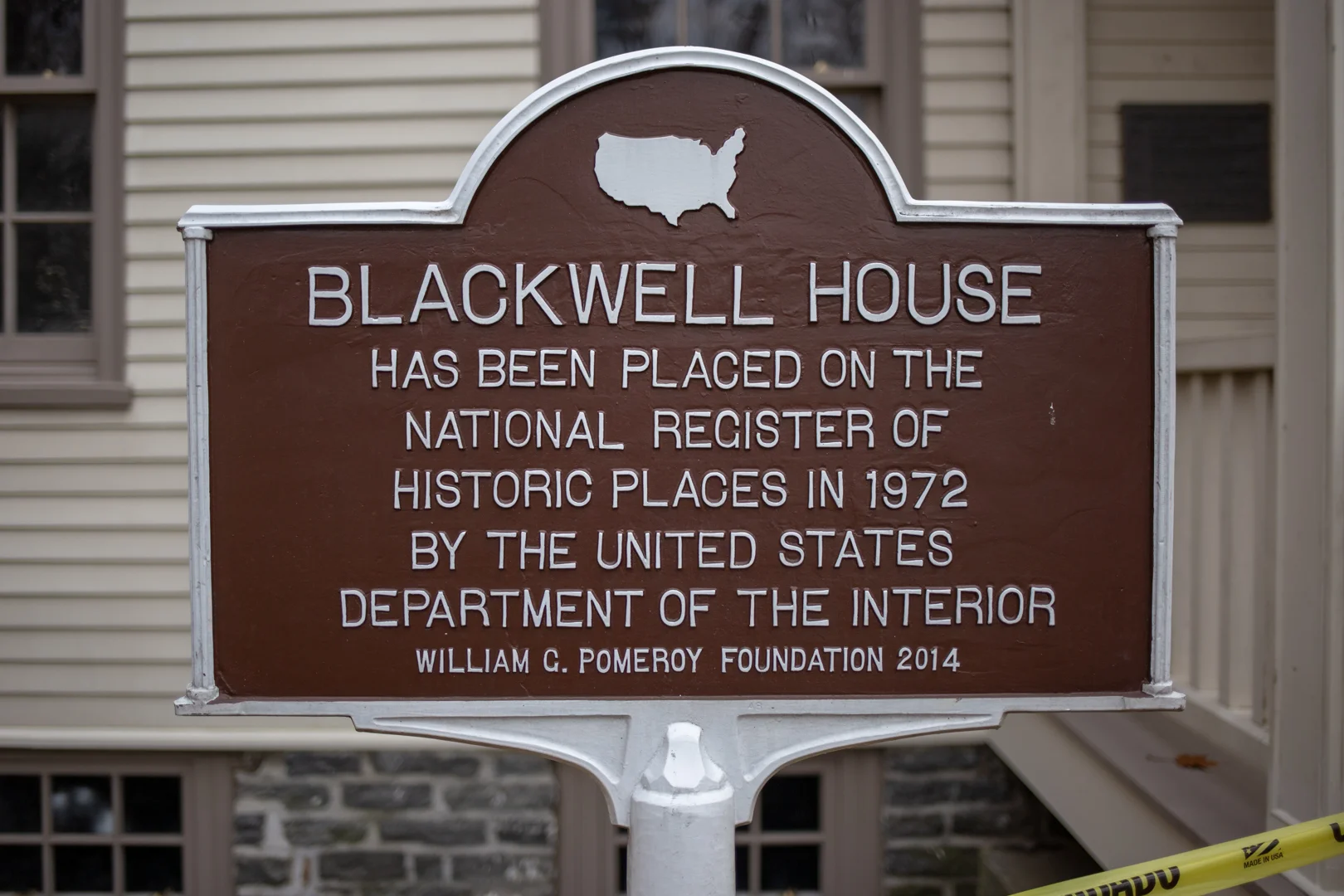
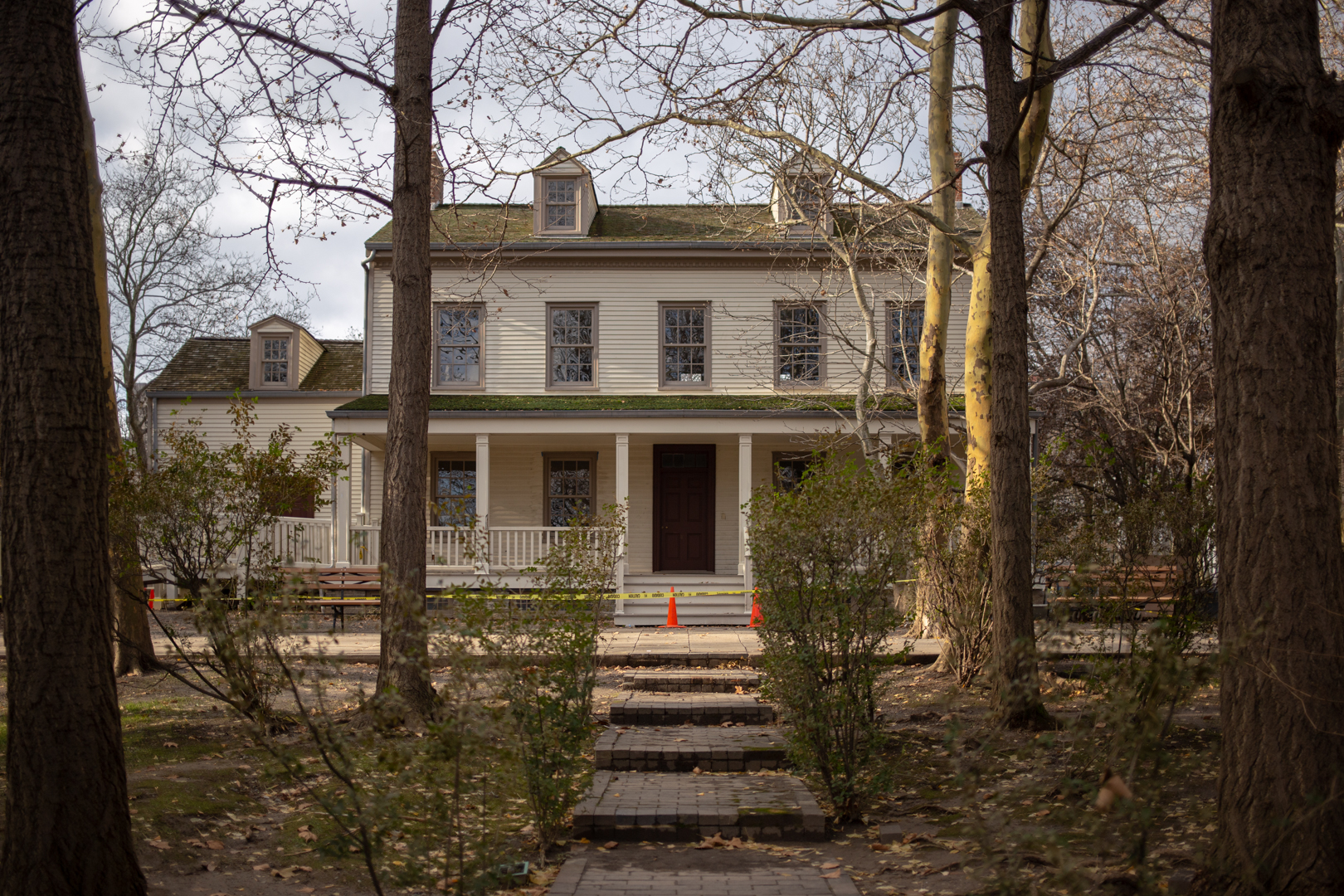
Built for James Blackwell between 1796 and 1804, this house is the only building on Roosevelt Island from when the island was still privately owned. The Blackwell family owned the island from the late 17th century until 1828, when it was sold to the city. In 1829, with the building of the penitentiary, the Blackwell House became the residential quarters for administrators. Placed on the National Register of Historic Places in 1972, and restored in 1973, the Blackwell House is currently undergoing renovations to be used as community space offering historical tours and a library with space to store the Roosevelt Historical Society's archives.


The Octagon, built in 1834, originally served as the main entrance to the notorious New York City Lunatic Asylum (the setting of Nellie Bly’s exposé, Ten Days in a Mad-House). In true New York City fashion, the Octagon was renovated and in 2006, the five-story rotunda made of blue-gray stone quarried on the island reopened as the lobby of a luxury housing complex containing 500 apartments.
Blackwell Island Lighthouse

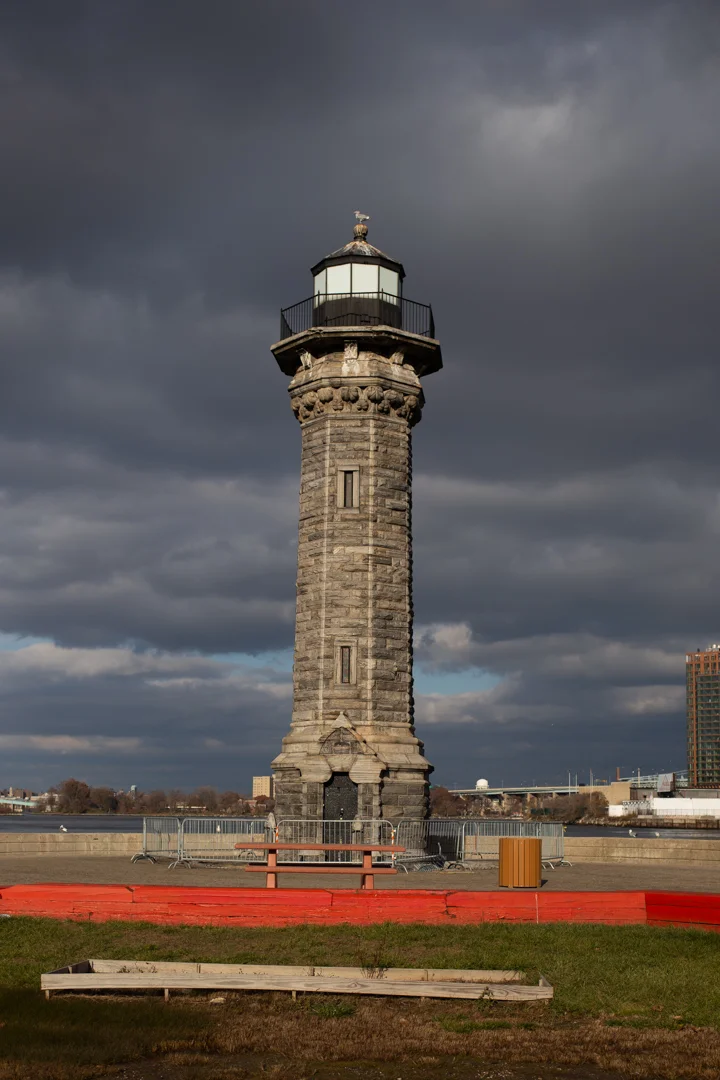

Designed by the architect of the Smallpox Hospital, James Renwick Jr., this 50-foot-tall, gray gneiss, Gothic-style lighthouse was built in 1872. Built by inmates of the penitentiary with stone extracted from the island, the lighthouse was named to the National Register of Historic Places in 1972 and was designated a New York City Landmark in 1976. The light was operated until about 1940. Because of its vulnerable location at the northernmost tip of the island, the park has frequently been closed when I’ve visited due to weather-related damages from Hurricane Sandy and most recently an October nor’easter.
The Marriage of Real Estate and Money Sculptures


If you peek over the railing on the western bank of the island, into the East River between RI and Manhattan, you’ll see three sculptures by Tom Otterness. Installed in 1996 and titled The Marriage of Real Estate and Money, “the sculptures make a statement situated between the dueling residential developments on both Roosevelt Island and Midtown East.” If Otterness’s work looks familiar, you may have seen his little mischievous figures in the 14th Street subway station.
Stay for sunset


One advantage of the sun setting so early in the winter is that you don’t have to stay out too long to catch a beautiful sunset. Roosevelt Island is the perfect place to watch the sun set behind the Manhattan skyline, and I was lucky to catch one of the best sunsets I’ve ever seen while waiting to see the Smallpox ruin at night.
WHERE TO EAT:
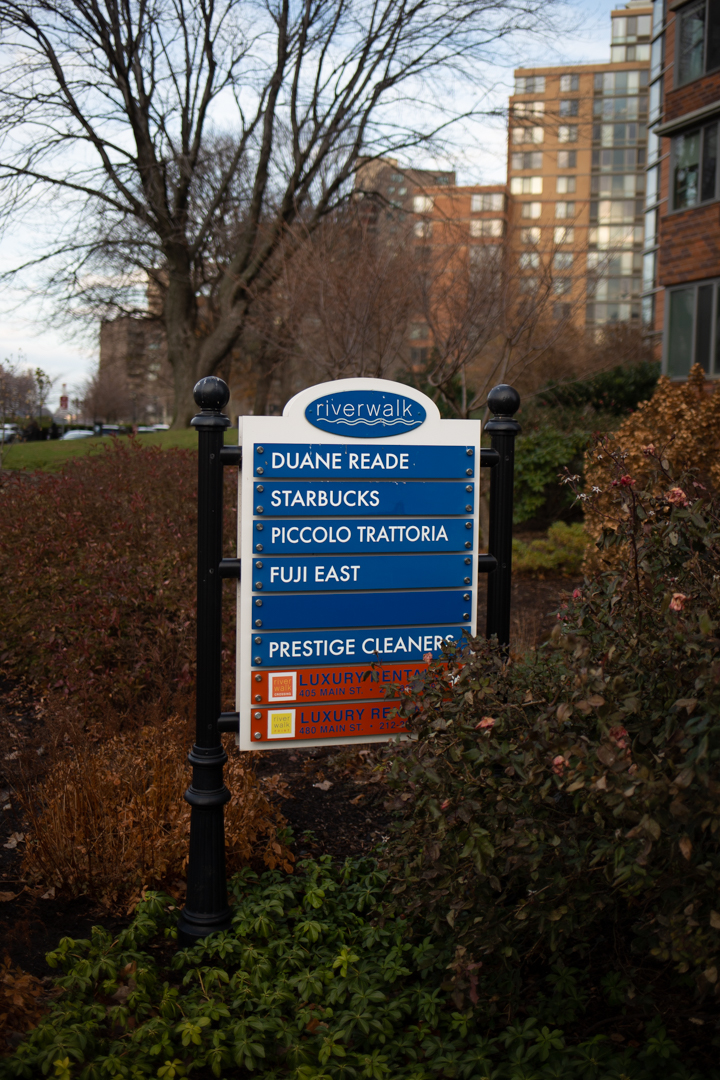
For all of its charm, the one area where Roosevelt Island is lacking is in food options. There are a few chain outposts: Duane Reade, Gristedes, Subway and Starbucks, in addition to a bubble tea shop, sushi bar and classic Chinese takeout.


I did finally eat at the pizza joint right next door to Starbucks on my most recent visit, and despite the lackluster reviews, it was exactly what I wanted: hot, greasy, thin crust New York pizza. I ordered a personal pie to go and ate it by the river, but you can dine-in as well.
Want more? See all of my Roosevelt Island posts here.

Gift Guide: Diner Lovers

I’ll be suspending my regular Happy Friday link round-ups until after Christmas and doing some gift round-ups instead. I’m obsessed with reading gift guides and I hope you are too. So grab a cup of coffee and a plate of eggs because first up is a guide for diner lovers.

1 / A keychain to declare your diner allegiance to the ultimate in fantasy diners, Luke’s.
2 / For those days when you can’t make it to your local breakfast spot, flip your omelettes like a pro with this spatula.
3 / Fact: syrup tastes better when it’s poured from a classic slide-top diner syrup bottle.
4 / It’s not a true diner unless it has simple, glass salt-and-pepper shakers in an easy-to-clean metal caddy on every table.
5 / Name a more iconic duo. I’ll wait.
6 / I’ve never actually seen anyone order diner pie, but they sure do look pretty on the counter, especially when they’re on a nice cake stand.
7 / Sadly, Tabasco is the hot sauce you’ll find most often in diners, but the best ones know that Cholula is the superior choice (sometimes you just have to ask for it).
8 / Everything looks better with a face, especially food. These prints are perfect for any size kitchen and look good alone but really shine as a set.
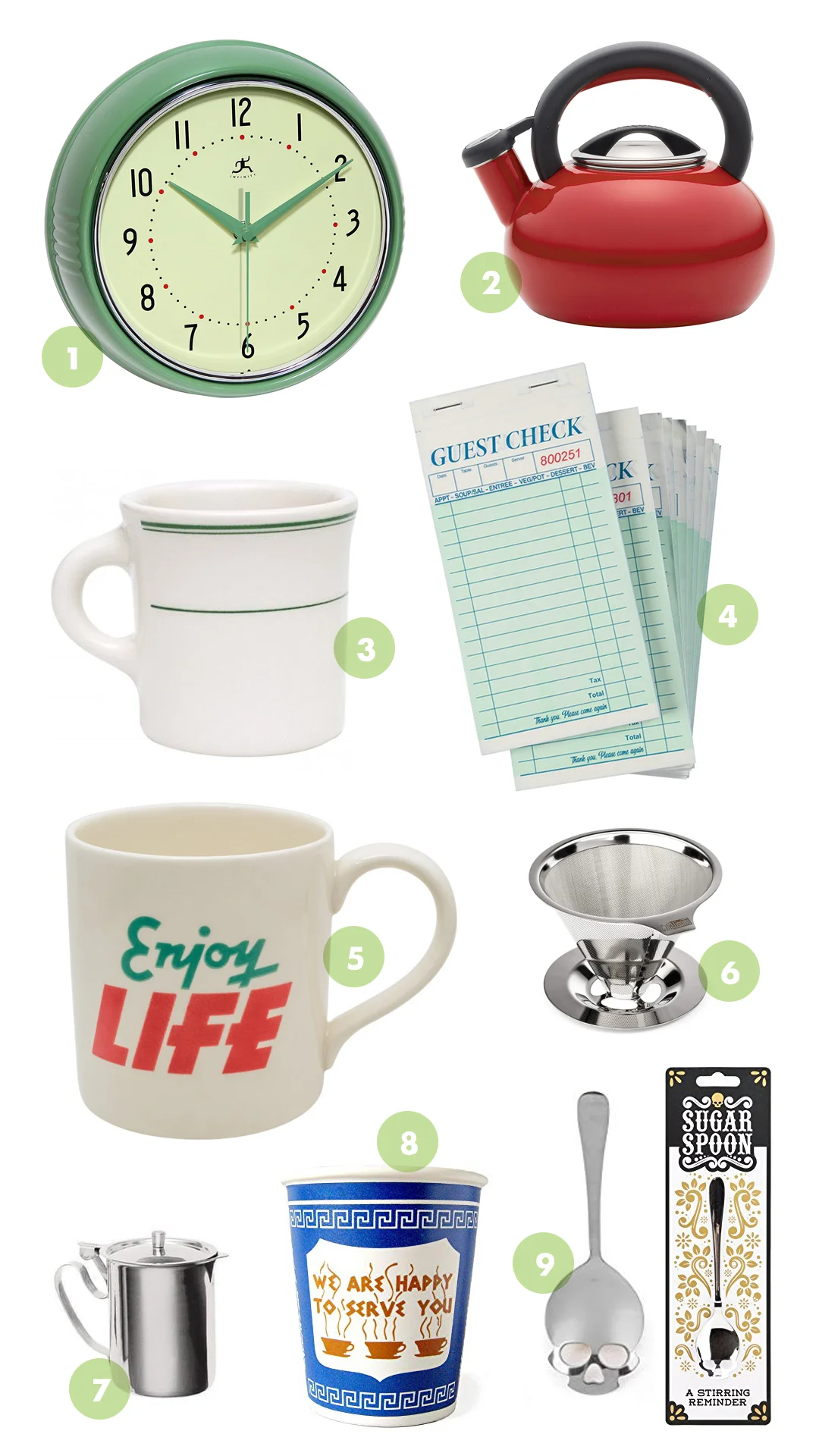
1 / I have this clock in my bathroom and it’s hard to be stressed that I’m running late for work when the bearer of bad news reminds me of a classic diner.
2 / I have a similar kettle and I’ve so far resisted painting eyes on the side, but it’s probably inevitable. I don’t have room for a coffee maker in my play kitchen, so a kettle looks nice sitting on my stovetop while keeping what little counter space I have free of gadgets.
3 / Most of the coffee mugs in my collection come from local diners (and they’re sadly not usually available online), but you can’t go wrong with this classic shape and striped design.
4 / Replace your boring Post-its with guest check pads for quick notes.
5 / I’m not a huge fan of statement mugs, but this is a sentiment worth remembering.
6 / If you’re brewing coffee for one (*raises hand*) this filterless pour over coffee maker is cheap, efficient and environmentally friendly.
7 / Just like syrup, creamer just tastes better when it’s poured from a diner style stainless steel covered milk creamer.
8 / The paper version of this iconic Greek coffee cup is getting harder to find at diners, but the ceramic version can be used over and over again.
9 / One year I received not one, but two of these sugar skull spoons from friends for Christmas and it’s the perfect stocking stuffer for your spooky, coffee-loving friend.

1 / Ketchup on everything (but especially french fries, hash browns and breakfast sausage).
2 / I know diners aren’t really known to have a toaster pastries, but this clutch would be the perfect breakfast accessory and it has an interior zippered pocket to hold your cash (a lot of classic diners are cash only).
3 / Fake foliage is a big part of classic diner decor, and this fake pothos plant looks just like the real thing (years of dust not included).
4 / Most diner pendant lamps are vintage, but luckily you can find newer versions pretty easily.
5 / Bring your love of breakfast into the bedroom (or the living room) with a plush donut or stack of pancakes pillow.
6 / Toothpicks are usually available by the register and this bird dispenser is both whimsical and hygienic.
7 / Don’t forget to grab a mint before you leave the diner (or your house) to freshen up your coffee breath.

The very perfect gift for a diner lover might just be to take them out for a genuine diner breakfast. Some diners offer gift certificates, but supporting a local diner (before they close due to rent hikes or catch on fire) by patronizing them frequently—and tipping well—is a gift for everyone involved.
Some of my favorite New York diners: Kane’s Deli Flushing Diner / The New Floridian / Square Diner / Tom’s Restaurant / Pearl Street Diner / Broadway Restaurant / Neil’s Coffee Shop

Great Pyramids of Giza
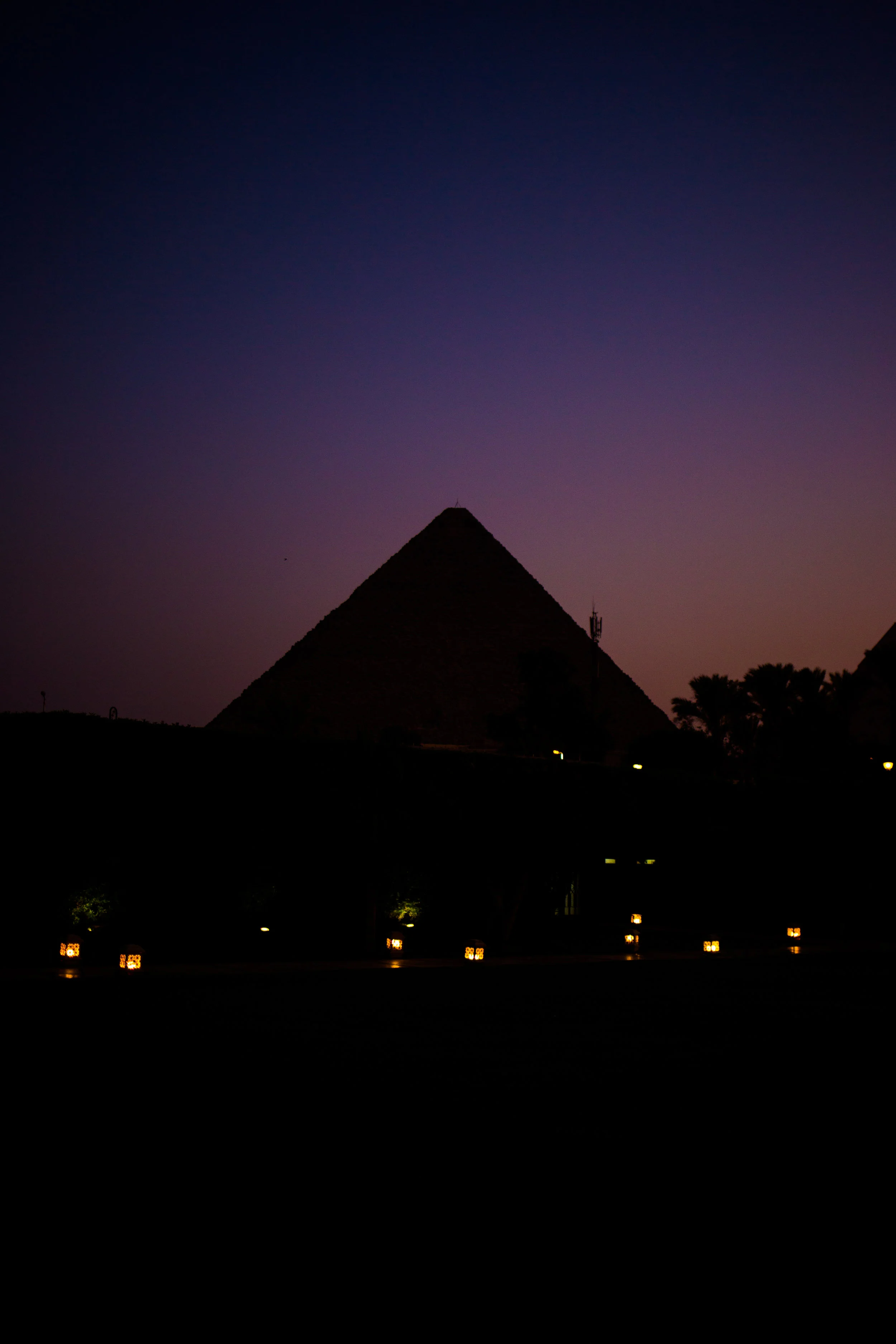
In conjunction with the Great Sphinx, the nearby pyramids were an obvious highlight in our trip to Egypt. The Giza Plateau is the only place in the world where you can still find a Wonder of the Ancient World—of the seven original wonders, the Great Pyramid of Khufu is the only one that remains. The plateau actually contains six pyramids—the three most famous ones plus three smaller subsidiary pyramids—a workers’ village, quarries and several cemeteries.

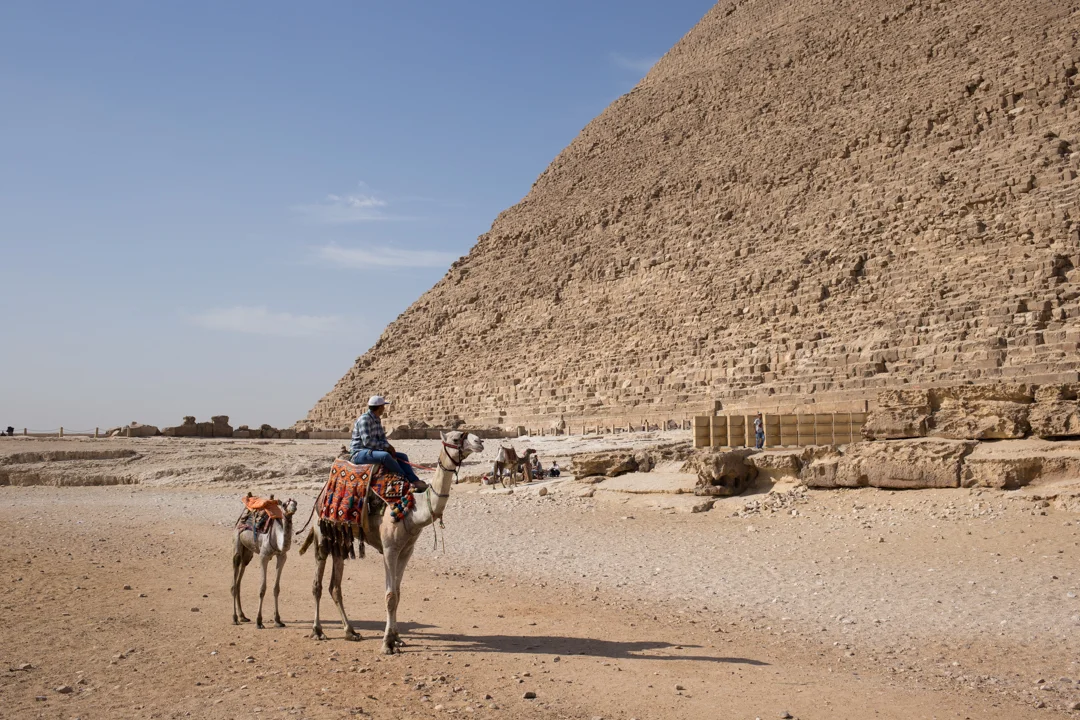


The three largest pyramids were built by three generations of pharaohs—a grandfather, father and son. The largest and oldest, The Great Pyramid (also known as the Pyramid of Khufu or the Pyramid of Cheops) was built during the Fourth Dynasty between 2580 and 2560 BCE. It is the oldest of the Seven Wonders, and it was constructed for the pharaoh Khufu. It was originally 481 feet, but now due to erosion and the absence of its casing stones, it measures 455 feet (a rod placed at the top shows its original height).


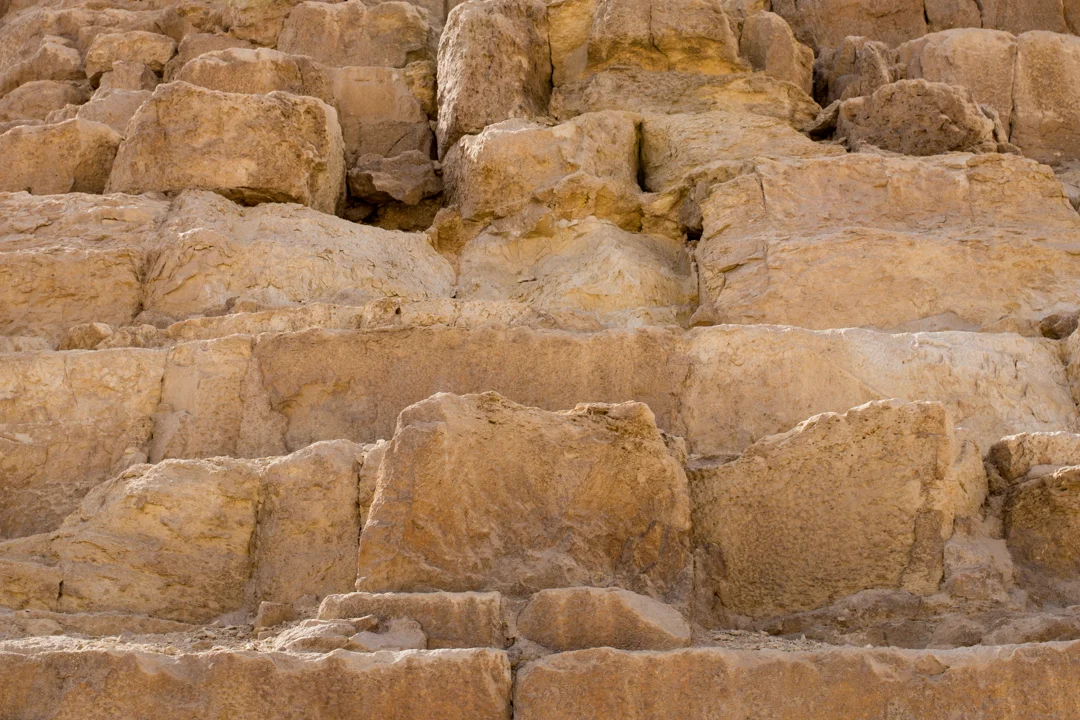
It’s a common misconception that slave laborers built the pyramids. The more than two-million blocks—used to build the Great Pyramid alone—were actually quarried and transported by tens of thousands of skilled (and paid) workers, whose village and tombs were discovered nearby. The limestone building blocks were cut from nearby quarries, the Tura limestone casing stones were quarried across the Nile and the granite used to build the interior chambers was transported from Aswan.

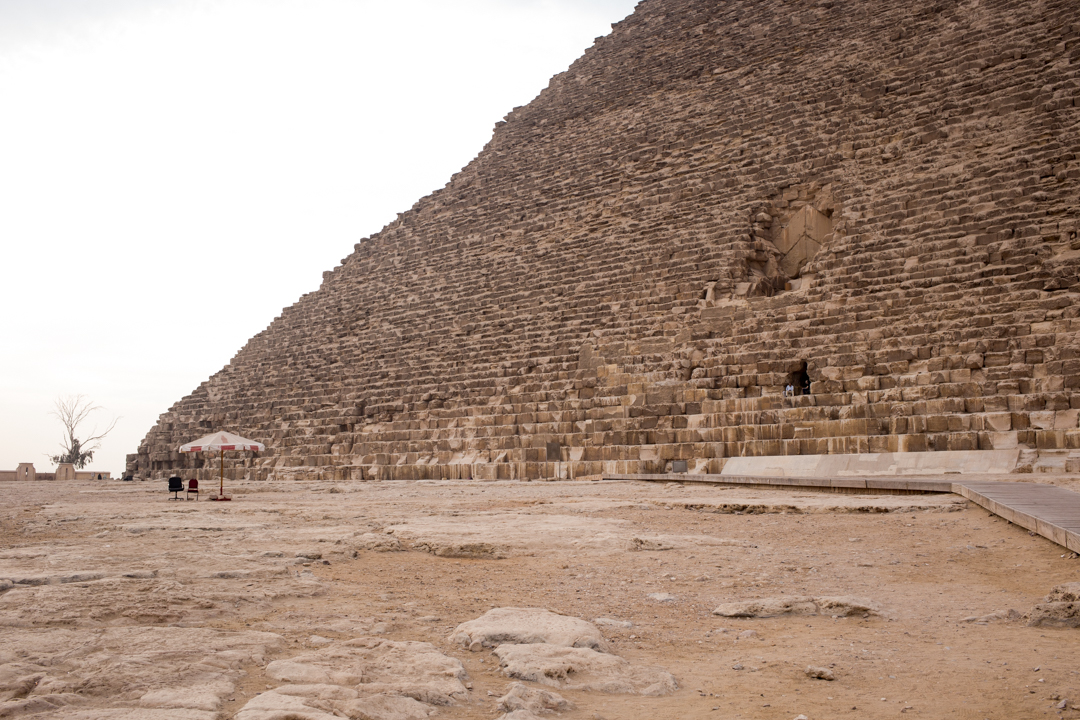
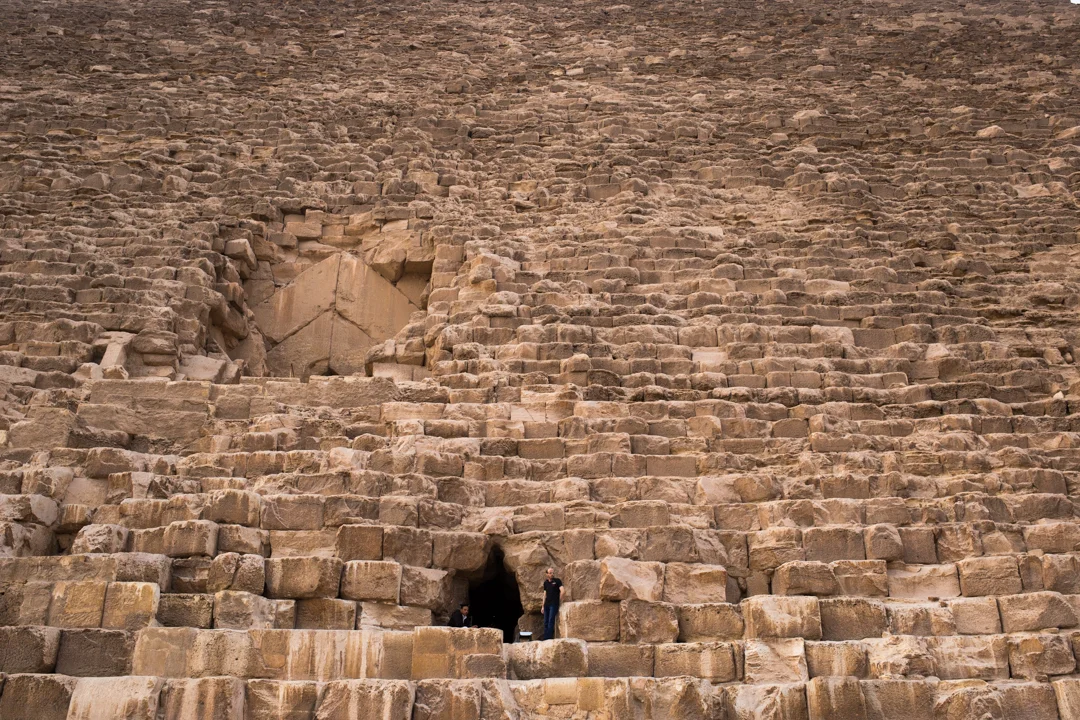

The Great Pyramid is the only of the three that you can currently enter, and it contains three known chambers. I actually entered the pyramid with the rest of our group, but had second thoughts when the corridors began to narrow, so I turned back. It’s impossibly hot and airless inside, and the low ceilings and tight spaces are a claustrophobic nightmare. The King’s Chamber and Queen’s Chamber are connected by the Grand Gallery, and from what I heard they are mostly empty and lack the colorful inscriptions of other tombs.

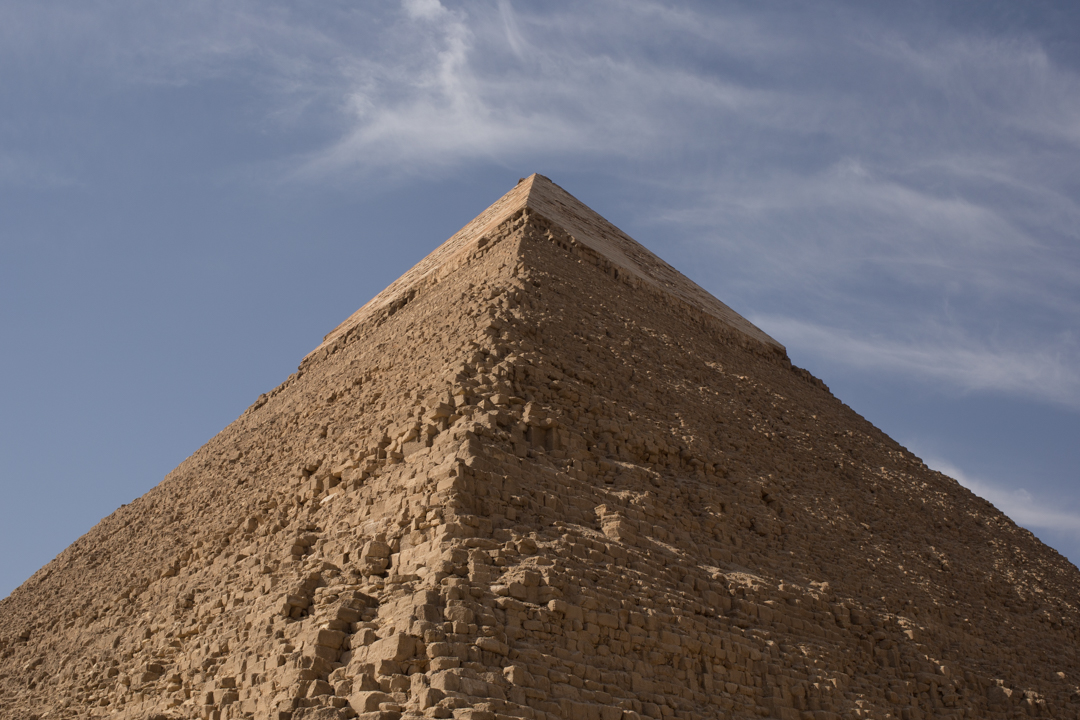


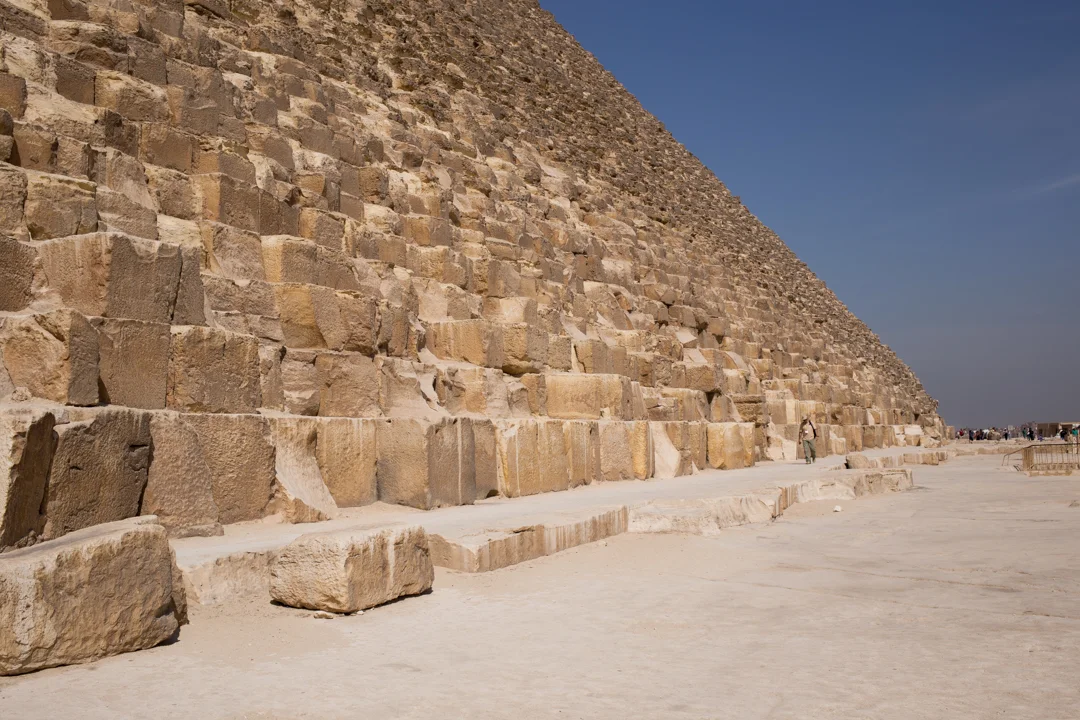
The second-largest pyramid, the Pyramid of Khafre, is my favorite of the three because it still contains portions of its original limestone casing stones. What an incredible sight it must have been to see all three pyramids as they were originally designed, polished and bright white, gleaming in the sun. The Pyramid of Khafre was originally 471 feet tall and now stands at 448 feet, but because it’s built on slightly higher ground, it looks to be about the same size as the Great Pyramid.
The third, and smallest pyramid is the Pyramid of Menkaure, son of Khafre and grandson of Khufu. Constructed in 2510 BCE, the 213-feet-tall pyramid would be impressive on its own but it is dwarfed by its two more famous neighbors.

The Giza Solar Boat museum was built in 1985 at the base of the Great Pyramid to house Khufu’s reconstructed solar ship. The ship was rediscovered in 1954 buried in a pit near the pyramids. It is one of the oldest, largest, and best-preserved ships from antiquity. Found in 1224 small pieces, the 143’ long, 19.5’ wide ship took years to reassemble.
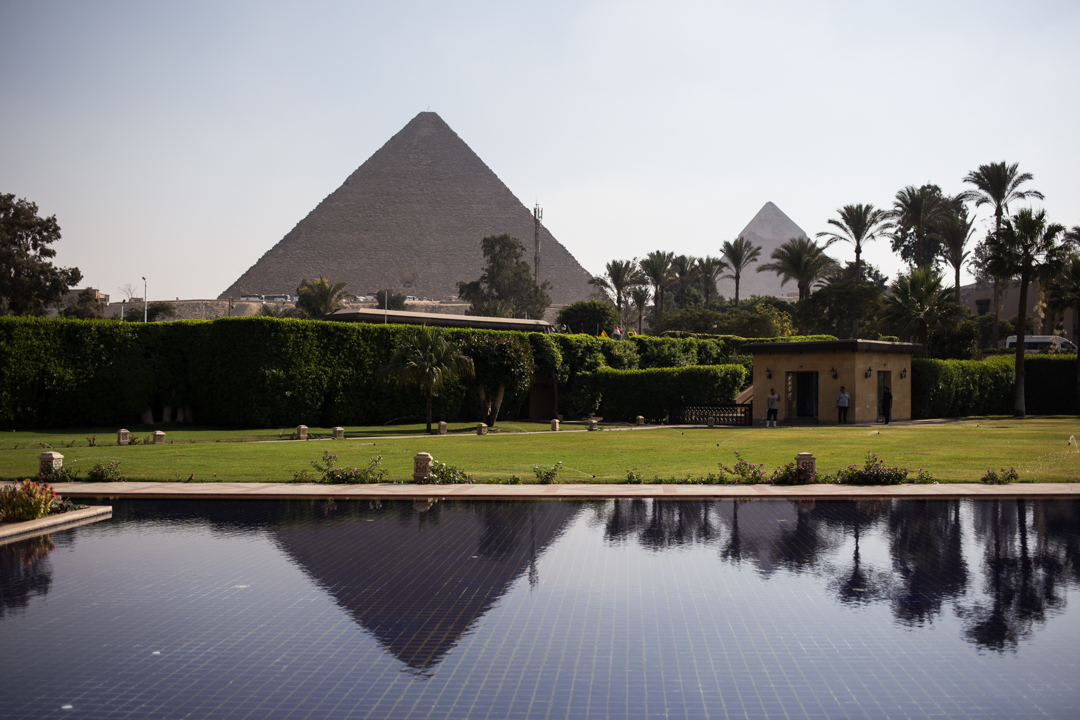

We were lucky enough to have special early-morning access to the Giza Plateau, and we basically had the entire complex to ourselves for a blissful hour before the hordes of tourists began arriving. On the last day of our trip, we stayed at the Mena House in Cairo, and even after all of the other magnificent temples and tombs we saw along the way, a view of the pyramids still managed to thrill. They are just so massive and otherworldly that photos will never be able to truly convey the feeling you get while standing in their great shadows.

Holbrook
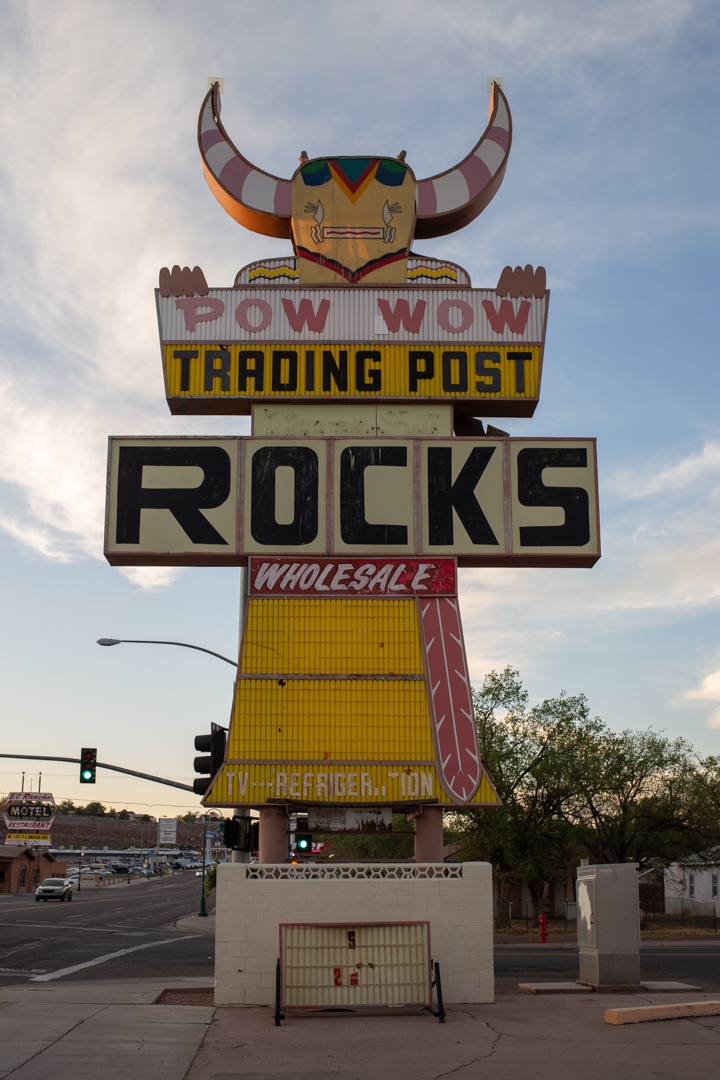
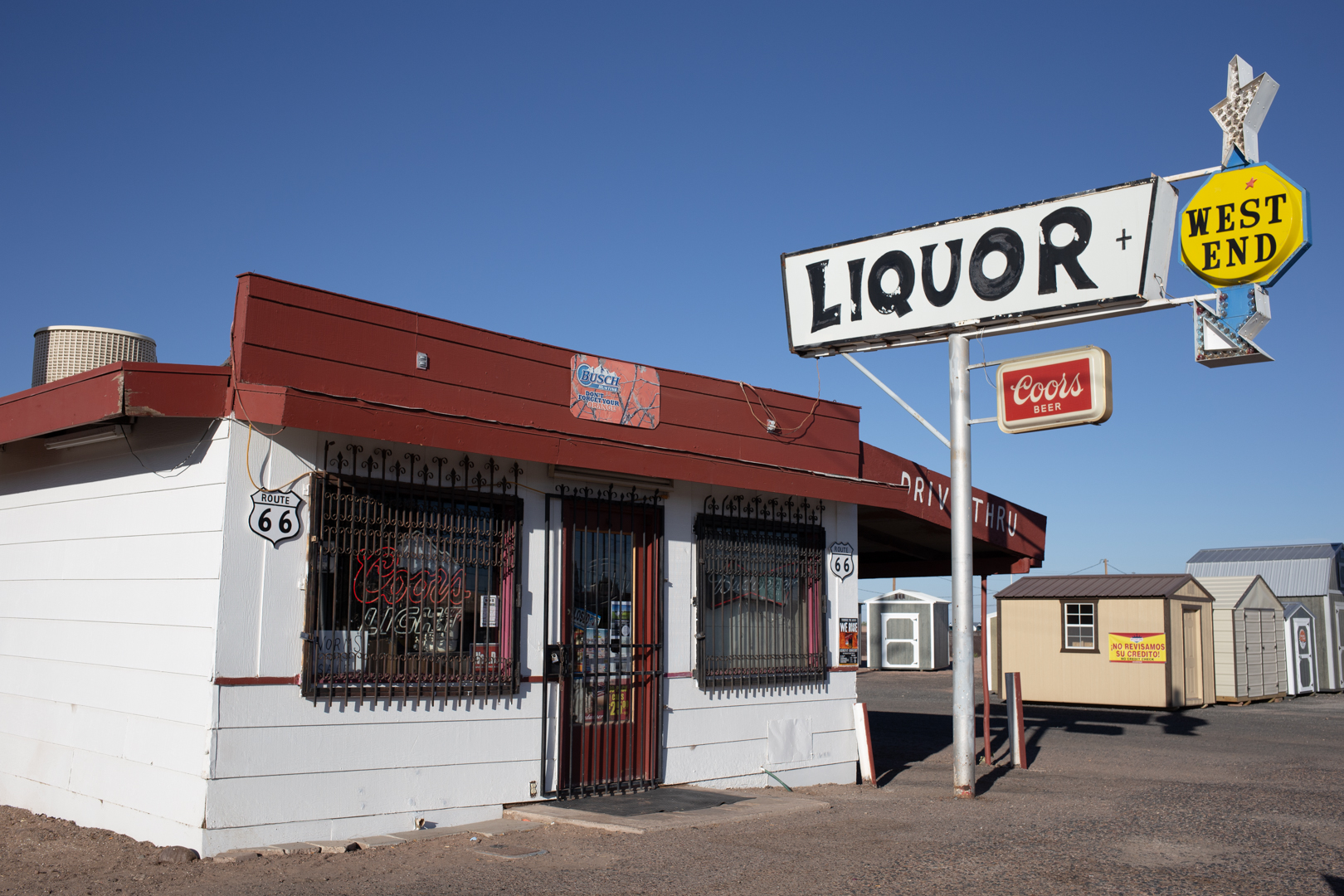
Picking a favorite town along any stretch of Route 66 would be like picking a favorite child, but Holbrook is definitely a strong contender. Not only is it home to one of the three remaining Wigwam Motels (and the last one I slept in), but it is full of fantastic signage, overcrowded souvenir shops and more kitsch per-square mile than any other place we stopped along the way from Flagstaff to Albuquerque.
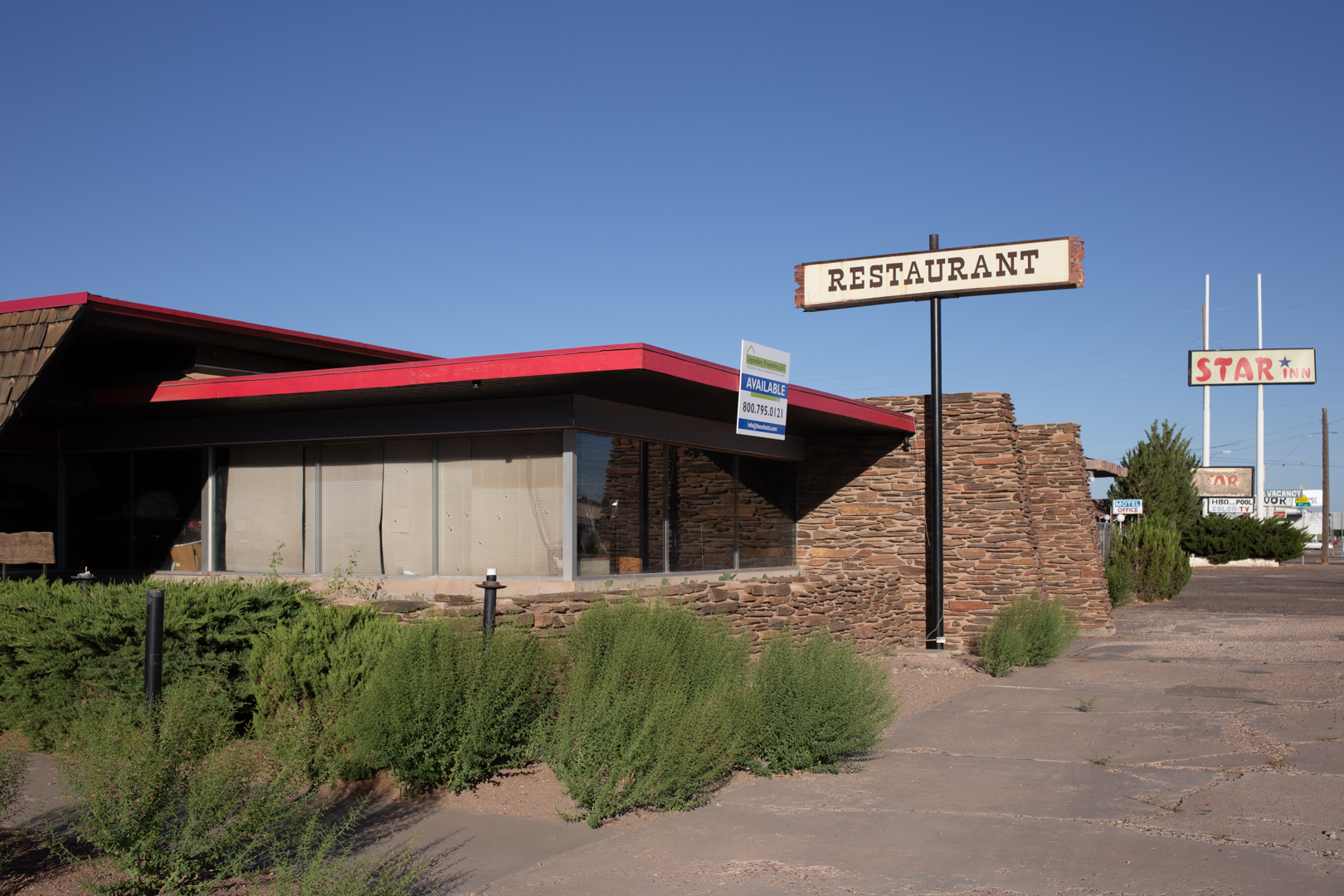
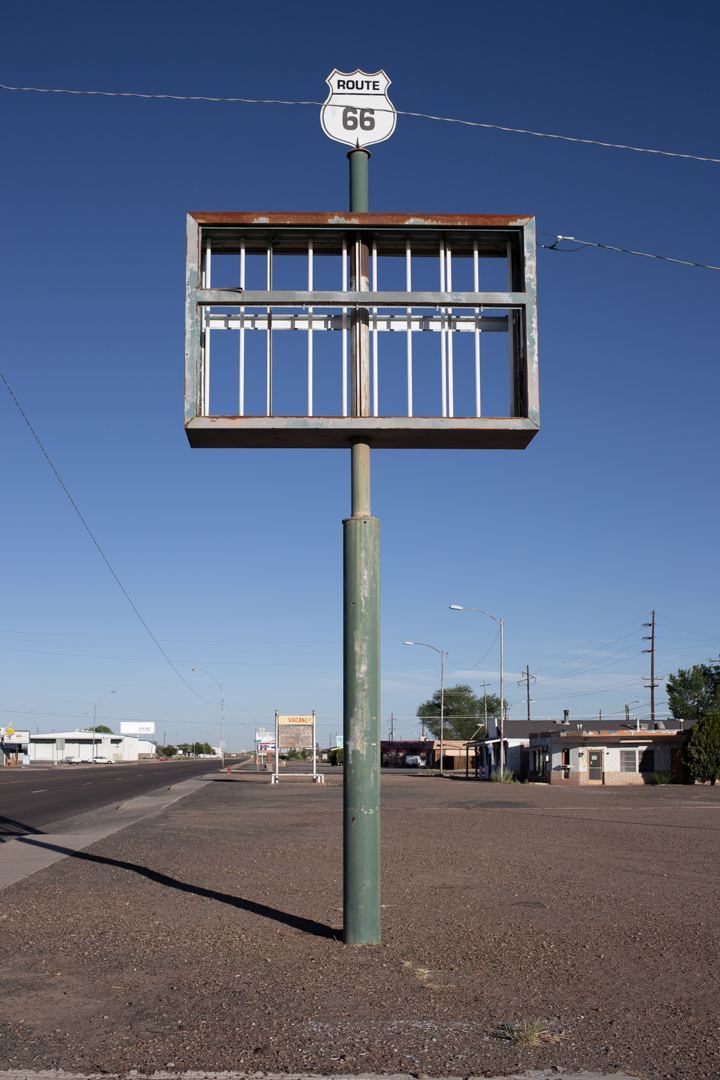


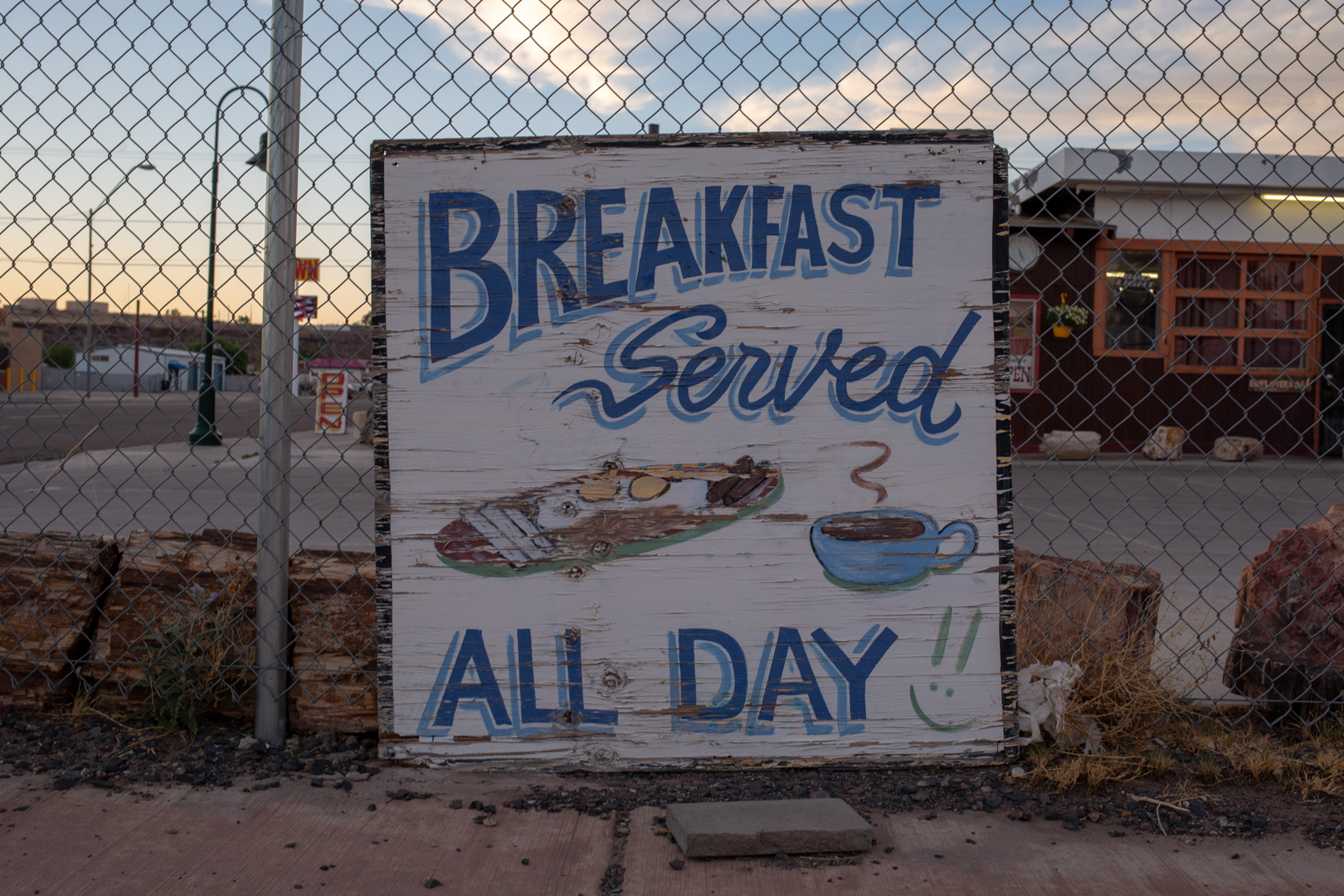
According to the 2010 census, the population of Holbrook was just over 5,000 people. Originally inhabited by the Anasazi, Puebloans, Navajo and Apache, the town was founded in the 1880s, and named after the first chief engineer of the Atlantic and Pacific Railroad. In July of 1912, a 419-pound chondrite meteorite exploded over Holbrook, showering the area with 16,000 fragments. The largest piece, weighing 14.5 pounds, is currently housed at Arizona State University in Tempe.


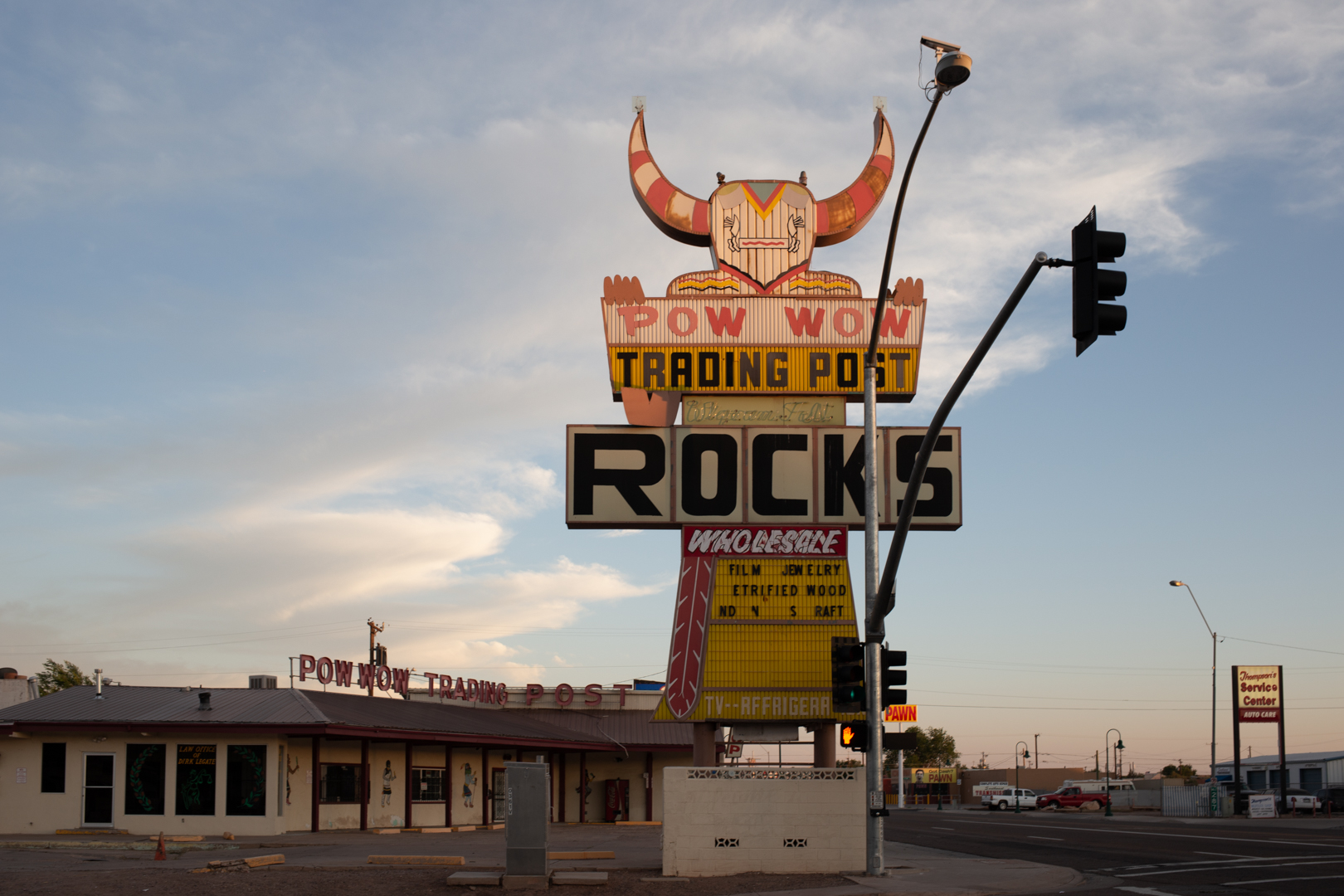

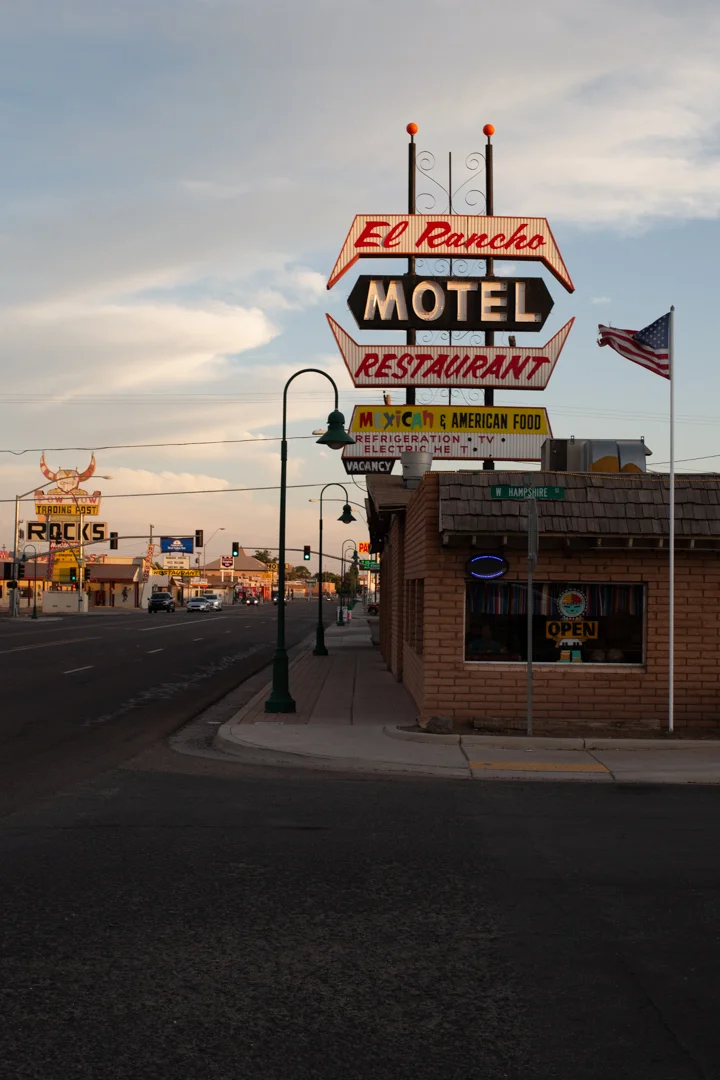


Route 66 was officially designated in 1926 and the Mother Road passed right through Holbrook and the nearby Petrified Forest National Park. Holbrook isn’t quite as iconic as Tucumcari and it doesn’t have an up-and-coming arts district or a burgeoning restaurant scene, but it’s full of charm and more than its fair share of roadside dinosaurs.




After checking into the Wigwam, JMP and I headed out to explore the tiny town and we weren’t disappointed with what we found. We ate dinner at the Mesa Restaurant, serving authentic Italian cuisine alongside seafood, steaks, ribs and burgers (all of which are advertised on a excellent neon sign). We explored as much as we could before the sun went down, and ended the night with a DQ blizzard, which we ate under another excellent sign while sitting across from the Holbrook cemetery.


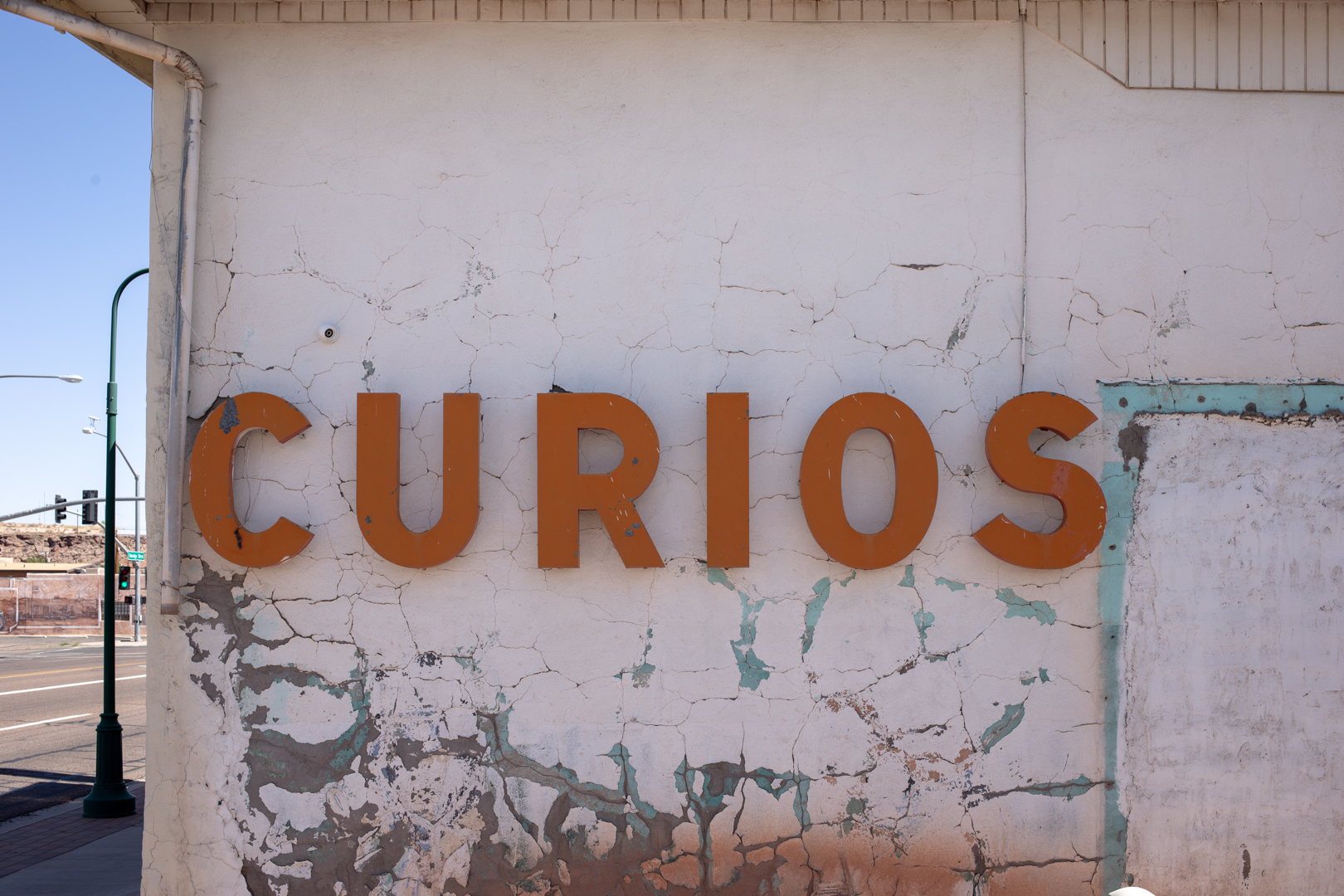

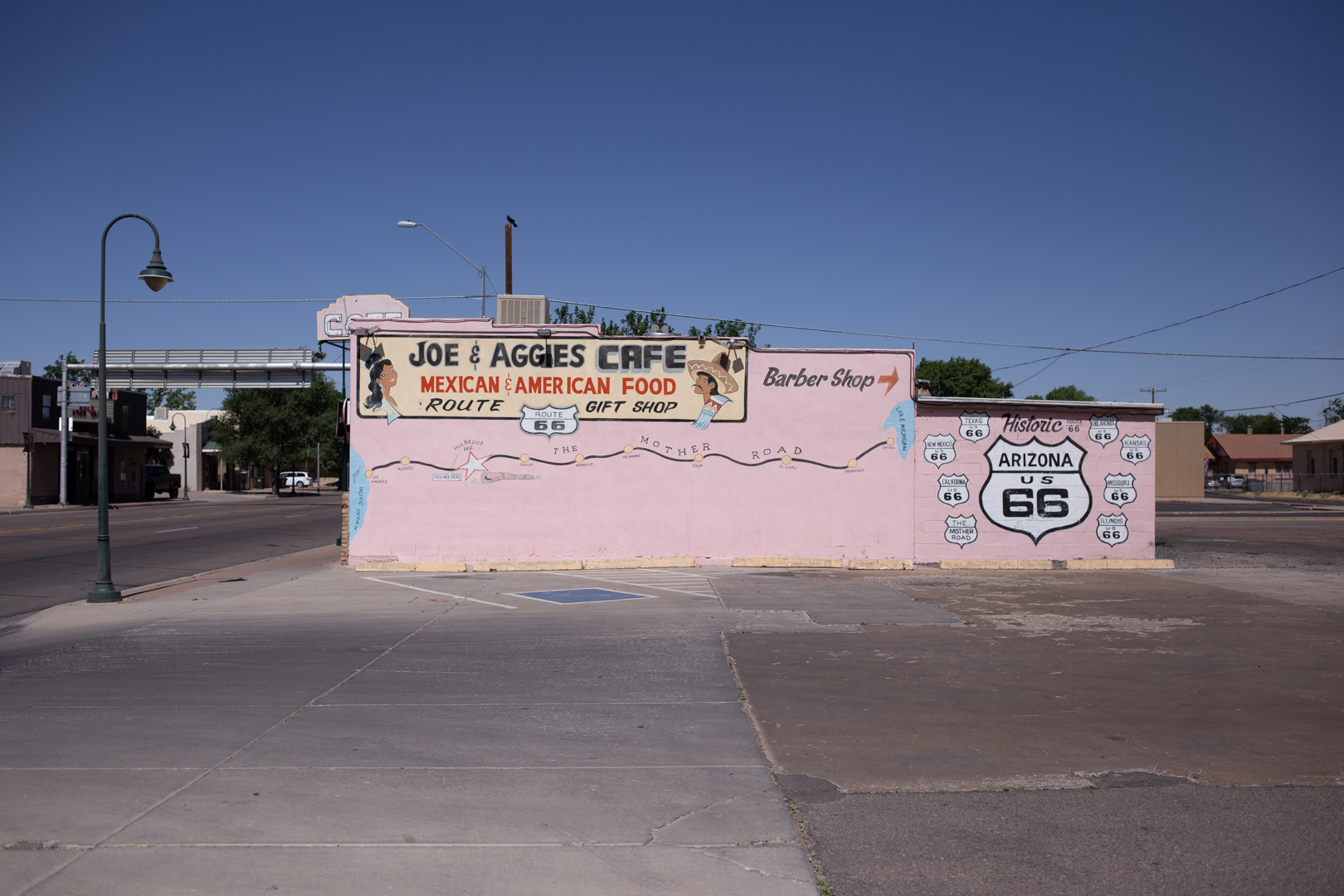
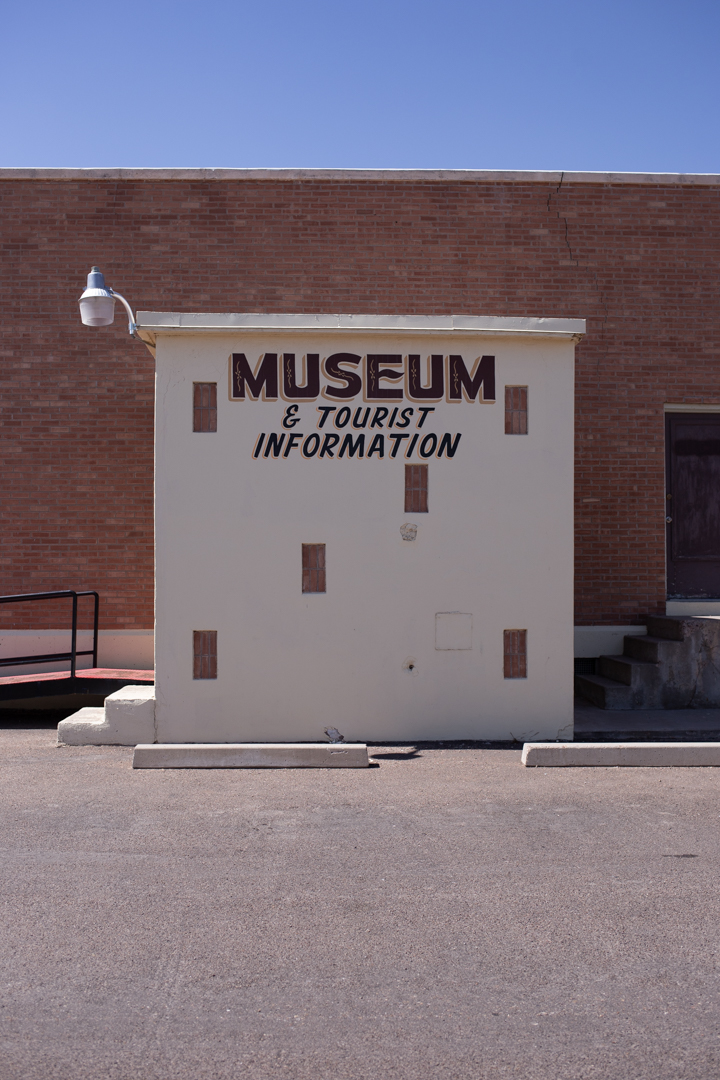
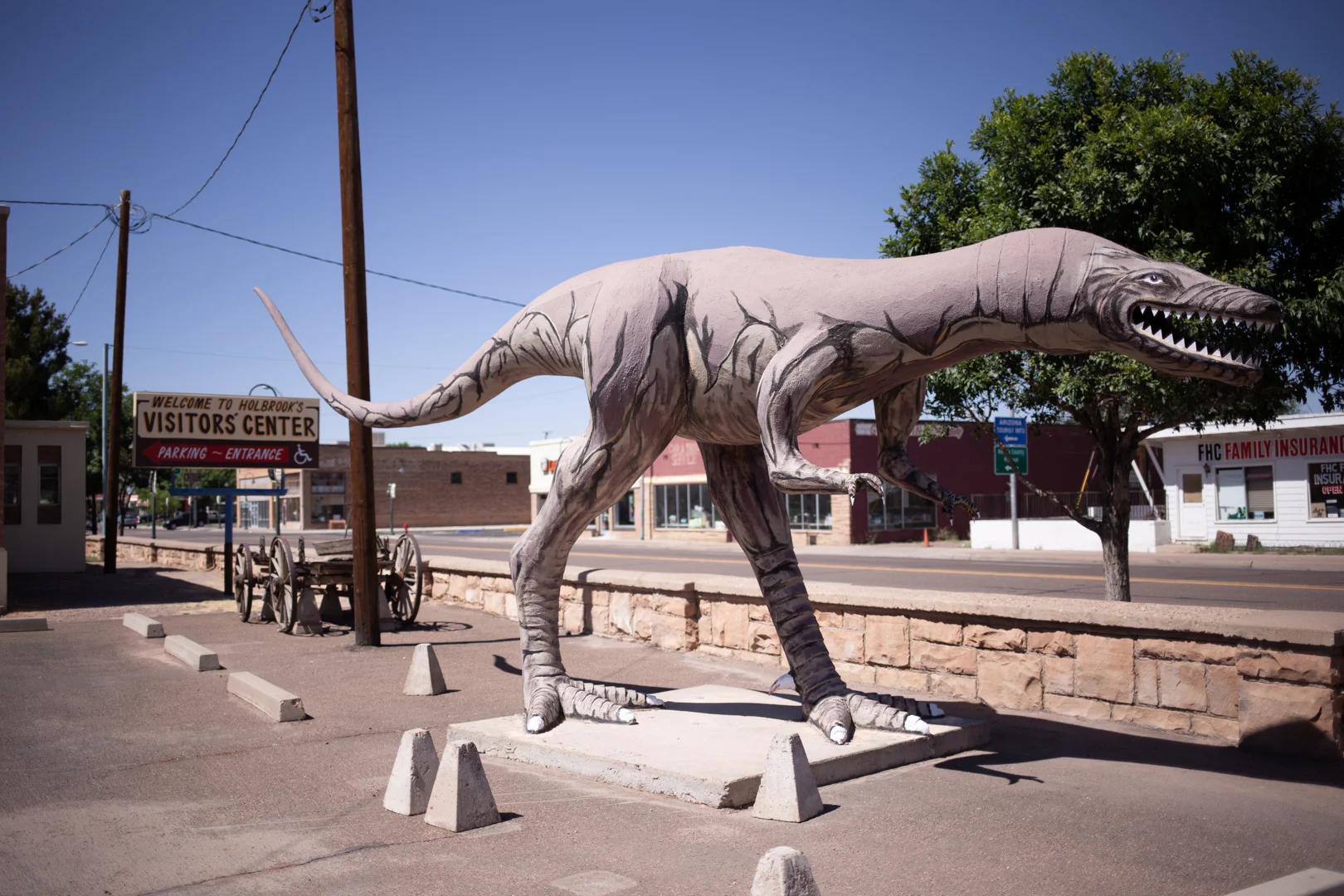


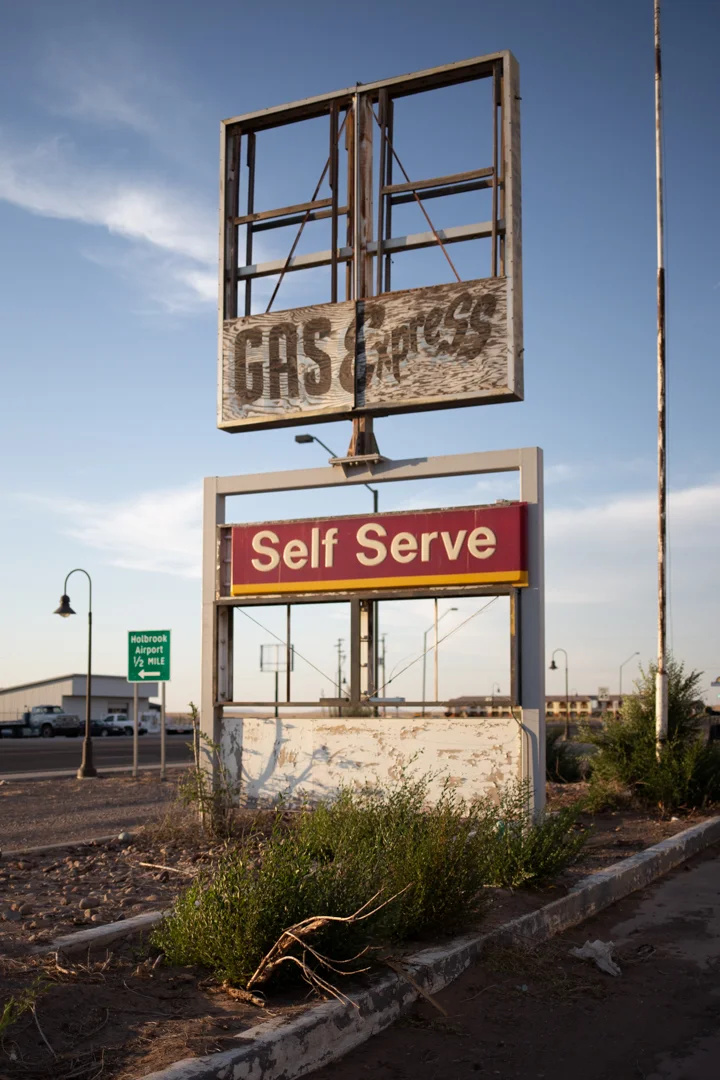
The next morning, while waiting for the Rainbow Rock Shop to open (which, it never did), we explored more of the town including several dinosaurs, abandoned motels and smaller rock shops. On the way out of town, I couldn’t not make a quick stop at Bucket of Blood Street, so named for a saloon that once stood nearby. In 1886, a gunfight erupted in the bar, resulting in so much carnage that “the floors were said to be slick with a ‘bucket of blood.’”

Happy Friday!
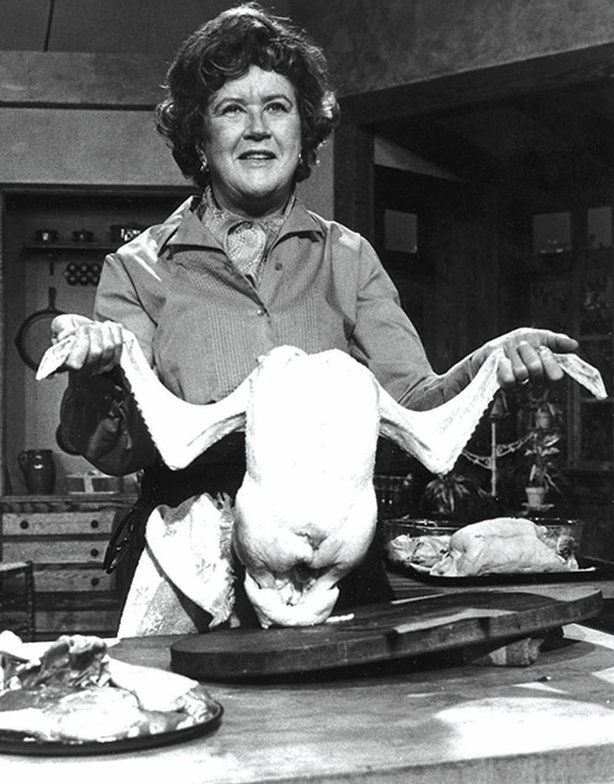
This time of year always makes me think of my life icon, Julia Child (Julie & Julia is available on Netflix and My Life in France is a must-read, as is the follow-up, The French Chef in America).
Things that happened recently:
Our toddler-in-chief has been a bad mood lately, and honestly it’s the first relatable thing about him.
Michelle Obama’s memoir, Becoming, was released this week, and everyone at Penguin Random House received a free copy so I’ve added it to my never-ending to-read list. This video of Ellen bothering Michelle while she signs books at a Costco made me LOL (“when they go low, we get high”).
I’ve finally gone full millennial and started eating avocado toast every morning (topped with Trader Joe’s magic Everything But the Bagel Seasoning) just in time for a drastic rise in the price of avocados.
Things to do in New York this week:
Get an early start on your Christmas shopping (I’m about half done already, no pressure) at the Renegade Craft Fair this weekend, held at the Metropolitan Pavilion on West 18th Street from 11am-5pm.
Maybe this will be the year I finally brave the children at the New York Hall of Science to see Gingerbread Lane, the Guinness World Records record-holder for largest gingerbread village, on display now until January 21st (so I have time).
Next week is Thanksgiving, which means that on Wednesday you can see the Macy’s Parade balloons as they’re inflated in the streets surrounding the American Museum of Natural History. I’ve gone twice (here are my photos from 2017 and 2016), and the lines are long but it’s very worth the wait.
Things I’ve discovered lately:
I was very happy about yesterday’s first snowfall, even more so since I have new boots and a new coat that I love.
I’ve been watching (and rewatching) a ton of movies lately including Carol (more devastating every single time I see it), Ghostbusters (the female version, so much better than it got credit for), The Miseducation of Cameron Post (basically Boy Erased, from a female perspective) and I’ve fully committed to a rewatch of the entire Ally McBeal series (I was so obsessed when it originally aired, that I taped every episode on VHS—luckily now it’s available to stream on Hulu). Anything else I should add to my watchlist?
Because you probably need it, here are some photos of a cat in a tiny jean jacket.
I have plans to go to my favorite Brooklyn diner, Tom’s Restaurant, on Saturday and it’s been far too long since I’ve had their divine Danish pancakes (with cinnamon butter!). My mom and I are going to hit up another diner in Yonkers on Sunday and I plan on exploring while she checks out the casino nearby. There’s no more snow in the near future forecast, but I’m always happy to take what I can get. I’m hoping the weather cooperates on Thanksgiving for the the parade, and afterward Francesca and I have plans for two dinners, like good, over-eating Americans (and of course, we’ll be dressed for the occasion). I hope you have a great weekend and enjoy your short workweek and holiday!

Canstruction 2018

I have always loved traditions, big or small. I love planning for the future and reflecting on the past, and traditions are reliable markers along the way. They give me something to look forward to each year, and are opportunities to compare where I am, with where I’ve been. The annual Canstruction competition may not seem like it would inspire sentimental feelings, but this was our fifth year attending and I’ve grown to appreciate this time of year and see the event as marking the transition from fall to winter.

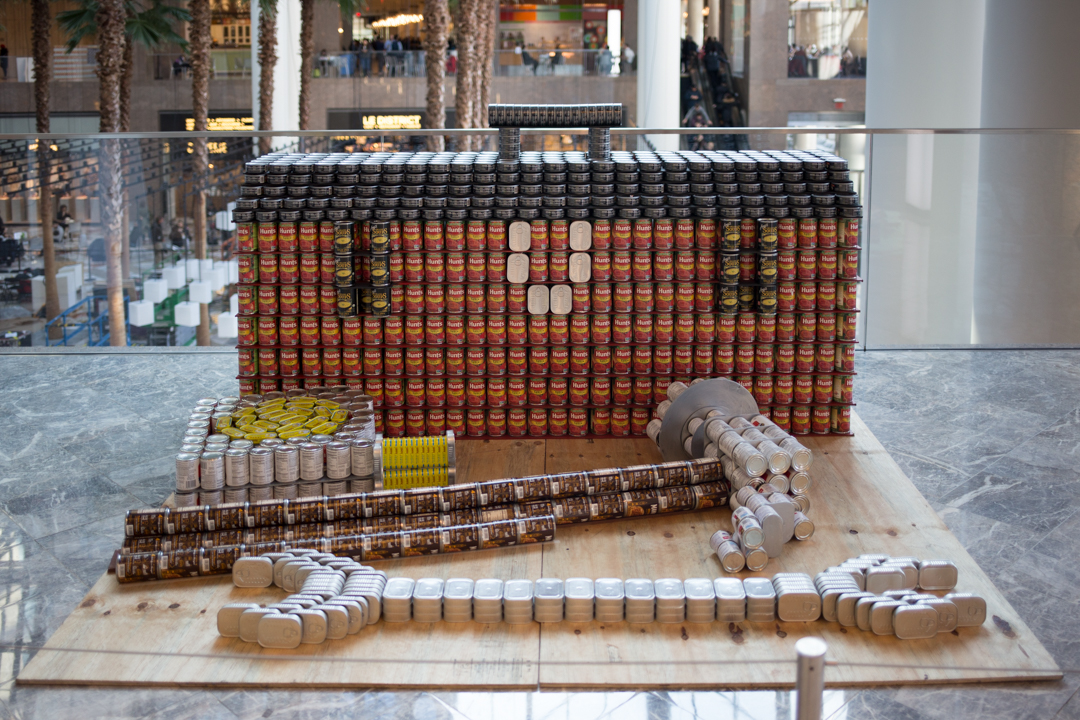

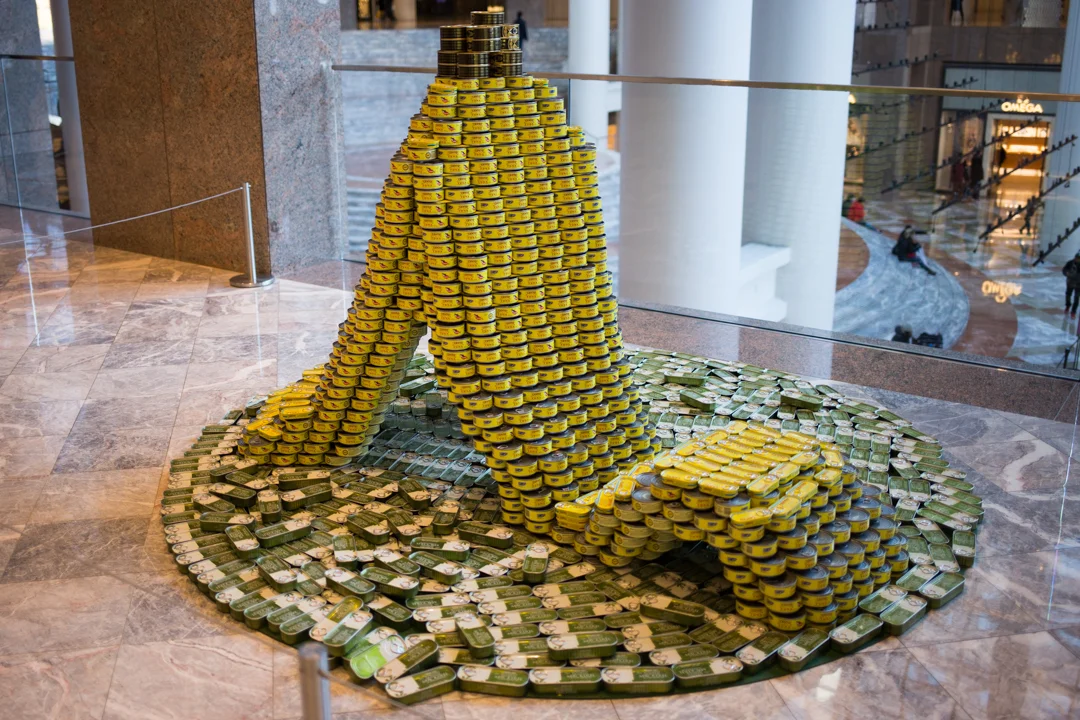
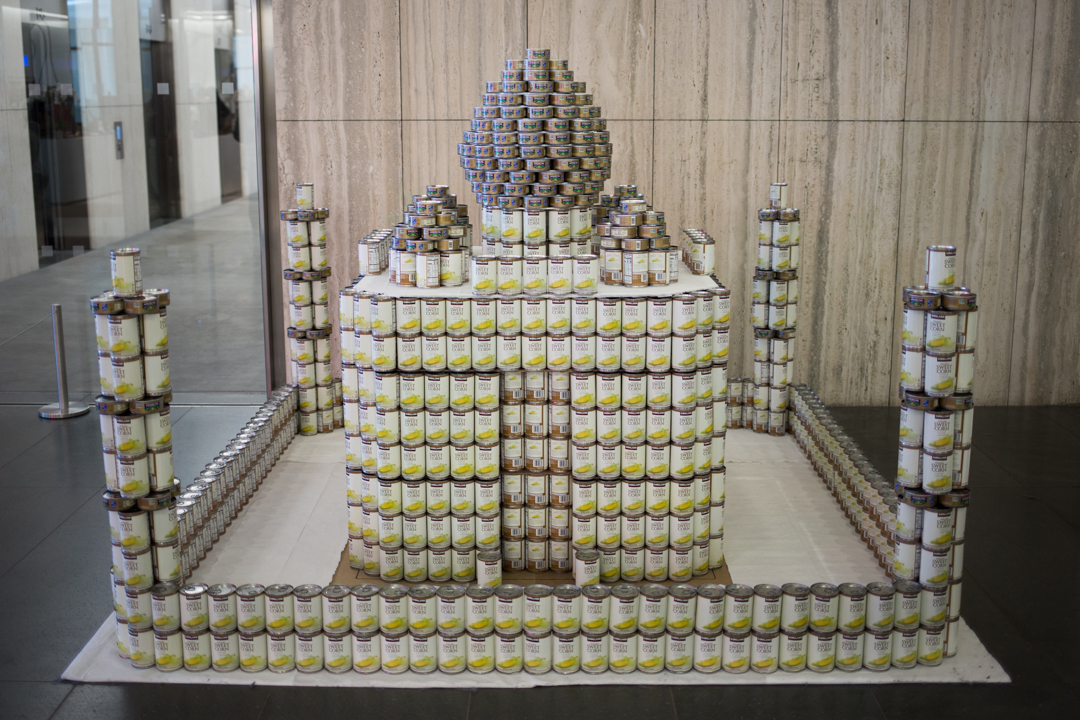

Every year, design industry professionals build sculptures made entirely out of full cans of food, which are then donated to local food banks. The sculptures are judged on local and international levels and there are junior and university-level competitions as well. Citywide chapters find teams, fundraise and find a suitable venue to exhibit the sculptures. Teams are responsible for purchasing their own canned food and Canstruction events have raised 70 million pounds of food to date.


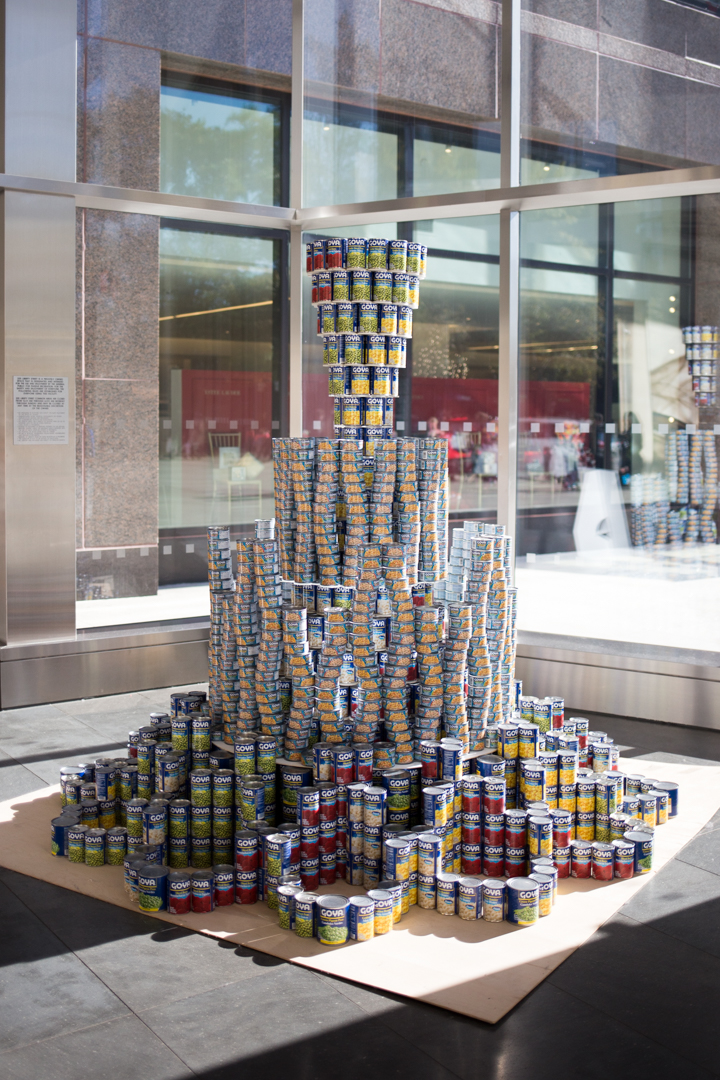
2018 is the 26th year for Canstruction, and more than 150 cities across North America and other countries hold competitions of their own. Sculptures can win in a number of different categories: structural ingenuity, best original design, best use of labels, best meal, people’s choice (vote here), and most cans used. NYC’s winner this year for most cans was the Grand CANyon which was built with 8,235 cans.


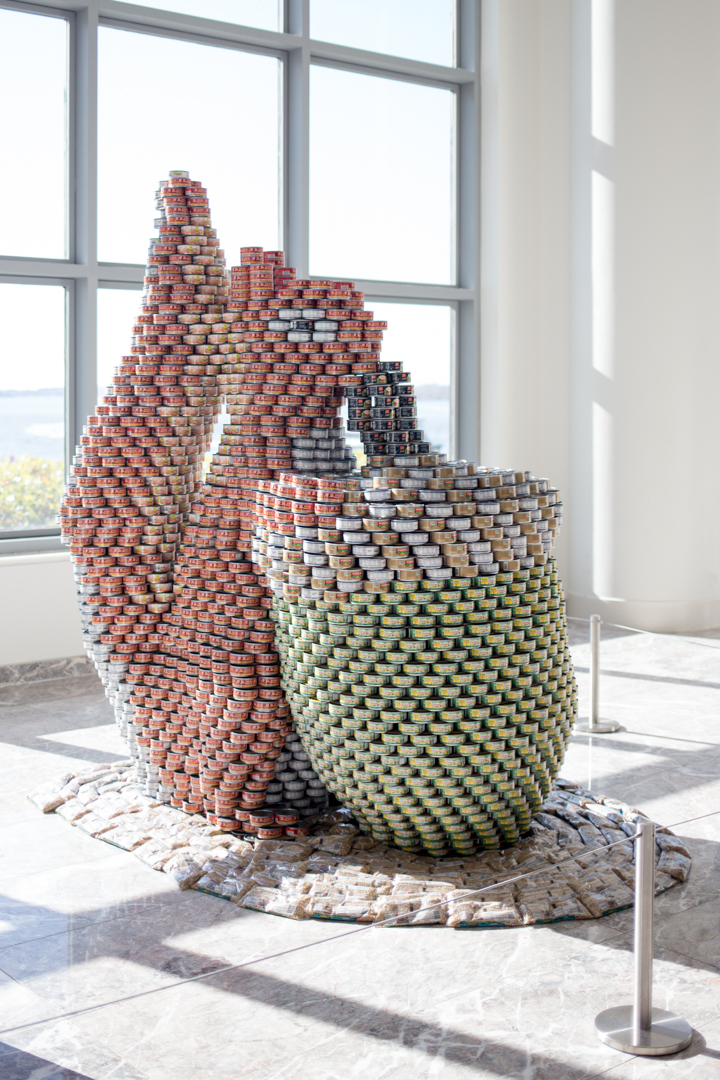


Every year my mom and I walk around the sculptures like they’re in a modern art museum, critiquing their creativity, complexity and overall impact as if we have any qualifications to do so. The past few years have been disappointing compared with the first year we went, but we both thought there were some real winners this year. I loved all of the animals—fox, squirrel(s) and orca especially—but my very favorites were the garden gnome and the two New York row houses.


Most of the time the sculpture’s inspiration is obvious, but sometimes the design is a bit abstract. We were surprised to see two squirrels and two timepieces this year, but somehow every year there is a whole new crop of 30 or so designs. Every sculpture is accompanied by a sign explaining the design and my favorite titles this year were “CANstruction Boot” and “Gnome More Hunger.”
From the top: Let’s OutFOX Hunger / CANstruction Boot / Tools To End Hunger / My Kingdom For a CAN / Peeling Away Hunger / CAN Mahal / Time’s Up For Hunger / Sitting in a Tin Can / Hunger is Snot Cool / Grand CANyon / Outrunning Hunger / Interweave / Let’s OutFOX Hunger / Make Hunger Irr-elephant / Squirrel Away For Winter / Tackling a Whale of a Problem / Ralph the Squirrel / Our Pride and Joy (wow they really missed the obvious AmeriCAN, huh?) / CAN-un-DRUM / No More Hungry Kiddos! / Time’s Up For Hunger / Please Keep Your CANS and Feet Inside the Ride / Gnome More Hunger / Evict Hunger!
Brookfield Place
230 Vesey Street
New York, NY
Canstruction 2018 sculptures will be dismantled 11/15 at 6pm.
The sculptures are exhibited each year for about two weeks in early November.

Recent Reads

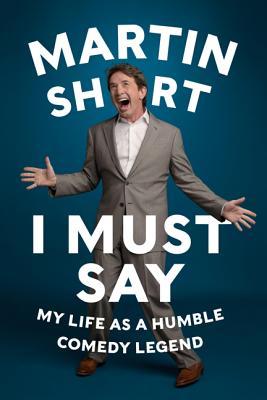
I Must Say: My Life as a Humble Comedy Legend, by Martin Short
I’ve loved Martin Short since I was a strange teen, at home watching late night reruns of Primetime Glick on Comedy Central while my friends were out partying. This summer I bought tickets to Martin Short and Steve Martin’s variety show, An Evening You Will Forget For the Rest of Your Life, and it was worth every penny. Martin Short is an underrated comedy legend and a National Treasure, and reading his hilarious and heartfelt memoir just reaffirmed my love for him. His positivity and humor in the wake of experiencing some real, visceral tragedies in his life is admirable and his interest in the absurdities of life is infectious. He endlessly name-drops celebrities, but instead of feeling obnoxious it just makes sense that so many people would want to bask in his light, myself included.
See What I Have Done, by Sarah Schmidt
I had high expectations for this book, a fictionalized retelling of the murders of Andrew and Abby Borden. It was helpful to be able to imagine the layout of the Borden house while I was reading, but the writing style was ultimately disappointing—unnecessarily wordy, overly descriptive and repetitive. I have a personal aversion to writers describing smells and Schmidt seemed to delight in trying to gross out the reader with her descriptions of body odors, rotting meat and strange tastes. Lizzie’s story is still intriguing more than a hundred years after the murders, but unfortunately there was nothing new or interesting about this version.
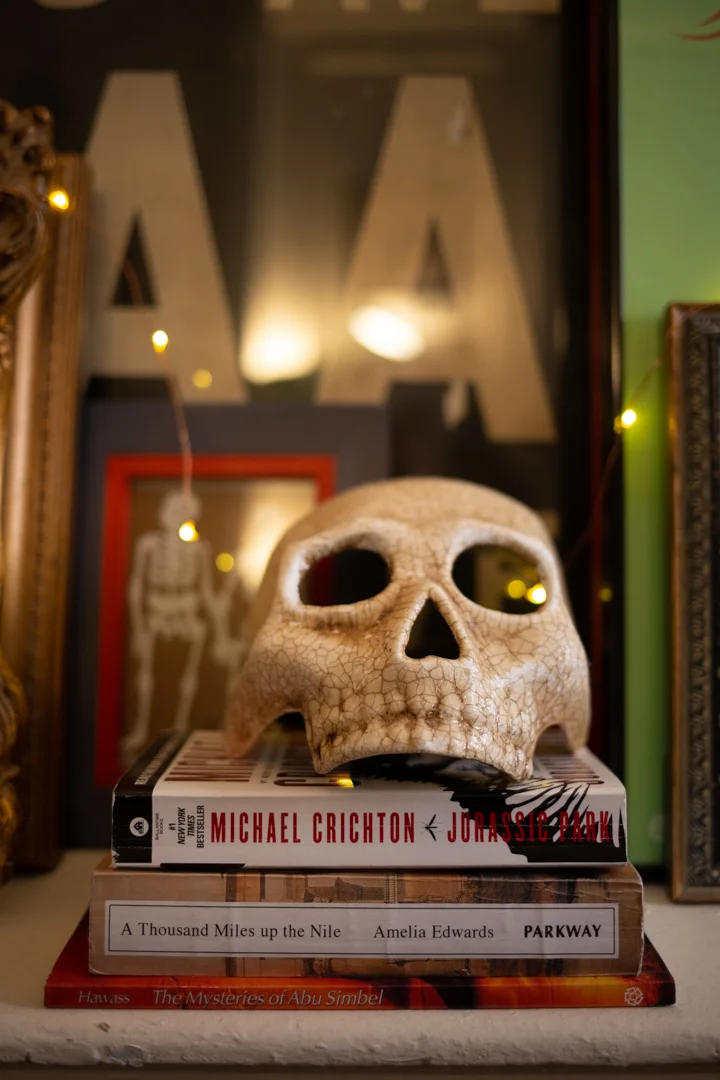
Jurassic Park: A Novel, by Michael Crichton
I took this book with me to Egypt, and it’s the perfect vacation read. I’ve been a huge fan of the movie ever since its 1993 release, and I finally treated myself to a copy of the book for my birthday. I usually prefer the book over its movie counterpart because books aren’t limited in the way that movies often are—however, in some cases (like Crazy Rich Asians) the movie manages to actually improve upon the source material. I think this was true of Jurassic Park, and while the book does differ from the movie in some significant ways, it had enough of the same characters and similar scenes to satisfy me.
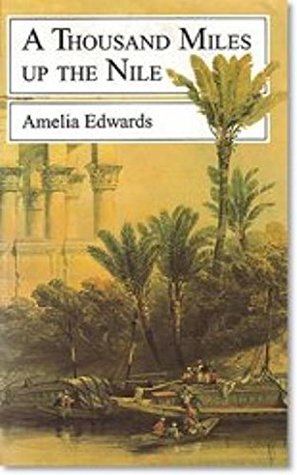
A Thousand Miles Up the Nile, By Amelia B. Edwards
My uncle recommended that I pick up a copy of this classic travelogue before we went to Egypt, but I couldn’t easily find a copy. When we walked into a bookstore in Aswan and I spotted it, I snatched it up and began reading it the next day. Amelia Edwards traveled through Egypt in the late 1800s, but many of her descriptions of temples, tombs and the Egyptian landscape could have been written just yesterday.
Despite my predilection for spoilers, I prefer to read about places after I’ve experienced them in person so I can have a mental picture of what is being described. Edwards certainly has a way with words and her observations on camels, crocodiles and Egyptian customs are laugh-out-loud funny and on most occasions mirrored my own. There is no better way to read A Thousand Miles Up the Nile than while actually cruising up the Nile with a wine glass in hand, but Edwards’s words have the power to transport you there, wherever you may be joining her from.
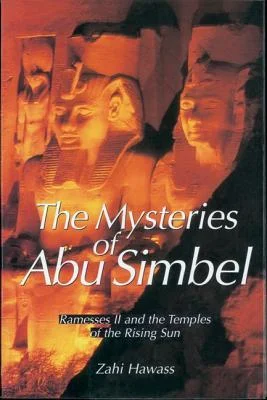
The Mysteries of Abu Simbel: Ramsses II and the Temple of the Rising Sun, by Zahi Hawass
My uncle sent this to me before our trip, but I brought it along to read in the days leading up to our visit of Abu Simbel. Dr. Zahi Hawass gave a few lectures during the course of our trip, so I couldn’t resist also getting him to sign my copy. It’s a quick read full of photos, but it was a good crash course on what I was about to witness in person. Egypt is full of incredible temples and monuments, but Abu Simbel is a true wonder amongst wonders.



Rainbow Rock Shop
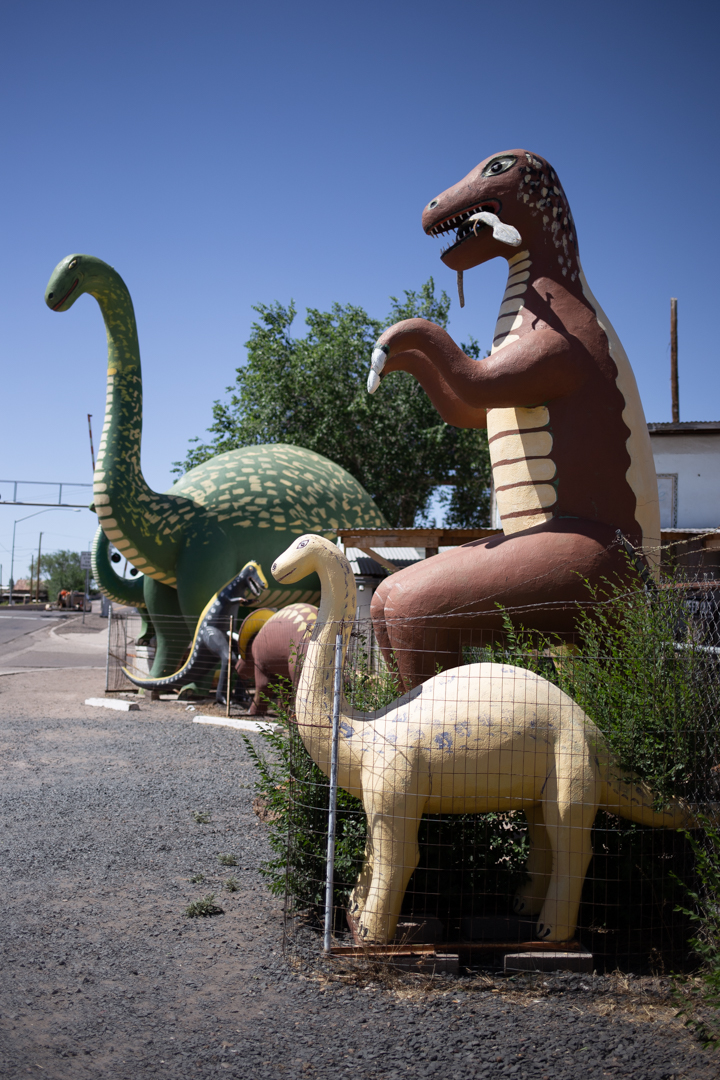
After checking out of the Wigwam, we stayed in Holbrook, Arizona specifically until 10 am to visit the Rainbow Rock Shop. Holbrook, a once-thriving stop along Route 66, has to have the largest dinosaur-to-people ratio of any town we stopped at on our trip along the Mother Road. The statues—made of various materials and styles—are scattered around town and each has its own unique story about how it ended up in Holbrook.




Holbrook is in an area of Arizona that is filled with fossils from the Triassic Period. Petrified Forest National Park, 25 miles northeast of Holbrook, contains the fossilized remains of terrestrial vegetation as well as the remains of dinosaur predecessors Phytosaurs and Allokotosaurs.

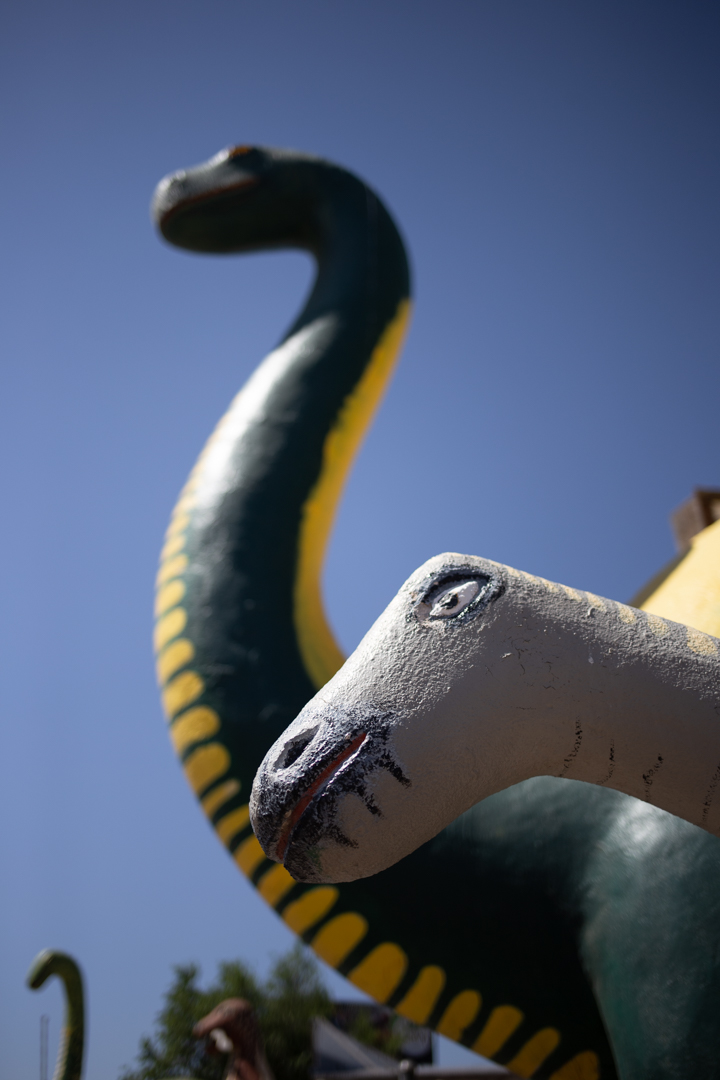
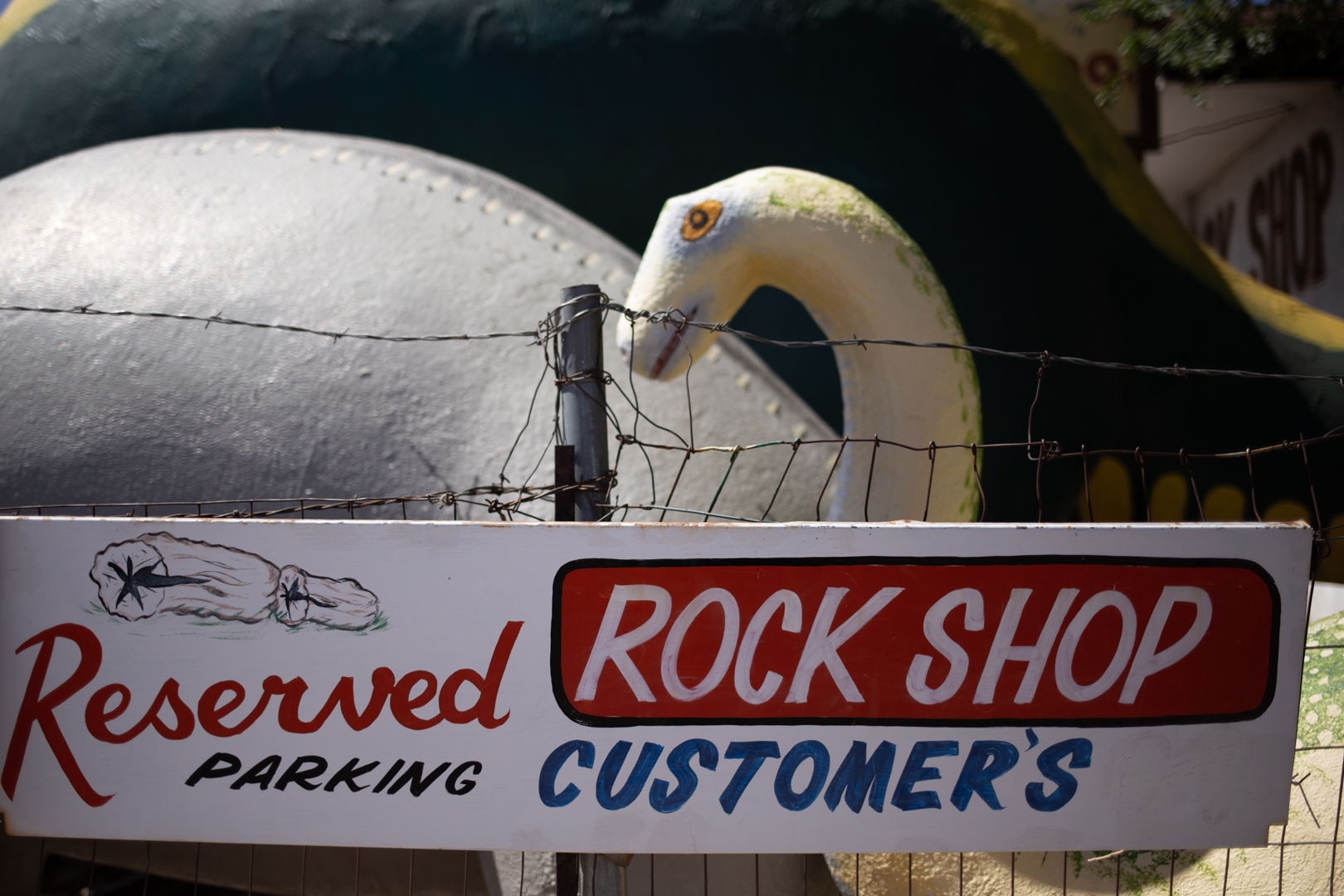

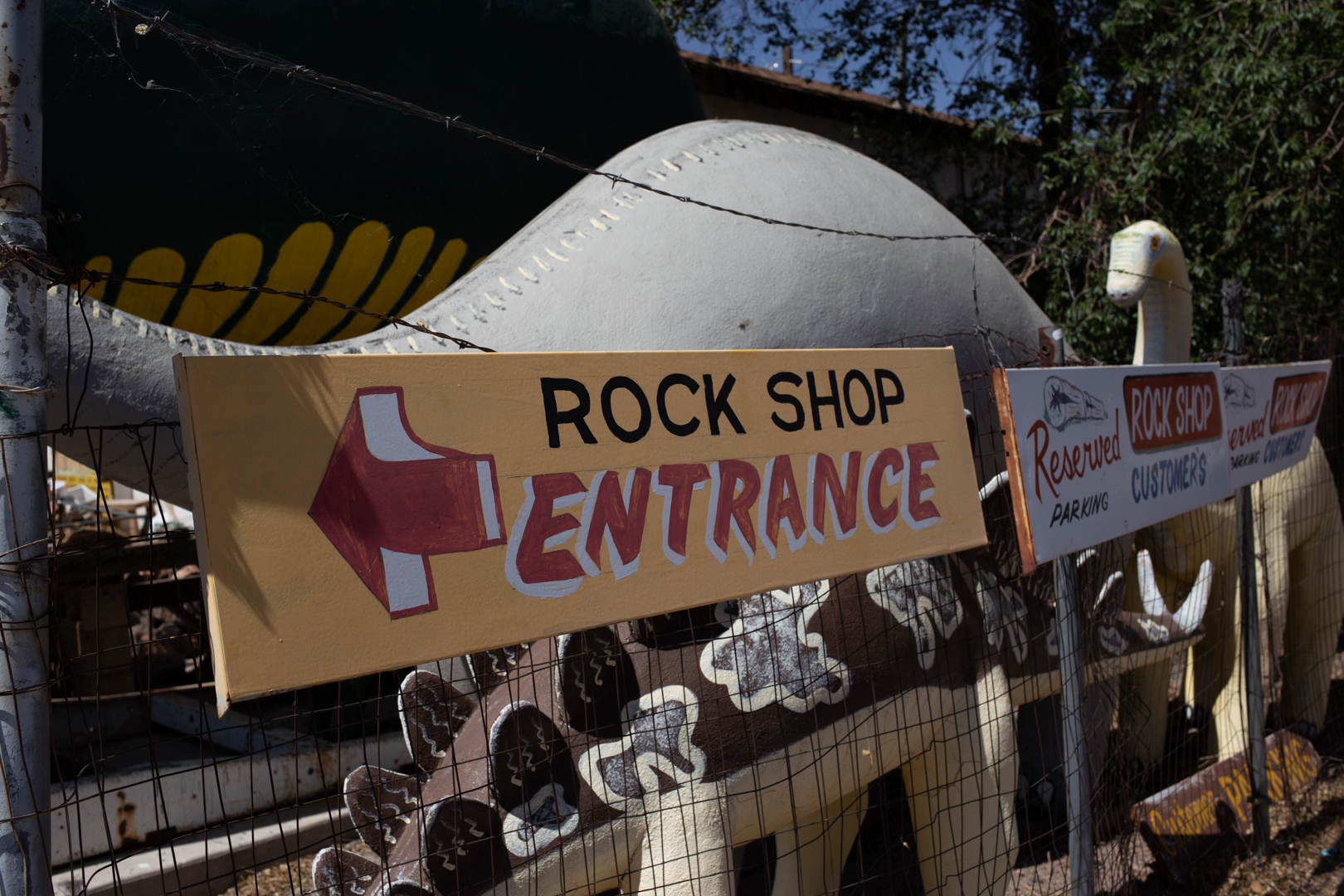
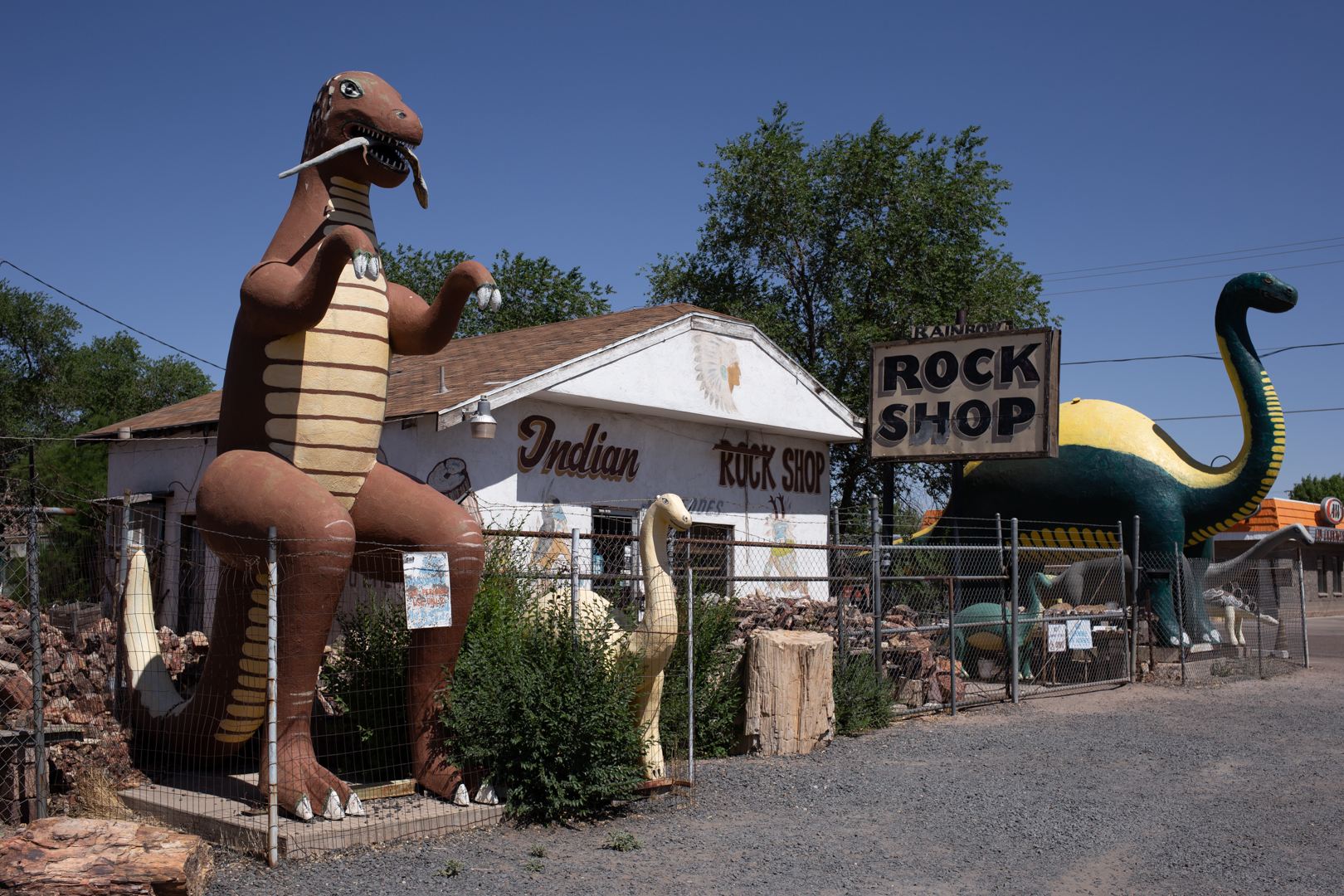
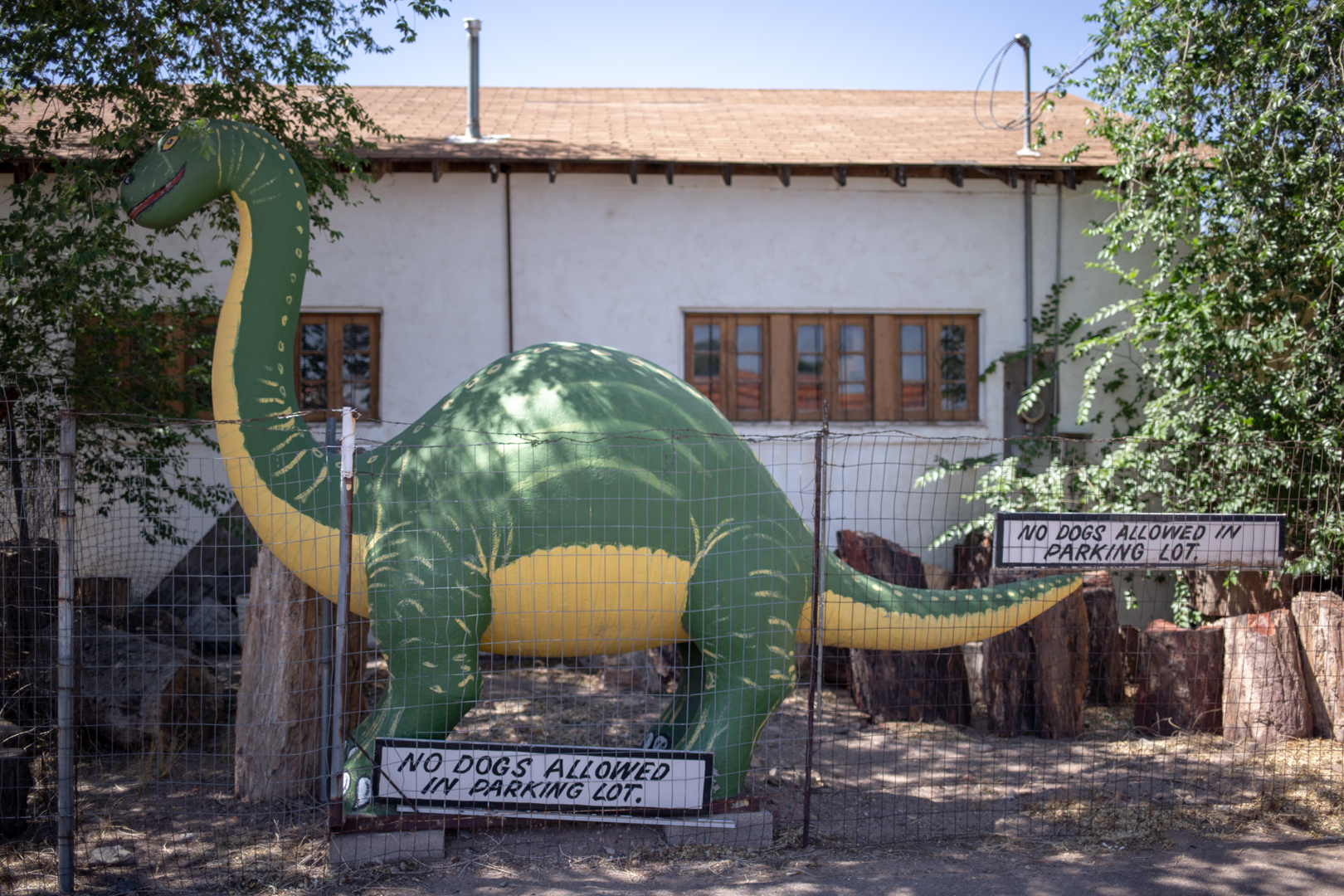
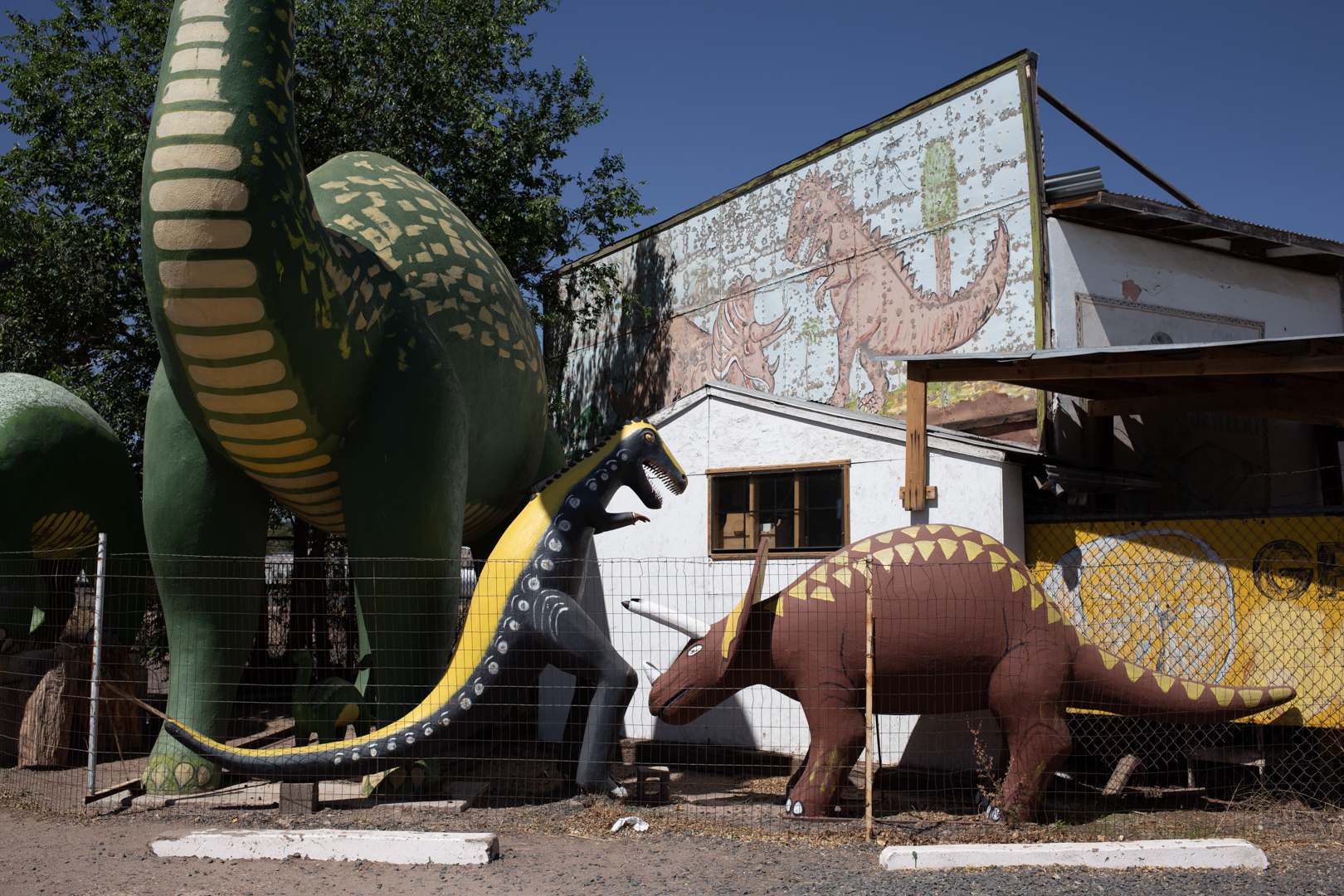
Located about a half mile east of the Wigwam Motel, the Rainbow Rock Shop is home to seven of Holbrook’s dinosaur statues. These concrete dinos were custom built by the owner over the course of twenty years, and they charge patrons to take photos with the prehistoric giants. I love their simple, cartoonish faces and they’re impossible to miss if you’re driving into, or out of, town.
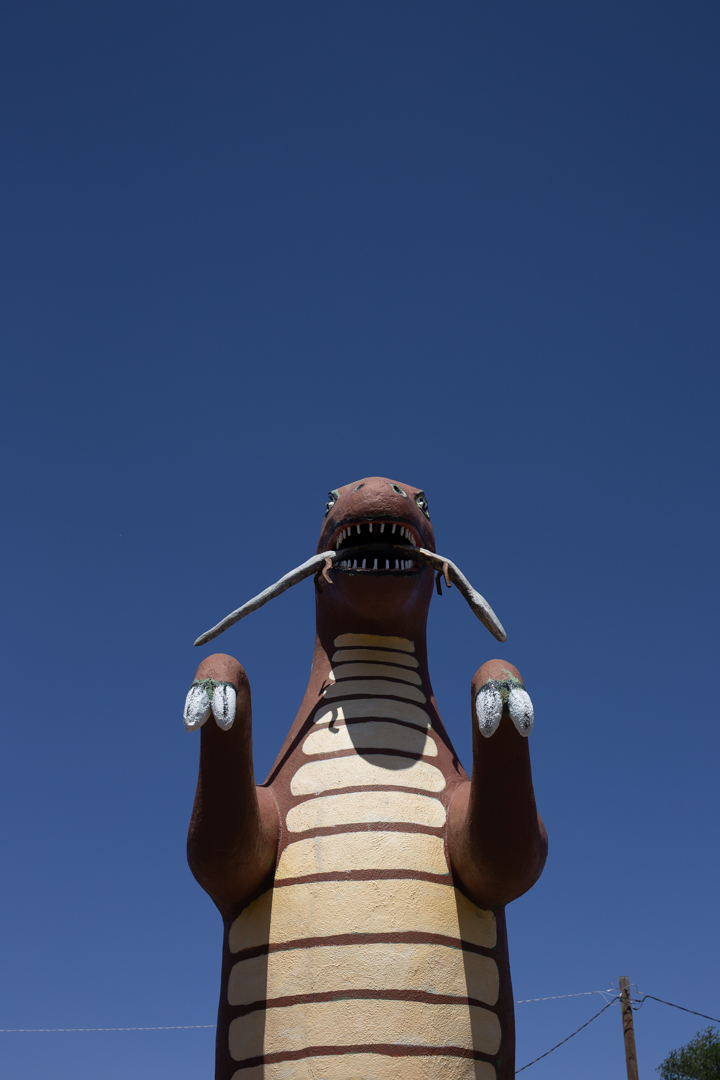


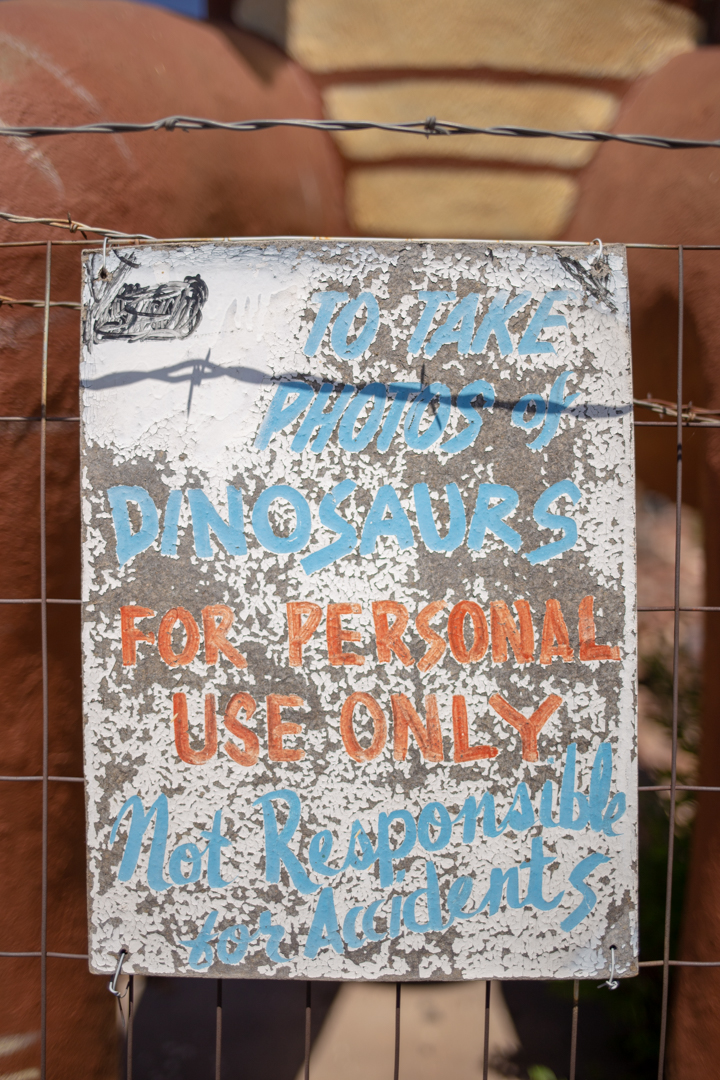


I should say that I’ve only read that the owners charge for photo ops, because we didn’t actually go inside of the Rainbow Rock Shop. We arrived promptly at 10 am to find the shop closed. I, meticulous road trip planner, somehow missed that they were closed on Sundays. Luckily, you can see the dinosaurs from the sidewalk and most of the shop by peeking through the chainlink fence.



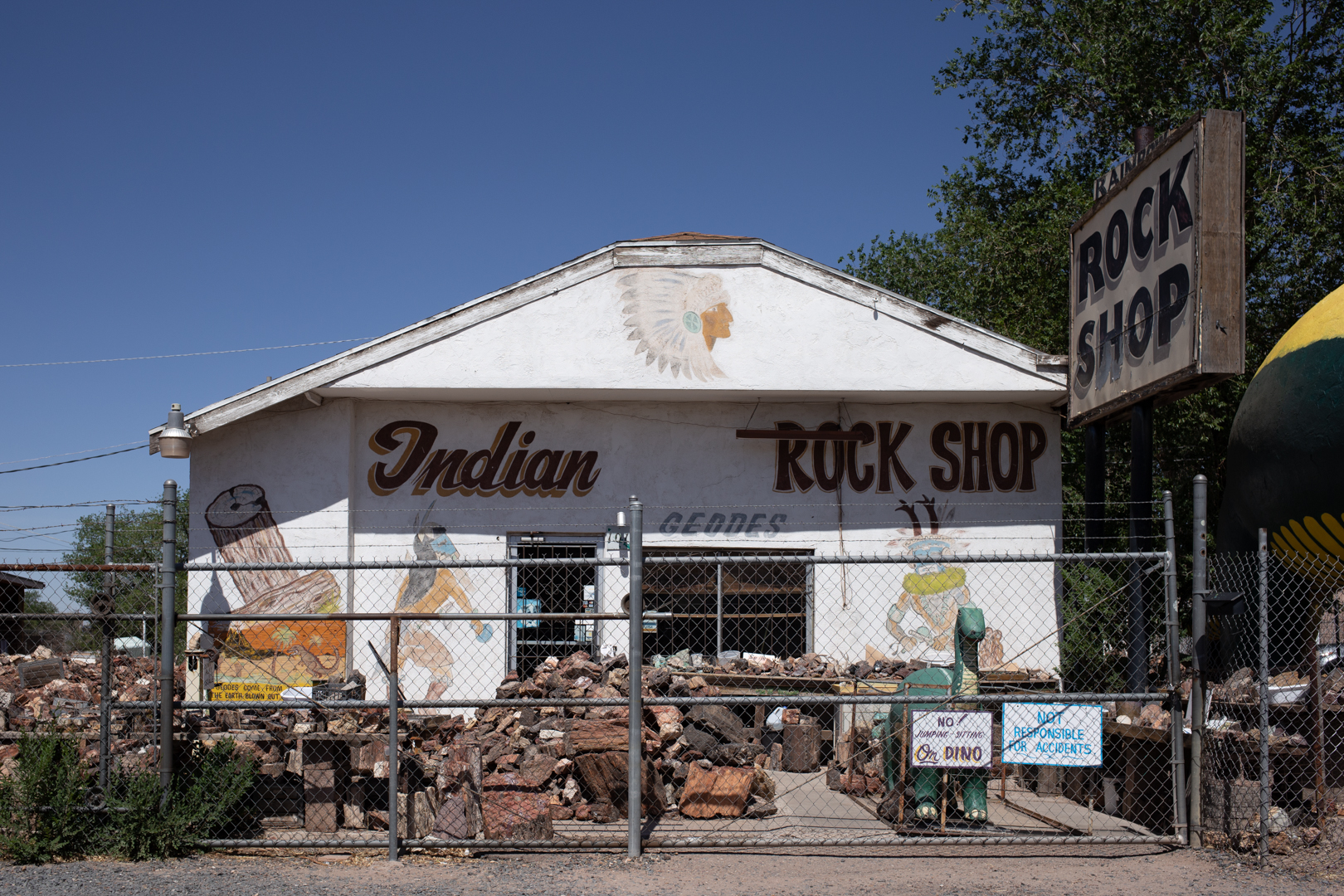

Rainbow Rock Shop is a souvenir shop that sells rocks, of course—Geodes each!—including petrified wood and other specialty rocks. I love the hand-painted signage, murals and low-tech, vintage vibe of the property. There is no shortage of options in the area to satisfy all of your specialty rock needs, but if you like to shop for your prehistoric souvenirs surrounded by roadside kitsch, the Rainbow Rock Shop is your place.
Rainbow Rock Shop
101 Navajo Blvd
Holbrook, AZ
Open 10 am - 4:15 pm (lol) every day but Sunday
Happy Friday!

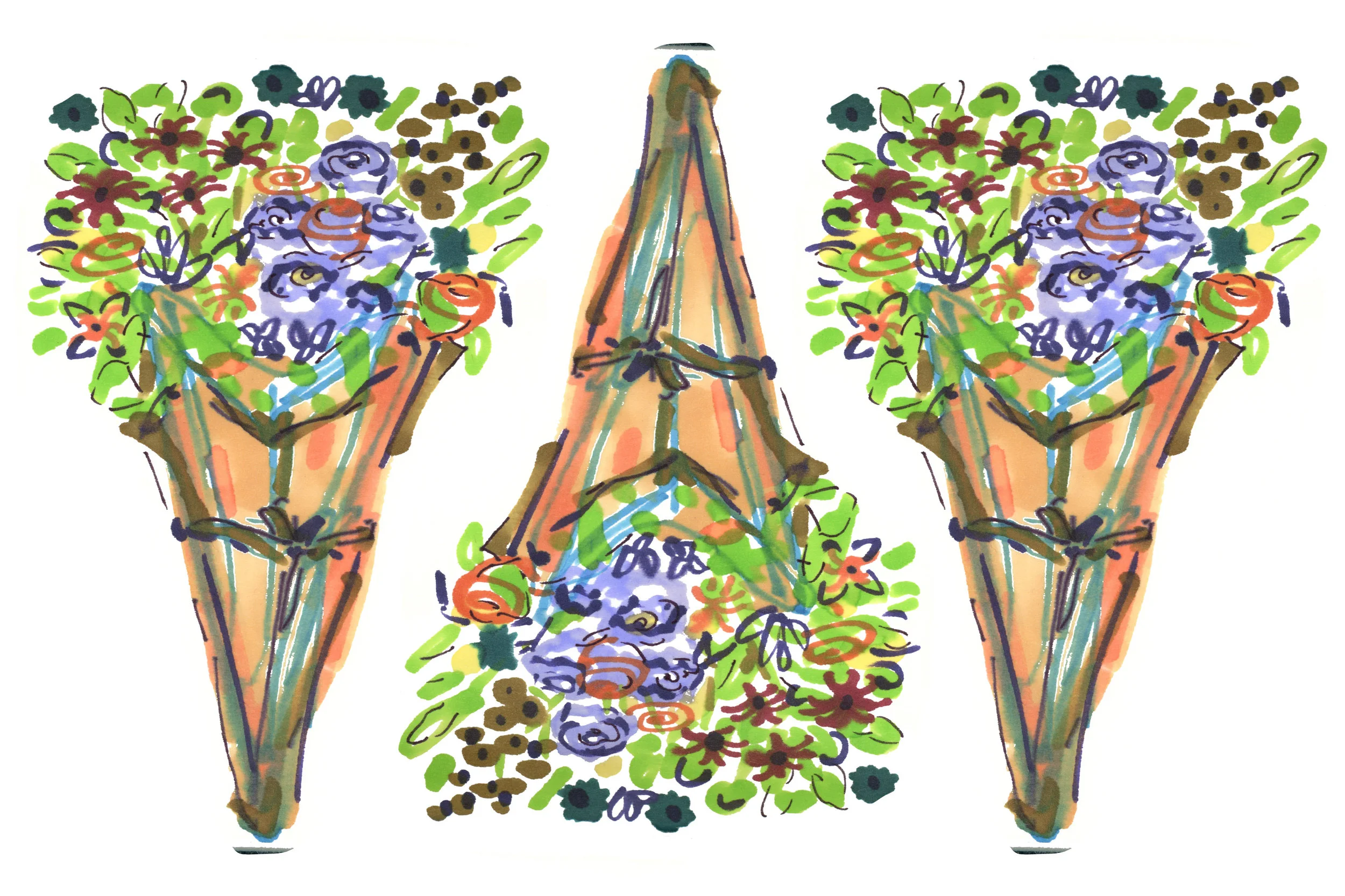
Bodega Flowers by Lindsey Frances
Things that happened recently:
We still have a sentient bag of excrement as our President, but at least there were some notable gains from the midterm elections on Tuesday. Jefferson Beauregard Sessions III is on his way back to his hollowed-out tree stump, Trump’s replacement definitely violates the Constitution, and beloved hero RBG is literally crumbling along with our democracy.
Men are still the actual worst, but I would probably still vote for one in 2020.
In what is probably too obvious of a metaphor for our current times, The Hall of Fame for Great Americans (in the Bronx) is in serious need of repairs.
Things to do in New York this week:
Saturday night a friend and I are going to see David Cross at BAM and then to the Trump Dump: American Tantrum Book Tour with The President Show’s brilliant Anthony Atamanuik at the Bell House—tickets for both shows are still available.
Bring your Halloween pumpkins and gourds to a Pumpkin Smash event this weekend, and turn your old jack o’lantern into compost for city parks and green spaces. Times and locations for all five boroughs can be found here.
The first major American retrospective of Andy Warhol in thirty years opens Monday (to the public) at the Whitney Museum of American Art (where I once saw Leonardo DiCaprio).
Things I’ve discovered recently:
Diets most definitely do not work, and we should all be intuitively eating.
Speaking of food, I just finished this book and it made happy that we no longer live in the age of embalmed milk and slimy military meats, but we still have a long way to go.
For years slipping bra straps were the bane of my existence but I just bought three new racer back bras and I wish I hadn’t wasted so much of my life fishing around for fallen straps.
I was excused from jury duty after just two days, which was a relief despite my lifelong eagerness to be selected for a case (be careful what you wish for!). I’m happy to be able to savor my last few weeks in my own office before we move uptown—and into cubicles—at the beginning of the new year. The weather lately has been absolutely perfect and despite the time change, I love this time of year (I once read an entire book about Daylight Saving time and I still don’t understand it). I’m looking forward to our comedy double header on Saturday night, and my mom and I have plans for diner breakfast before we check out this year’s Canstruction contest (our fifth time going!). I’ve decided to work my way through the Meryl catalog again this winter, and I’ve already rewatched Out of Africa (now I want to reread the book) and the underrated Plenty—I have Silkwood queued up next. Have a great weekend!
The most fantastic thing about the New York Botanical Garden’s annual Orchid Show is the orchids themselves