
Archive
- Abandoned
- Alabama
- Arizona
- Bahamas
- Books
- California
- Cemetery
- Climate
- Colombia
- Connecticut
- Diner
- Egypt
- Feature
- Florida
- Friday Fun
- Georgia
- Holidays
- Illinois
- Iowa
- Italy
- Kentucky
- Louisiana
- Maryland
- Massachusetts
- Mississippi
- New Jersey
- New Mexico
- New York
- North Carolina
- Novelty Architecture
- Ohio
- Pennsylvania
- Personal
- Peru
- Project 365
- Protest
- Rhode Island
- Roadside Attraction
- South Carolina
- Tennessee
- Texas
- Travel Guide
- Virginia
- Walks
- Washington DC
- West Virginia
- Wisconsin

Winslow, Arizona
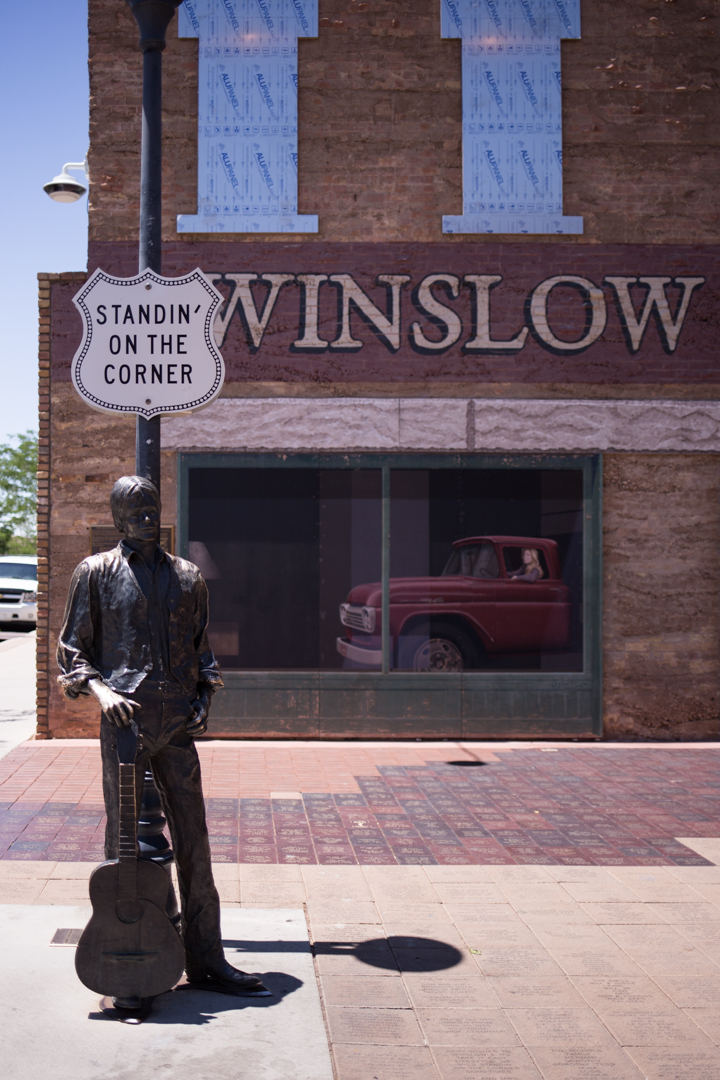
Winslow, Arizona is a town along old Route 66, east of Flagstaff, Twin Arrows, Two Guns and the Meteor City Trading Post. It’s about 20 minutes west of the Jack Rabbit Trading Post, 30 minutes west of Holbrook and 60 miles from the Petrified Forest National Park. Winslow wasn’t on my radar before our Route 66 trip back in June, but we had time before we had to check into the Wigwam Motel so we decided to stop.
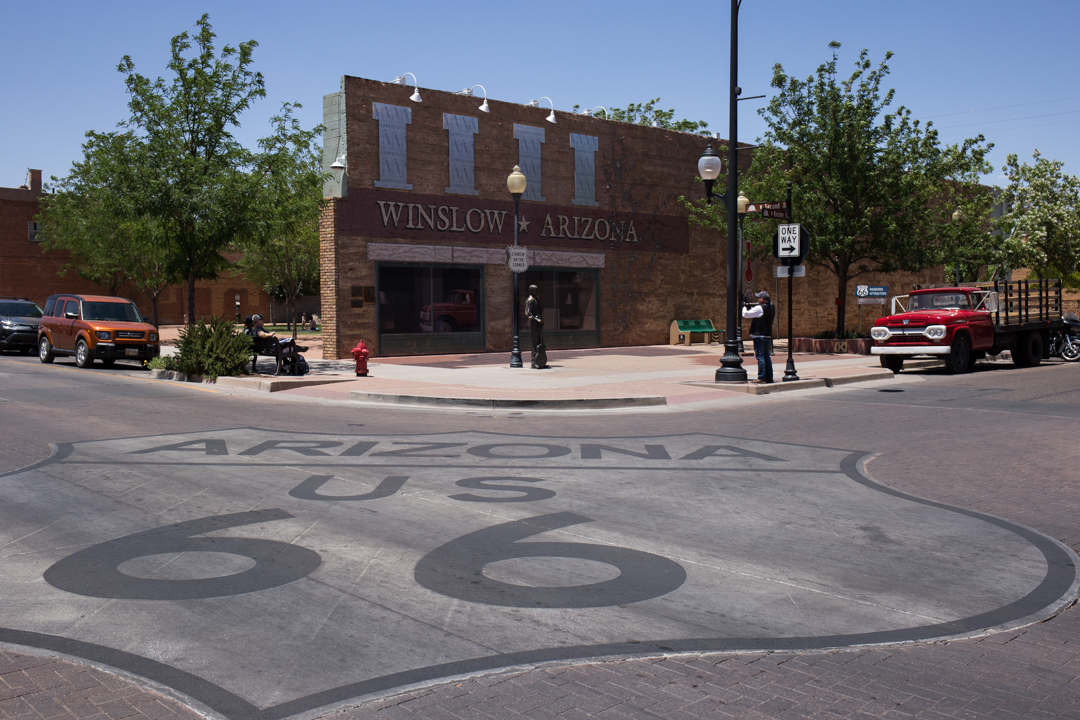


My co-pilot and frequent road trip collaborator, Jean-Marie, reminded me that I most certainly had heard of Winslow, Arizona—and you probably have too. The 1972 song Take It Easy, penned by Jackson Browne and Glenn Frey, was the first single released by The Eagles. The song peaked at No. 12 on the July 22, 1972 Billboard Hot 100 chart and contained the lyrics, “Well, I'm a standing on a corner in Winslow, Arizona and such a fine sight to see. It's a girl, my Lord, in a flatbed Ford slowin' down to take a look at me." The song was the opening track on the band's debut album; it has been included on all of their live and compilation albums and coincidentally (or not) it was playing outside of the souvenir shop when we stopped.


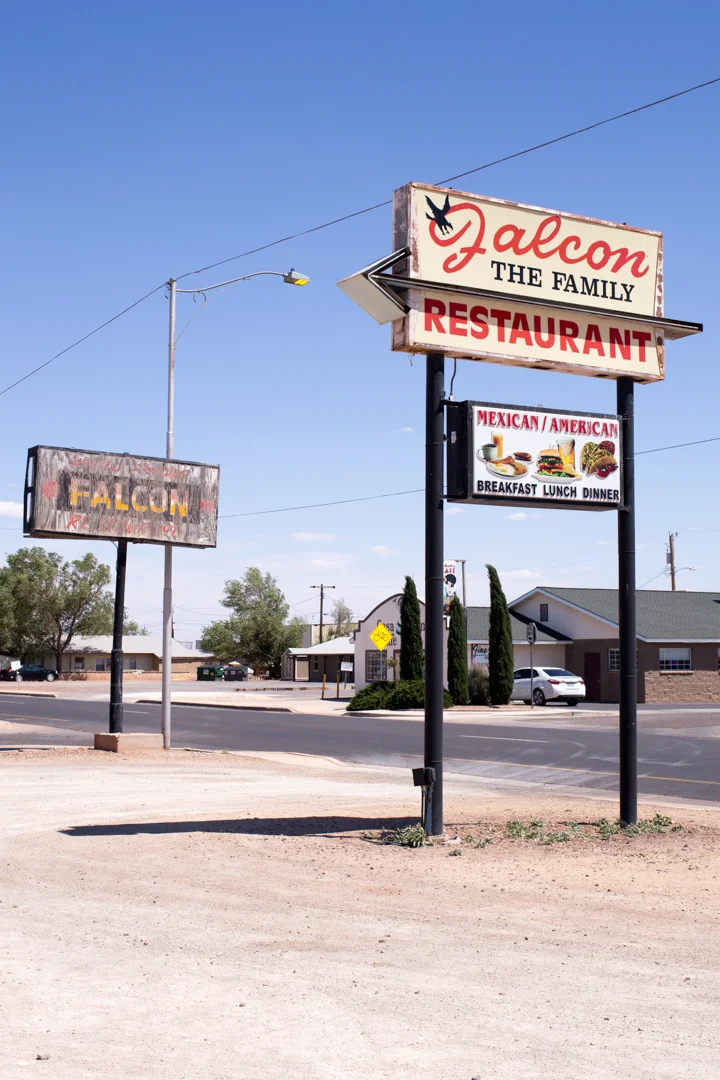


Apart from its tenuous connection to fame, there isn’t much to see in Winslow (apart from the Falcon The Family Restaurant’s wonderful signage). But you have to hand it to a city with a population of less than 10,000 for turning its proverbial fifteen minutes into a bonafide roadside attraction.
Once a thriving Route 66 destination, the town declined rapidly after it was bypassed by I-40 in the late ‘70s. The Standin' On the Corner Foundation was formed to build tourism and in 1999—funded by donors whose names are inscribed in bricks on the ground—Standin’ On the Corner Park opened.


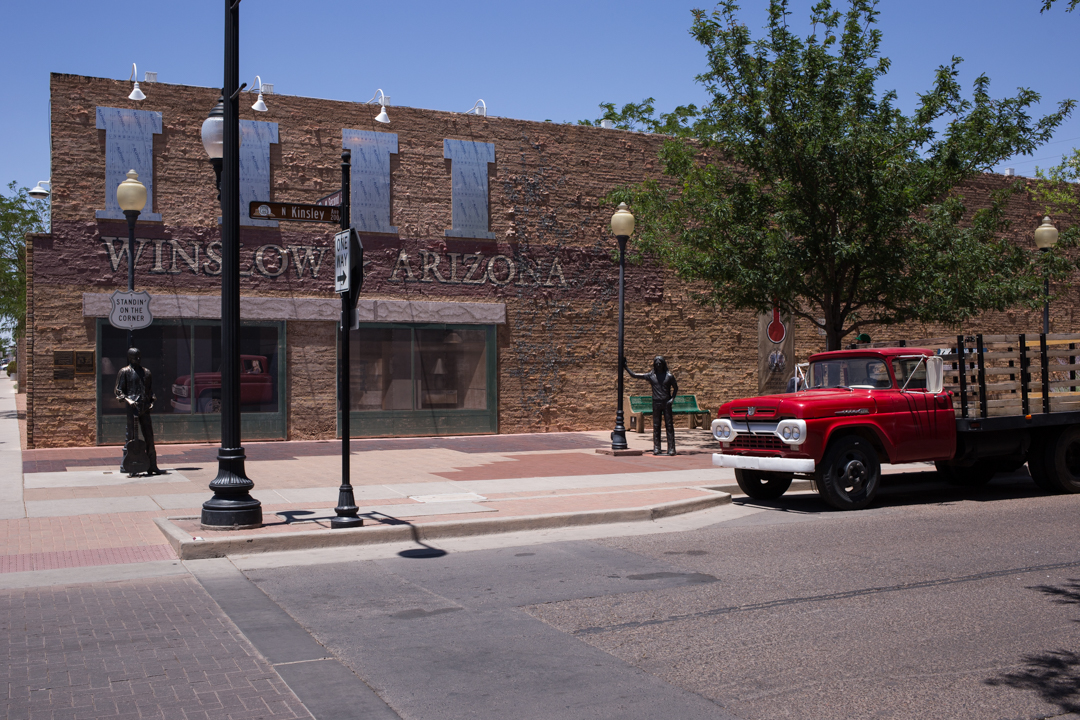
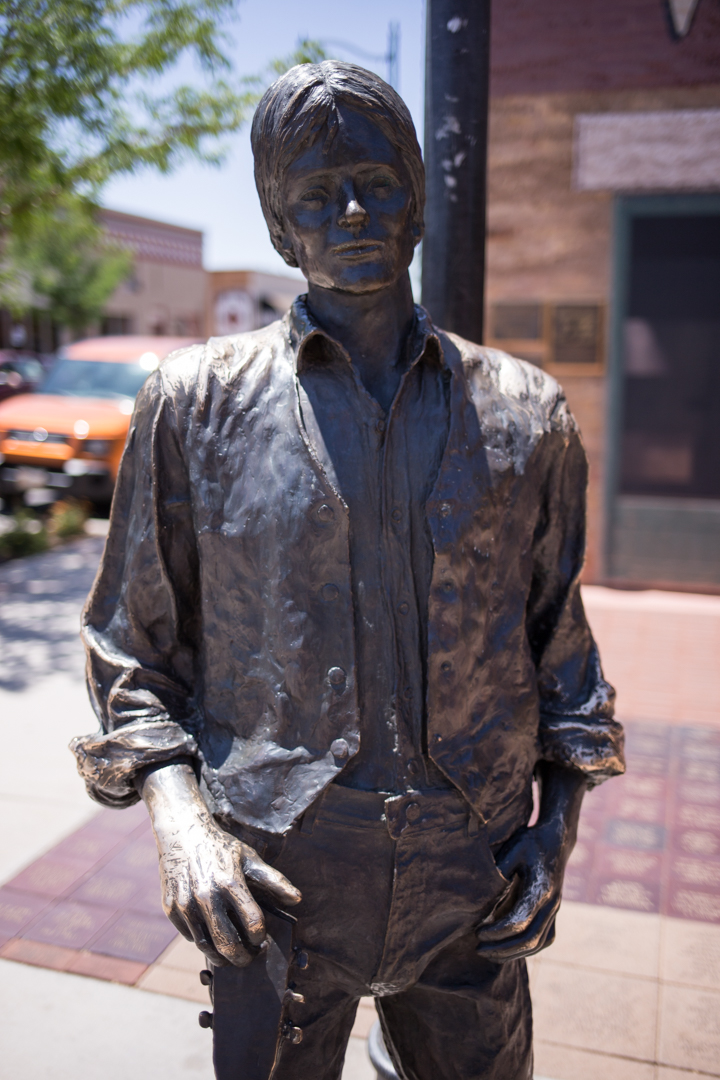

The small park features a two-story trompe l'oeil mural by John Pugh on the surviving brick face of a building that burned down in 2004. Two bronze statues stand in front of the wall, one of a life-sized man who is standing on the corner with a guitar by his side, and one of Glenn Frey, who died in 2016. A red flatbed Ford—slowin' down to take a look at me—is parked nearby.

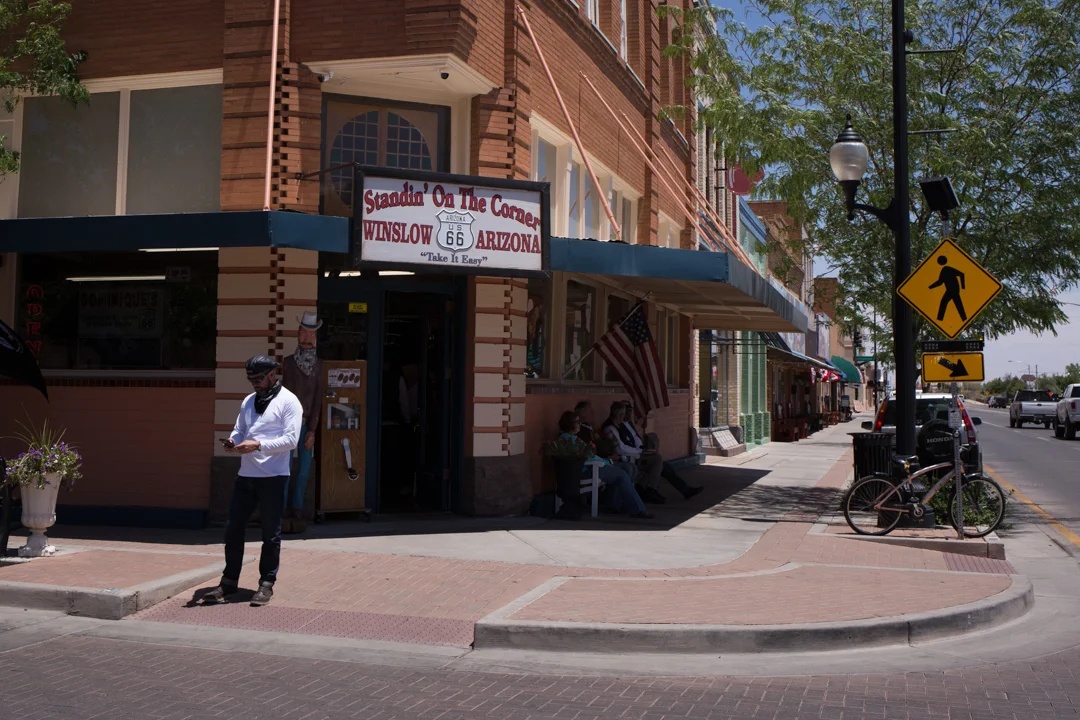
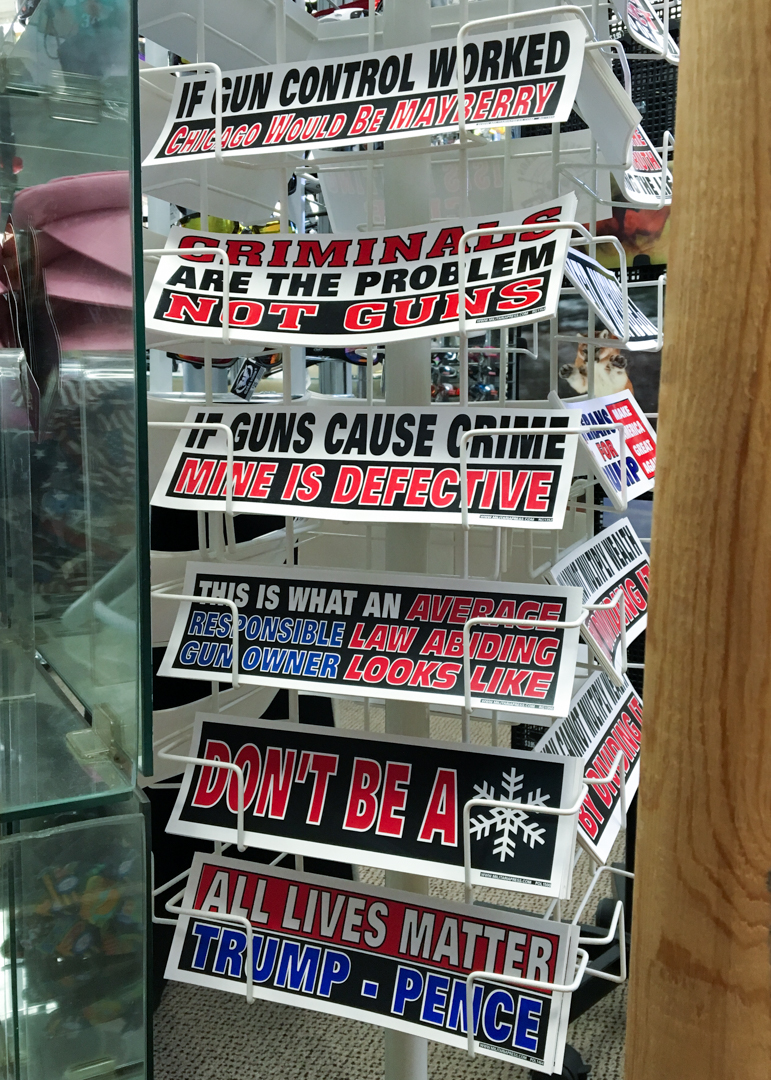


Across the street is a souvenir shop—also called Standin’ On the Corner—where you can squish a penny and buy Route 66 souvenirs or (disturbingly) pro-Trump bumper stickers and hats. Diagonal to the souvenir shop is a coffee shop and we sat outside sipping iced coffees and watched in amusement as families steadily piled out of their cars to take photos of themselves—you guessed it—standin’ on the corner (such a fine sight to see).
Standin’ On the Corner Park
Corner of Kinsley and E 2nd Street
Winslow, AZ

The Great Sphinx of Giza

It may be a cliché answer, but if I had to pick a favorite out of all of the wonders we saw in Egypt, I would have to say the Great Sphinx at Giza. The Giza plateau is the most famous of all the Ancient Egyptian sites and for good reason. I’ve experienced this with other things to a smaller degree, but photographs just can’t compete with the experience of seeing these wonders in person (I say this as a preface to a post containing … photographs 🤷♀️). Scale, detail and sense of place are all essential components that are impossible to grasp second-hand.

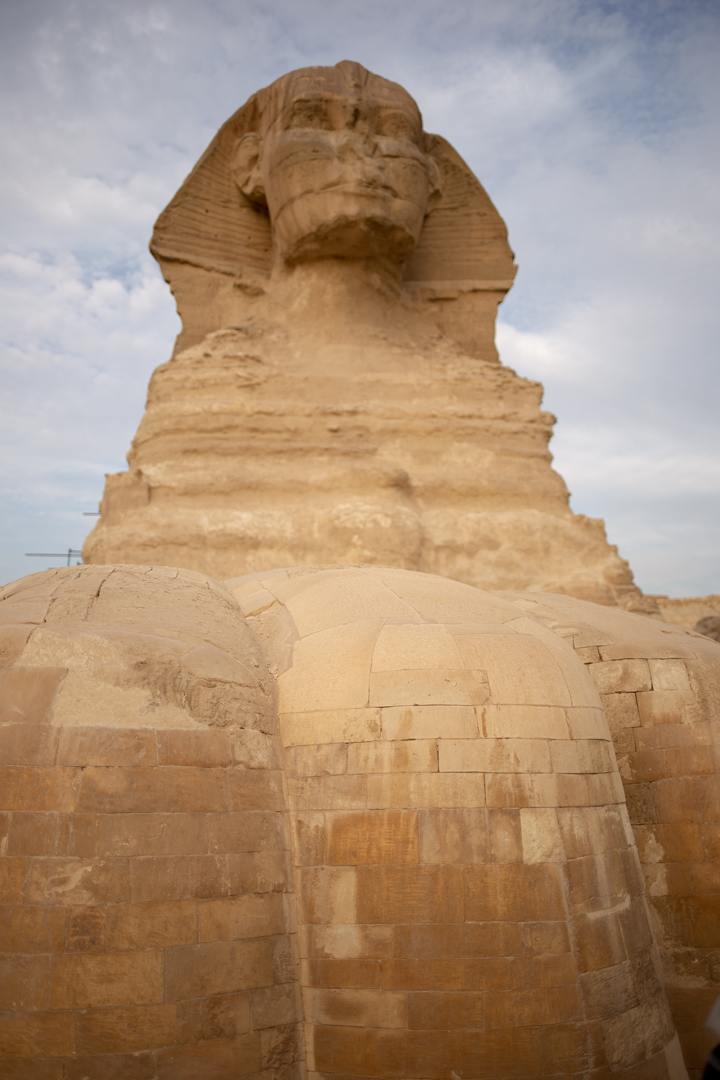

Because of our tour’s connection to Dr. Zahi Hawass, we had special permissions to meet him at the base of the Sphinx. There is a public viewing platform on the left side, but we were able to stand right in between the great paws and walk around the perimeter of the original, oversized roadside attraction (just a few days before Melania racked up her extravagant hotel bill).
Built in the Old Kingdom circa 2558–2532 BCE for the Pharaoh Khafra—the builder of the second pyramid at Giza—the Sphinx was carved into the bedrock of the plateau. It is 240 feet long from paw to tail, 66 feet high from the base to the top of the head and 62 feet wide at the rear.


“Sphinx” is a Greek word for a mythical winged creature with the head of a woman and the body of a lion. The most famous Sphinx in the world has been called that since antiquity, although the Egyptian version has the head of a man and is not winged.
At one time the Sphinx was buried up to its shoulders in sand and several excavations of the site were attempted over the years as early as 1400 BCE. The entire Sphinx was finally uncovered from 1925 to 1936, and in 1931 repairs were made to the head. Renovations to its base and body were done in the 1980s, and again in the ‘90s, but Dr. Hawass insists that it should never be fully restored and should be allowed to exist as a ruin (I agree).
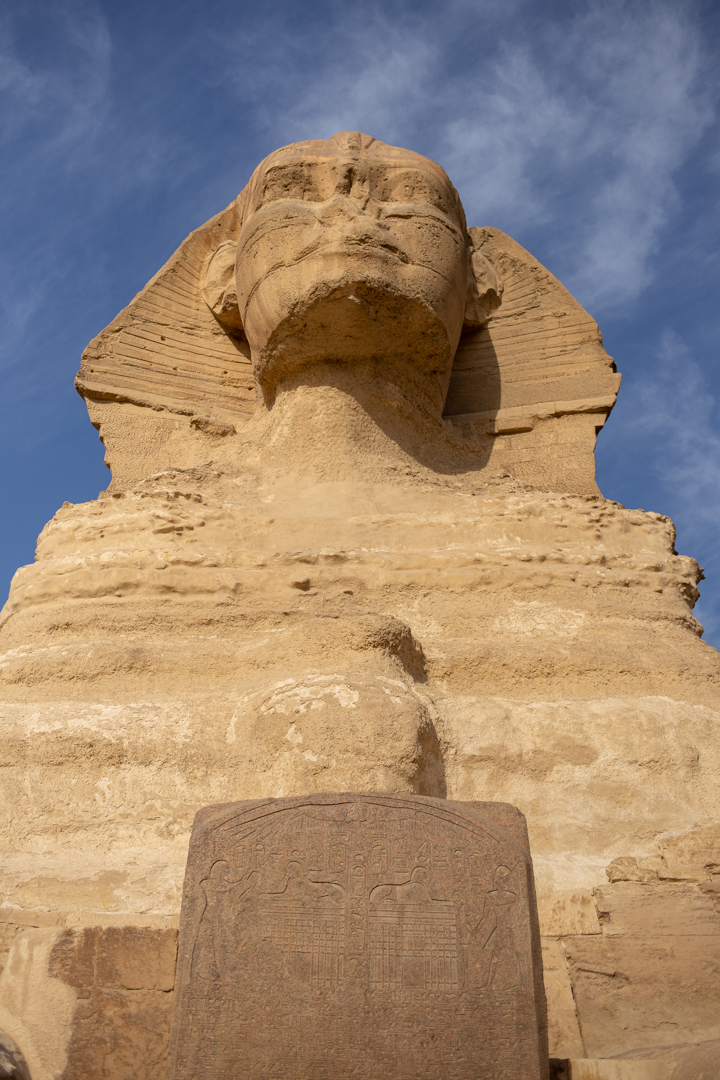
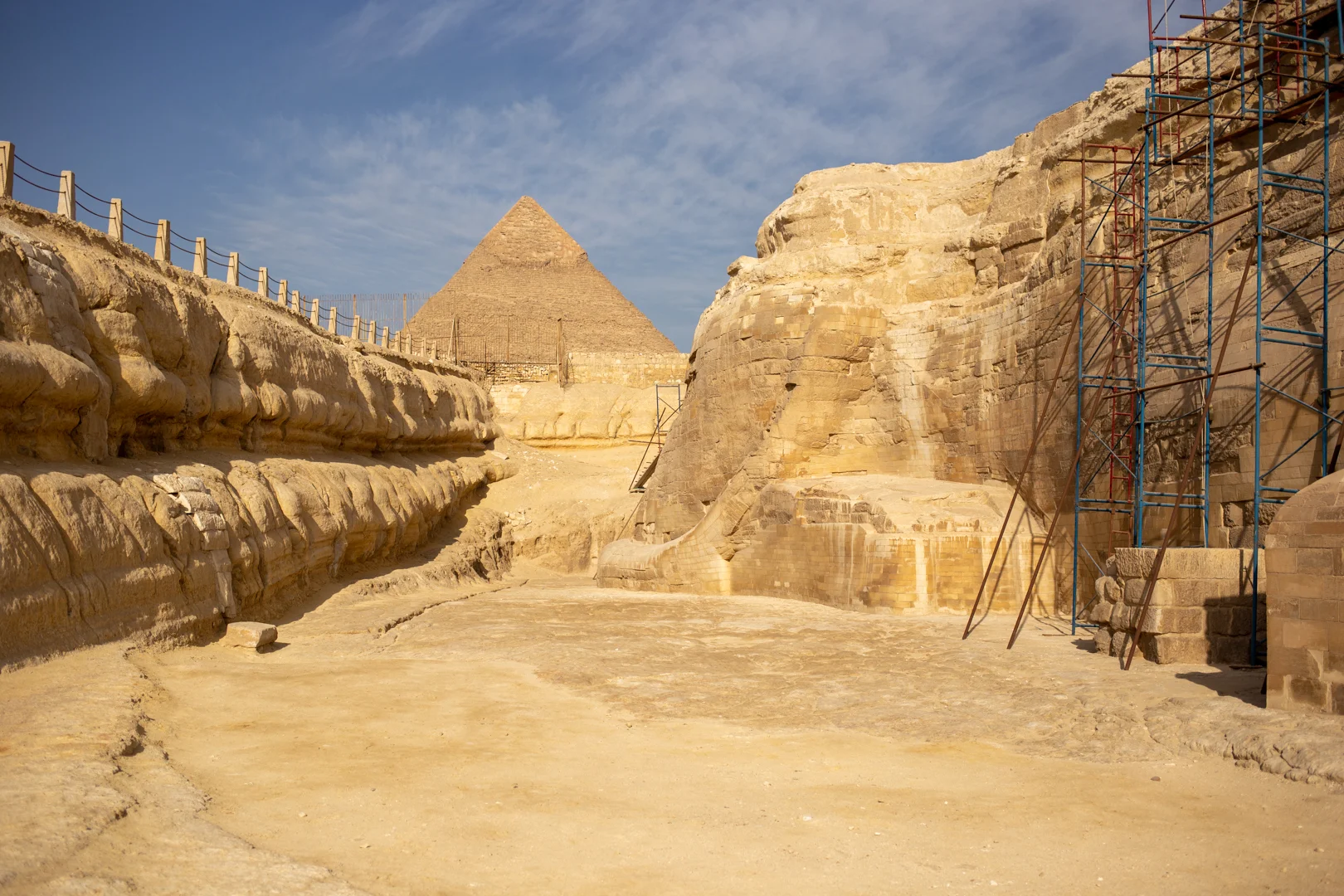


The Sphinx is famously missing its nose, but the legend that it was broken off by a cannonball from Napoleon’s army is incorrect because sketches that predate Napoleon’s time have been found depicting the Sphinx without a nose. Fragments of a ceremonial beard have also been found, although it may have been added later and therefore would not have been included in the original design. Traces of pigment are remarkably still visible on the face and headdress of the Sphinx, leading experts to believe that it was once brightly painted like most of the stone monuments and temples built by the Ancient Egyptians.


The Sphinx is such a remarkable and enigmatic figure that I found myself completely enchanted by it, thousands of years after its construction. Despite various theories, Dr. Hawass insists that there is nothing hidden within, or underneath the Sphinx, but that hasn’t stopped people from insisting otherwise. It may be the most famous “ruin” in the world, but I was struck by the power it still has to captivate—especially when combined with the pyramids rising majestically behind it.

Civil War Tails

Civil War Tails at the Historic Homestead is an attraction in Gettysburg, Pennsylvania. Located in the National Soldiers’ Orphans’ Homestead—used as an orphanage for soldiers’ children after the war—Civil War Tails is a museum featuring dioramas populated with hand-made miniature soldiers, trees, horses, cannon and ships. The “tails” part of the name is not a mistake—the miniature soldiers are actually cats, individually sculpted out of clay and painted to resemble Union or Confederate soldiers.


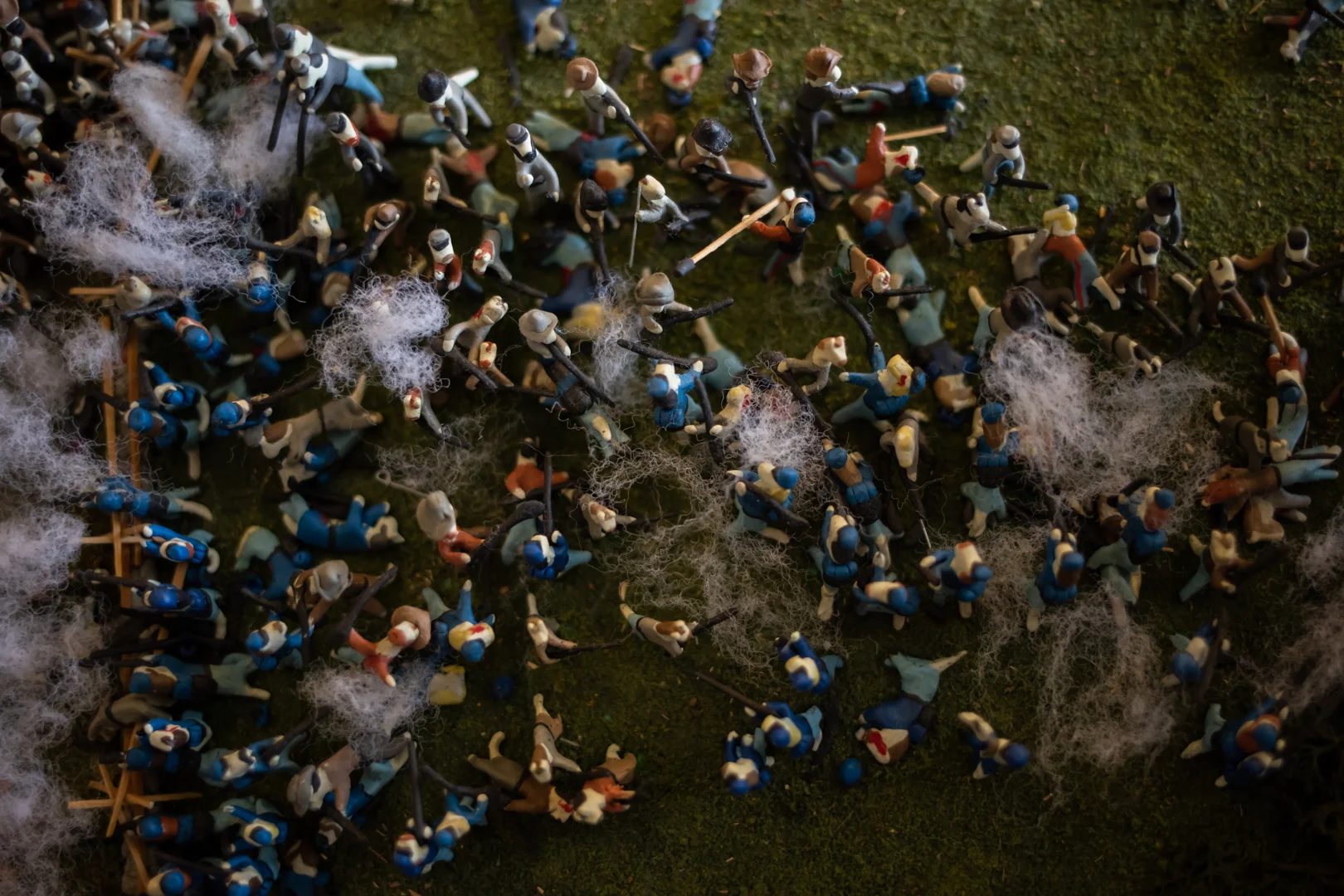


I shouldn’t have to explain why I wanted to visit a museum with dioramas filled with miniature cats, but unique, passion projects like Civil War Tails are my very favorite thing to see on road trips. The museum was started by identical twin sisters, Rebecca and Ruth. They both shared a love of cats, and an interest in the Civil War was sparked when they were young and read the biographies of Civil War generals Robert E. Lee and Ulysses S. Grant. Cats were easier to sculpt than humans, and thus Civil War Tails was born.


Every diorama is made on a one-to-one ratio with to-scale figures—each cat represents one soldier. The detail is incredible, and they continue to create new dioramas and improve upon their techniques. Current scenes include Fort Sumter, Pickett’s Charge, Little Round Top, Andersonville Prison and even photography pioneer Matthew Brady setting up his camera on the battlefield.


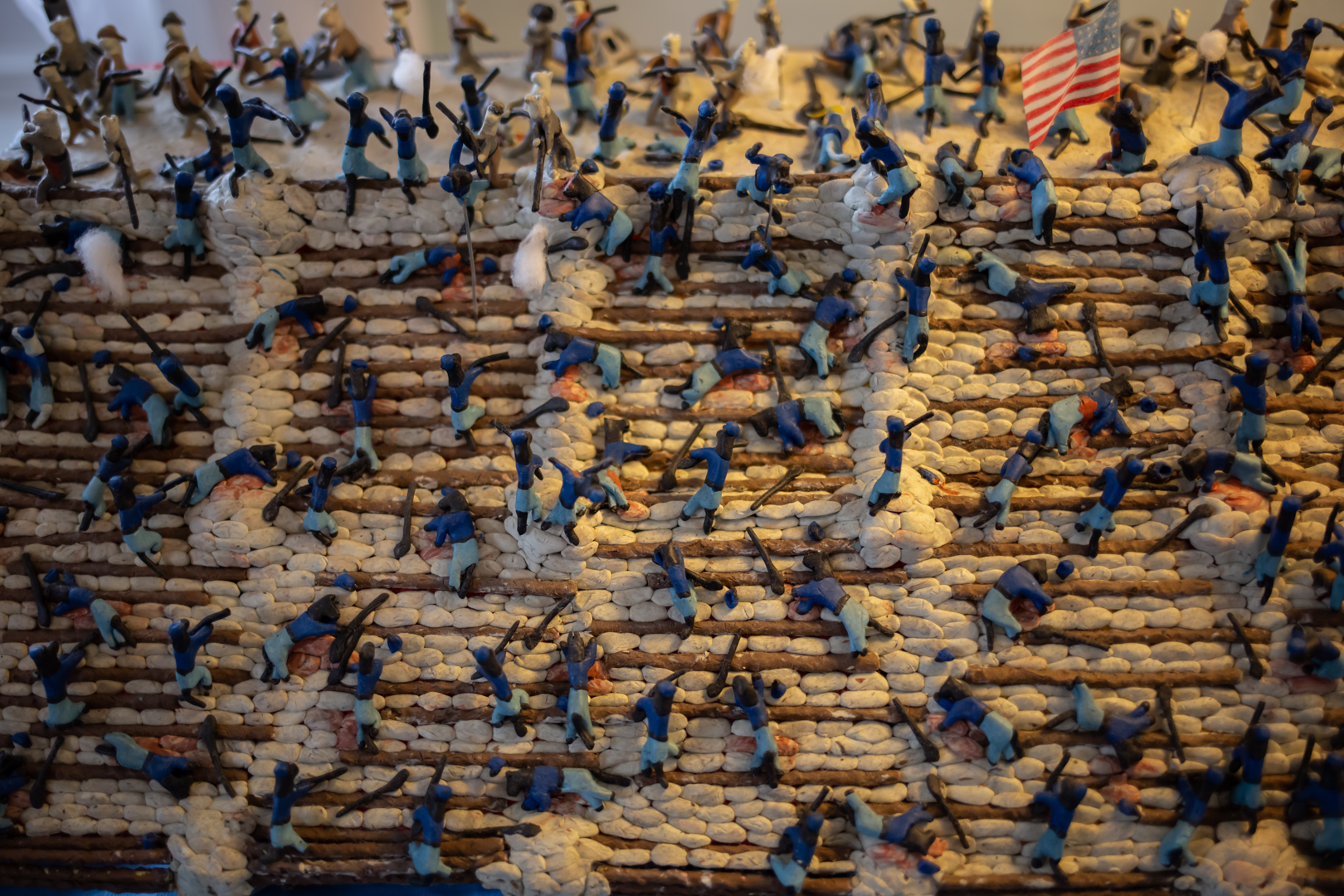
We were the only visitors the the Homestead, so we got a private tour led by one of the twins. She was clearly passionate about each scene and described them in great detail. There is a exhibit showing the evolution of the sisters’ craft, and you can take home a tiny clay cat souvenir if you wish. My favorite part about Civil War Tails was the ticket itself—an optimistic punch card that awards visitors with free admission on their tenth visit.
Civil War Tails
785 Baltimore Street
Gettysburg, PA
Hours vary by season-check here before you go
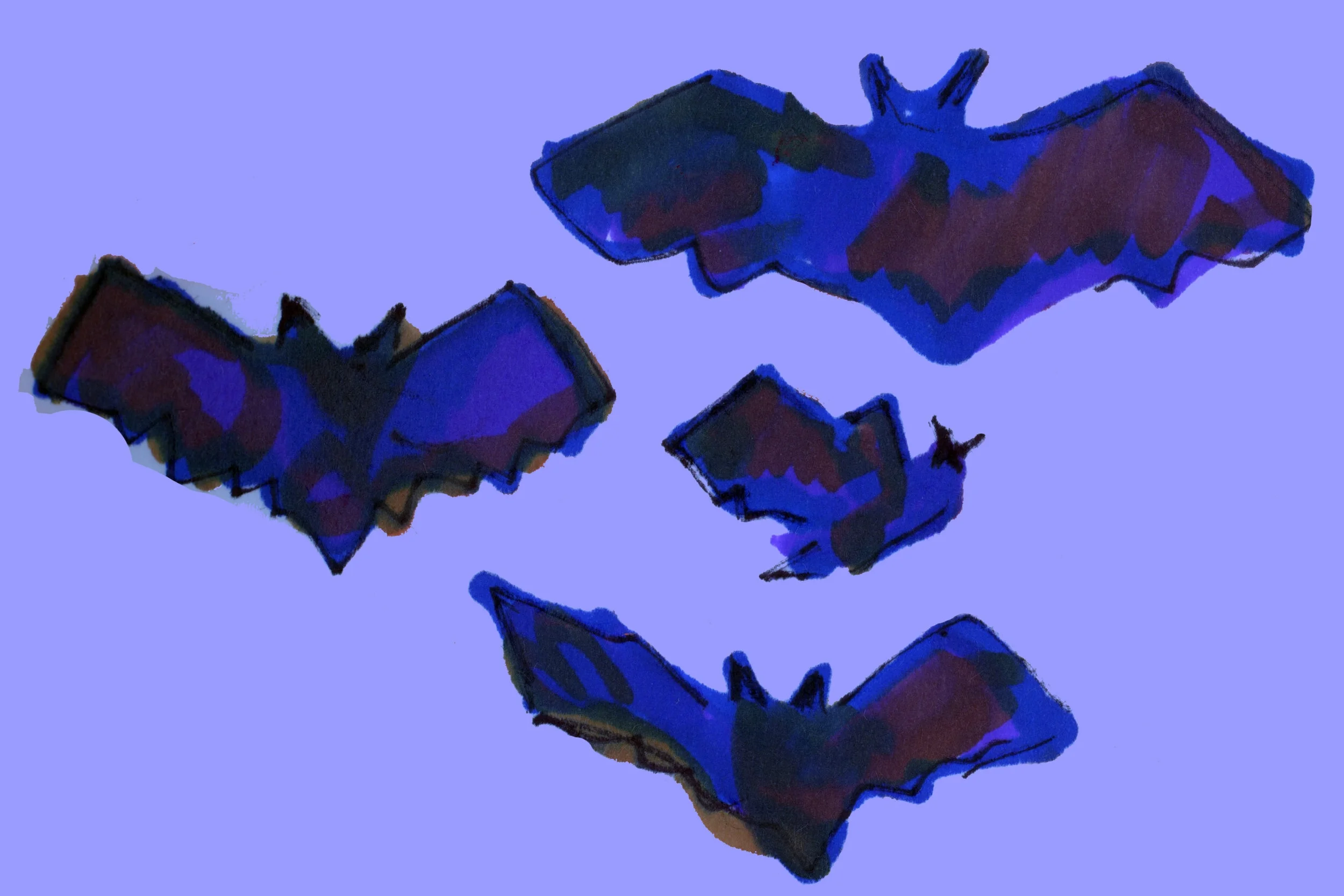
Happy Friday!

Illustration by Lindsey Frances
Things that happened this week:
For a President who literally doesn’t work, he still manages to threaten a new basic human right every week (and Fox News can’t get enough).
The Pittsburgh Synagogue shooting is heartbreaking in every single way, and sadly so very American.
Surprising no one, Silicon Valley parents are terrible.
Things to do in New York this week:
There is a great maps exhibit at the New York Transit Museum, on display until September 2019 so you have some time.
This weekend is the opening of Canstruction at Brookfield Place—here are my photos from 2014, 2015, 2016 and 2017.
The New York City Marathon is this Sunday—here’s how to prepare if you’re in it, where to cheer on the runners or which streets to avoid.
Things I’ve discovered recently:
Jerry Seinfeld is the number one celebrity I’m dying to see on the streets of New York, and this interview made me love him even more.
Aren’t we all just fifty-eight weasels in a trench coat?
After years of searching for the perfect black oxford, I think I finally found it.
My second Halloween as Grandmother’s Predictions was a rousing success, and David even joined in on the fun as Grandma’s Coney Island neighbor, Zoltar. We rode the subway, marched in the Village Halloween Parade, shopped at Duane Reade and were interviewed for the local New York news. Despite missing half of October, I still feel like I’m satisfied with my Halloween celebrations but maybe that’s because in my apartment it’s basically Halloween year-round.
This weekend David and I are headed to Ithaca for his son’s parents’ weekend and I’m already thinking about the beautiful fall foliage and diner breakfasts in my near future. I had my first day of jury duty yesterday and if I get picked it looks like I might be settling in at the court house for a few weeks. This is my first-ever jury duty so I’m still kind of fascinated by the process, and hopefully I’ll have a lot of time to smash my reading challenge for the year. Have a great weekend!
Manhattan Cemeteries

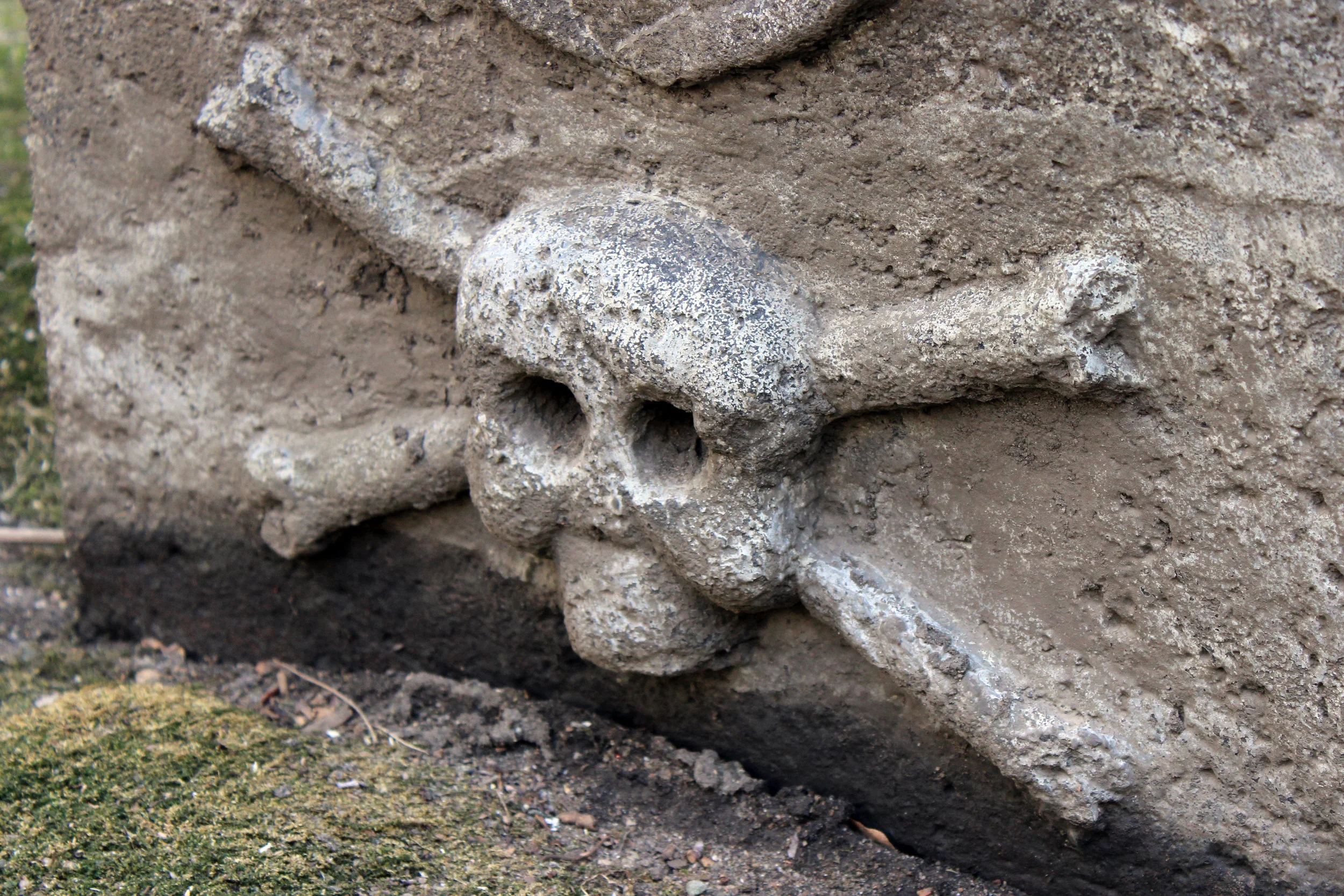
A few weeks ago I asked my mom if she wanted to go on a tour with me of some of the cemeteries in lower Manhattan and she replied, “I didn’t know there were any cemeteries in Manhattan.” Many people may know about the oldest cemeteries—or rather, graveyards—associated with Trinity Church near the World Trade Center, but even I didn’t know about all of the burial grounds tucked behind fences and in between buildings until I lived here.
The Cemeteries of the Spanish and Portuguese Synagogue
The Congregation Shearith Israel was America's first Jewish Congregation and was founded in 1654. There are three cemeteries associated with the congregation in Manhattan (a fourth, Beth Olam Cemetery in Ridgewood, has hosted burials for the congregation since 1851). The first is near Chinatown, the second is in Greenwich Village and the third is in Chelsea.


The first cemetery dates back to 1656 and is the first Jewish cemetery in the United States (the Congregation is the oldest in North America). Although the exact location of the original cemetery is not known, it was established at its current location in 1683. Over the years the land has been chiseled away by city expansion and erosion and sadly a lot of the bodies have been disinterred. It's larger than the second, gated (and locked) like the other two, and raised above sidewalk-level so you have to stand on your tip-toes to get a good look.
A special ceremony is held at the cemetery each year on the Sunday before Memorial Day, otherwise the cemetery is closed the public.
55 - 57 St James Place, near Oliver and Madison Streets


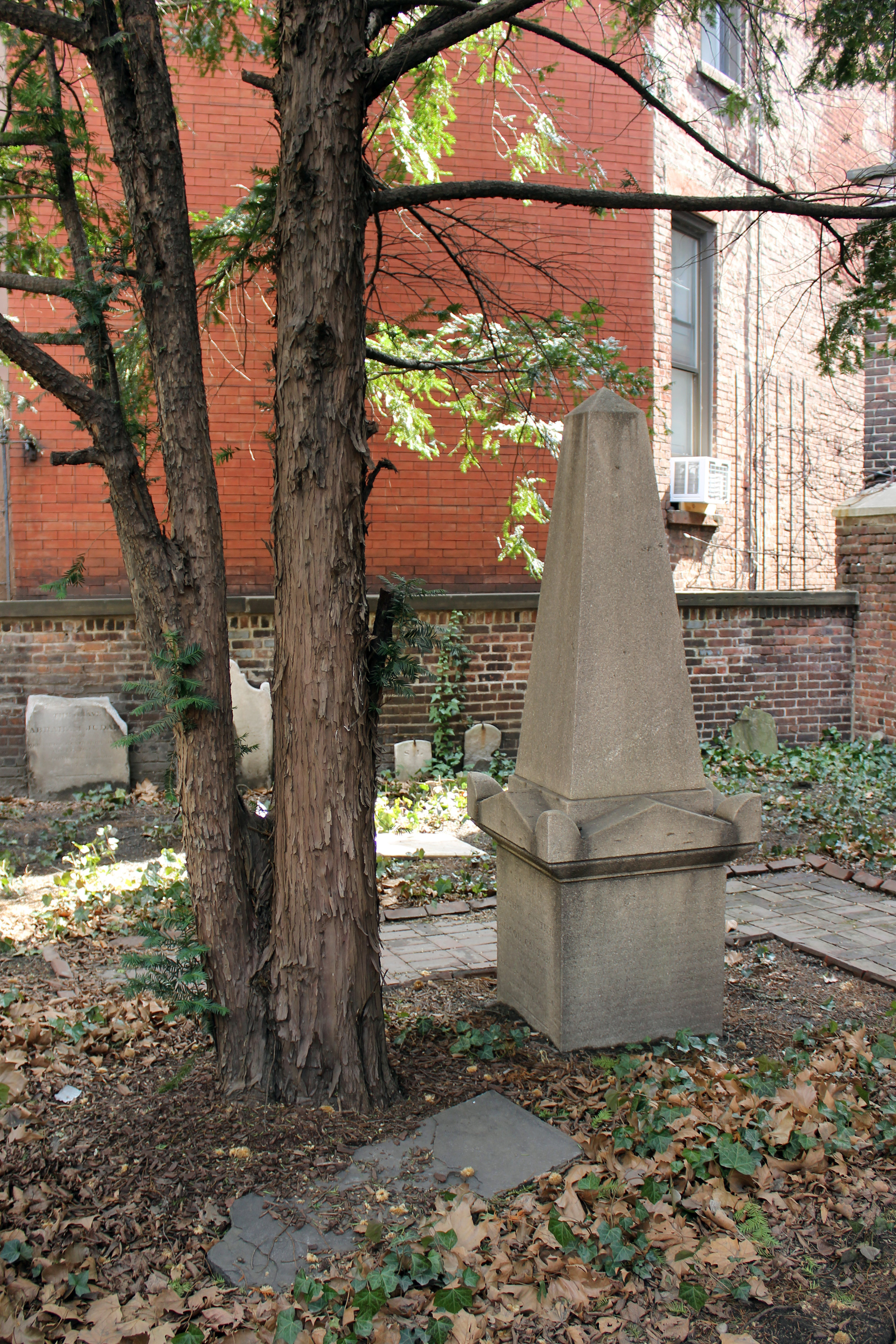
The second cemetery was active from 1805-1829 and was used primarily to bury victims of communicable diseases like yellow fever and malaria, as well as for Jews who passed away in New York but were not members of the Congregation. The expansion of the (very desirable) neighborhood has forced many of the remains to be re-interred elsewhere, but a few worn tombstones remain and it is now officially the smallest cemetery in Manhattan.
Closed to the public but it’s so small the entire cemetery can be seen from the sidewalk.
72 W 11th Street, near Sixth Avenue

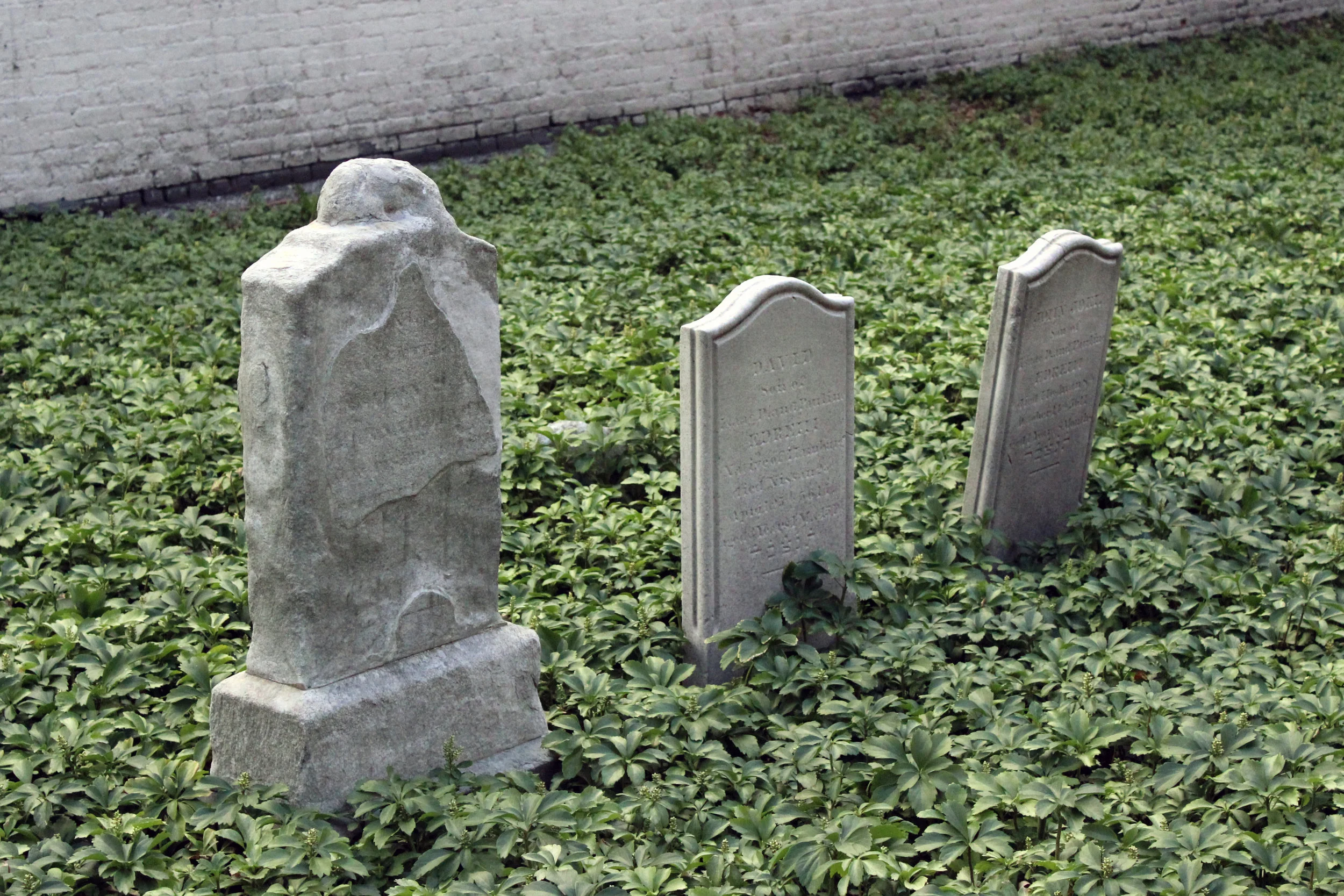

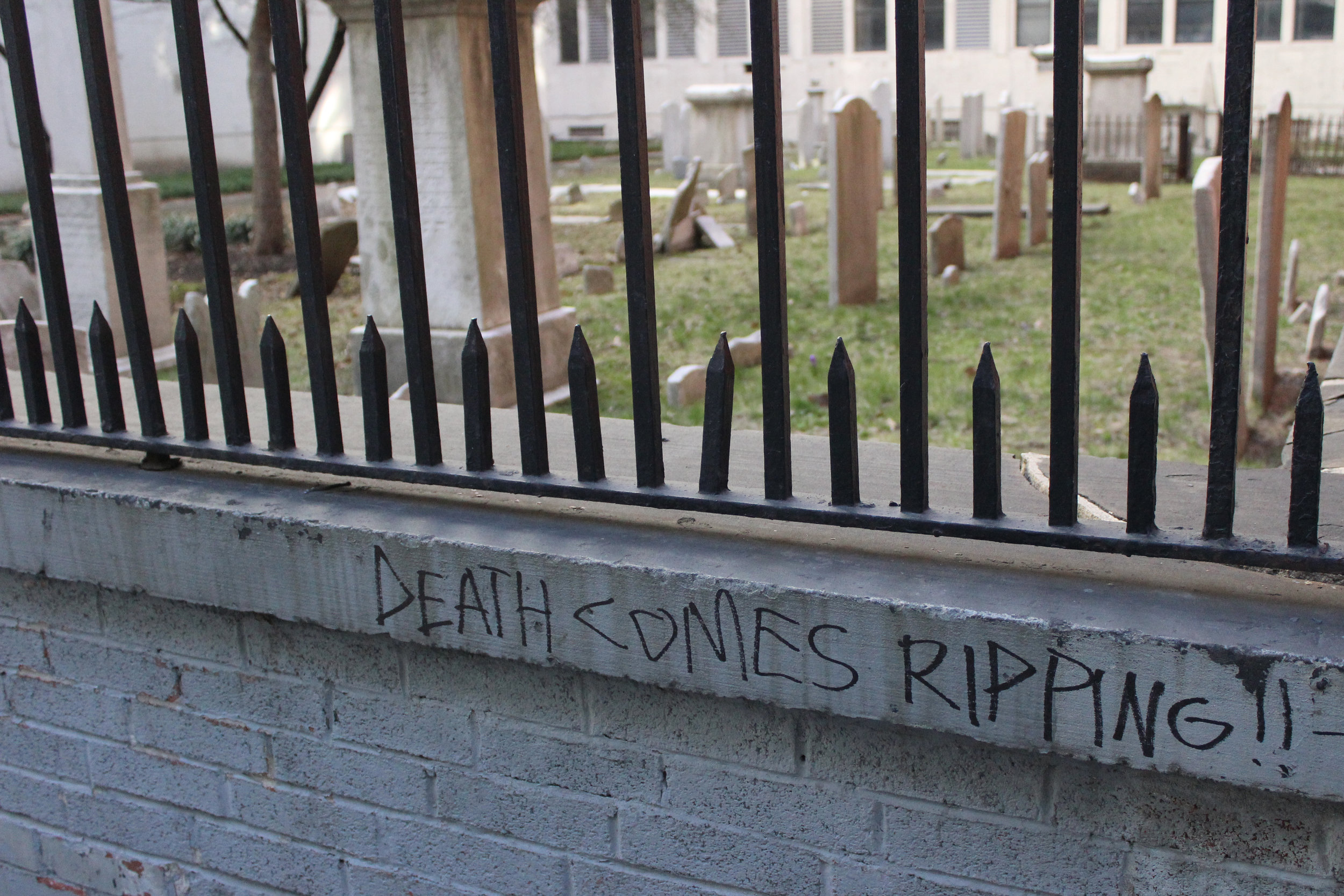
The third cemetery was in use from 1829-1851 and it’s currently located right across the street from a Trader Joe’s. It appears to be the largest of the three cemeteries, and is in the best condition (a plaque on the fence mentions a recent restoration). However, a lot of the stones are worn to the point of being unreadable from the street.
Closed to the public, but mostly visible from the sidewalk.
W 21st Street, near Sixth Avenue
Trinity Church


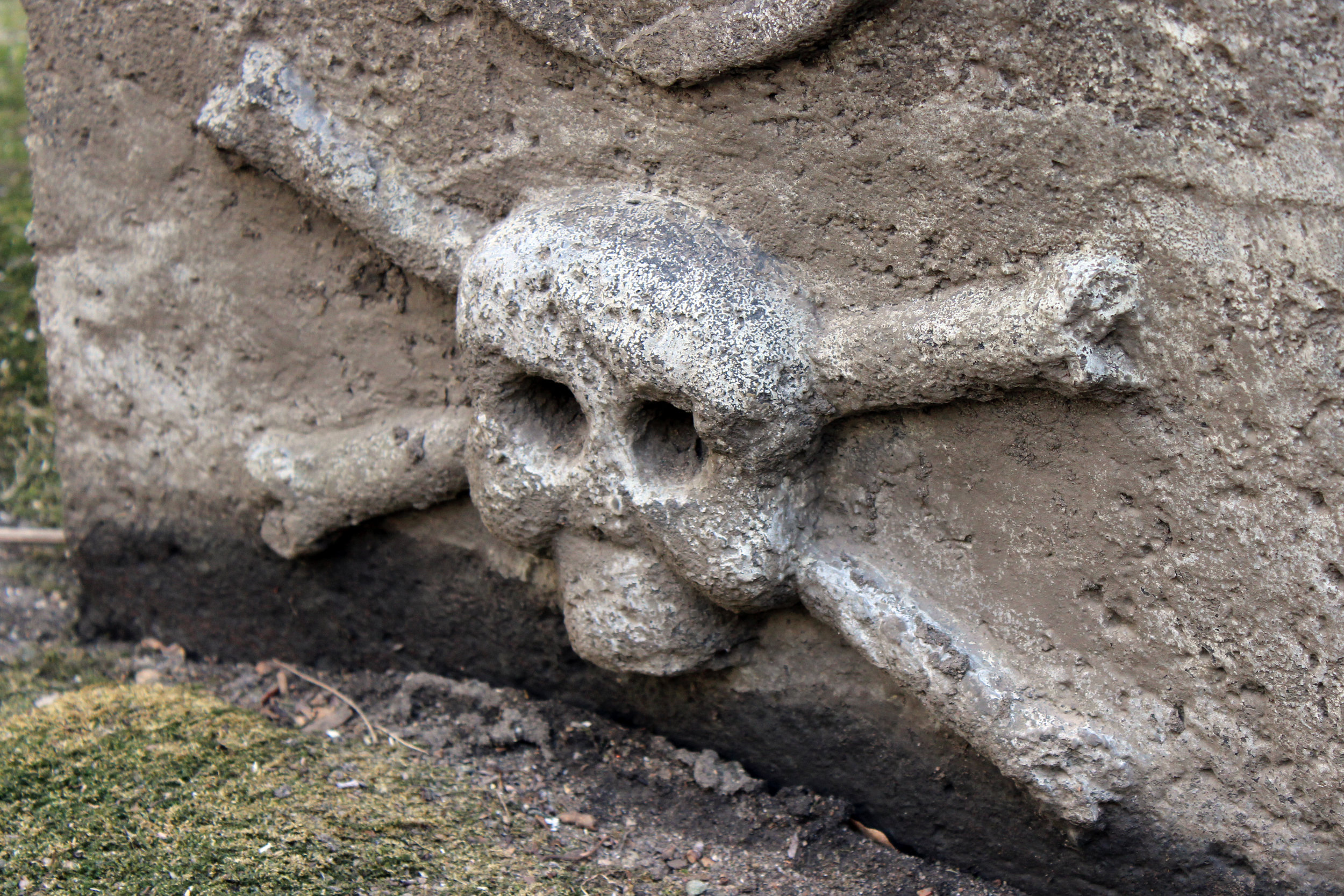


The original graveyard at Trinity Church in lower Manhattan, opened in 1697 and is one of three separate burial grounds associated with the church. The other two are located at the nearby St. Paul's Chapel and uptown at Trinity Church Cemetery and Mausoleum. This is probably the best place for finding classic skull and winged cherub stones in all five boroughs and most of the stones are remarkably well-preserved. Trinity’s most famous resident is Alexander Hamilton, but my favorite epitaph belongs to David Ogden, "who on the 27th of September 1798 in the 29th year of his age fell a victim to the prevailing epidemic."
Tours of Trinity churchyard are available by request, weather permitting, but self-guided tours are allowed during normal hours—just stay on the paths and be respectful of the historic stones.
Trinity Church: 75 Broadway, between Rector and Liberty Streets
St. Paul’s Chapel: 209 Broadway, between Vesey and Fulton Streets
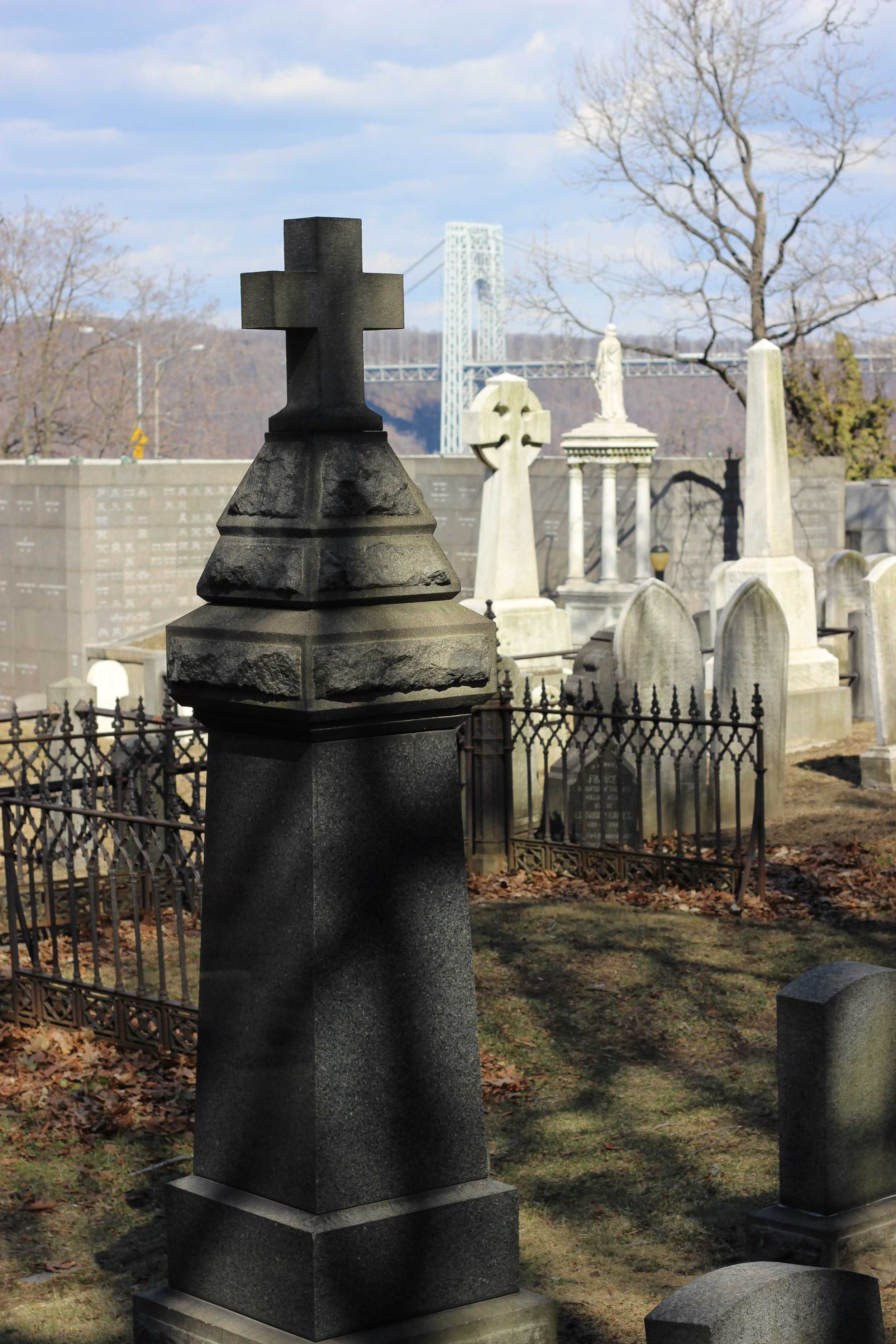
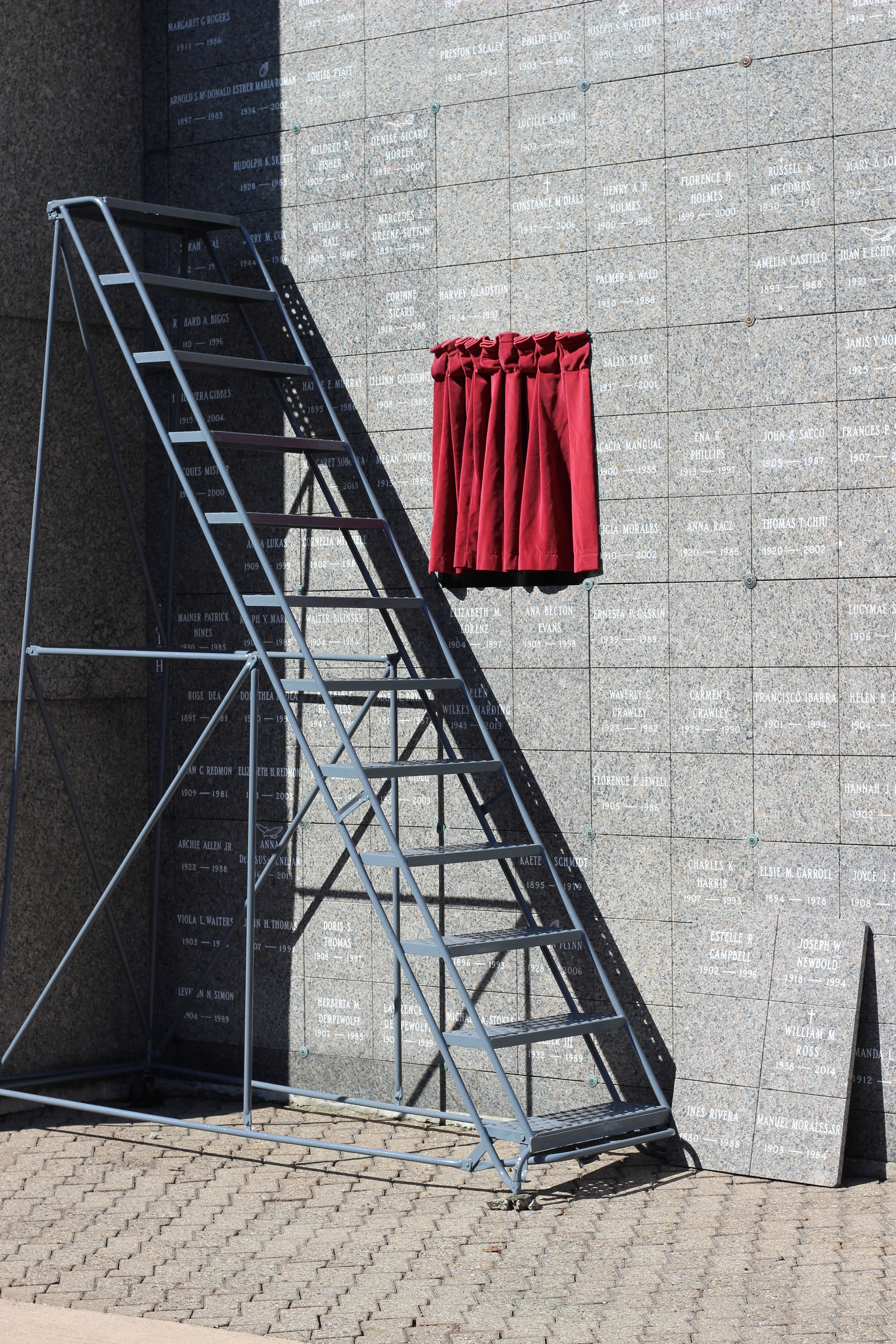


Trinity Church Cemetery and Mausoleum is the only active cemetery remaining on the island of Manhattan. It’s located between West 153rd and 155th streets with Broadway splitting the grounds into two sections. The west section is set on a hill with beautiful views of the Hudson River and the George Washington Bridge. This is the final resting place of the Astors, Ralph Waldo Ellison, John James Audubon and—more recently—Law & Order’s Jerry Orbach and former New York Mayor Ed Koch.
Gates are open 9am-4pm. The entrance to the east side of the cemetery is on 155th street.
Entrance to the west side is at 70 Riverside Drive, between W 153rd and W 155th Streets.

More than 15,000 enslaved and free Africans were buried here during the late 17th and 18th centuries. 419 skeletons were found in the ‘90s during construction of a federal building and in 1993 the site became the first underground New York City and national historic landmark. New York had the second-largest number of enslaved Africans in the nation after Charleston, South Carolina, and this site was designated as a National Monument in 2006. Although it doesn’t look like a traditional cemetery, in 2007, a memorial was dedicated and a visitor center opened in 2010.
Open 10am-4pm, Saturday-Friday.
290 Broadway, New York, NY 10007


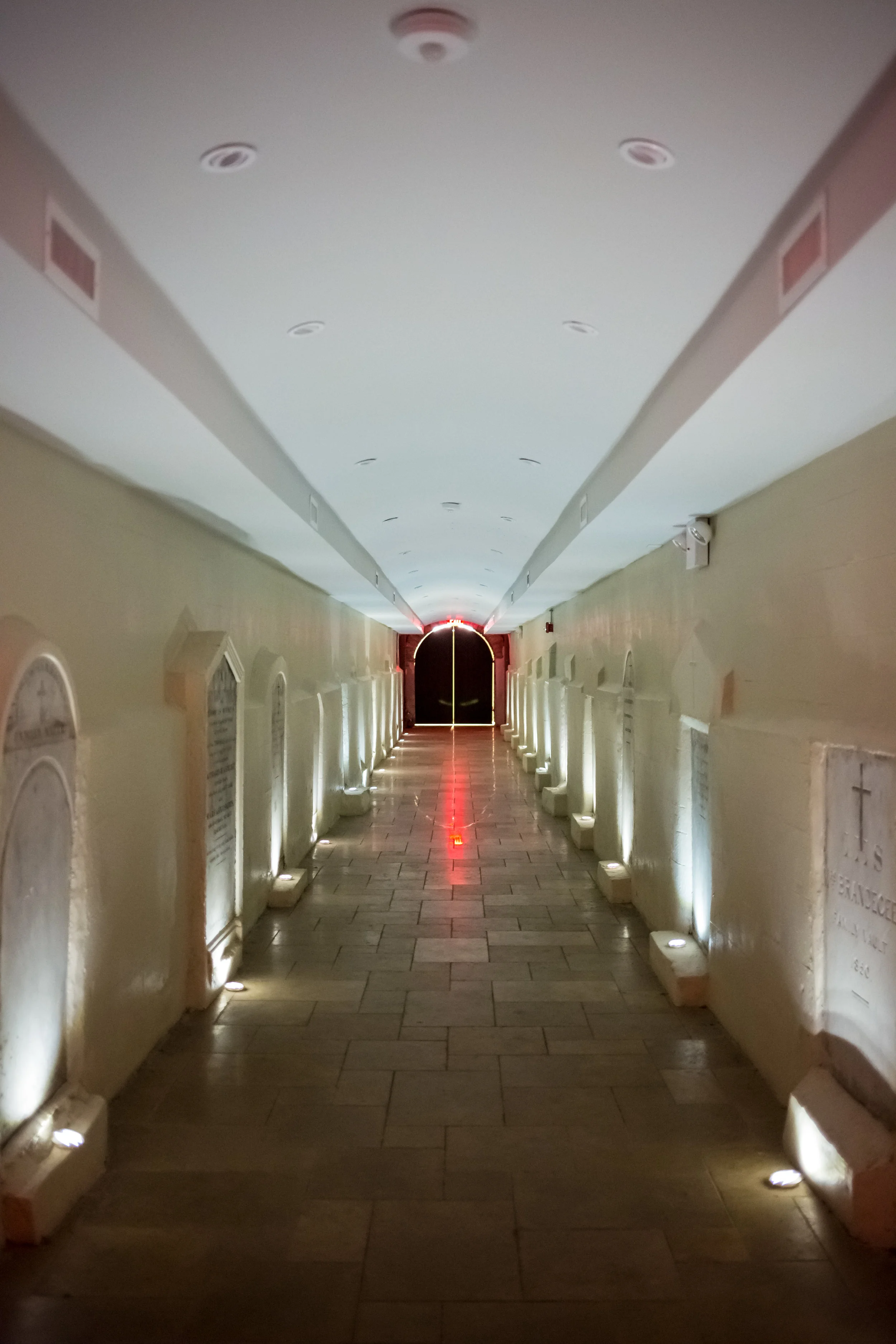
Most of the headstones and catacomb interments date from the 1800s at Old St. Patrick’s Cathedral. The catacombs aren't like the bone-filled niches of Europe, but more like the ones at Green-Wood Cemetery—underground tunnels lined with hermetically sealed crypts and marked with carved stones. There are 35 family crypts and five clerical vaults, in addition to newly-built columbaria.
Notable interments include: members of the Delmonico family, founders of Delmonico's, the first American restaurant to allow patrons to order from a menu; Countess Annie Leary, one of the only Catholics to be included in Mrs. Astor's "The 400," a list of fashionable socialites; and Tammany Hall boss and Congressman "Honest John" Kelly.
Access to the cemetery and catacombs is available only by taking a tour with Tommy’s New York.
263 Mulberry Street, between Houston and Prince Streets


Founded in 1830, the oldest public non-sectarian cemetery in New York City—not to be confused with the nearby New York City Marble Cemetery—is open at least one day a month during warmer months. The grounds are hidden away down a little alleyway and marked by an arched gate. There are no traditional headstones here—instead, there are 156 below-ground burial vaults with the names of the interred carved in plaques embedded in the surrounding stone wall.
Underground vaults were popular at the time due to health concerns over the burials of people who had suffered from infectious diseases like tuberculosis. The New York Marble Cemetery is available to rent out for parties and weddings (get married and buried!) and still hosts the occasional burial—if your family vault still has space and you have proof of relation.
Open select weekends April-October.
41 1/2 2nd Avenue, between E 2nd and E 3rd Streets

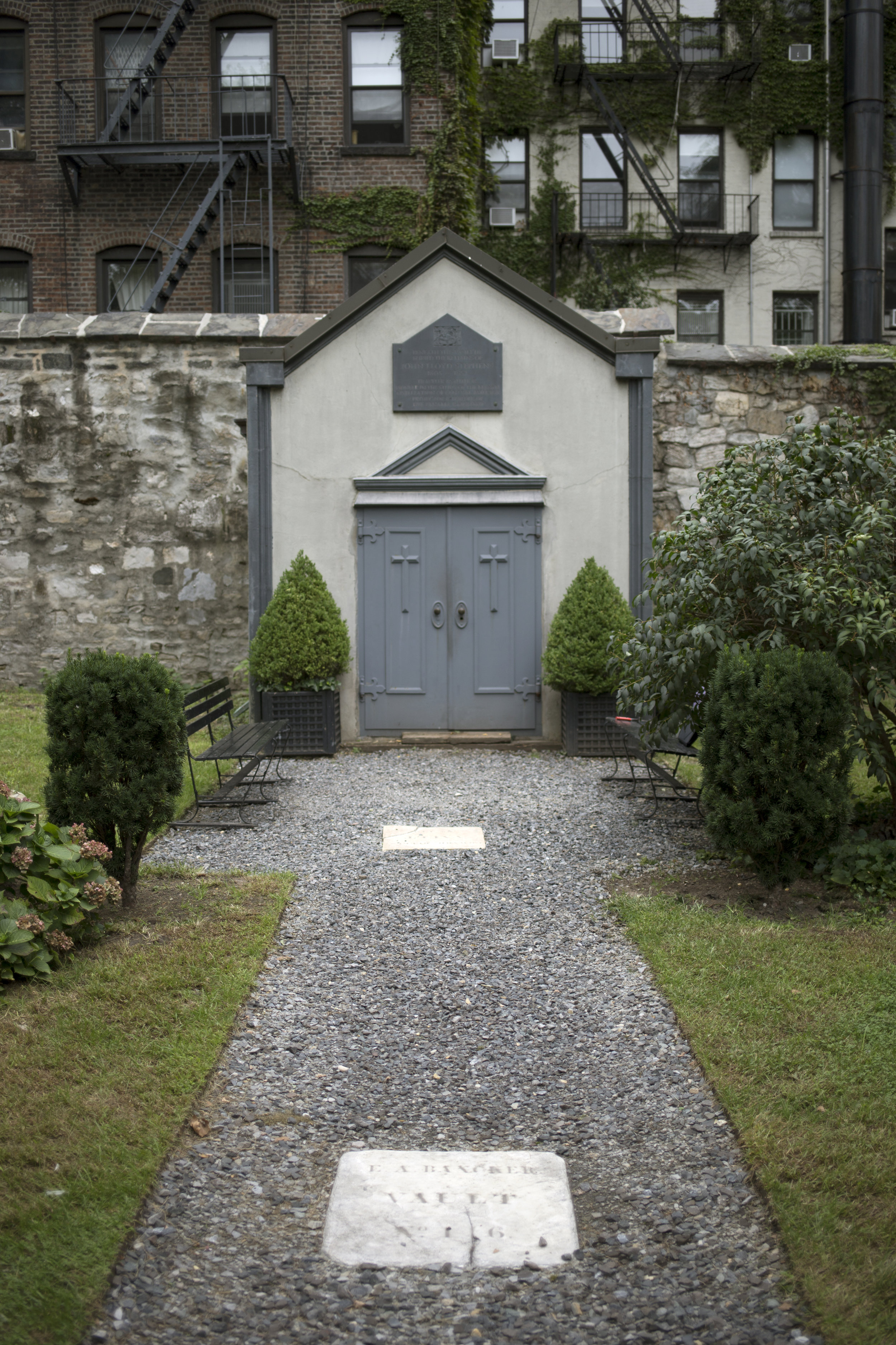
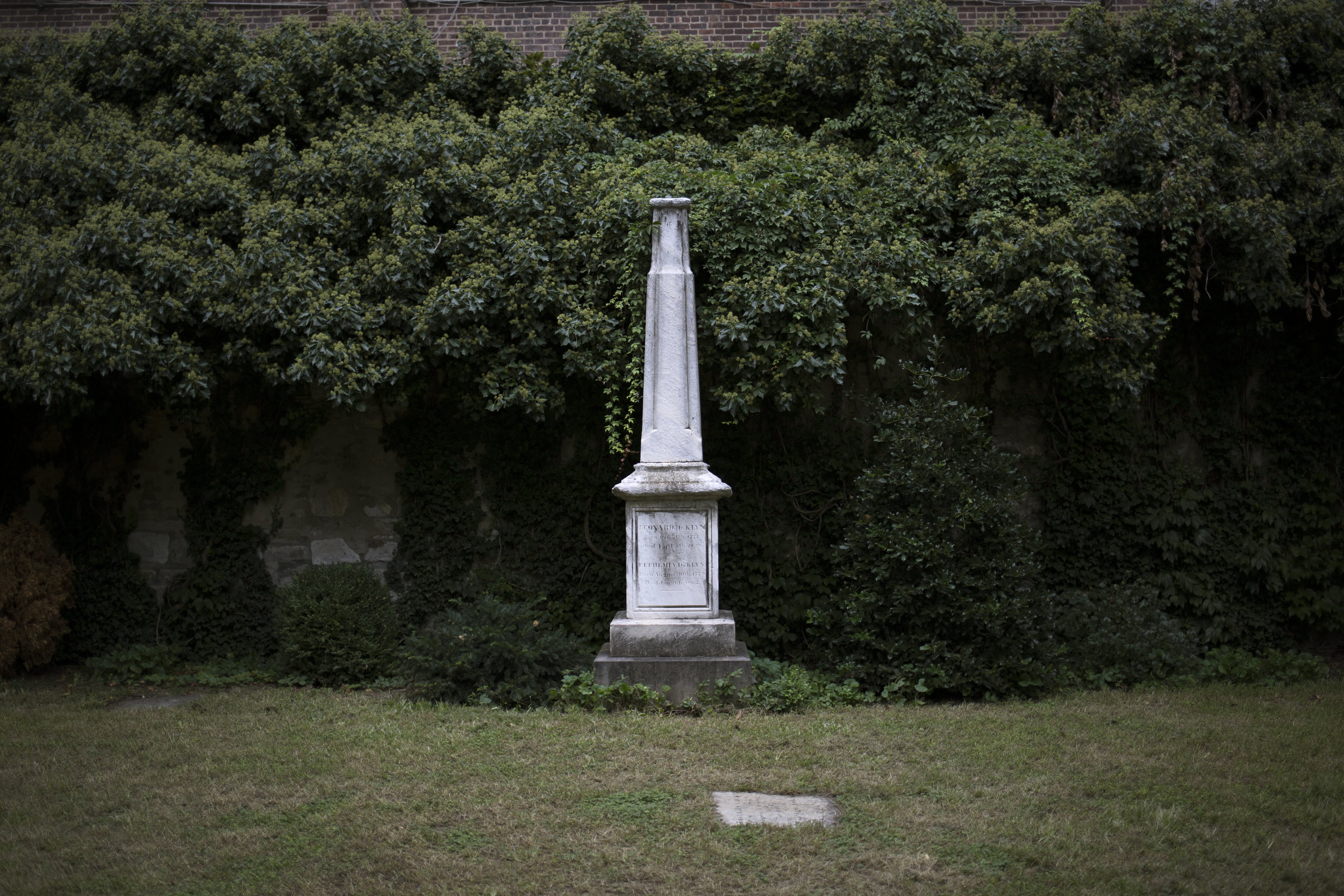

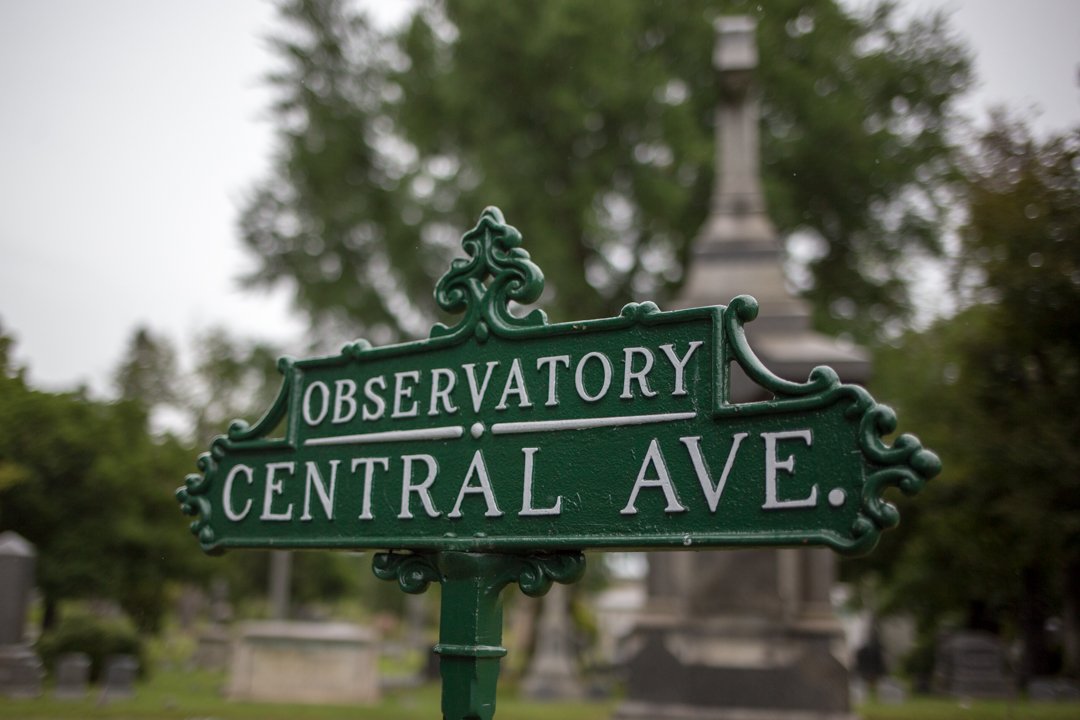
Just one block east is the New York City Marble Cemetery, established in 1831. The grounds are studded with headstones like a traditional cemetery, along with underground vaults designated with flat, marble markers. It also has a fantastic iron fence and gate, with a wonderful tombstone-shaped sign with arching letters. It's not as secluded as the New York Marble Cemetery, but it's a great place to spend the afternoon and have a picnic amongst hundreds of circa-1800s graves.
Open select weekends May-October.
52-74 E 2nd Street, between Second and First Avenues
💀 It’s Día de Muertos! Celebrate by browsing my cemetery posts here 💀

Valley of the Kings

Most people have heard of the Valley of the Kings in relation to its most famous resident, King Tutankhamun, whose nearly-intact tomb was discovered by Howard Carter on November 4, 1922. The valley contains 63 known tombs, and 18 are open to the public on a rotating basis.
The Valley, located on the west bank of the Nile across from Luxor, was used for burials from approximately 1539 to 1075 BCE. The name is a bit of a misnomer because in addition to Pharaohs, the valley is also the final resting place of nobles, wives and children—only about 20 of the tombs actually contained the remains of kings.


The Valley of the Kings was our first stop after flying to Luxor, and we arrived just after noon (yes, it was very, very hot). The Valley has been a popular tourism destination since antiquity and the tombs contain more than 2,000 instances of graffiti. Members of Napoleon’s expedition visited the Valley in 1799, and Belzoni—former circus strongman and my favorite Egyptian explorer—discovered several tombs in the early 1800s.
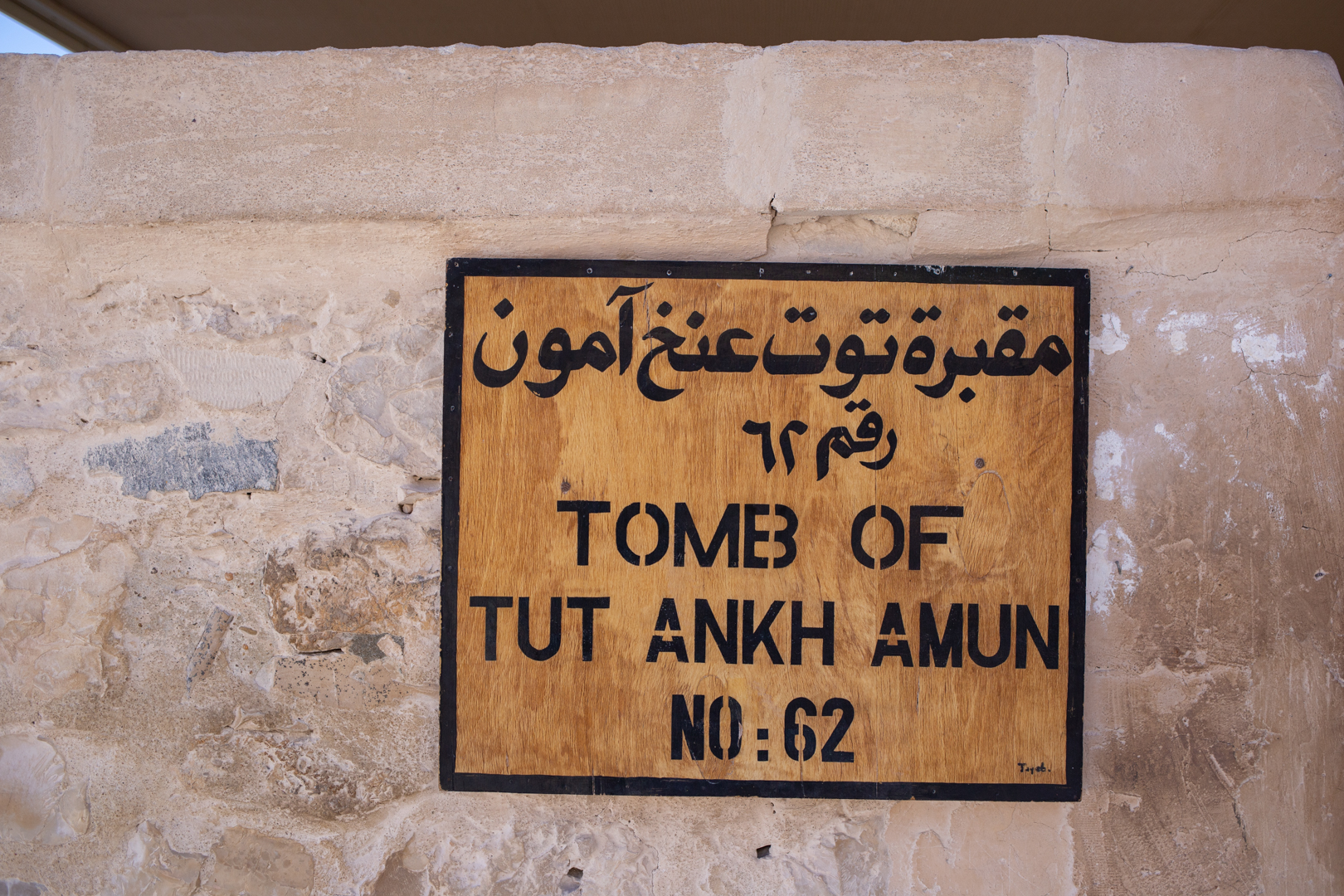
Tickets for the Valley of the Kings allow you to visit three tombs of your choice, but separate tickets must be purchased to enter the tomb of Tutankhamun. Purchasing yet another separate photo ticket will allow you take photos inside of some of the tombs, but photography is prohibited completely in others, like KV62 (Tut’s tomb). Carter’s discovery was such a big deal because it was the first time a royal tomb had been found that still contained an intact burial. The tomb had actually been robbed several times in antiquity, but a large amount of funerary treasures still remained in the tomb.
Thieves never discovered the young king’s mummy and it is now displayed in his tomb adjacent to his gilded wooden coffin which lays inside of his sandstone sarcophagus. Aside from a few paintings, there is nothing else to see inside of the small tomb—the rest of his treasures are on display at the Egyptian Museum in Cairo and the entire collection is in the process of being moved into the still under-construction Grand Egyptian Museum.


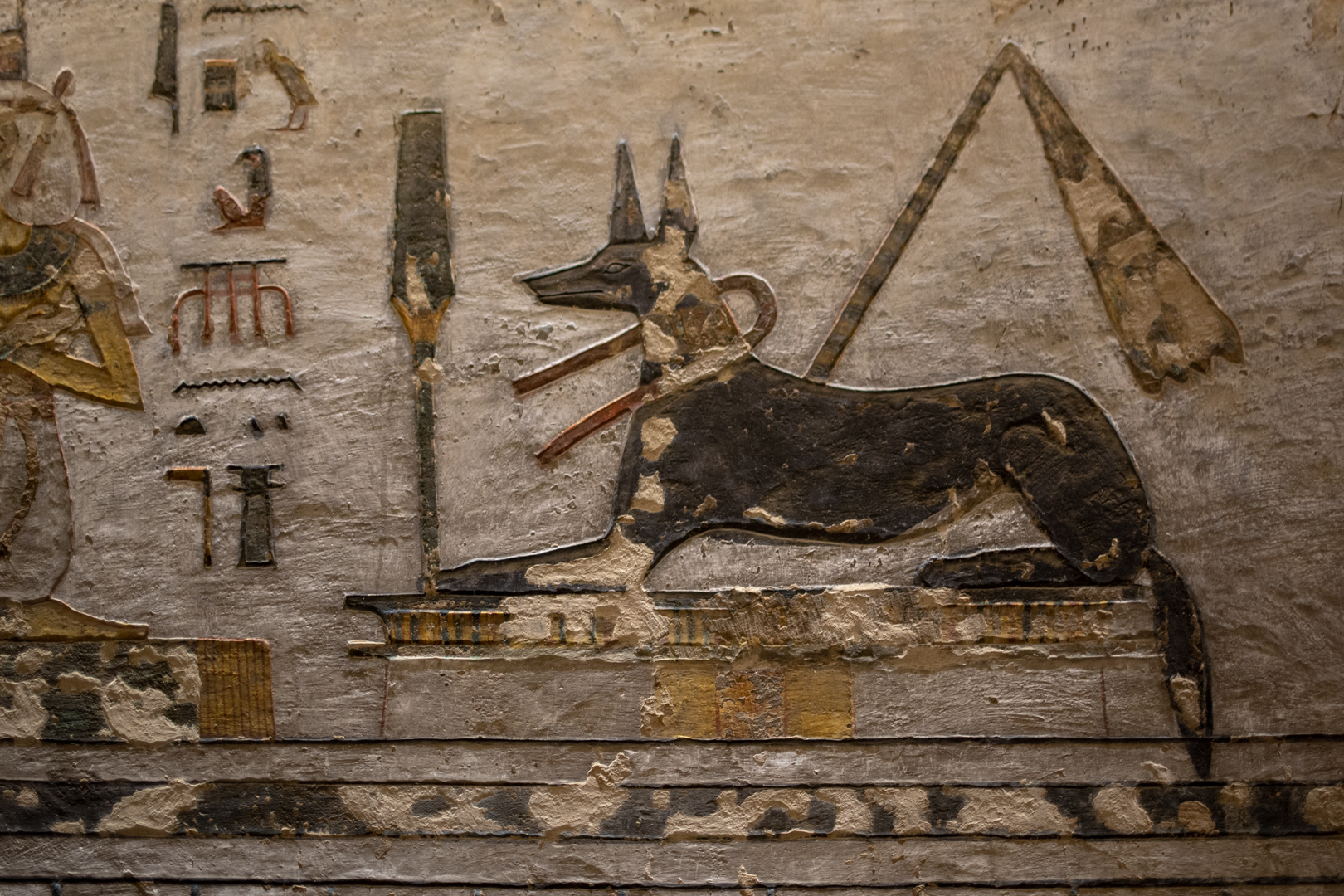
I don’t want to sound bratty and say that I was disappointed with King Tut’s tomb (I was), but I was also pleasantly surprised by the beauty of the other tombs that we toured. The Valley was our first experience with richly decorated tombs, and while they’re all different, they’re all spectacular in their own ways. It’s a shame that most were stripped of their treasures, but I’m glad that the beautiful interiors haven’t remained hidden forever, as originally intended.

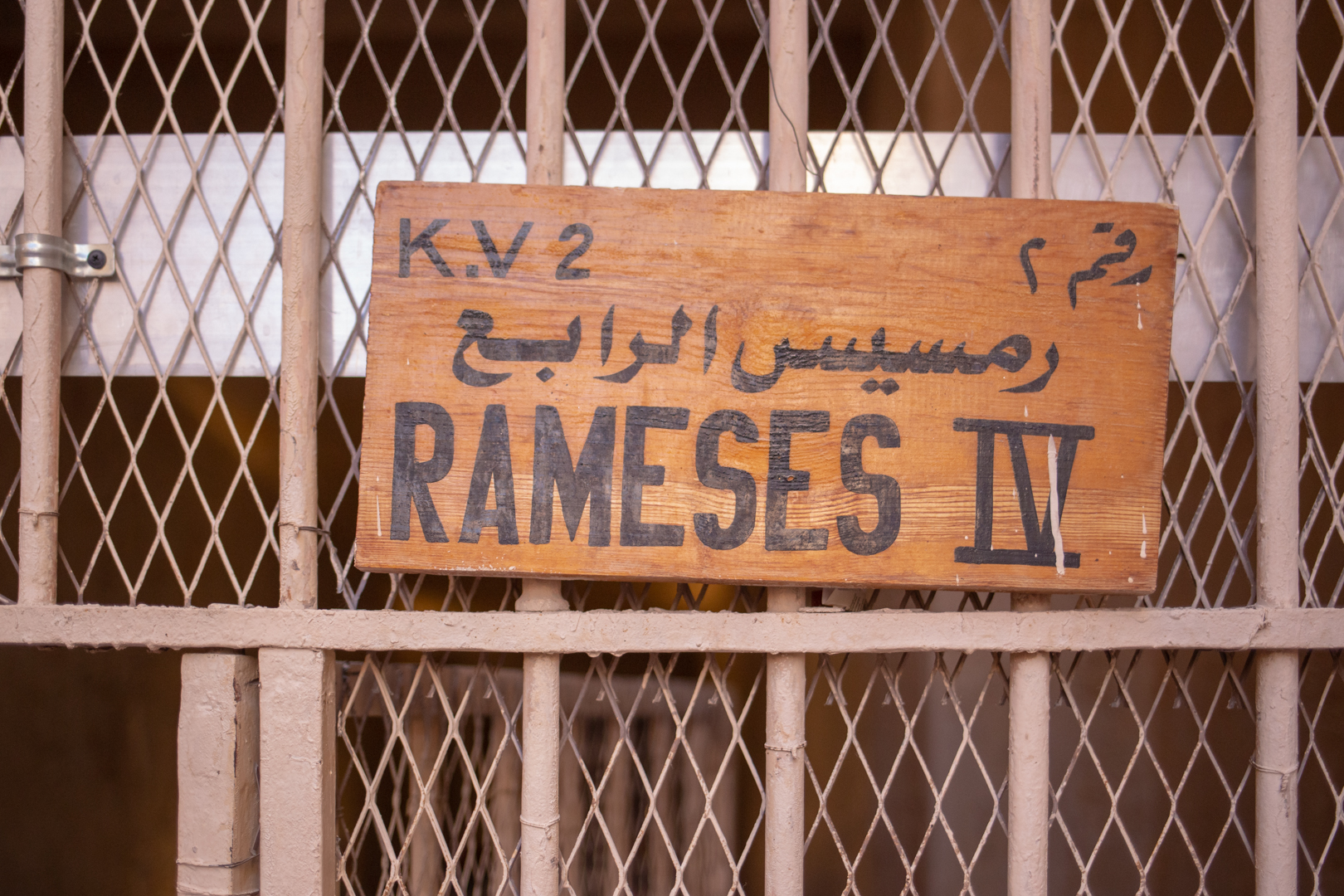


KV2, the tomb of Rameses IV, has been open since antiquity but is somehow still covered in colorful carvings and reliefs of scenes from the following funerary texts: Litany of Ra, Book of Caverns, Book of the Dead, Book of Amduat and the Book of the Heavens.
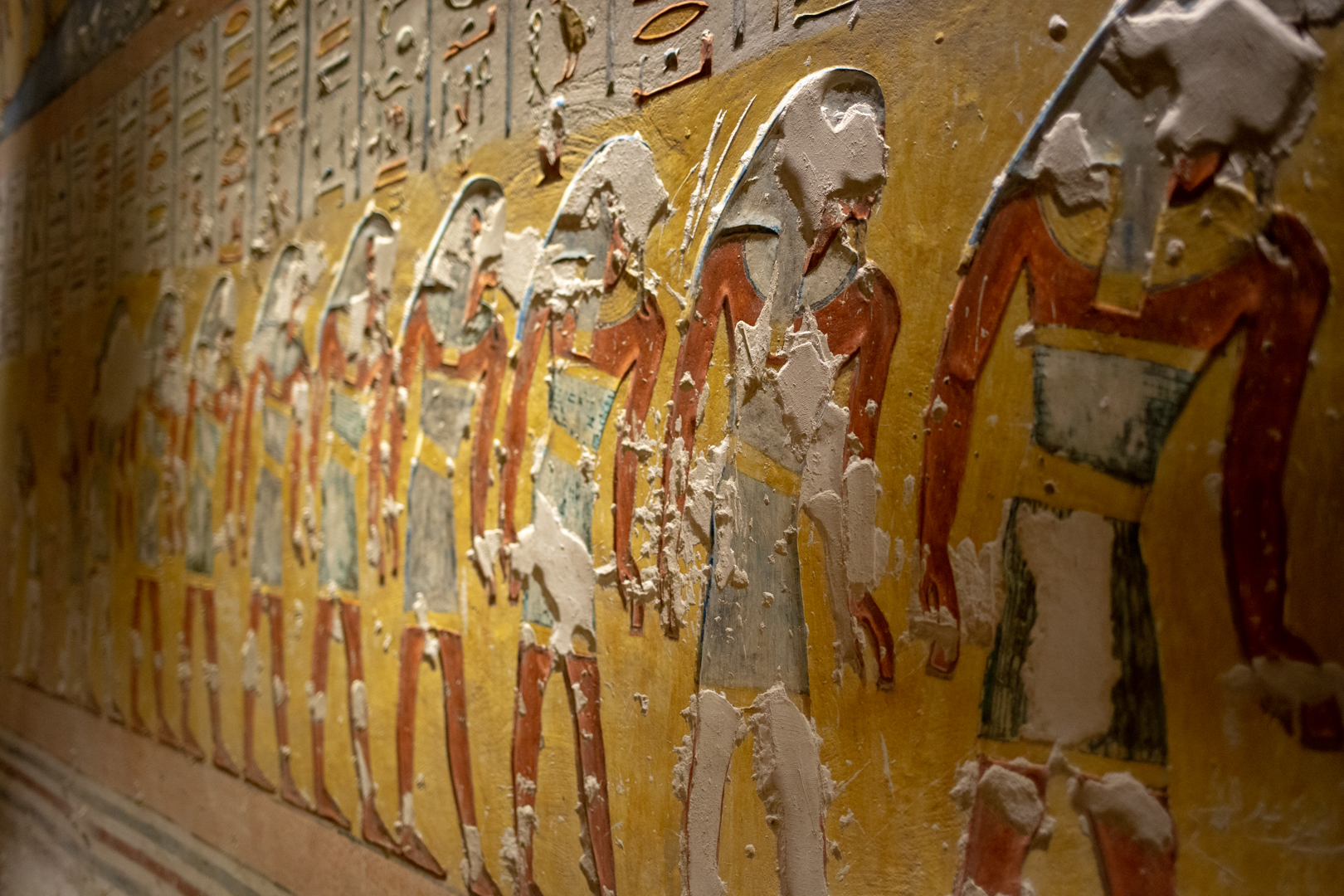
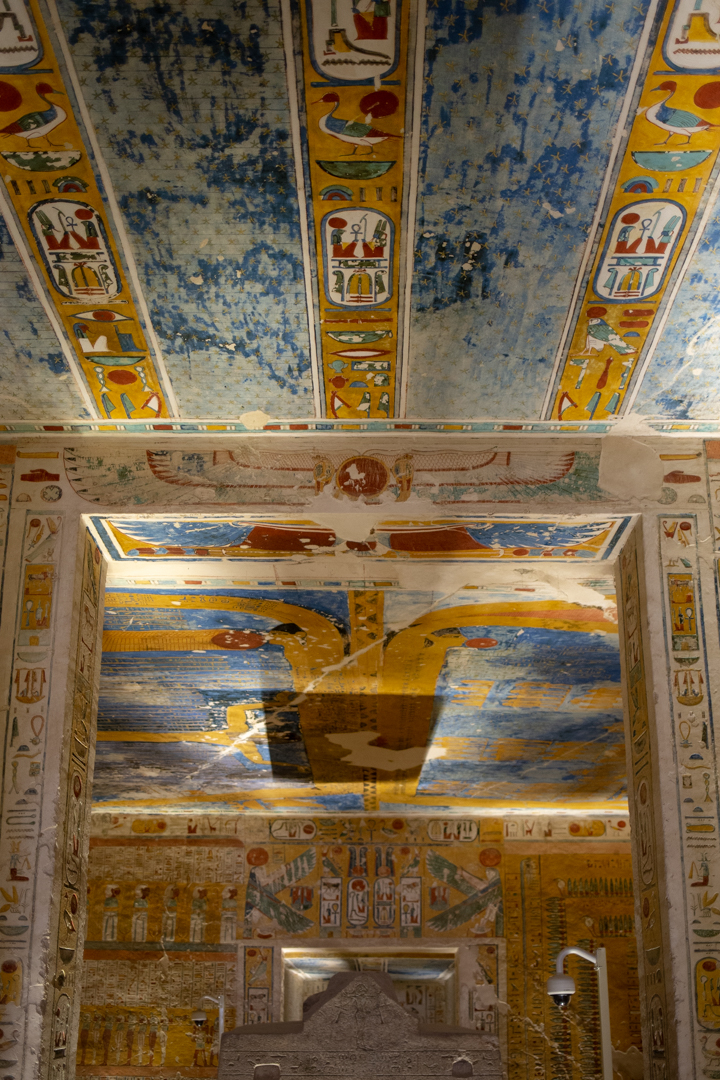


One of the things I was most blown away by in Egypt was the meticulous planning of the Ancient Egyptians, and there were two plans discovered for the layout of KV2—one on papyrus and one inscribed on a slab of limestone. The tomb has three corridors followed by a large chamber and the burial chamber. Past the burial chamber is a narrow corridor and three side chambers. The successors of Rameses III (there were at least eleven Pharaohs that took the name Rameses) constructed and decorated their tombs in a similar style.

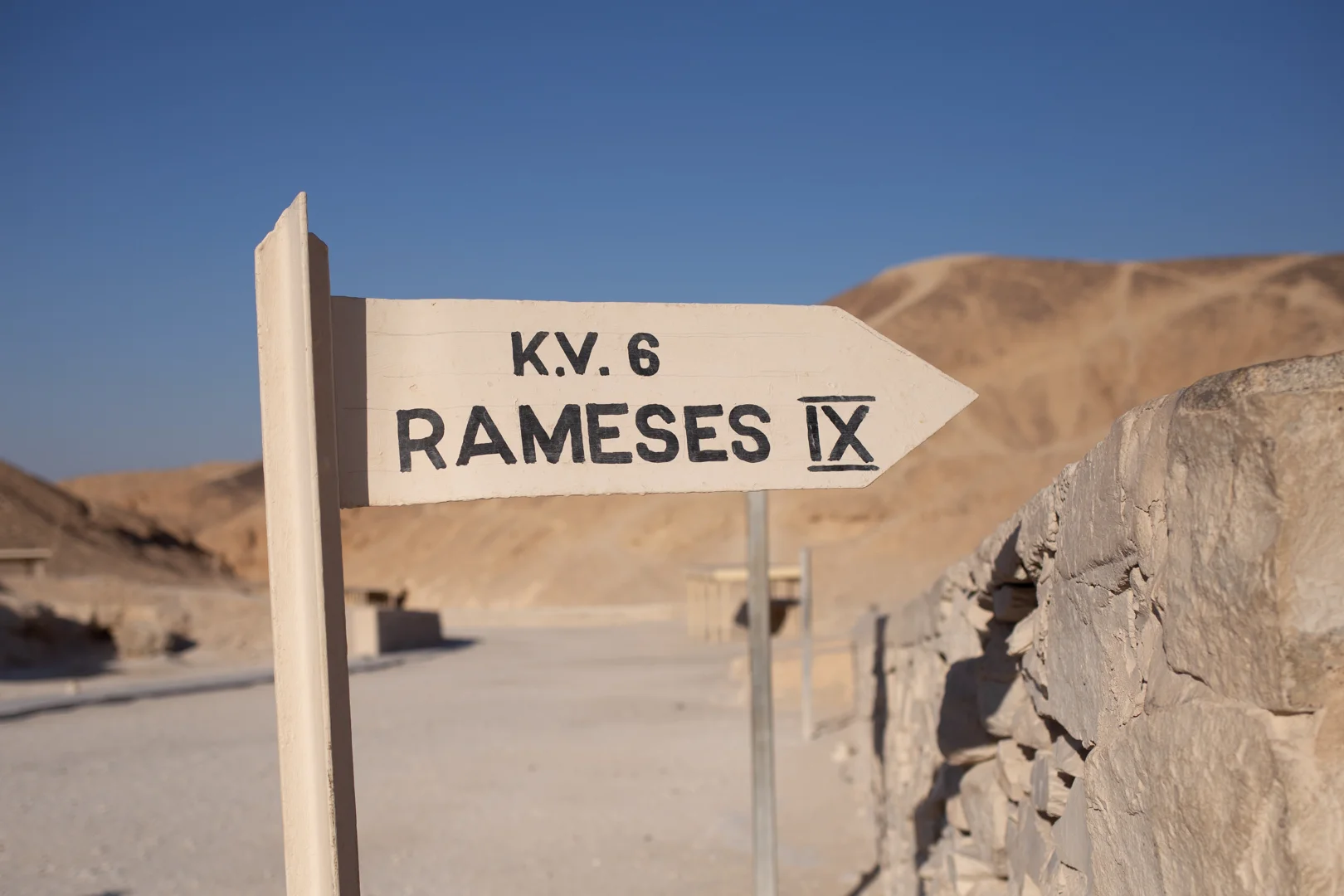


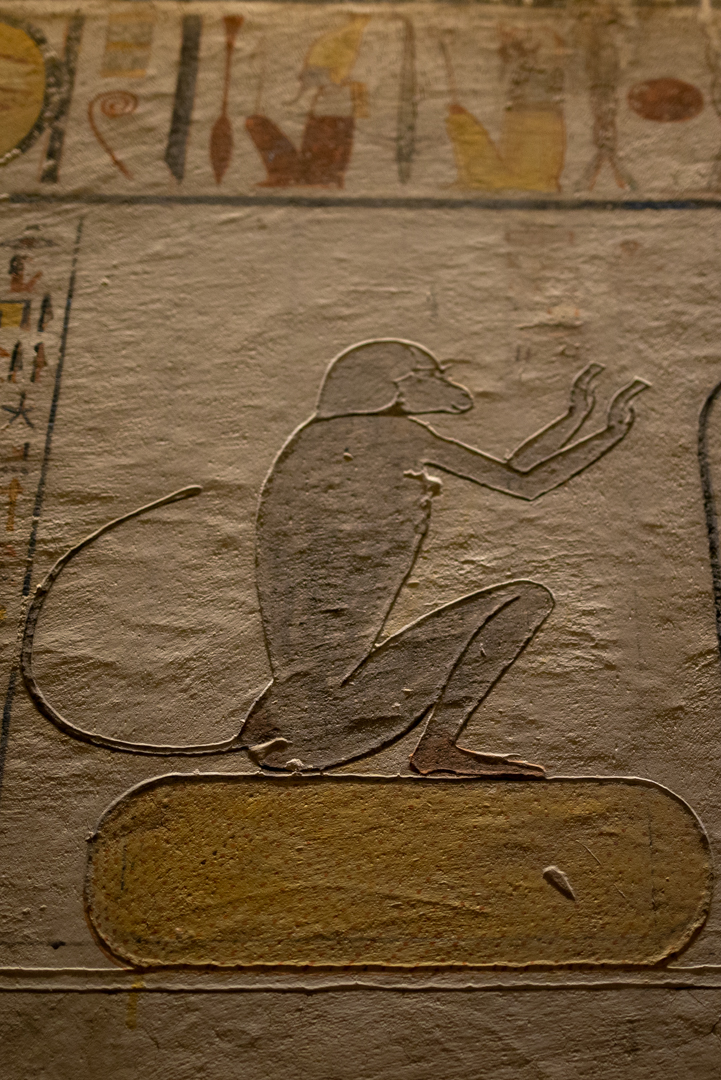


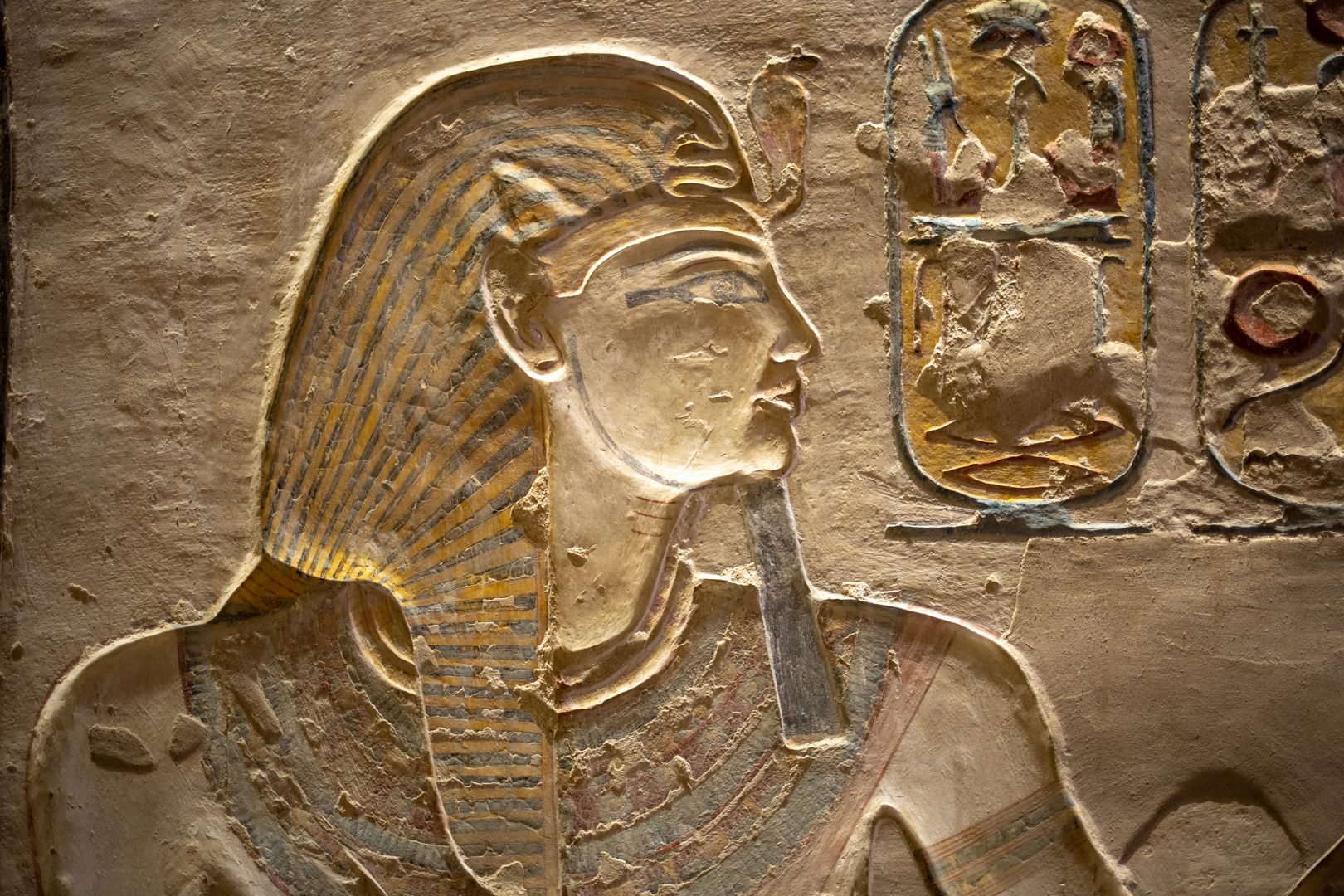
KV6 was the final resting place of the 20th-dynasty Pharaoh Rameses IX. There are indications that the tomb was not finished at the time of Rameses's death and that it was rushed to completion. Graffiti left by Roman and Coptic tourists can be seen on the tomb’s walls.


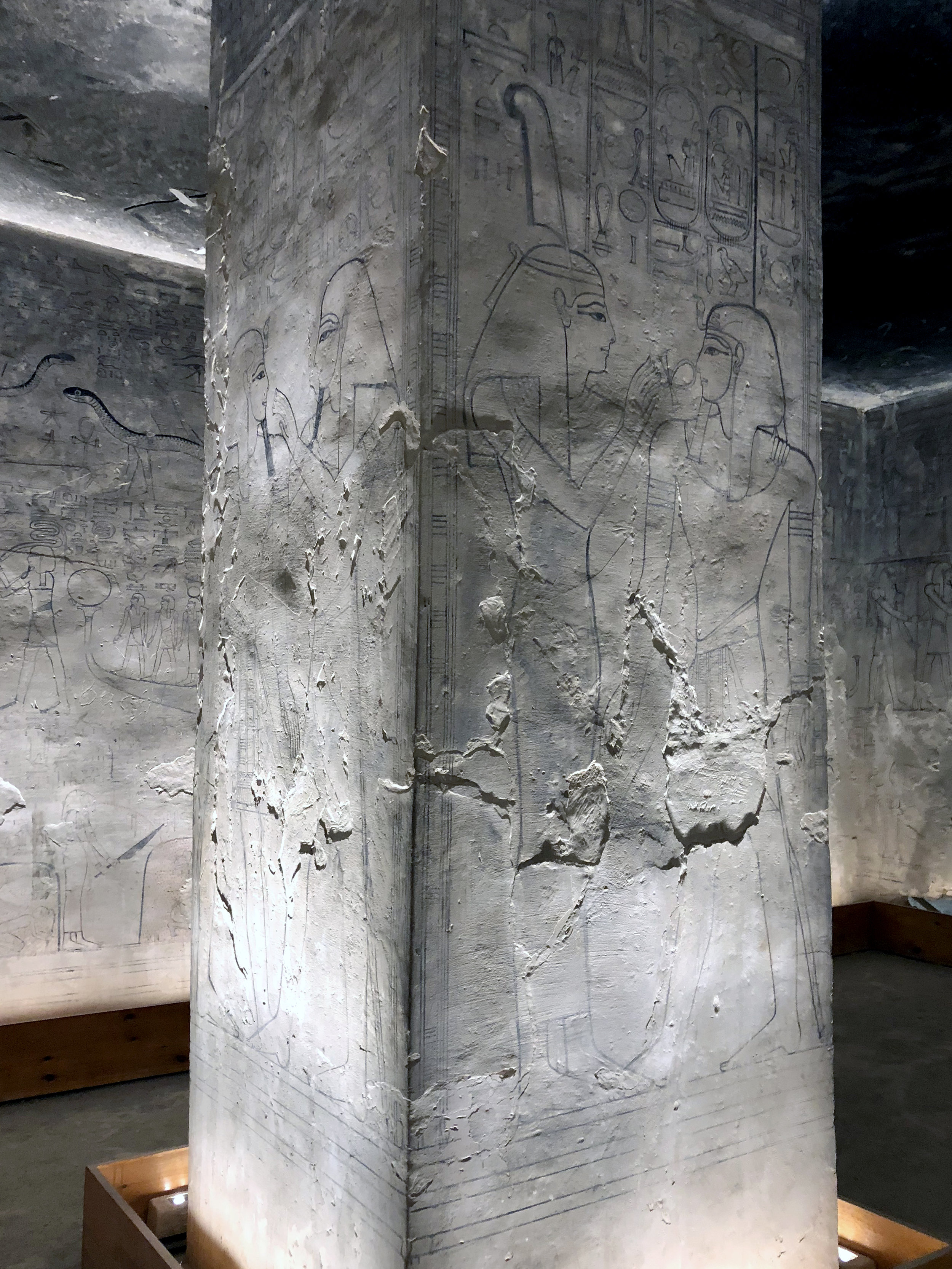

The most dazzling of all the tombs we saw in the Valley of the Kings, however, belonged to Seti I. KV17 was discovered in 1817 by Belzoni, and it also requires a separate ticket for entry. If you only have time to see one tomb in the Valley, I would direct you to this one, which contains beautifully preserved decorations in all but two of its eleven chambers and side rooms. Work on the tomb was abandoned upon the death of Seti, and although photography wasn’t allowed I couldn’t resist snapping a few photos of the unfinished drawings that offer a rare glimpse into the Ancient Egyptian’s artistic process.
Bonus Mummy Content:
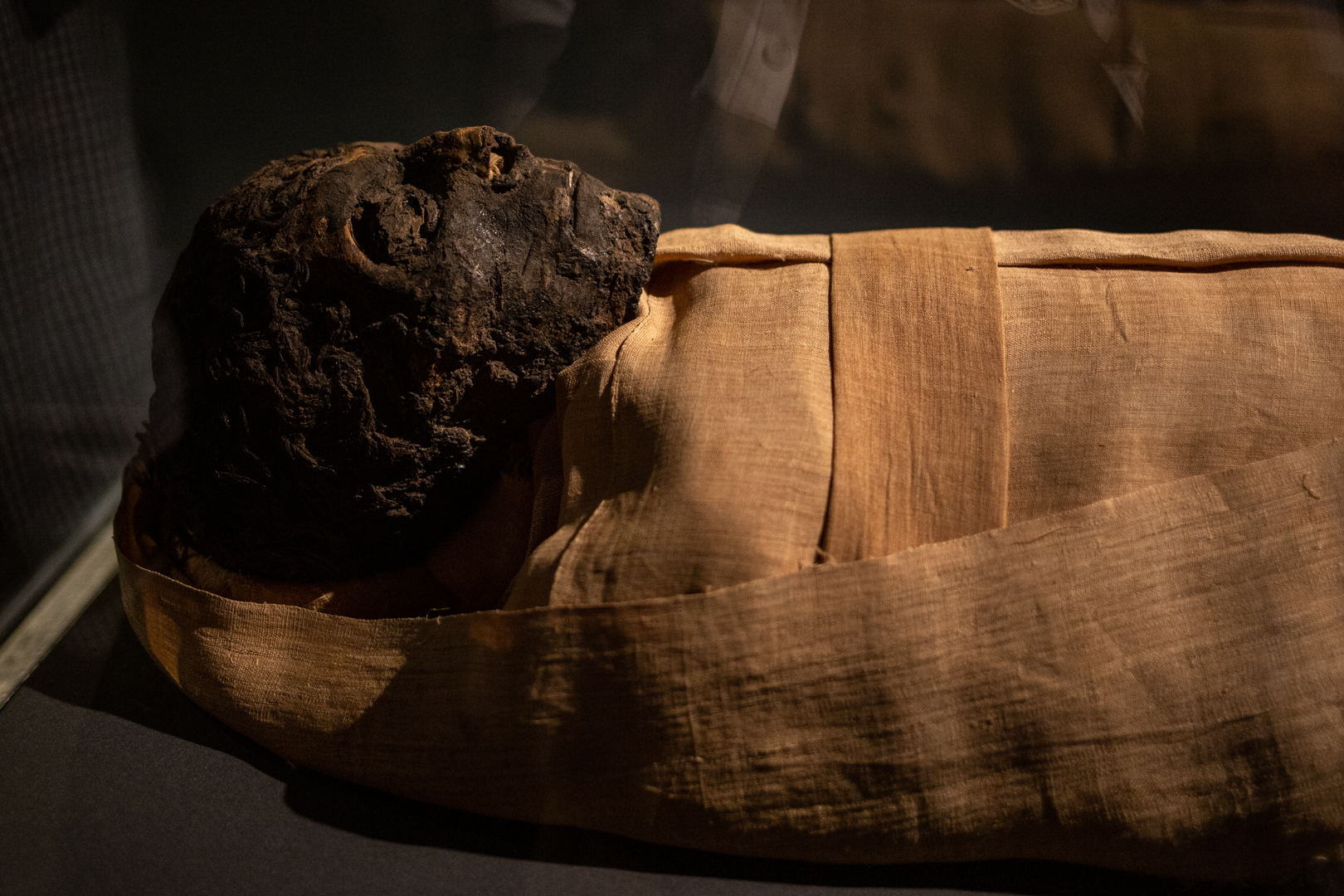


In 1881, a tomb-robber discovered a tomb at Deir el-Bahri containing the mummies and funeral equipment of more than 50 kings, queens, and other royalty, including mummies that have been identified as Rameses IX and Seti I. A separate cache was discovered in the Valley of the Kings, containing more than ten mummies, one of which was identified as Rameses IV. The only mummy still in his original tomb is King Tut’s, but the others can be viewed at the Egyptian Museum (no photos allowed in the Royal Mummy rooms) and in the Luxor Museum.


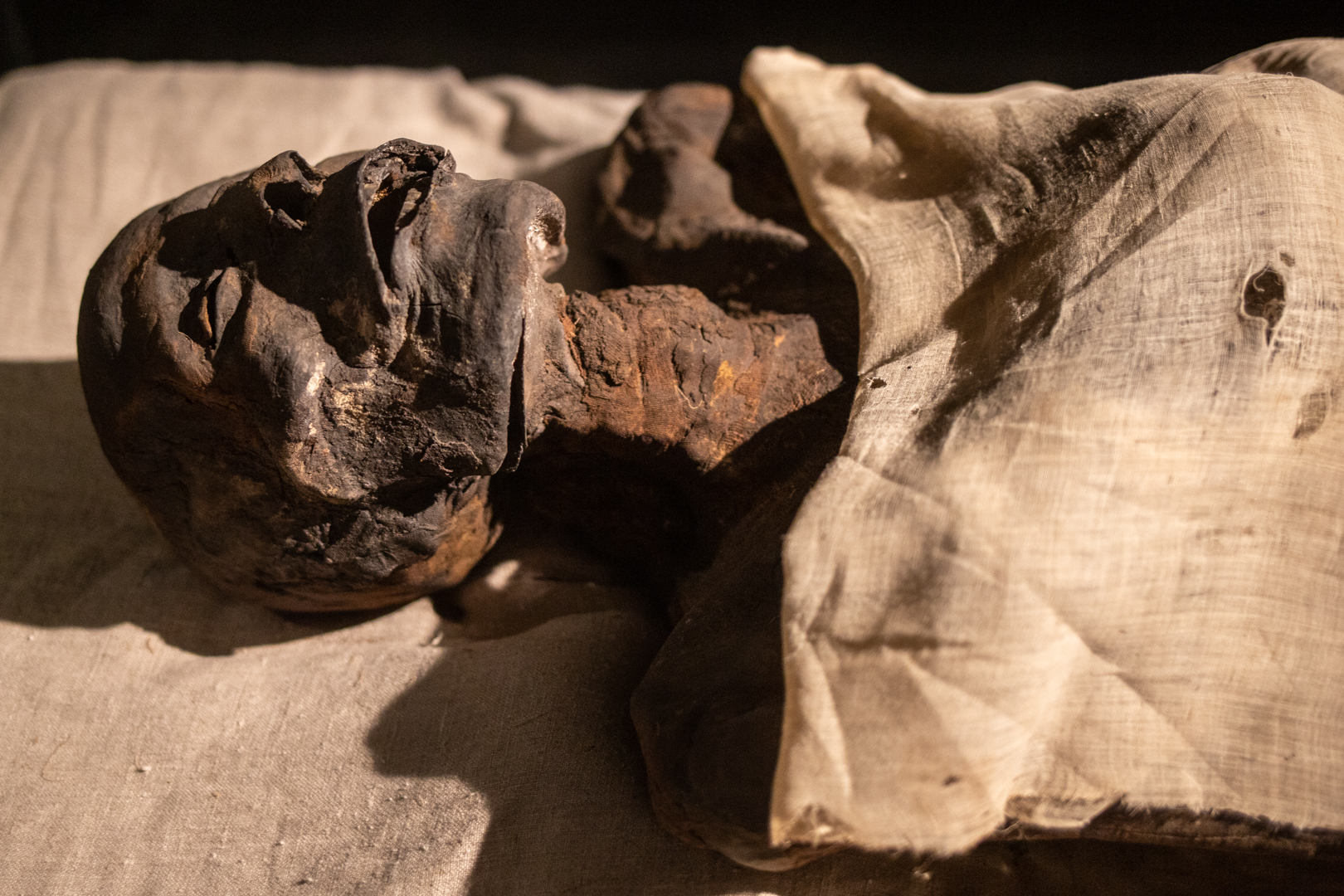
One of the mummies currently at the Luxor Museum took a rather circuitous path to get there. A Canadian doctor purchased one of the mummies from the Deir el-Bahri cache and it soon ended up at the Niagara Falls Museum. The museum exhibited curiosities (my kind of museum) and its collections traveled between Canada and New York before it closed in 1999.
In the 1980's, the mummy was tentatively identified by a German Egyptologist as Rameses I, and when the museum closed it was sold to the Michael C. Carlos Museum at Emory University in Atlanta. The mummy was studied and identified as royal—its arms were crossed right over left on its chest and radiocarbon dating placed the mummy from sometime between 1570 to 1070 BCE. In 2004, it was returned to Egypt and is now resting much closer to its original home, just across the Nile in the Luxor Museum. The Rameses I designation remains controversial, and the placard in Luxor simply identifies it as a Royal Mummy.
💀 Happy Halloween! 🎃

Travel Guide: Sleepy Hollow
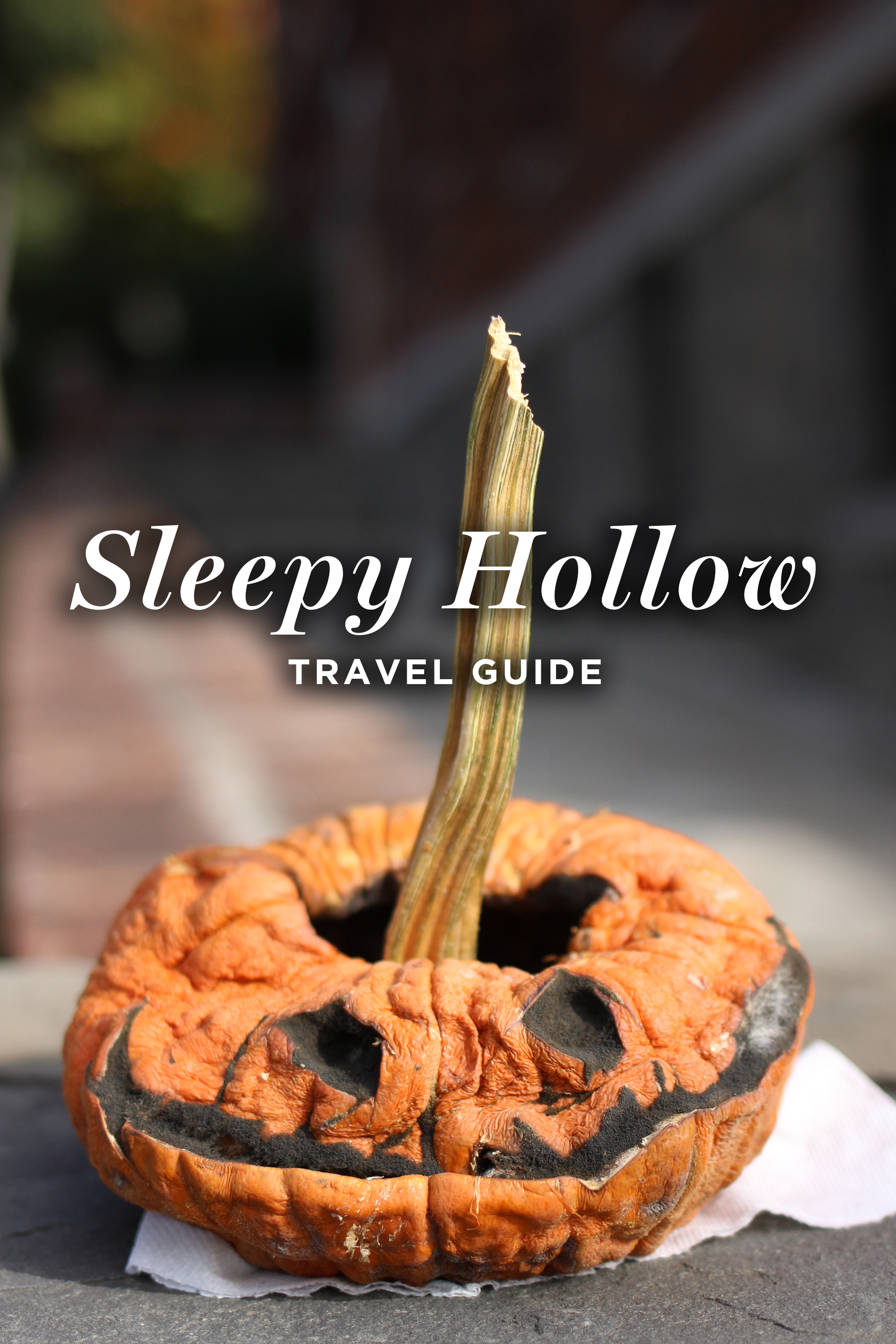
This weekend marked my fifth fall adventure to Sleepy Hollow, aka North Tarrytown in the Hudson Valley of New York. When I lived in Ohio, I remember only dreaming of a trip to the village made famous by Washington Irving, so as soon as I moved to the city I made it my number one fall priority. It was better than I even expected, and I’ve gone every year that I’ve lived here—except 2016, but I went to Salem that year, so that’s a valid excuse.
There are plenty of non-Halloween related activities to do in and around Sleepy Hollow, but to get the full effect it’s best to visit in October (keep in mind that while it’s not as crowded as Salem, ticketed events sell out very quickly so get them as soon as they go on sale in early September from Historic Hudson Valley).
GETTING THERE:


My favorite part about Sleepy Hollow is that you don’t need a car to get there. It’s under an hour by Metro North from Grand Central to the Tarrytown station, and trains run frequently. Once you’re in Tarrytown you can use a car service like Uber or Lyft to get you into town or to the sites nearby, but most things are within walking distance of the train station. We did have an issue once with spotty cell service when we were relying on Uber to get us back into town after visiting Union Church, but after renting a Zip Car one year (and dealing with the traffic on the one, two-lane road that runs through town), I’m solidly team public transit.
WHAT TO DO:




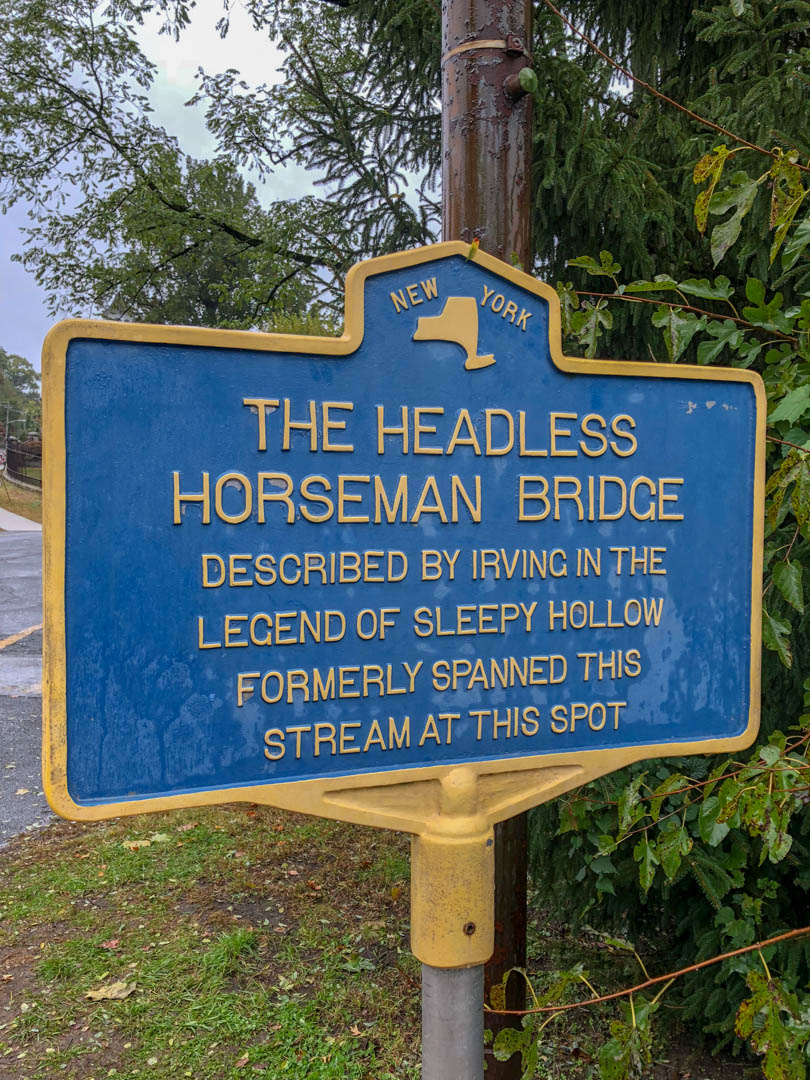
There is no doubt that Irving’s short story, The Legend of Sleepy Hollow is the reason why the area is a popular October destination. In fact, North Tarrytown officially changed their name in 1996 to Sleepy Hollow, the traditional name for the area. Purchased by Irving in 1835, Sunnyside is a National Historic Landmark and a museum containing a large collection of Irving's original furnishings and personal items.
Located in the nearby town of Irvington, the house is open May-November and tours are led by guides in period costume. In the fall you can also “create Halloween-themed art activities, explore the grounds on a literature-themed scavenger hunt, play historic games, pose for a spooky photo op, and take in a shadow puppet performance.”


Kykuit was the 40-room home of four generations Rockefellers, beginning with John D. Rockefeller, founder of Standard Oil and noted philanthropist. The stone mansion is situated on the highest point in Pocantico Hills, overlooking the Hudson River and on a clear day you can see the New York City skyline. In addition to the house, the property includes beautiful gardens and an impressive art collection.
If you want to see something specific make sure you choose the right tour—I’ve been twice, and I would definitely recommend making time for the grand or classic tours. Although Kykuit is located outside of the village, tours originate from the visitor center at Philipsburg Manor (across from the cemetery) and a shuttle bus takes you to and from the estate.

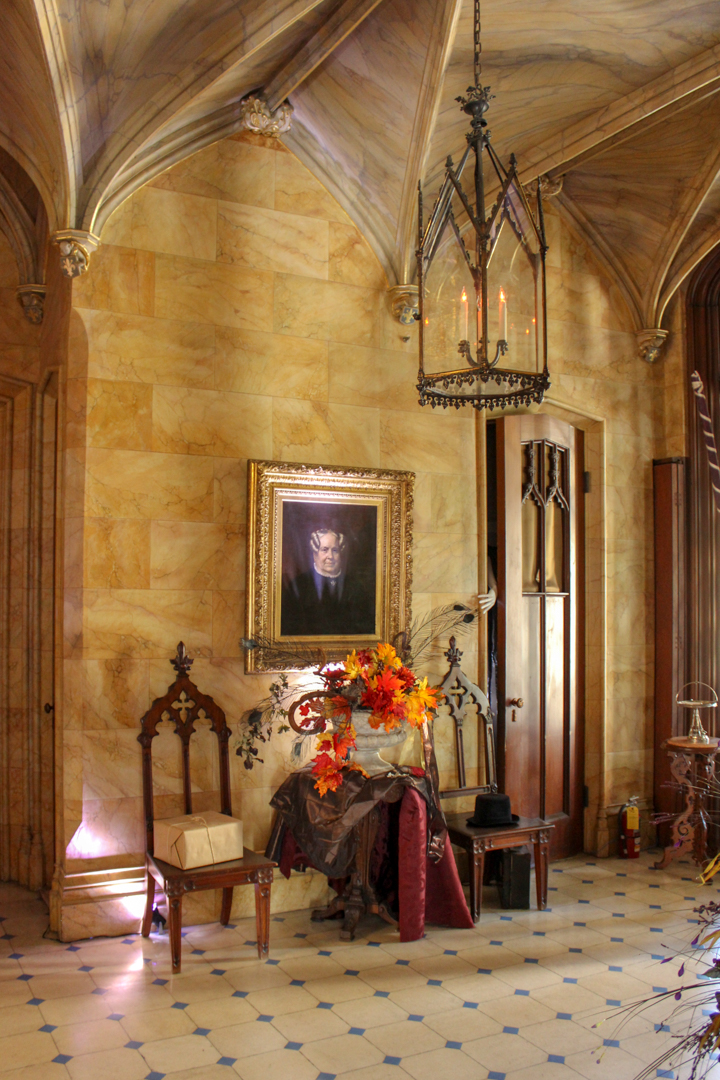

Lyndhurst, a Gothic Revival mansion, was designed in 1838 and had five different owners from three different prominent families before it became part of the National Historic Trust for Preservation in 1961. The mansion is furnished with original furniture/décor from all five owners so the inside is just as interesting and historic as the outside (and, if I’m picking favorites, it’s my favorite of the historic homes in the area). The 67-acre grounds include the bones of the nation's first steel-framed conservatory, a stand-alone bowling alley, a rose garden and a children's playhouse all with sweeping views of the Hudson River.
Open for tours March-December, the mansion and grounds were decked out for Halloween when we visited. Even without the extra help, Lyndhurst is spooky enough on its own and has appeared in numerous movies and TV shows including two star turns as the Collinwood Mansion in the 70’s films House of Dark Shadows and Night of Dark Shadows.


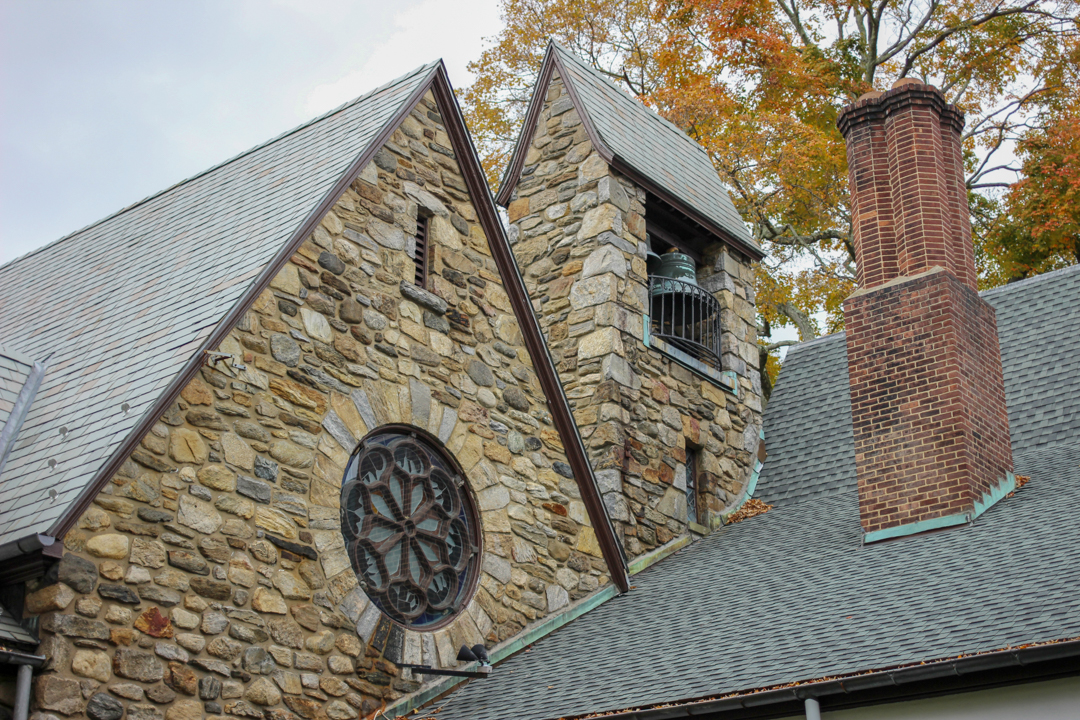
The church itself, built in 1921 by John D. Rockefeller, Jr., is pretty standard but the church’s rose window was the last work completed by Henri Matisse before his death in 1954. Nine other stained glass windows were created by Marc Chagall, who didn’t start designing in glass until he was nearly 70 years old. Other Chagall windows can be found around the world and in the UN building in New York.
The church is open from April-December with varying hours depending on the worship schedule, there is a suggested donation if you visit just to see the windows, and photography is not allowed inside. The church isn’t really within walking distance from the village (and it’s up in the hills), but it’s just a short car ride away (again, beware the spotty cell service).


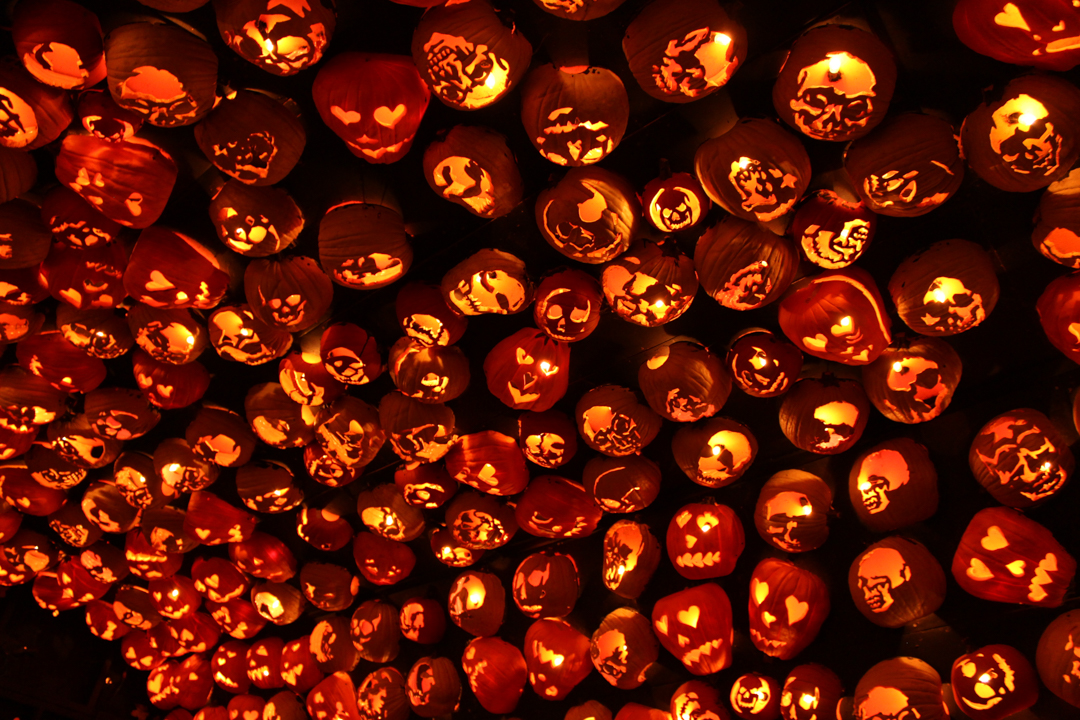

The Great Jack O’Lantern Blaze is what put this area on my radar eight hours west in Ohio. Held every year at the historic Van Cortlandt Manor in Croton-on-Hudson (not exactly walkable from town, but just a short car ride north), the Blaze seemingly gets bigger and more popular every year. Tickets for weekends close to Halloween sell out very quickly, but it’s worth some advance planning to see more than 7,000 hand-carved and illuminated jack o’ lanterns (spoiler alert: they’re mostly fake, but there are some real pumpkins mixed in). I’ve been to the Blaze twice and can attest that, while there are some repeats from year to year, enough changes that you could go again every year and still be thrilled.

Billed as “Sleepy Hollow’s premiere haunted attraction,” Horseman’s Hollow is like corn maze and a haunted house combined. Set outside on the grounds of Philipsburg Manor, guests—if you dare!—walk along a haunted trail populated by all types of spooky scenes and creepy people. I’ve never been a huge fan of paying to be frightened, but I’ve gone through Horseman’s Hollow twice and I think I finally understand the appeal of these attractions. Skulls, spiderwebs and mannequin parts don’t actually scare me—have you seen my apartment?—but there is a strange sort of thrill in watching your friends get (harmlessly) startled and in surrendering to it all yourself.


Speaking of tickets selling quickly, this is the first year I was actually able to secure tickets to Irving’s Legend, a dramatic retelling of the famous Legend. Held at the Old Dutch Church (located within Sleepy Hollow Cemetery), the story is told by one man, accompanied by one musician. It’s low-tech, old-fashioned storytelling at its best and it’s the perfect way to get acquainted (or reacquainted) with Irving’s spooky tale.

This was a new event for the 2018 season, an original silent film starring Bill Irwin accompanied by live musicians and special effects provided by a Foley artist. Inspired by Washington Irving’s The Adventure of the Mysterious Picture, the film was shot on location at Van Cortlandt Manor. I’ve never seen a silent film before, but I was just as interested in watching the Foley artist produce sound effects for every character as I was in watching the actual movie.



Details on when to secure tickets to the Village of Sleepy Hollow’s Haunted Hayride are a little murky but this year I just kept checking the website and eventually was able to buy tickets. Tickets go on sale “sometime in September” only through the villages’s website, and the Hayride is for two nights only—the Friday and Saturday before Halloween. It started raining just as we were settling into the bed of hay (pulled by a pickup truck), and it wasn’t nearly as scary as walking through Horseman’s Hollow—but we felt about as far away from New York City as we could get, while still being a short train ride away.


One of my favorite cemeteries (and I’ve seen…a few), Sleepy Hollow Cemetery is home to a number of famous residents, including a Rockefeller, a Chrysler, the Helmsleys, Andrew Carnegie, Elizabeth Arden and, of course, Washington Irving himself. Formally opened in 1849, the cemetery is 85 acres and has over 40,000 in-ground interments. They offer day and night walking tours but keep in mind if you’d like to explore on your own that the grounds close promptly at 4:30 pm every day.
WHERE TO EAT:

Located on Main Street, just up the hill from the Tarrytown train station, Muddy Water is a great place to stop and fuel up before beginning your fall adventure day. There is plenty of cozy seating, the coffee was good, the blueberry scone was delicious (have them heat it up) and my order came to a very festive total of $6.66.


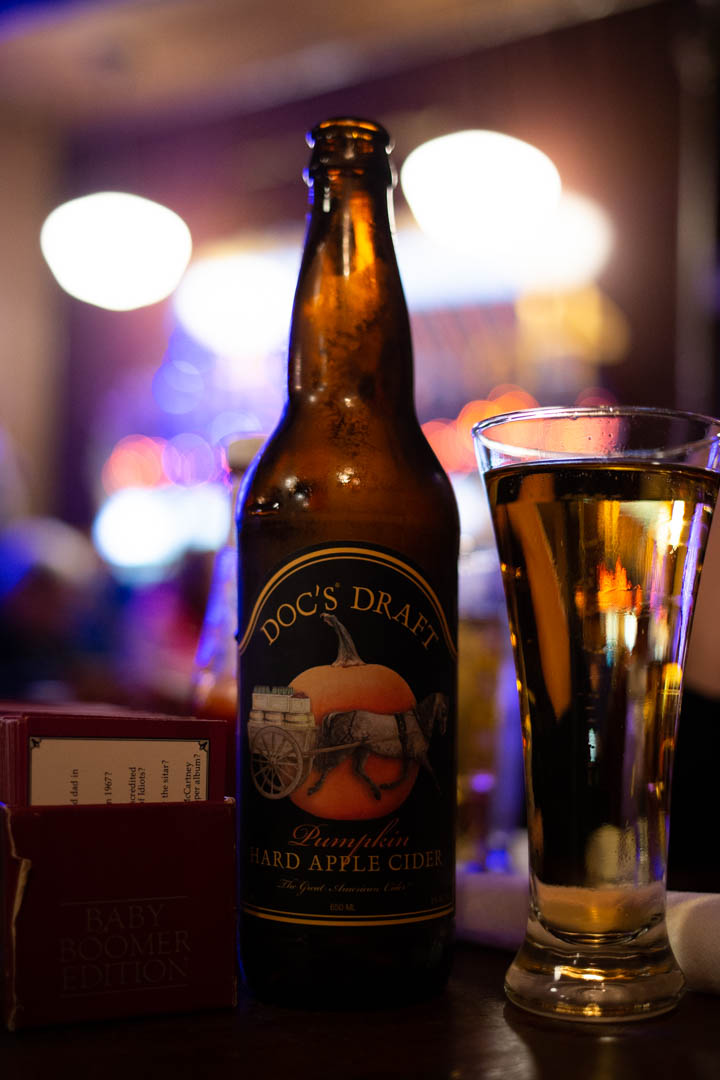
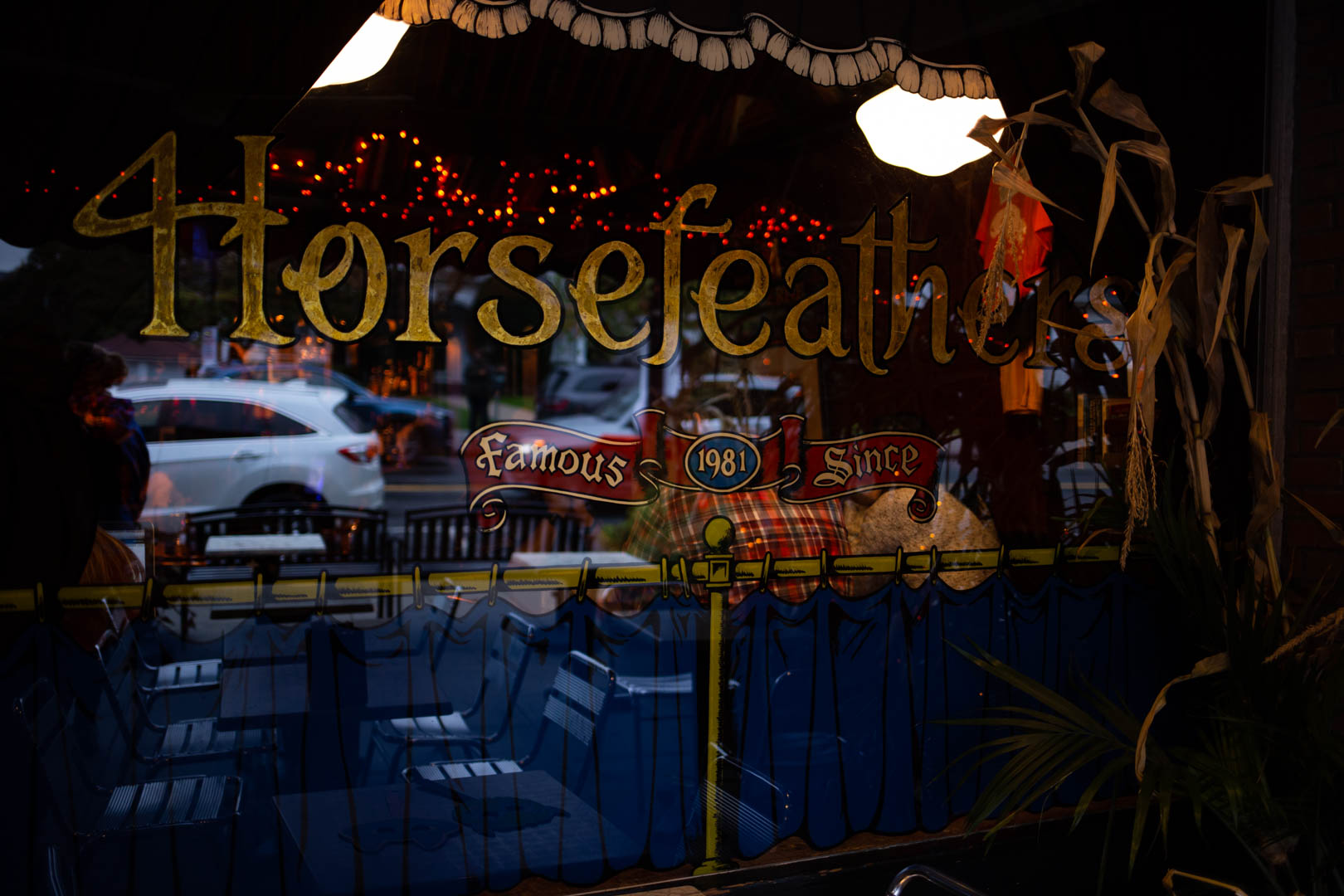
This section is short because I really only ever eat dinner or lunch at one place in Sleepy Hollow—Horesefeathers—and I love it so much that I can’t bring myself to try anywhere else. Ok, so we did make the mistake of eating at The Huddle once and it was terrible, so learn from us (here is the Yelp review by my friend Alisha, detailing our issues) and stick with Horsefeathers.
Family owned since 1981, Horsefeathers is exactly the kind of dark, wood-paneled bar that you’d expect to find in the area, and I dream about their Knickerbocker burger (paired with a seasonal cider) all year long. As if that wasn’t enough of an endorsement, they’re usually playing a Halloween movie at the bar (one year it was Casper) and they have ancient boxes of Trivial Pursuit cards on every table (Sample Q: Which country pulled out of NATO in 1967?), so at least stop in for a drink.
Want more? See all of my Sleepy Hollow posts here.

Happy Friday!

My five seconds of Internet fame | Thumbnail illustration by Lindsey Frances
Things that happened recently:
Trump critics are getting sent bombs, Chinese and Russian spies are listening to our idiot President’s conversations, superfoods are a lie and even escalators are going rogue—but at least the second season of The Marvelous Mrs. Maisel finally has a release date (look for my apartment in the background of the last episode)!
A man’s body was behind the wheel of a parked car for a week before it was discovered that he had been dead the entire time.
Things to do in New York this week:
Sunday you have not one, but two dog costume events to choose from: the Tompkins Square Halloween Dog Parade, held at the East River Park Amphitheater located along side the FDR at Grand Street in East River Park from noon - 3pm, and the 20th Annual Great PUPkin Dog Costume Contest, beginning at 11:30 am in the Fort Greene Park monument plaza.
Wednesday is Halloween and you can catch me recycling my costume from last year (hey it got me on Gothamist, can you blame me?) at the 45th Annual Village Halloween Parade.
If the parade is not your thing, maybe you’d like to help impale the most pumpkin heads ever on a Cobble Hill fence (from 3-7pm on Halloween)?
Things that I’ve discovered recently:
I’m obsessed with this National Parks-inspired custom wallpaper. See it in action here.
Halloween is obviously my favorite holiday, but it’s never too soon to prepare for what’s next.
I just finished Martin Short’s incredibly funny (and heartfelt) memoir, and I spent my lunch break crying with hysterical laughter while watching this Jiminy Glick compilation. Why is Primetime Glick only available on DVD—and why is it so expensive??
We have plans (and non-refundable tickets) to visit Sleepy Hollow on Saturday, and I’m hoping that the weather isn’t as frightful as they’re predicting. Thankfully, two out of the three ticketed events are indoors, and I’ve been dreaming about a Horsefeathers burger since our trip last year. I’m glad I’m not just imagining that these early wintery days feel more brutal than actual winter days with similar temperatures (because science!), but I’m still glad that I’m not sweating every single second of the day. October through March is my favorite time to be in the city. I didn’t go overboard with Halloween preparations this year (me? go overboard? never!) but I still have to make sure my costume is street-ready before Wednesday. I hope you have a great spooky weekend and if you’re in the northeast try to stay dry!

Woodlawn Mausoleums

I don’t have great luck getting into Woodlawn Cemetery. I was turned away at the gates on two separate occasions due to snowy conditions (the exact reason why I wanted to visit) and I had tickets to an evening illuminated mausoleum tour that was rescheduled three times due to rain (on the day that it finally did happen, I was unavailable).
Woodlawn is every bit as beautiful as its Brooklyn counterpart, Green-Wood, and much easier to get to now that I live back in northern Manhattan. My mom and I recently took a NY Adventure Club tour inside some of the mausoleums at Woodlawn that was thankfully still held, despite the rain.


The first mausoleum that we got inside of belongs to Dr. Clark W. Dunlop. Dr. Dunlop made his fortune from the sale of medical manuals and several patent medicines including Dr. Dunlops King of Pain, and a laxative called Dr. Dunlop’s Cascara Compound. The granite mausoleum has several design elements that are bird-themed, and for good reason: Dr. Dunlop’s beloved pet parrot is also interred within the mausoleum.


Dr. Dunlop, most likely suffering from the end-stages of syphilis, was declared mentally incompetent in 1907 and—despite being treated by a dubious doctor and his pair of “magic mechanico-physiological” boots—died in 1908. The parrot joined Dunlop in 1921, and his wife came to rest in the mausoleum in 1932.
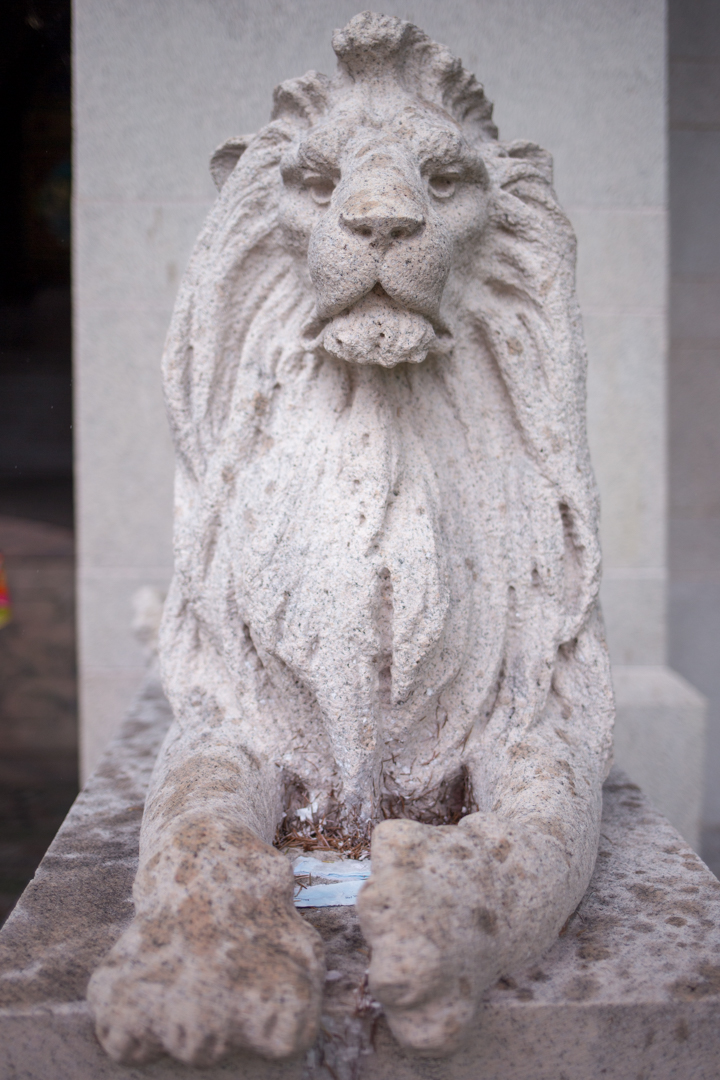


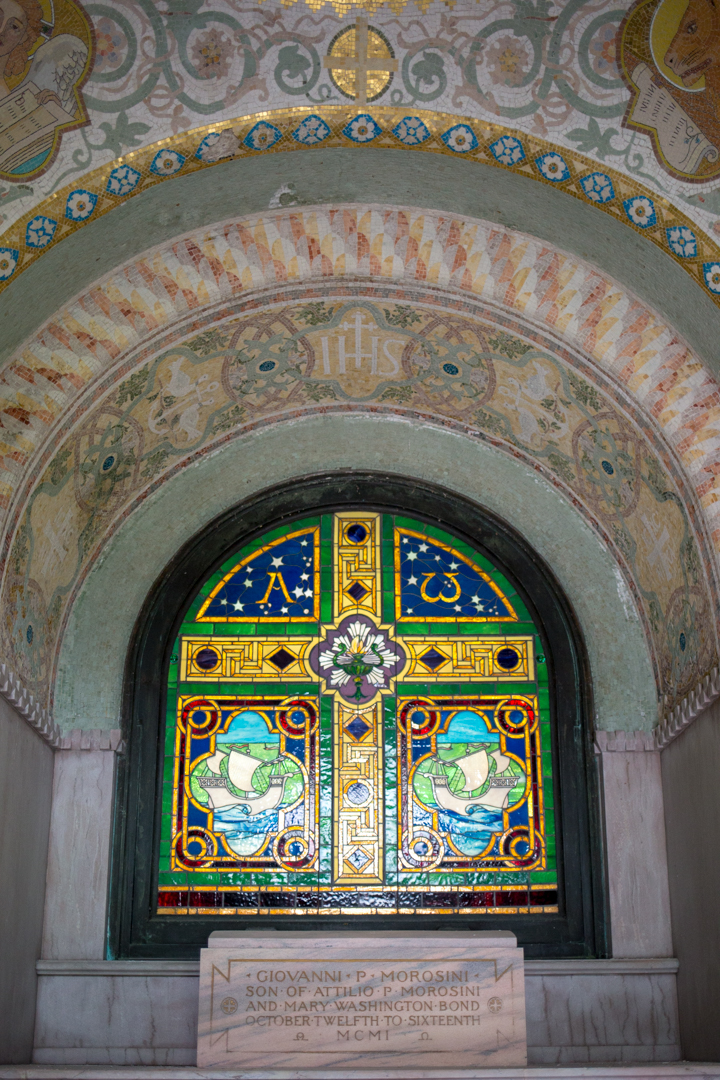

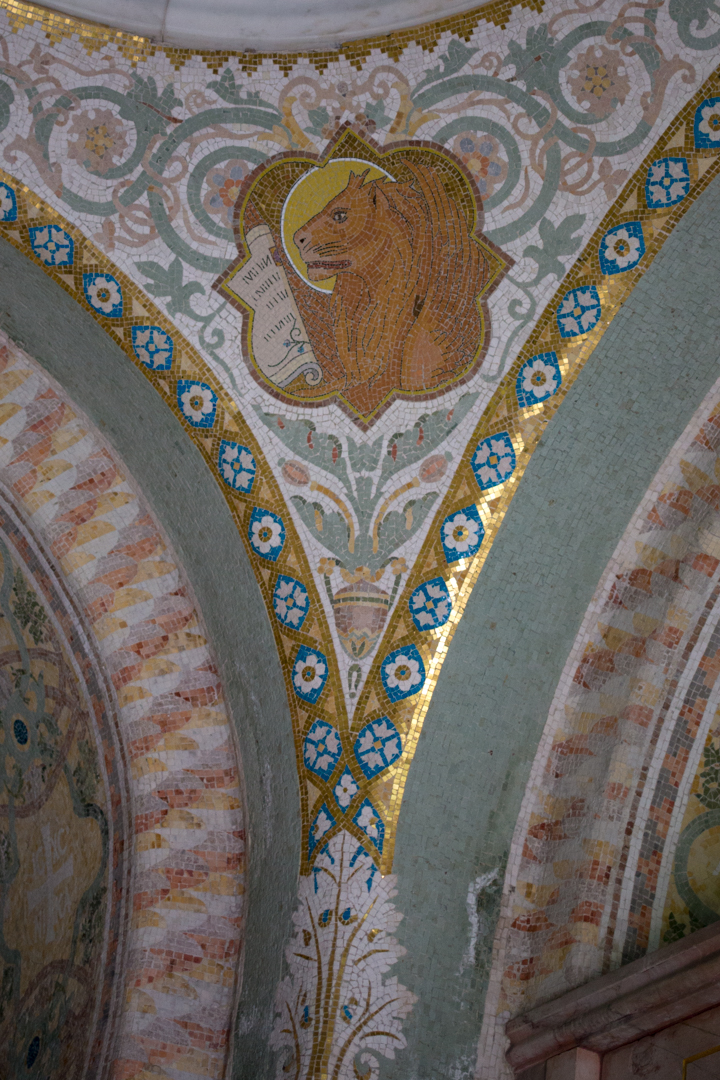
Giovanni P. Morosini, born in Venice, was the confidential secretary of railroad magnate Jay Gould. He amassed a fortune worth several millions of dollars, and there is a Giovanni P. Collection at the Metropolitan Museum of Art. Morosini and his family are interred in a Renaissance-style structure with stone lions flanking the door. There are stained glass windows and a vaulted ceiling with beautiful celestial tile-work reminiscent of the ceiling at Grand Central Terminal.

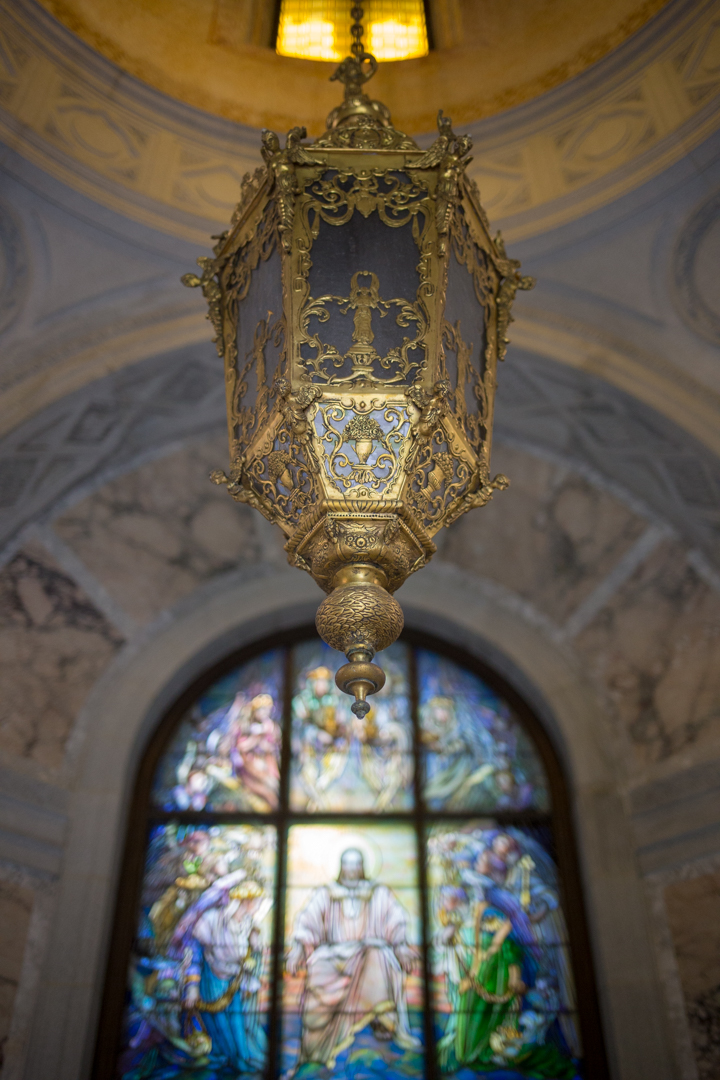


I joke about some grand mausoleums being more spacious than my studio apartment, but that might actually be true of John H. Harbeck’s final resting place. Harbeck inherited a fortune from his father, the founder of a substantial Brooklyn warehousing empire known as the Harbeck Stores.
His Renaissance Revival mausoleum was designed in 1918 by Theodore Blake, an architect with the firm of Carrere and Hastings. It sits alone in the middle of a traffic oval, and its double bronze doors are replicas of the north doors of the Baptistery in Florence. Intricate stone carvings flank the doors and the inside is full of beautiful stained glass, a tiled dome ceiling and was set up for electricity even though the plots were never actually wired for it.


George Ehret, born in Germany, started the Hell Gate Brewery and became one of the richest men in New York City. When he died in 1927, his estate was valued at $40 million. He is interred within a huge, 56-crypt mausoleum, flanked by granite lions. The interior includes a domed, Guastavino-tiled ceiling and Tiffany windows. In the ‘70s, most of the Tiffany glass was stolen from Woodlawn and they’ve been slowly recovering pieces ever since.
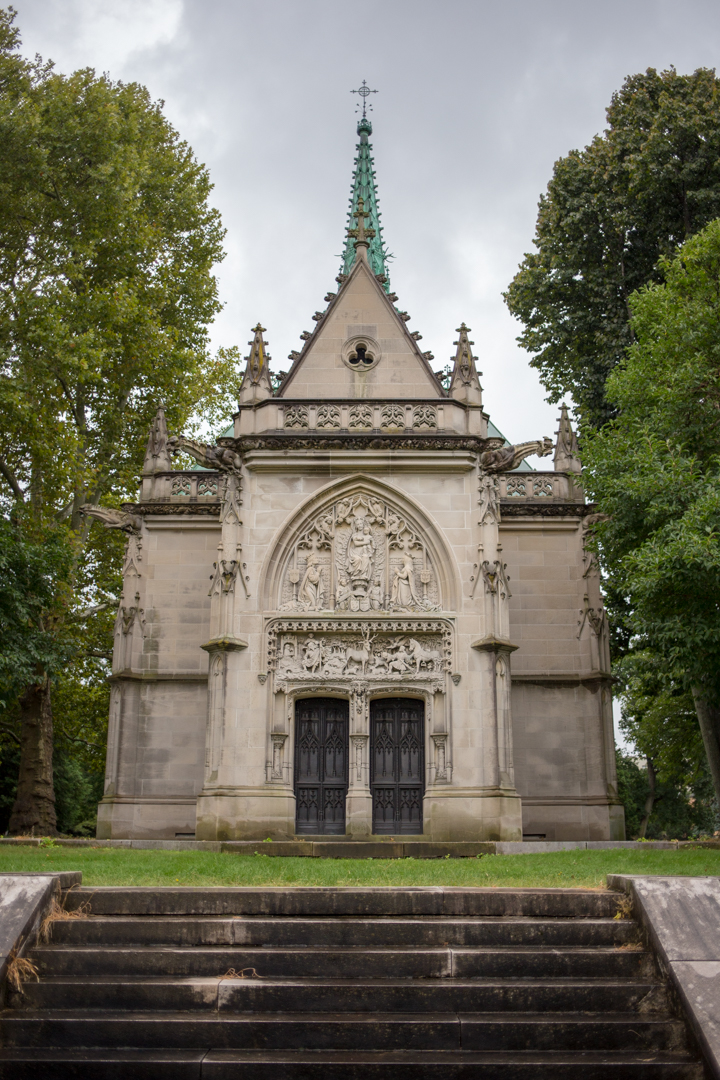


O. H. P. Belmont’s elaborately-carved mausoleum is an almost exact, full-scale replica of the Chapel of Saint-Hubert in France’s Loire Valley. Designed by the architecture firm of Hunt & Hunt, and fabricated in limestone, the mausoleum is the final resting place of Belmont—founder of the Belmont Raceway and a representative in Congress from New York—and his wife, Alva Vanderbilt Belmont. Alva, previously married into the famous Vanderbilt family, used her fortune to support the women’s suffragette movement. The mausoleum contains an original suffragette banner, inscribed with the words, “failure is impossible.”
Woodlawn Cemetery
4199 Webster Avenue
Bronx, NY 10470
8:30 am-4:30 pm every day (except, apparently, when it’s snowing)
Mausoleums aren’t usually open to the public, but Woodlawn and the NY Adventure Club frequently host tours.

Saqqara

Located about 19 miles south of Cairo, Saqqara was the necropolis for the Ancient Egyptian capital of Memphis. There is virtually nothing left in present-day Memphis to hint at the city’s former glory, but the Saqqara complex contains several pyramids, tombs and mastabas.


Arguably the star of Saqqara is the famous Step Pyramid of Djoser. It was built from 2667 to 2648 BCE during the Third dynasty for Pharaoh Djoser by his vizier (the highest official to serve the pharaoh), Imhotep. It’s considered to be the first Egyptian pyramid, the earliest large-scale cut stone construction, and the birthplace of architecture. It started off as a traditional mastaba tomb—flat-roofed with sloping sides—and was expanded several times into the 197-foot-high stone and clay pyramid, with six layers built on top of one another.


Under the step pyramid are chambers and galleries totaling more than 3.5 miles in length, with rooms for the king, his family members, and the storage of goods and offerings. The pyramid is surrounded by a large limestone wall and you enter the complex through a nearly-intact colonnade, with 20-foot columns chiseled to look like a bundle of plant stems.


Nearby on the plateau is the Pyramid of Teti. Teti ruled during the Sixth Dynasty in the Old Kingdom from 2345 to 2333 BCE. You wouldn’t immediately know that this large pile of rubble was once a pyramid, but below ground the chambers and corridors are well preserved. Like most of the tombs in Egypt, the pyramid was looted in ancient times but still contains an unfinished sarcophagus (the first of its kind found to contain inscriptions), a lid fragment, beautifully carved walls and a corbeled ceiling.
The Pyramid of Teti also has the honor of being the first and only pyramid that I actually entered fully. I am extremely claustrophobic and the low ceilings and the hot, airlessness was almost too much for me for me to bear.


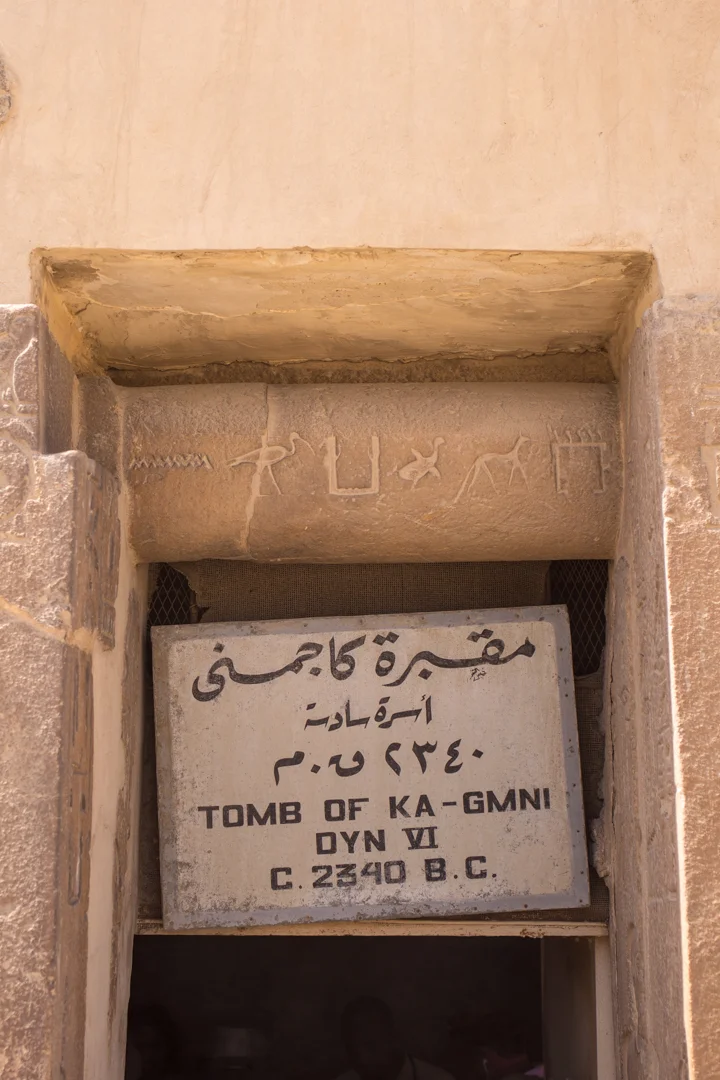


Teti’s vizier Kagemni is buried in the largest mastaba in the Teti cemetery, located right next to the King’s pyramid. The mastaba was rediscovered in 1843 and while the lower registers of the walls are well preserved, the upper registers have been replaced (and are thus devoid of inscriptions).


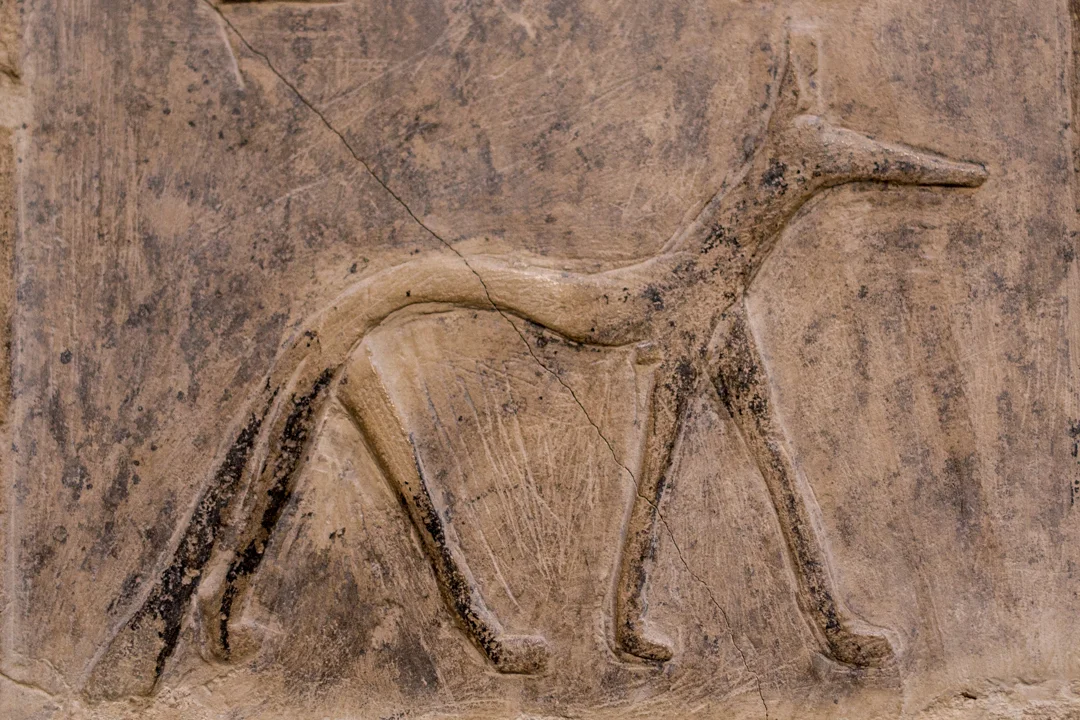
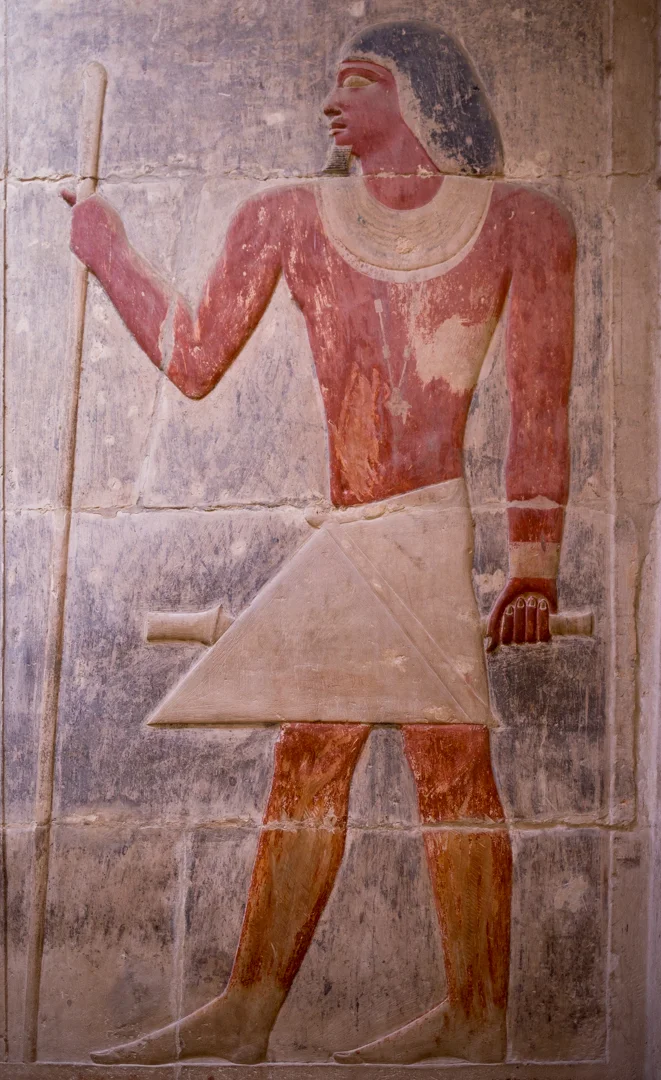

The limestone tomb comprises several rooms covered with beautiful scenes (including one that resembled the Ancient Egyptian version of a Rockettes kickline), some still retaining their original colors. This was my very first time seeing tomb reliefs in color and there really is nothing like it. We saw so many more brightly colored temples and tombs on our trip, and it never ceased to be a thrill.


In addition to being our first pyramid(s), Saqqara was also the first time we truly experienced the great Egyptian souvenir gauntlet. We were warned that we would be hassled by vendors, and while it was at times intense (and always annoying), my New York-honed tactics of ignore, ignore, ignore served me pretty well during this outing and subsequent others. The best piece of advice I received about the Egyptian haggling experience was “It’s very cheap to get on the camel, but very expensive to get off.”

Travel Guide: Salem

I’ve been to Salem, Massachusetts twice—once in August and once in October. I’m positive that Salem is charming all year-round, but for obvious reasons it becomes a destination in October, especially weekends close to Halloween. My advice is to go on a weekday if at all possible, so you’ll still be able to enjoy the Halloween spirit without the crushing crowds. This is also a great book to read before you go.
GETTING THERE:


Like a lot of places in the US, unfortunately, it’s best to get to Salem by car. But, the good news is that once you’re there, the city is small and walkable. Taking a bus or train to Boston and then another bus or ferry to Salem is an option, but renting a car will give you more freedom to stop along the way (just outside of town you can see the Hocus Pocus house and Old Burial Hill, or the Lizzie Borden house in Fall River and her gravesite, if you’re coming from the south). If you really plan ahead, you can book a hotel that guarantees parking so you can dump your car as soon as you arrive and you don’t have to compete with the day visitors who fill the expensive garages.
WHAT TO DO:
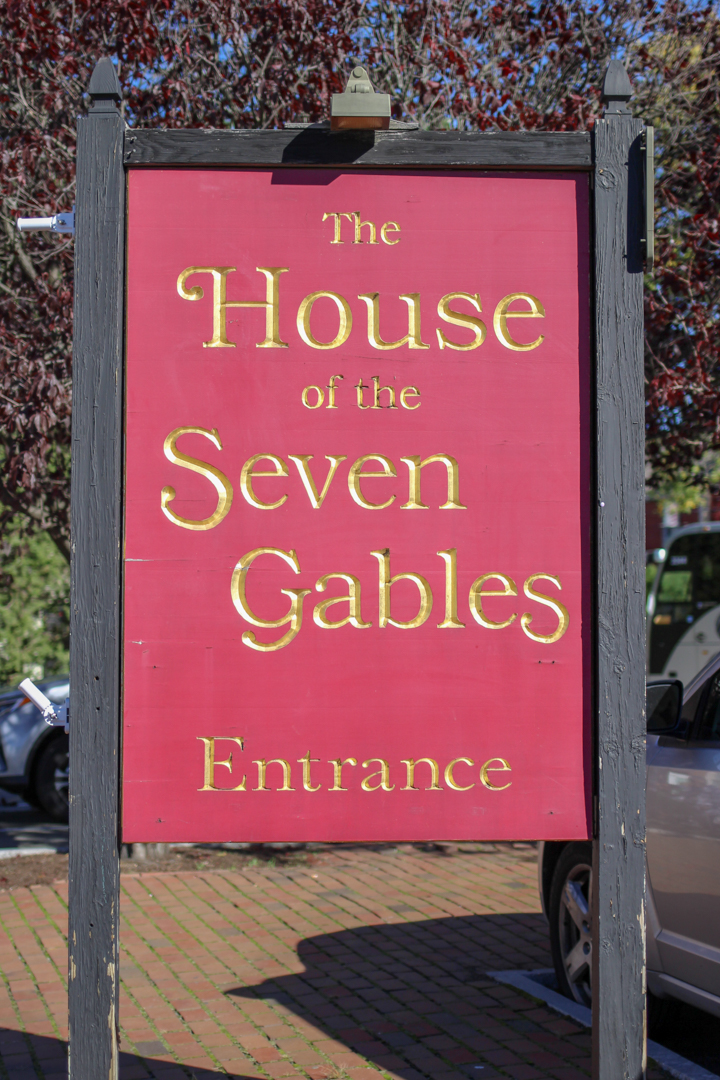

Tour the house that inspired Nathaniel Hawthorne’s famous book (and pick up a copy in the gift shop, it’s not an easy read but it’s worth tackling). Hawthorne is a descendent of John Hathorne, the only judge involved in the Salem witch trials who never repented of his actions (the ‘w’ was added to the surname later to distance the family from the trials). This is a popular place and tickets are limited, so get here right when it opens to secure your spot and enjoy the secret staircase!


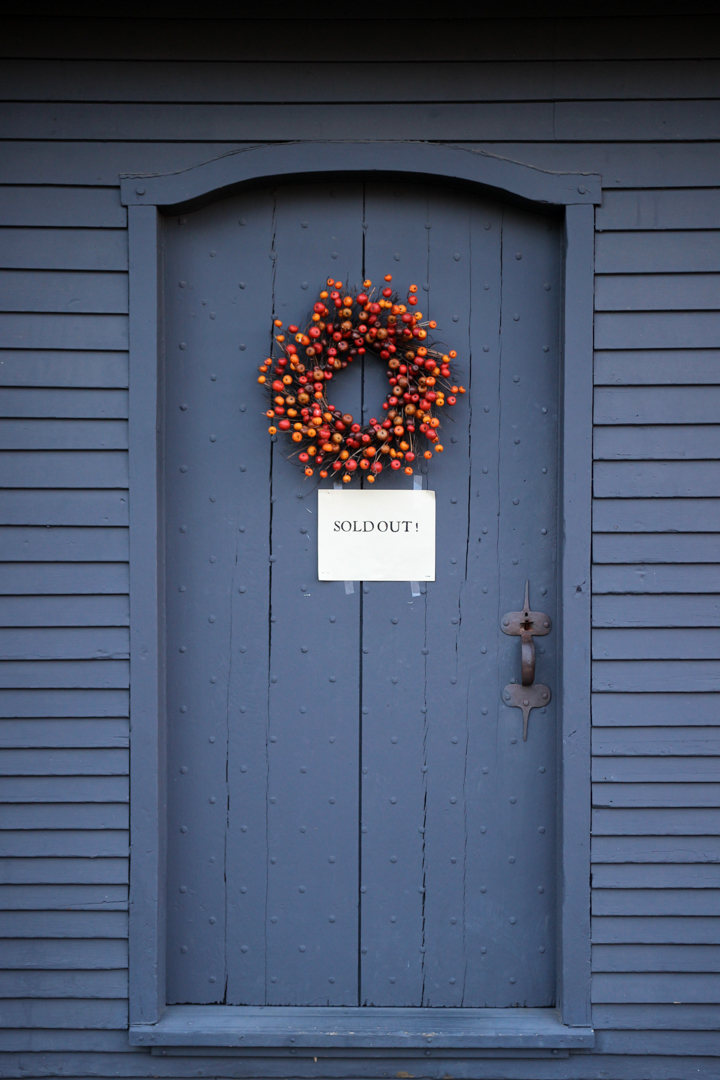
The Witch House is the only structure still standing in Salem with direct ties to the witchcraft trials. Corwin was a local magistrate and he served on the court which ultimately sent nineteen people to the gallows. Corwin lived in the house, an excellent example of seventeenth-century architecture (and my dream home), for more than forty years and it remained in the Corwin family until the mid-1800s. You can take a guided or self-guided tour, and they have extended hours in October (but again, the house is small so get there early).

The Salem Witch Museum was the thing I was most disappointed by on my first visit, but I still went back on my return trip. You can’t really go to Salem without visiting this museum, but while it starts out promising—with an animatronic retelling of the witchcraft trials—it is seriously lacking in artifacts or anything else you might expect to find in a traditional museum. The gift shop is worth a visit, though, if only for their floaty pens.
Cemeteries


Even if you don’t normally spend hours wandering cemeteries like I do, a visit to Salem isn’t complete without at least seeing the first cemetery established in Salem in 1637, the Old Burying Point (also called the Charter Street Cemetery). Adjacent to the cemetery is a memorial to the victims of the witchcraft trials and the whole area gets very crowded during October. Since our last visit they’ve taken measures to limit visitors to the cemetery, but it’s definitely worth the wait. There are a few other less famous cemeteries within walking limits—like the Howard Street Cemetery or the Broad Street Cemetery—which are just as historic and interesting without the annoying crowds.


You know how much I love a good, crumbling, creepy wax museum and the one in Salem does not disappoint. There were long lines for almost every October pop-up attraction in the area around the Old Burying Point, but one of the shortest was for this wax museum—which was good for us but it also makes me concerned for the future of this dusty relic.
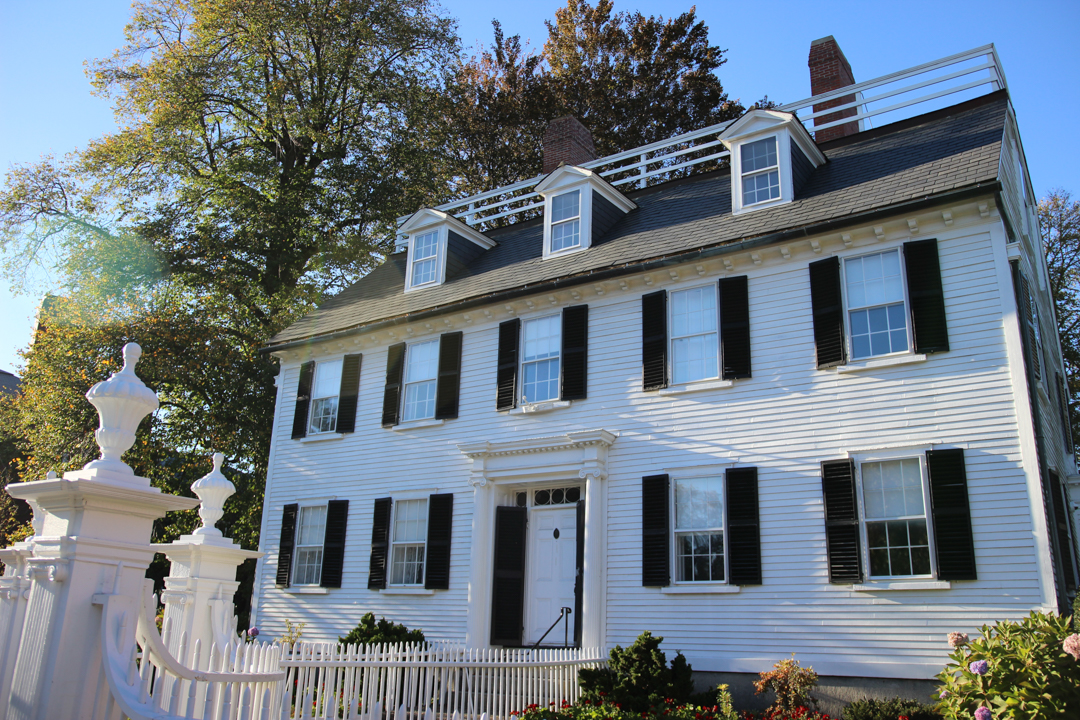

I did an entire blog post on the filming locations around Salem from this 1993 classic, but Allison’s House (aka the Ropes Mansion) is located right next to the Witch House, and both aren’t far from the Old Town Hall where Bette Midler sings "I Put A Spell on You" while doing just that.
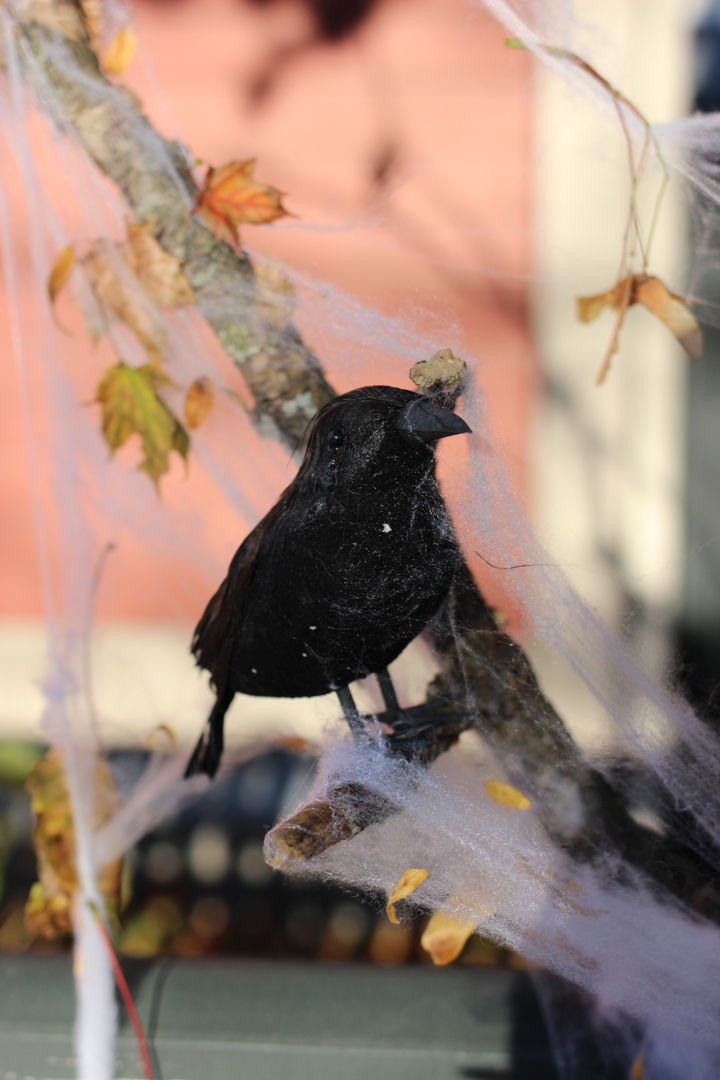

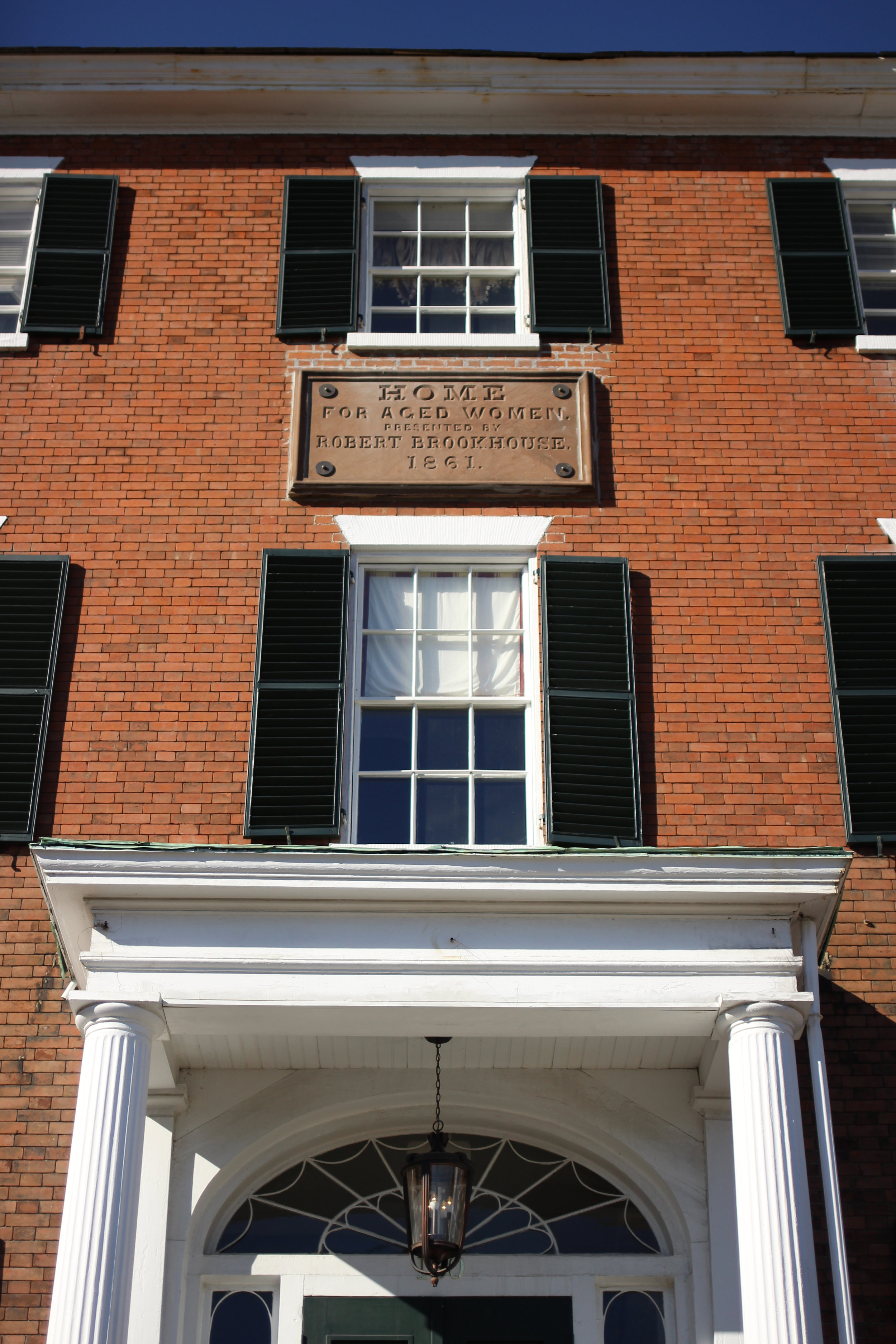
There are a hundred ghost tours to choose from, but the one we took was fantastic (“not recommended for children” will seal the deal for me every time). Our guide pushed around an old-timey baby carriage containing a creepy doll named Myrna, and bought our entire tour Dunkin’ Donuts coffee. I just heard that he may not be doing nighttime tours anymore but it’s still worth inquiring about (and if he’s not available, I still recommend doing a ghost tour—I think every single person that came to Salem when we did was out at night on a tour).

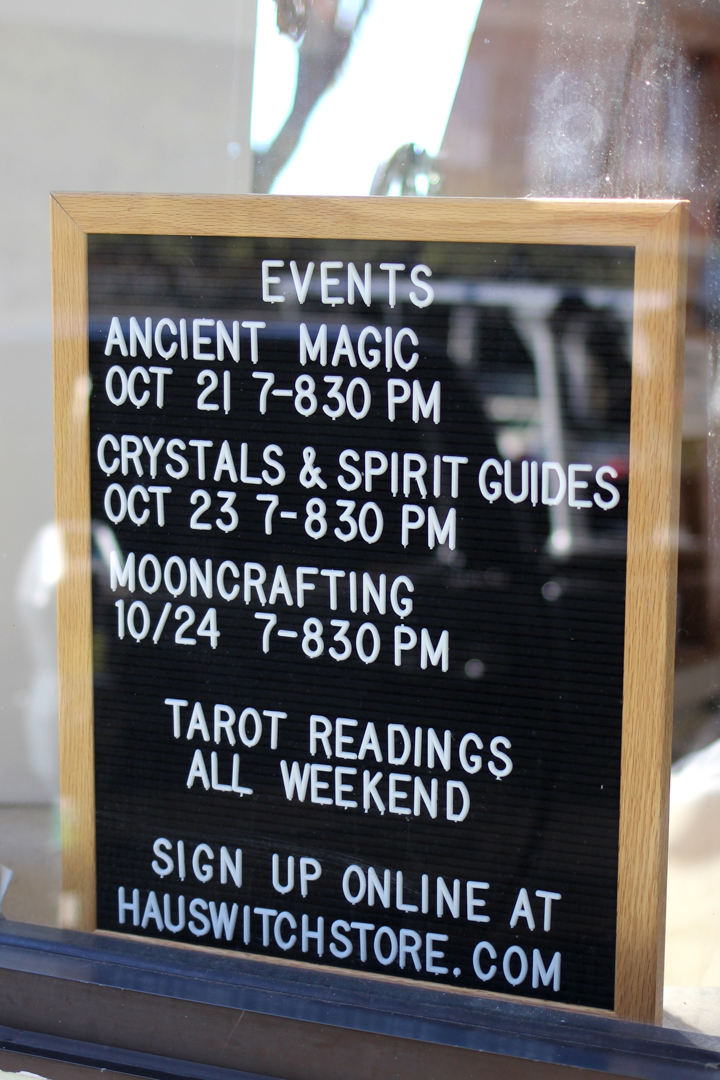
There are tons of cheesy, witchy stores in Salem, but for something a little more refined, check out Hauswitch. They have beautiful (if expensive) things, and for a brief second we all felt like we’d found a portal back to Brooklyn.
WHERE TO EAT:
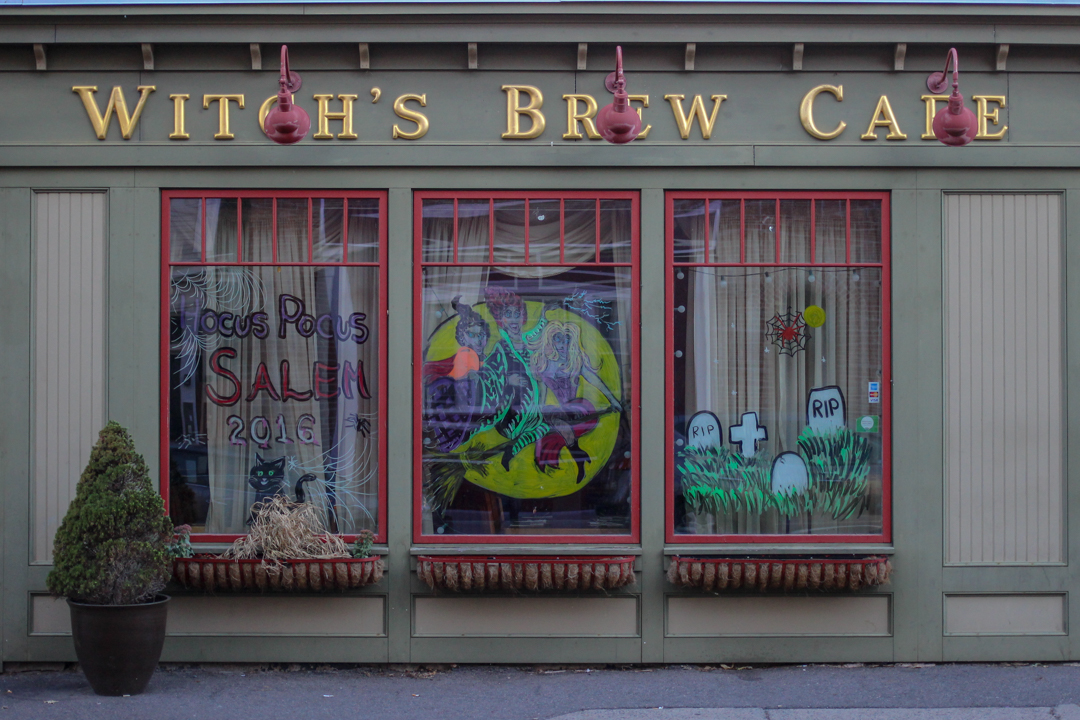
We didn’t actually eat here, but their window was painted with a Hocus Pocus theme, so how can it be bad?
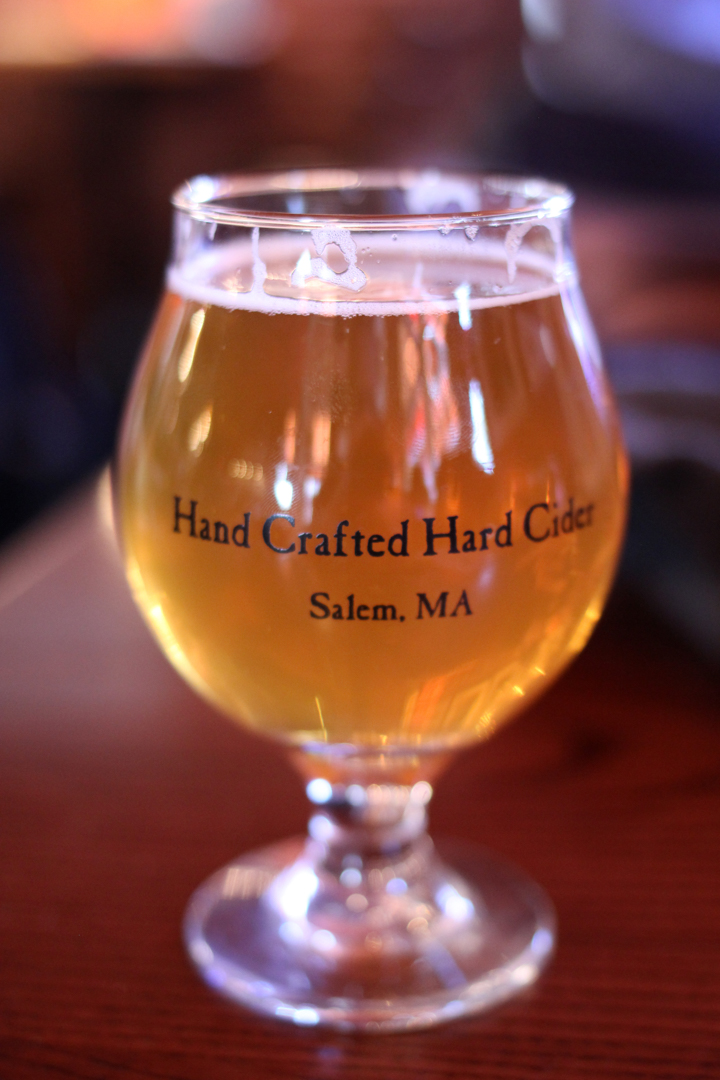
We ended up at the Mercy Tavern somewhat randomly, but they ended up having delicious nachos and a great local cider selection (you can buy this glass here). I don’t eat seafood so I’m not at all qualified to write recommendations for New England eateries, but I’ve heard good things about Turner’s Seafood.

I loved this store—America’s oldest candy company—so much that I used it as the inspiration for a college branding project. They have all sorts of old-timey candies, including Gibralters, the first commercially-made candy in the US (they have a similar consistency to a really hard dinner mint). It’s located right across from The House of the Seven Gables, so after your tour grab some fudge or a Salem blackjack, still made by hand with the original 1800s recipe.
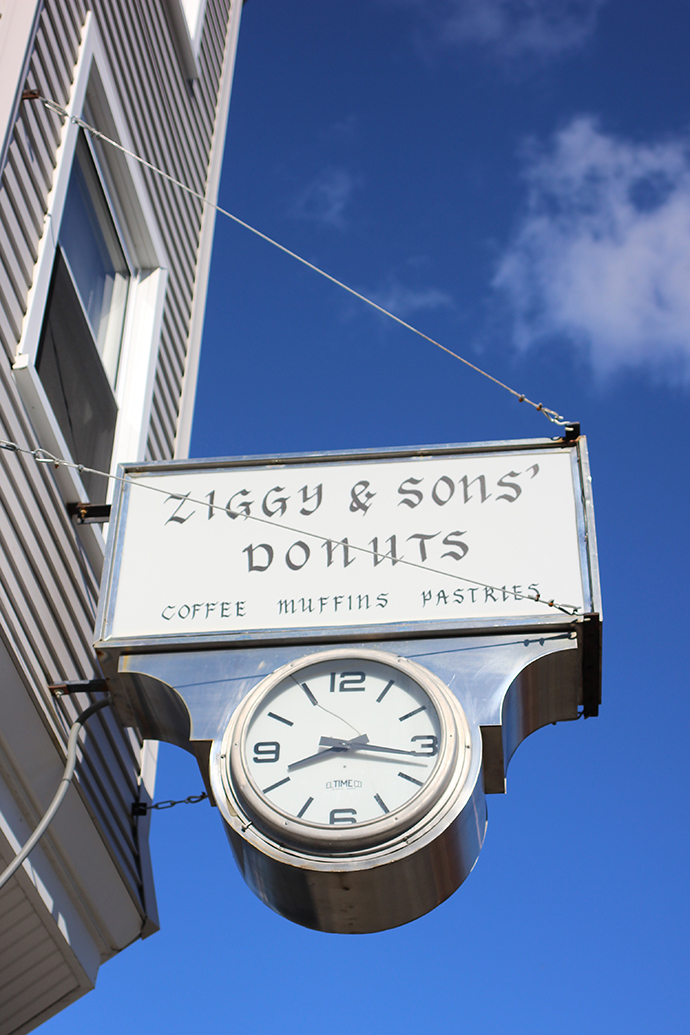
When you walk into Ziggy’s, you might think you’ve made a mistake and accidentally walked into someone’s private kitchen. Located outside of the main tourist area, the tiny Ziggy’s (there are a few stools, if you want to eat in) feels like a local secret, which is amazing considering that the donuts and coffee were cheap, delicious and served with a smile (and a heavy dose of curiosity about where we were from and what we were doing in Salem).
Traveling to Massachusetts? See all of my individual posts from the state here.
Happy Friday!
Illustration by Lindsey Frances | Purchase some of her city prints here
Things that have happened recently:
Surprising no one, our President is as classy as ever and (probably) knowingly covering up a murder but relax, ladies. Don’t be so uptight. You know you want it.
Two more things we should all be outraged by: the Sackler family getting rich while people die, and the shady student loan business; and one thing to be excited about: the new season of The President Show.
Imagine hating Trump so much that you pay nearly $250,000 to have his name removed from your condo building (oh wait, I do hate him that much).
Things to do in New York this weekend:
Saturday is the Ghost of Uncle Joe’s music fest at the Historic Jersey City and Harsimus Cemetery. It’s a great place to explore on its own, and they always have interesting events, the proceeds of which benefit the cemetery directly.
It’s Giant Pumpkin Weekend at the New York Botanical Garden. “Monstrous pumpkins from around the country—some weighing in at more than a ton—once again arrive at the Garden, arranged in collaboration with the Great Pumpkin Commonwealth.” The Spooky Pumpkin Garden is also open until Halloween.
It’s the beginning of not-terrible movie season, and I already have plans to see A Star is Born and Can You Ever Forgive Me. I still want to see The Hate U Give (the book was incredible) and I hope Lizzie is streaming soon since it was only in theaters very briefly (I’m currently reading this book, which is perfect for this time of year).
Things I discovered recently:
My very favorite artist, Cat Power, has released her first new album in six years and it’s fantastic. She just added a New York City date to her tour list—Brooklyn Steel in December—and I’ve already bought my tickets.
I literally cannot stop thinking about this tortoise wearing pants.
Elin Thomas makes the most beautiful (and maybe the only?) crocheted petri dishes and mold specimens you’ll ever see.
We had a great time in Egypt and saw so many wonders that I will be processing it (and going through my photos) for a long time, but I’m definitely glad to be home. I’m not an adventurous eater, I have real flying anxiety and ultimately I just don’t think I’m cut out for frequent international travel. I’m incredibly grateful to have seen what I’ve seen, but I’m happy to only have domestic trips in my near future. Fall (or more like early winter) has finally come to New York, and I don’t remember ever being as excited for midterm elections as I am this year—somehow I still have hope for Democratic victories. Don’t forget to make sure you’re registered and most importantly, VOTE on November 6th! My calendar is blissfully open at the moment, with a few fun things to look forward to including a trip to Sleepy Hollow (my fifth time?) and, of course, the end-of-year holidays. I don’t have the energy to have a Halloween party this year, but I think I’ll be recycling my costume from last year because I spent far too much money and time on it to just limit it to one outing (after which maybe I’ll be able to actually get rid of it and free up some valuable space in my studio apartment). Have a great weekend!
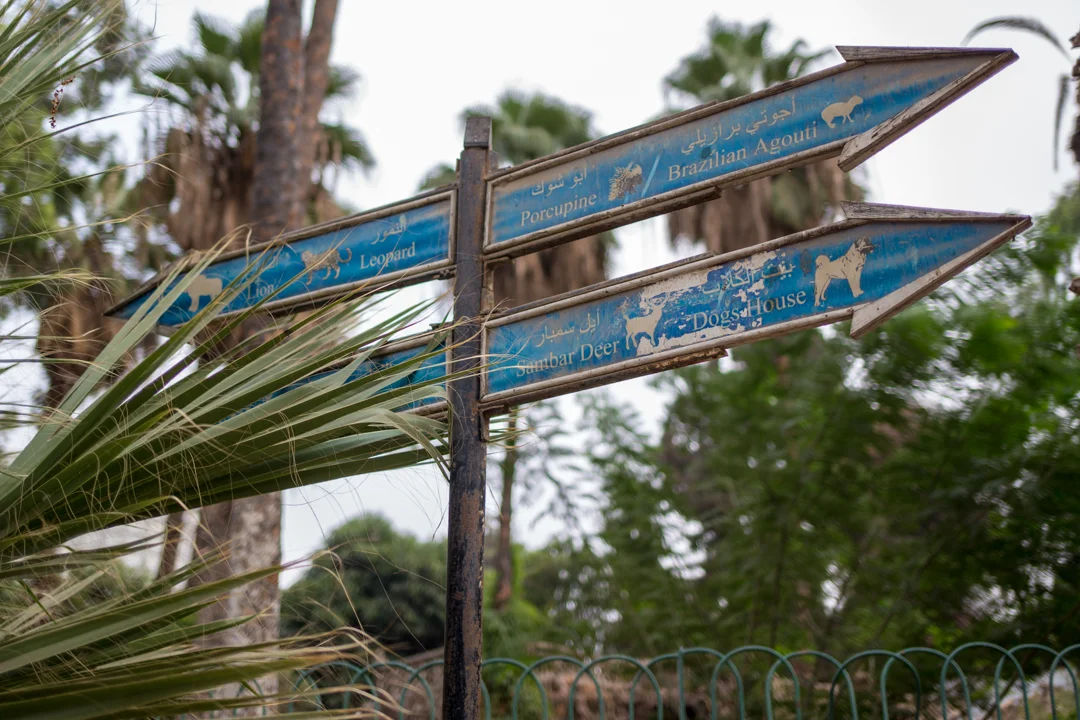
Giza Zoo

We arrived in Egypt with one and a half days to spare before our tour officially started. Our first order of business was the Egyptian Museum, but the next day we wanted to do something that didn’t require a taxi ride. The Giza Zoo was located directly across the street from our hotel, so it won by default.


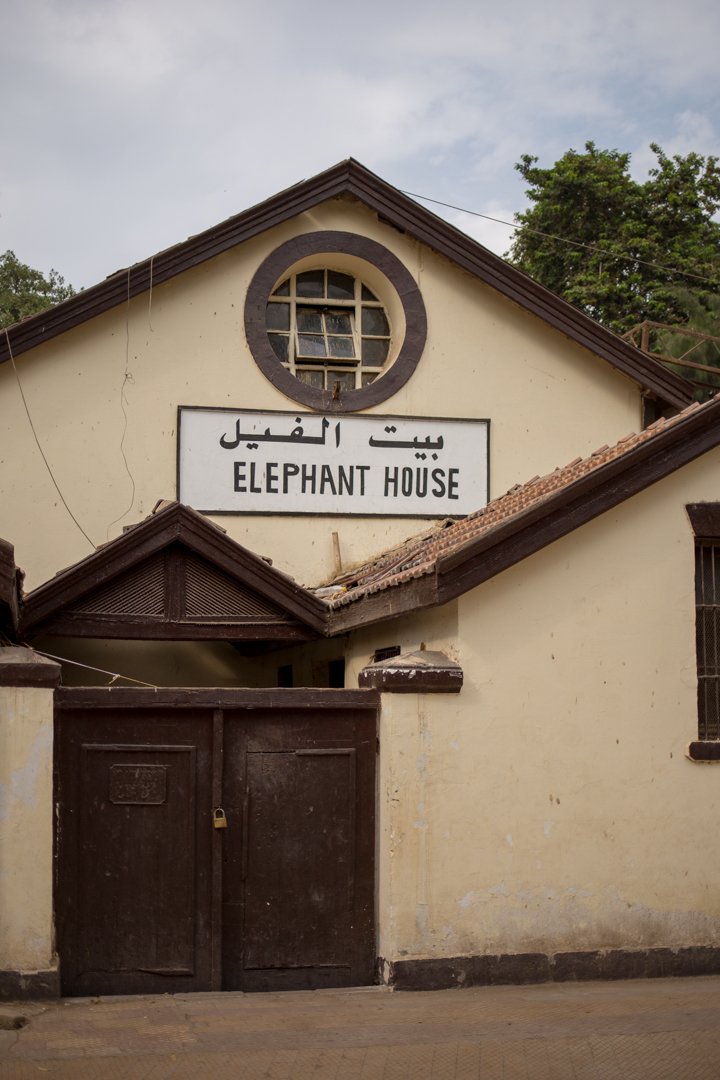

The Giza Zoo opened in 1891 as a botanical garden over an area of about 80 acres. It’s one of only a few green spaces in the city, and I’m not exaggerating when I say that we were literally the only non-Egyptians there. In fact, I think my uncle and I drew significantly more attention than any of the animal exhibits, and several couples asked to take photos with us.


A quick search of the Giza Zoo yields some horrors, such as an article with the title “Giza Zoo Might Be the Worst Zoo in the World.” Luckily, I read these dismal reviews (“not recommended”) after we had spent the day there. While the negative reviews certainly have merit, we thoroughly enjoyed our time exploring the grounds, which are—as my uncle accurately said—in an exquisite state of decay (my preferred state, to be honest).


In 2004, the Giza Zoo was expelled from the World Association of Zoos and Aquariums because it had stopped paying membership fees and began ignoring the association’s recommendations. In 2004, two gorillas thought to be infected with the Ebola virus were killed by zookeepers; in 2006, more than 500 birds were slaughtered to prevent the outbreak of the bird flu; in 2013 a giraffe at the zoo allegedly committed suicide after being hassled by visitors (“don’t teas animals, they have feeling like you") and around the same time three black bears died during a bear riot.


You don’t pay much attention to rules and regulations until you suddenly find yourself in a place without them, and the Giza Zoo felt like we had traveled not only to another county, but to another time as well. A time when you could interact with and feed the animals (for a fee, of course, nothing in Egypt is free) or easily climb into their enclosures. My uncle and I were enamored with the shear volume of stray cats, although we did recognize that it was silly to go all the way to Africa and spend our time gawking at cats (something that we can both do for free in our respective homes).


When I later told others in our group about our day at the zoo, someone mentioned that the zoo had recently been accused of trying to pass off a painted a donkey as a zebra. It turns out that the zebra imposter was found at a different zoo in Cairo, but based on what we had seen at the Giza Zoo, the story seems entirely plausible.
Giza Zoo
Charles De Gaulle، Road، Oula,
Giza Governorate 12612, Egypt

John Brown Wax Museum

John Brown was an American abolitionist who believed that armed rebellion was the best way to overturn slavery. He advocated for action over talk, and in 1856, Brown and his supporters killed five pro-slavery settlers in the Pottawatomie massacre in Kansas. He’s best known for leading a raid on the federal armory at Harpers Ferry, Virginia (now West Virginia), where seven people were killed and ten were injured when Brown tried to arm slaves with stolen weapons. He was captured and tried for treason against the Commonwealth, murder and inciting a slave rebellion—he was found guilty on all counts and hanged.
The raid at Harpers Ferry may have helped fuel the fire for the South's secession from the Union a year later and the Civil War that followed. Brown’s position in history is still controversial, with some people seeing him as a hero while others label him a terrorist. Another distinction that Brown has is that he’s one of only two historical figures to have a wax museum exclusively devoted to his story (Jesus is the other one).
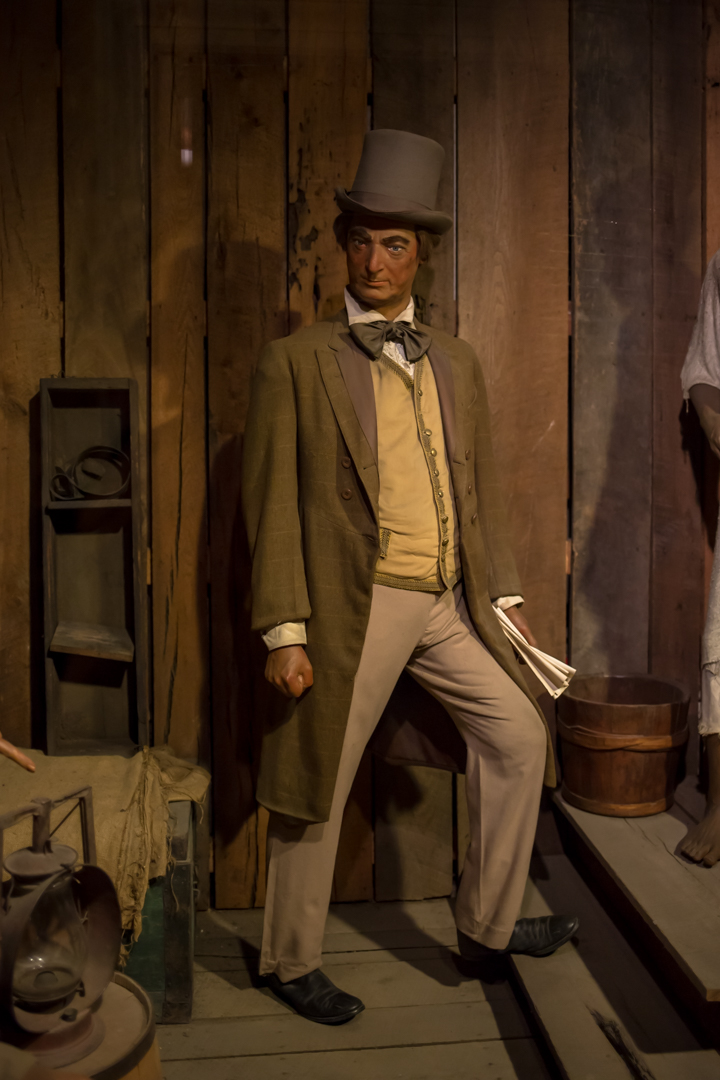
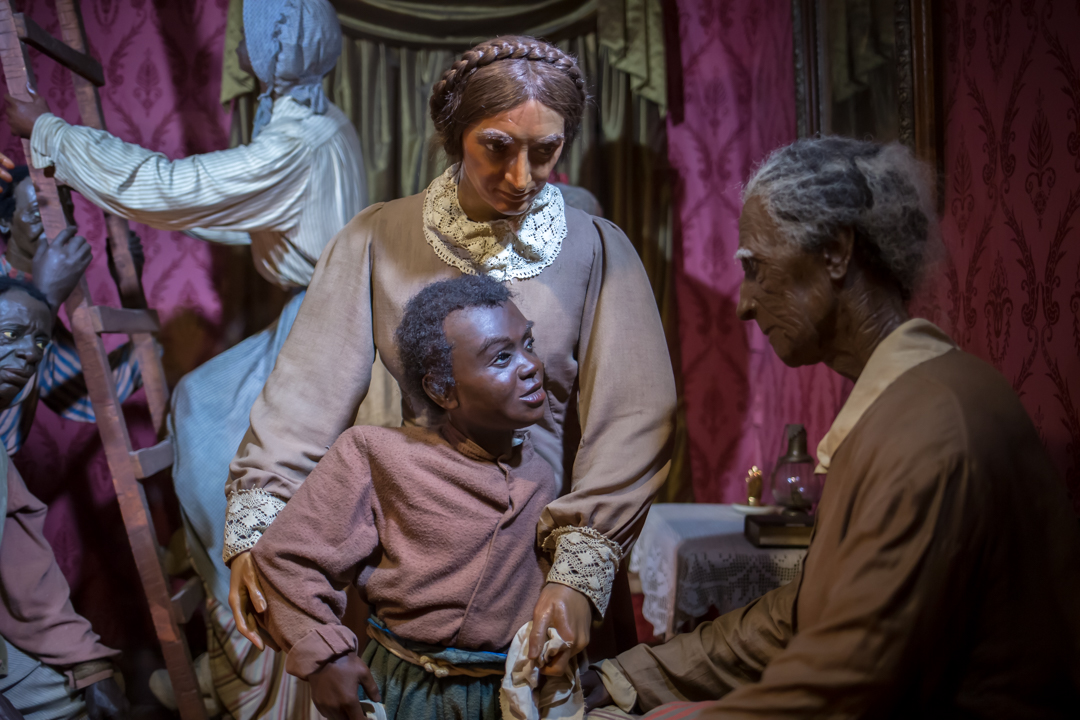

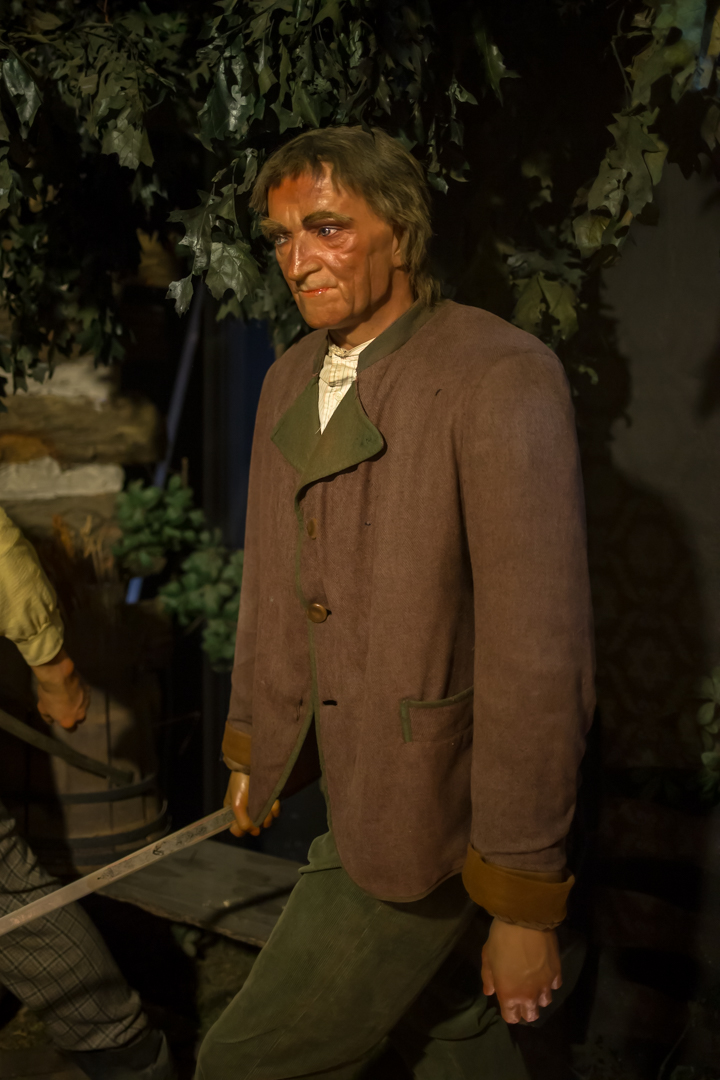


The John Brown Wax Museum opened in Harpers Ferry in 1963. The museum is located in a building that actually existed in 1859 during Brown’s raid, and the block on which it stands became a protected National Historical Park shortly after the museum opened. Harpers Ferry is a cute little historical town, with some restaurants, shops and a train station.


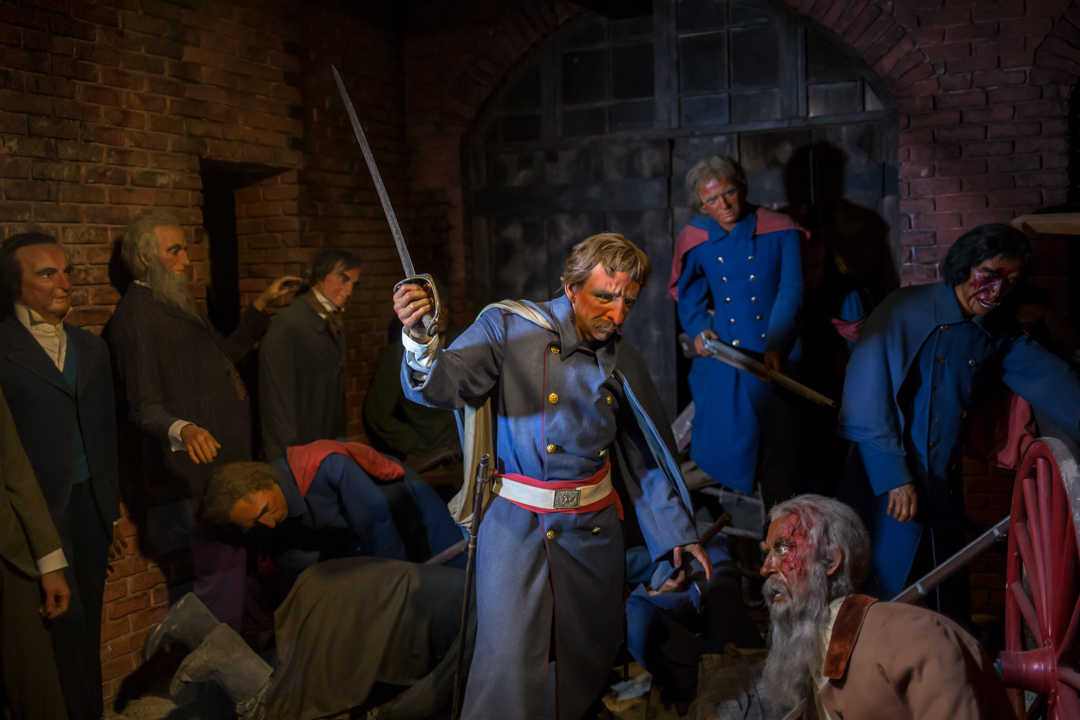


I adore old wax museums, and I just had to see one entirely devoted to a somewhat obscure historical figure. We were driving from Gettysburg, and I was afraid that we weren’t going to make it to Harpers Ferry before the museum closed at 5pm. We pulled up the museum at 5:01 and I nearly pushed my mom out of the car in front of the museum so I could find parking.
After circling the tiny town for what seemed like forever, I finally found a spot and literally ran to the museum. When I burst in the front door, the woman at the front desk had already graciously decided to stay open long enough for us to see the ten or so dioramas. “You’re my last customers of the day,” she said—although from the looks of things we may have been the only customers of the day.
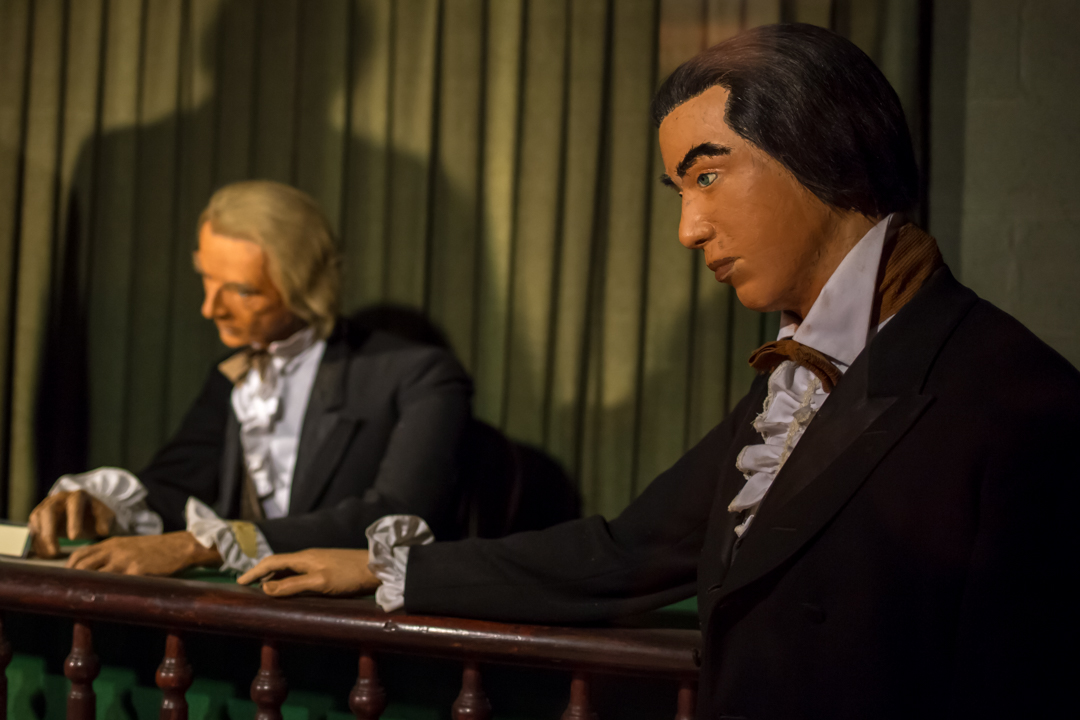

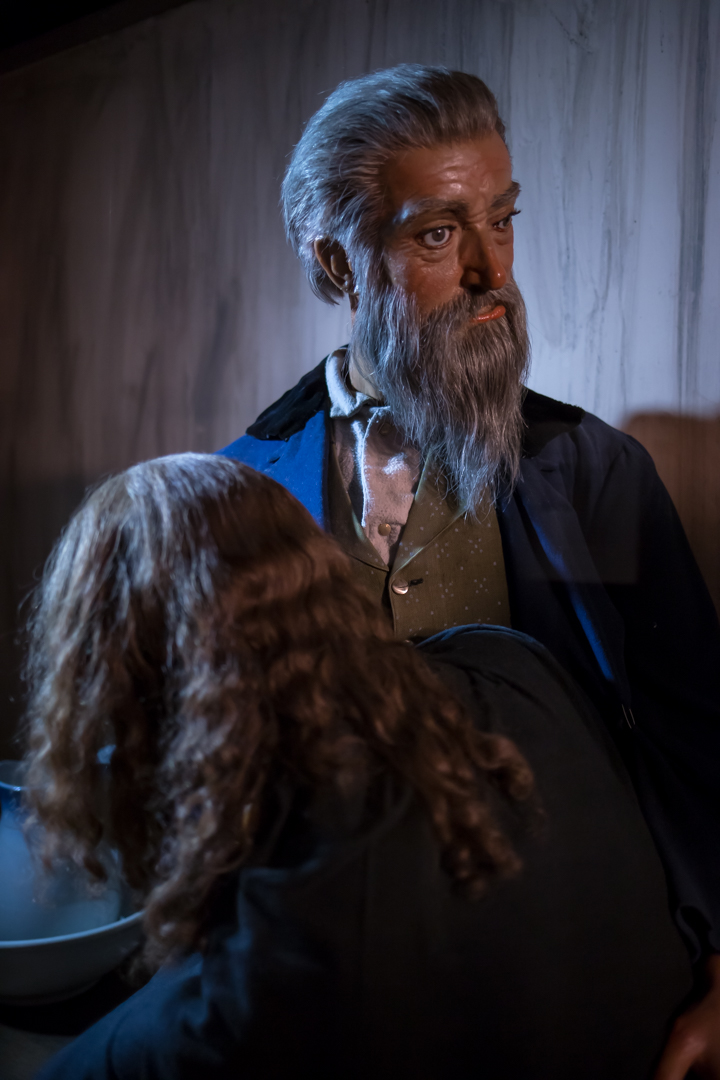


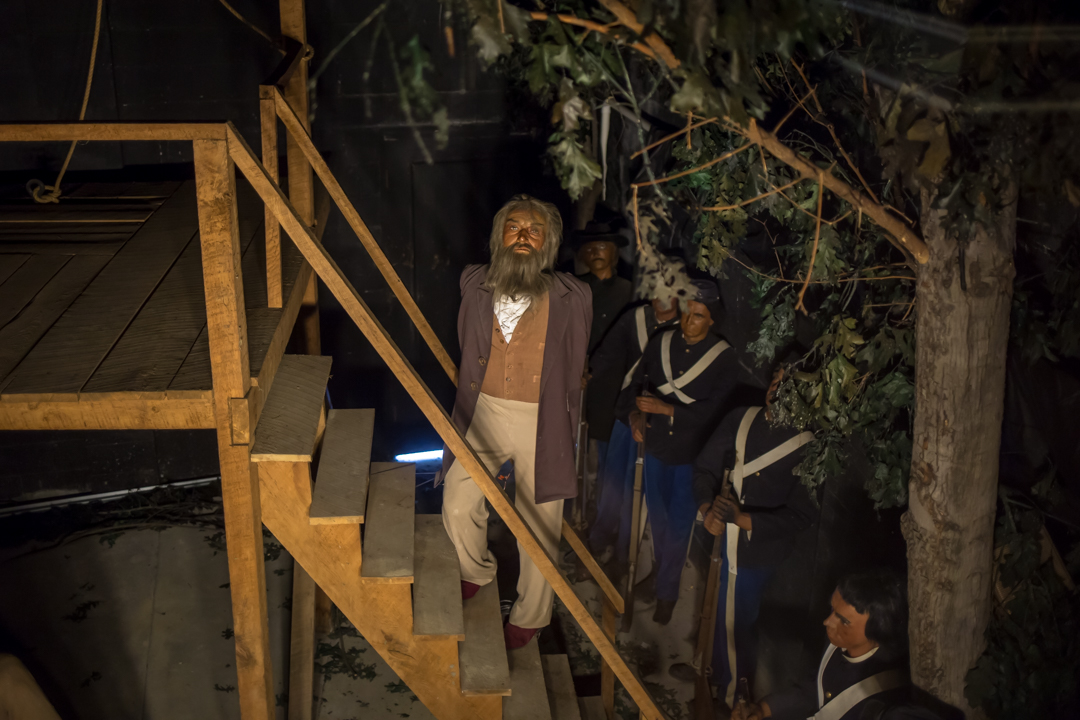
The 87 life-size figures are wonderful in their detail, and the entire museum feels like a time capsule from the ‘60s. There are handpainted signs, creaky steps, crude animatronics, cobwebs and a lot of dust, much like you’ll find at the Salem Wax Museum, the House of Frankenstein in Lake George or Niagara’s Wax Museum of History. It’s a little bit educational, a little bit creepy, and exactly the kind of thing worth speeding to get to while it’s still—somewhat improbably—open for business.
John Brown Wax Museum
168 High Street,
Harpers Ferry, WV 25425
Parking at the train station behind the museum

Happy Friday

Illustration by Lindsey Frances | Buy a print here
Because I’m currently in Egypt for two weeks, I have been (hopefully and blissfully) disconnected to current events, so I’m doing a different type of “Happy Friday” post this week with some fun things that I own or want to own.


I’ve had these three prints for a few years, and they’ve held prominent spots on the walls of my last two apartments. They were unavailable for a while, but Brave the Woods brought them back this fall. You can buy them individually, but they really shine when displayed as a set. I love all of their artwork, but I’m also partial to this Bunyan and Blue print for obvious reasons.

I wanted a pair of light and comfortable pants that I could wear in Egypt, and you can’t beat this wide-legged drape pair from Uniqlo for just $14.90. I actually thought I was ordering the green pair, but ordered black instead and liked them so much I just decided to keep them (but I might also have to buy the green?).

I have tried many different daily sunscreens, but this is by far my favorite. It’s cheap, smells great and doesn’t leave my face shiny or oily like some other sunscreens. It’s currently sold out, but keep checking back—it’s worth the wait!


New York Target’s are notoriously terrible and devoid of anything that I want, but if you live somewhere with a blissfully suburban Target, drop everything and go get these adorable planters.

I bought a black iPhone recently for the sole reason that I wanted to get this starry see-though case from Sonix. I had a similar case on my last iPhone and I loved it so much, but this was a fun change.

I barely have enough plants to justify owning a dedicated watering can, but if I did it would definitely be this one (look at those googly eyes!).

Birthdays are for getting gifts that you definitely want but don’t need, and nothing fits that category more than Cornelius the plush corn dog (thanks Francesca!), who fits right in with my sausage links and Greek coffee cup.

This is the most comfortable, breathable shoe I’ve ever owned and the black sole and metallic details make it a bit less dorky-looking than a traditional athletic shoe.
El Rancho

The El Rancho hotel and motel in Gallup, New Mexico, opened in 1936. It was built by film director D. W. Griffith as a base for numerous movie productions. As a result, the hotel has hosted hundreds of movie stars over the years, including Errol Flynn, Gregory Peck, Humphrey Bogart, Jane Fonda, Jimmy Stewart, Joan Crawford, Katherine Hepburn, Kirk Douglas (still alive!), John Wayne, Lucille Ball, Mae West, Rita Hayworth and Ronald Reagan. As you drive along Route 66, there are billboards for miles advertising the El Rancho’s “celebrity” credentials, although most of the people used in the advertising campaign haven’t stayed at the El Rancho (or any other hotel) for quite some time.


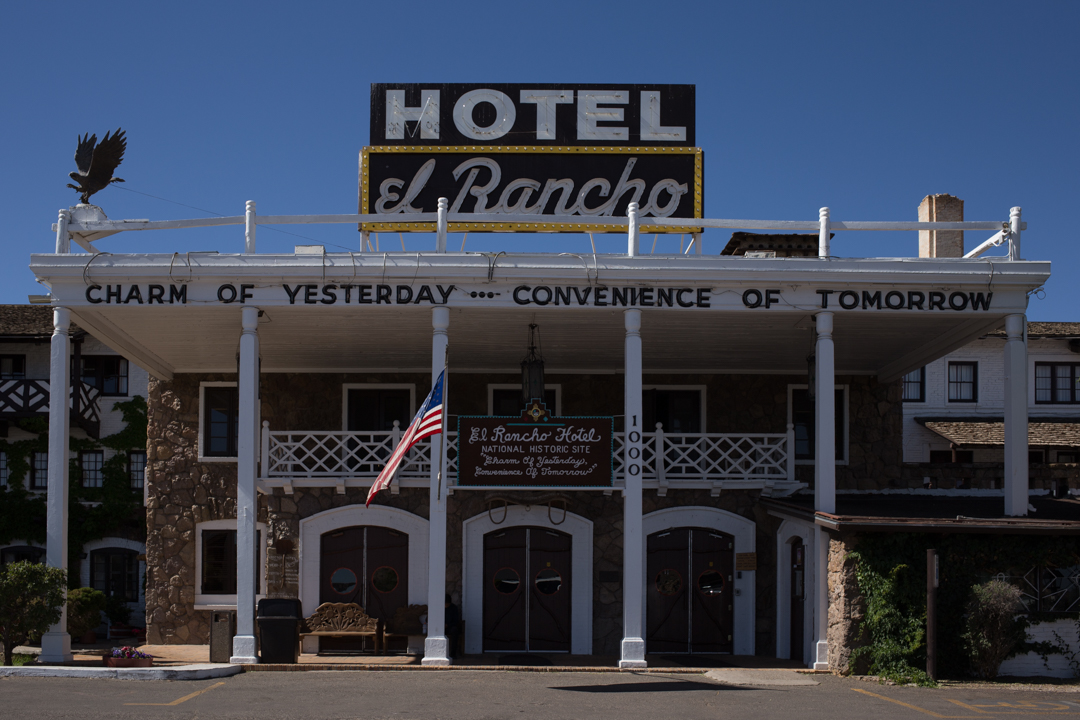
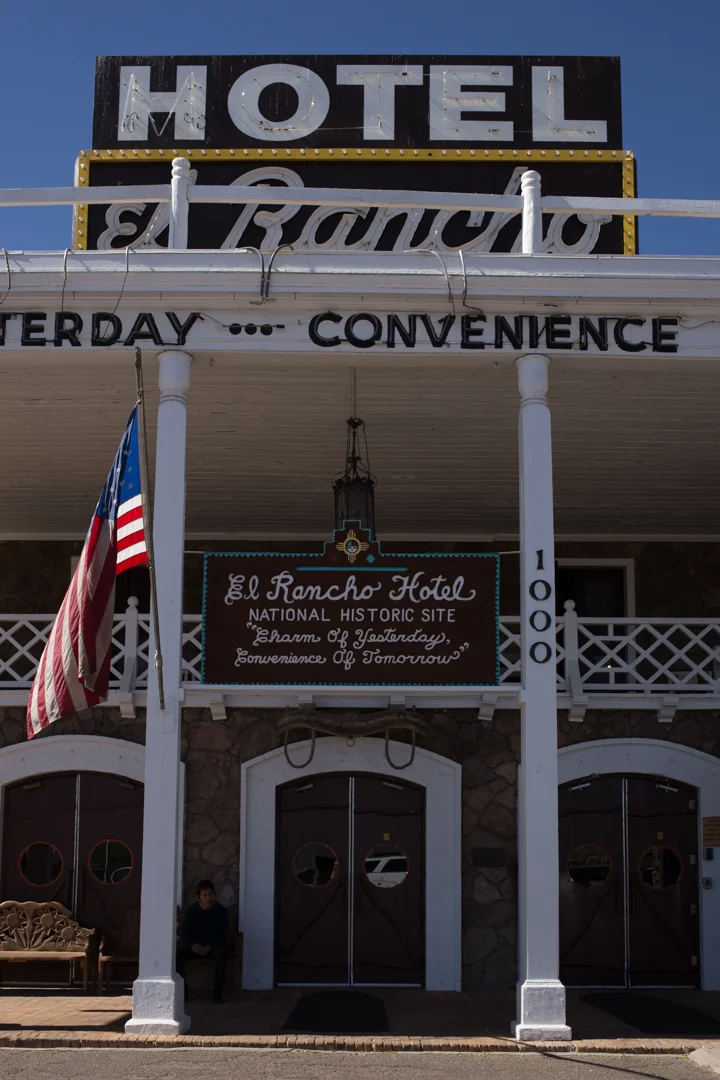

This was the first trip that I’ve taken where every hotel that we stayed in was just as much of an attraction as our other stops. Route 66 has no shortage of roadside motels but the El Rancho—older than a lot of the other surviving hotels—feels special. There isn’t much to see in Gallup (be sure to say hi to Dude Man), but it’s a great place to stop for the night in between Holbrook and Albuquerque.


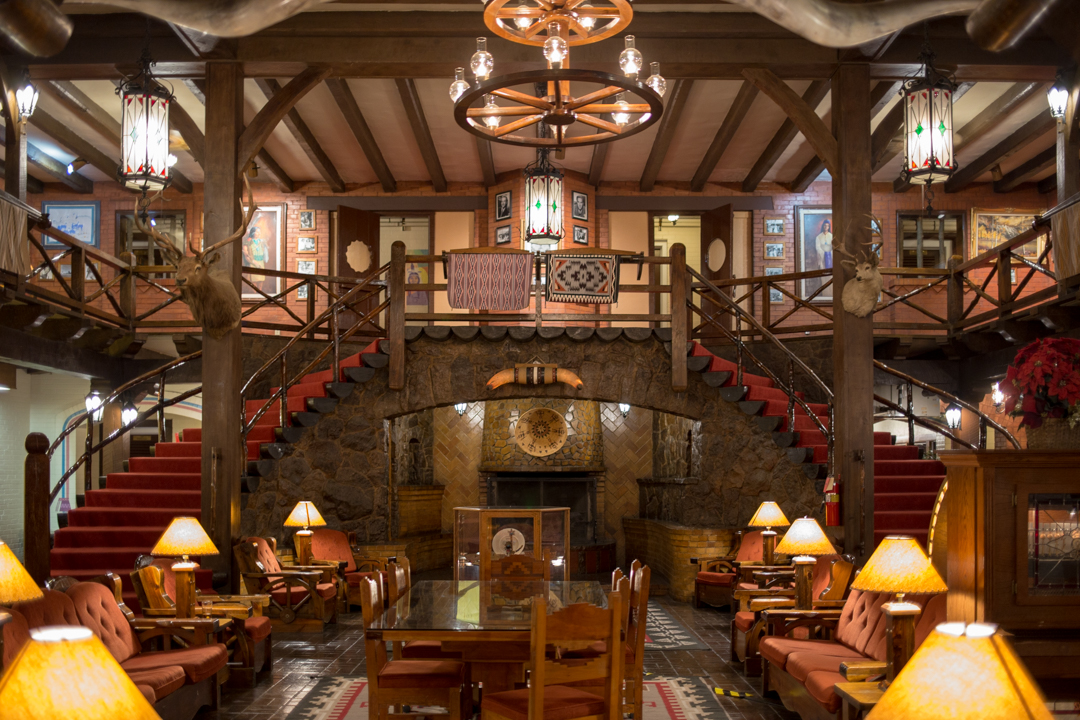


The rooms are all named for its famous past residents, and they’re spacious and clean. If you don’t want to stay over I recommend at the very least stopping in to see the beautiful lobby or to have a drink in the 49er Lounge, named one of the Top 50 bars in the US by Esquire magazine. We had dinner and breakfast in the hotel restaurant and both meals were fantastic—green chile enchiladas (when in New Mexico…) and the crispiest pancakes I’ve ever had.


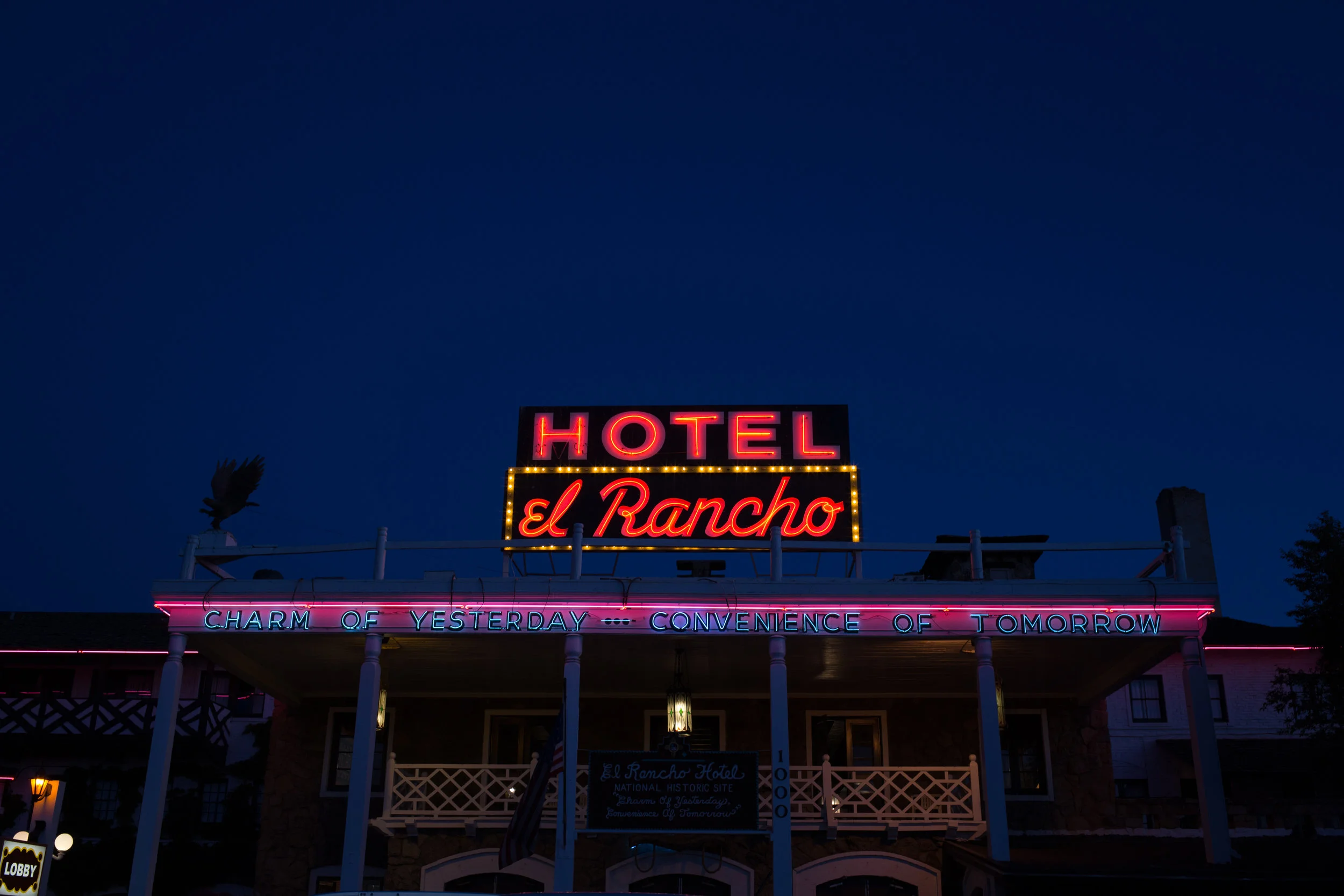
The El Rancho has a lot of competition among all of the classic neon signage to be found in Gallup and along Route 66, but the El Rancho holds its own with a blinking sign that reads both “motel” and “hotel.” Their slogan is “the charm of yesterday with the convenience of tomorrow,” and while I’m not so sure the latter is still true, the El Rancho more than makes up for it in the charm department.
El Rancho
1000 E. Highway 66
Gallup, NM 87301

Mister Ed's Elephant Museum + Candy Emporium
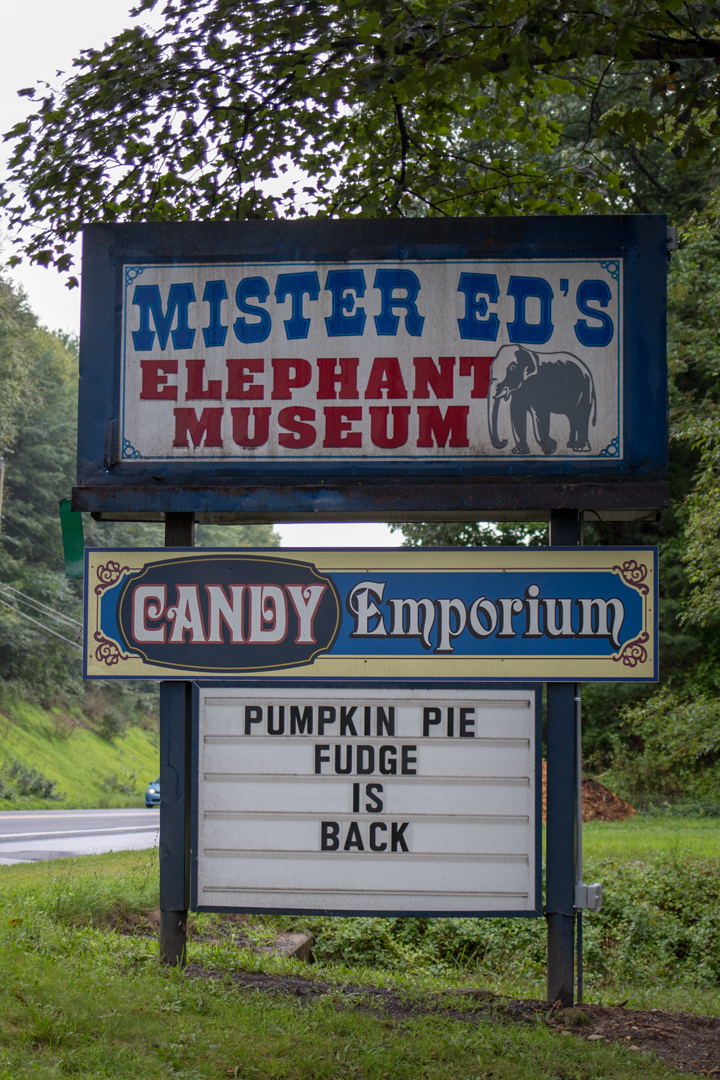
After a night spent in Gettysburg, I couldn’t pass up a 20-minute detour to see what is billed as the “Gettysburg area’s most unique attraction.” Mister Ed’s was opened by “Mister Ed” Gotwalt in 1975 and he sold the business to his granddaughter Nicole and her husband Isaac in 2014.


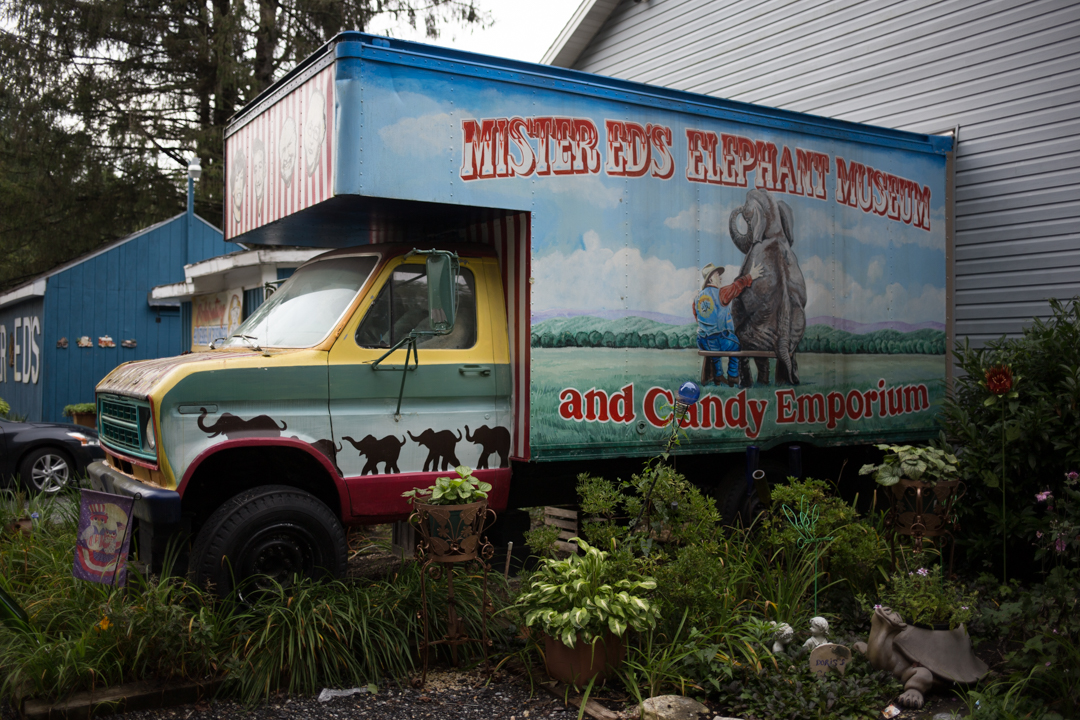


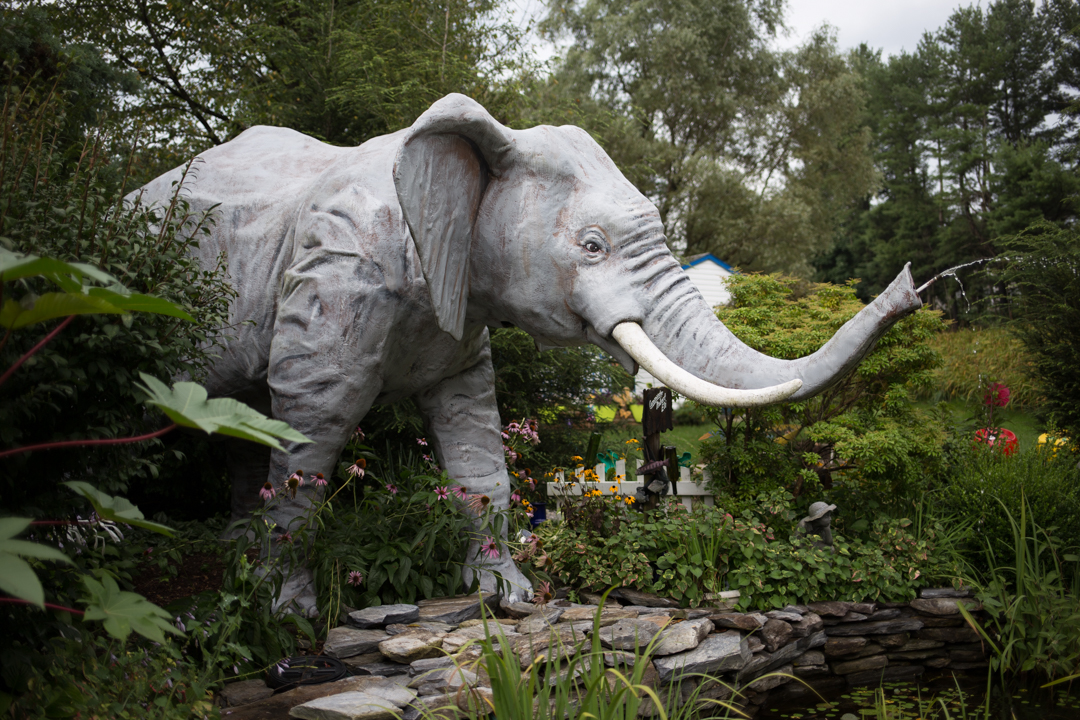


The 82-year-old Mister Ed is something of a local celebrity—he stayed up 76 hours during the nation’s bicentennial and stages elaborate Fourth of July fireworks displays and Christmas celebrations. He received his first elephant as a wedding gift and the collection grew as he started to receive elephants as gifts and donations. The museum part of the general store can be viewed free of charge and now contains more than 12,000 elephant figurines.
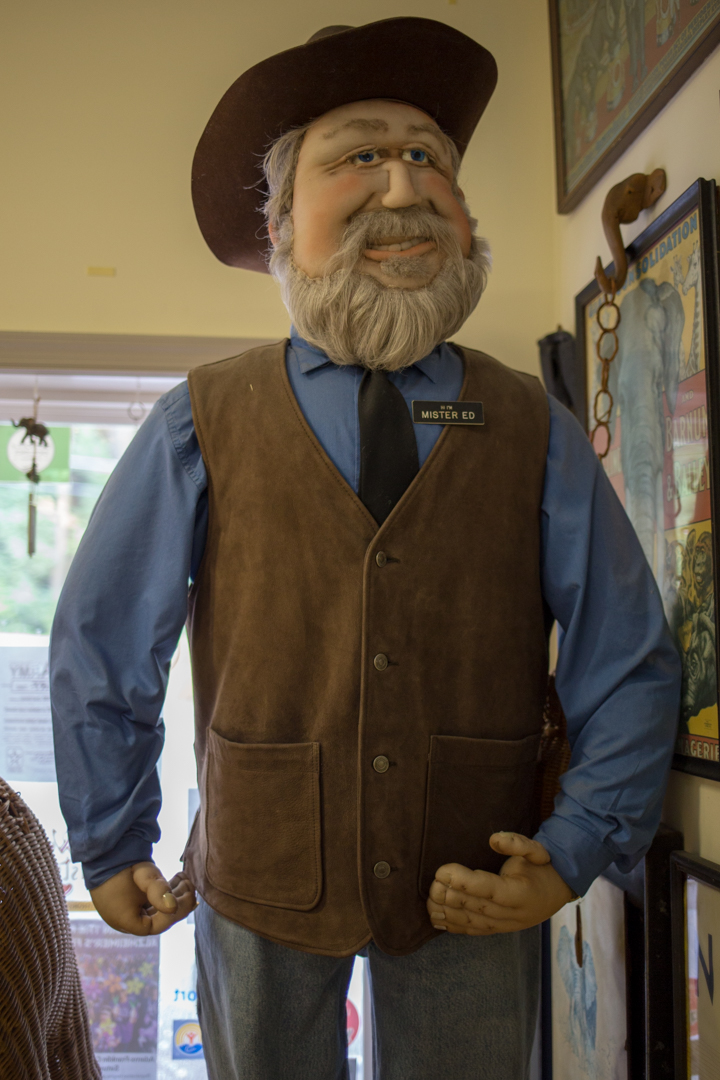


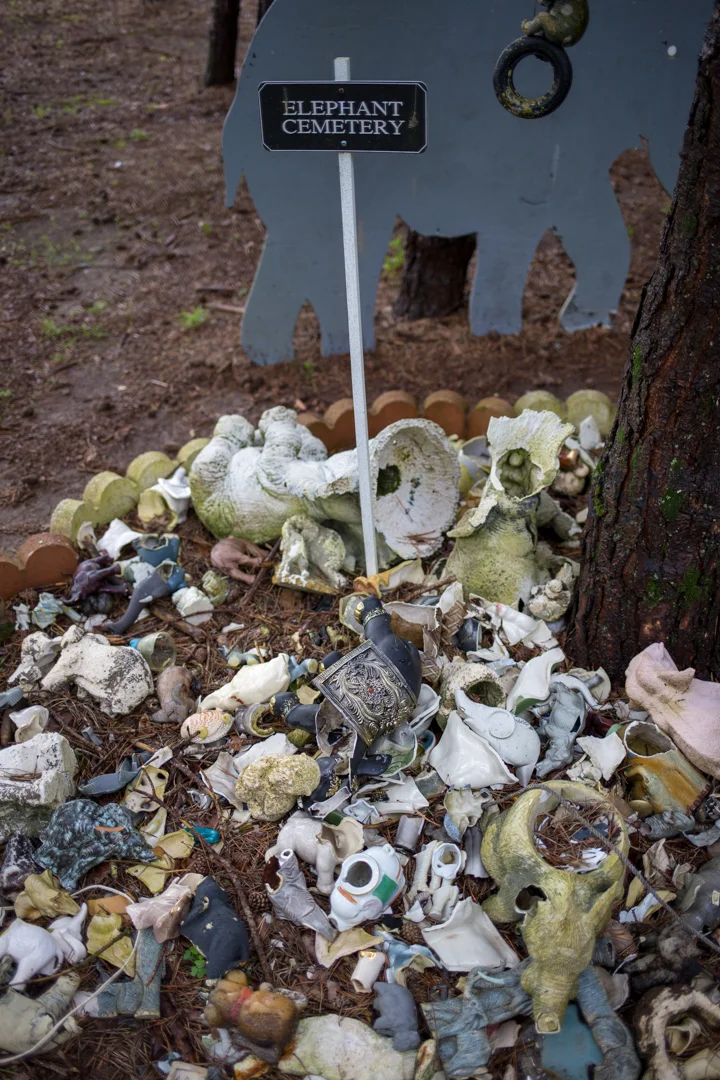

In July of 2010, the store caught fire and was destroyed. More than 2,000 elephants were lost in the fire, but Gotwalt received thousands of donations from across the world and opened a new store in February of 2011. Outside the store is an elephant graveyard, full of the broken bits of figurines that couldn’t be saved.


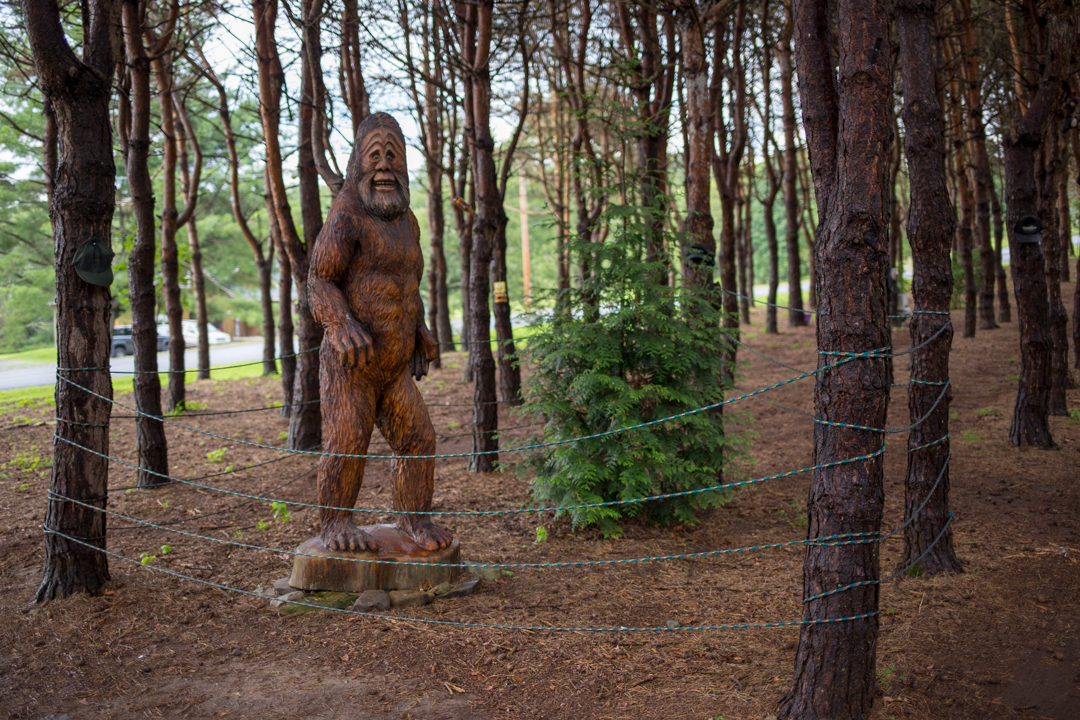

In addition to the elephants that can be found nearly everywhere on the property, Mister Ed’s also has a lovely garden with Bigfoot, Jon Deer and a stairway to nowhere. I don’t really care about teapots, but I do love novelty architecture so I was charmed by Miss Pat’s (Ed’s wife) teapot museum shaped like a big teapot.


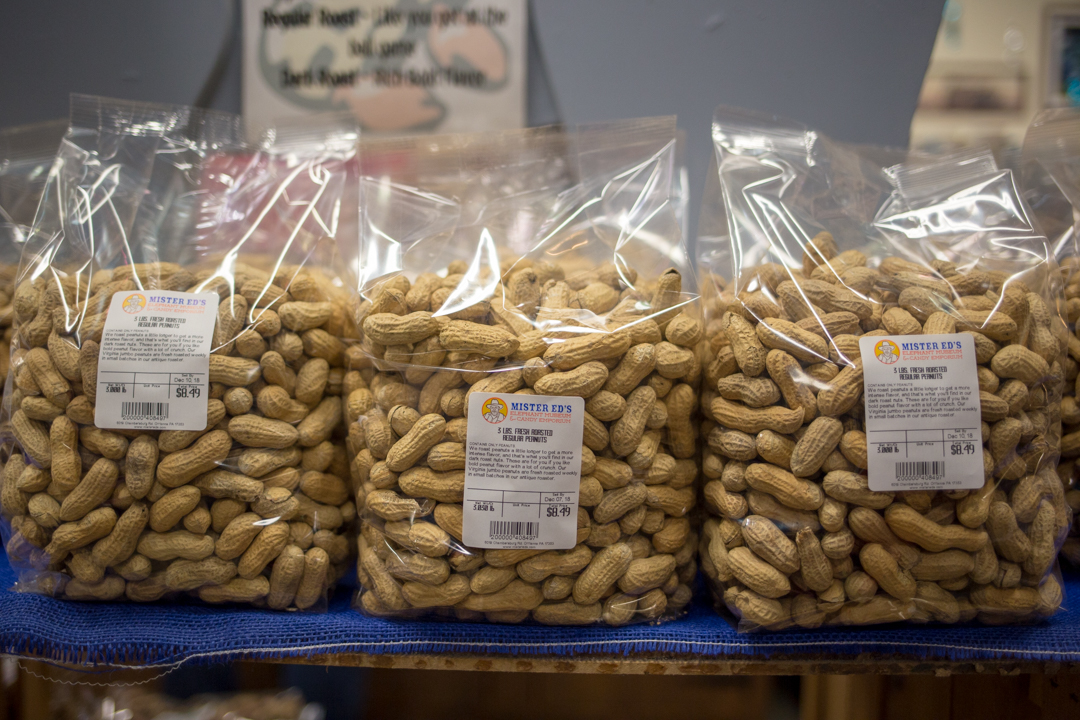

They sell more than 900 different candies, make more than 100 flavors of fudge and roast their own jumbo peanuts. Every Thursday is peanut day at Mister Ed’s and they roast at least five small batches of Virginia jumbo peanuts in a small shed outside. Sadly we didn’t visit on peanut day, so I’ll just have to believe Mister Ed when he says that “there are few things better than the smell of good nuts roasting.”
Mister Ed’s
6019 Chambersburg Rd
Orrtanna, PA 17353

Farnham Colossi
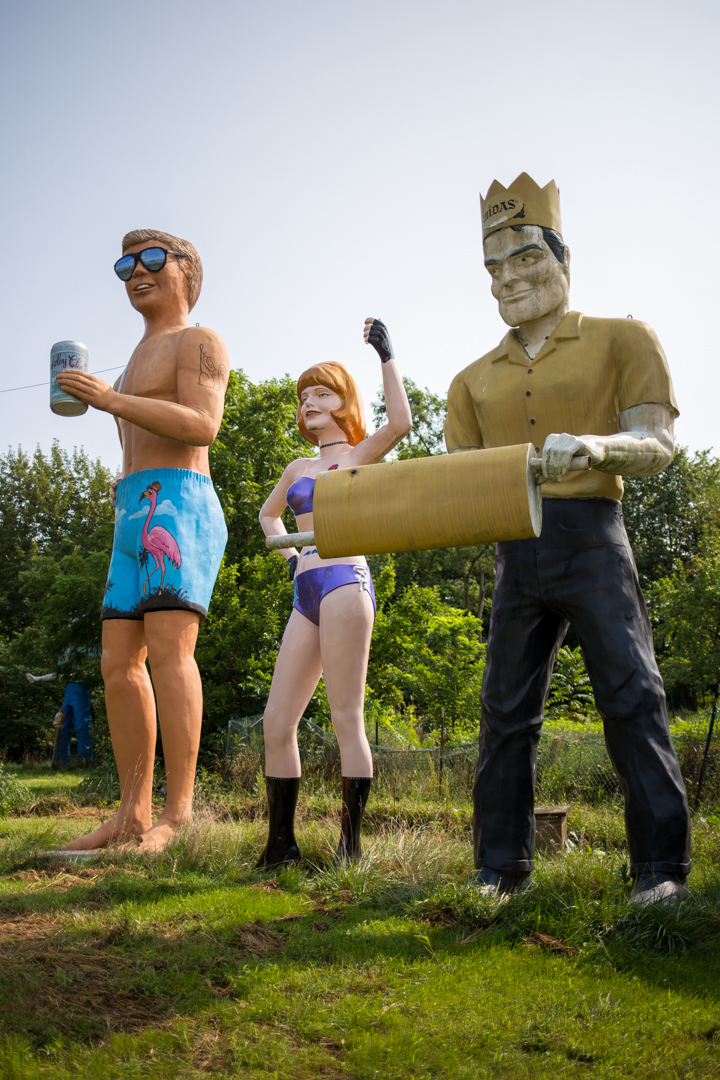
When my mom and I returned from our South of the Border road trip last year, I discovered that we had been literally ten minutes away from the Farnham Colossi. I obsessively scan maps on Roadside America and elsewhere to plot my road trip destinations but this area has so many states so close together—West Virginia, Virginia, Maryland and Pennsylvania—that I hadn’t thought to check a WV map. The Farnham Colossi is located in Unger, West Virginia, just over the border from Virginia, and it shouldn’t be hard to see why I planned our entire August road trip around it.

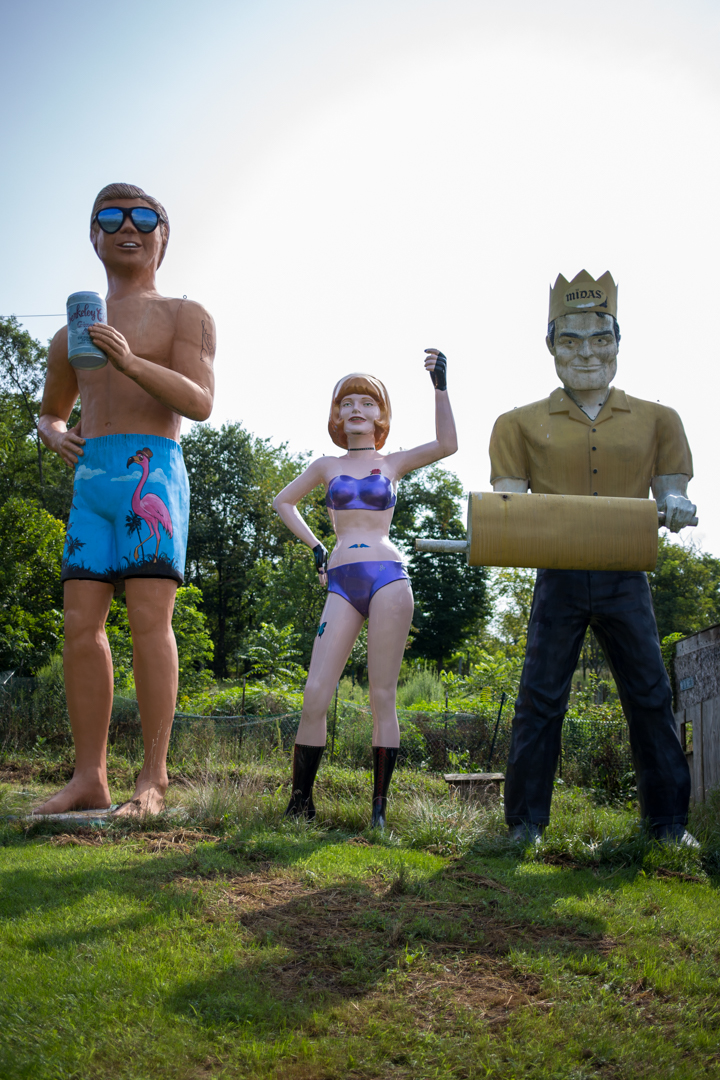


The Farnham Colossi, also called the Farnham Fantasy Farm, is located on the private property of George and Pam Farnham. George, a former DC lawyer, moved to West Virginia in the 1980s. Both George and Pam are collectors—the house and garage are filled with old magazines, nudie calendars and naughty hot sauce bottles. They both also share a love of “big things” and they bought their first Muffler Man on eBay from a Midas muffler shop in California. He’s the first Muffler Man I’ve seen that is actually carrying a muffler, which—despite the name—seems to be rare.


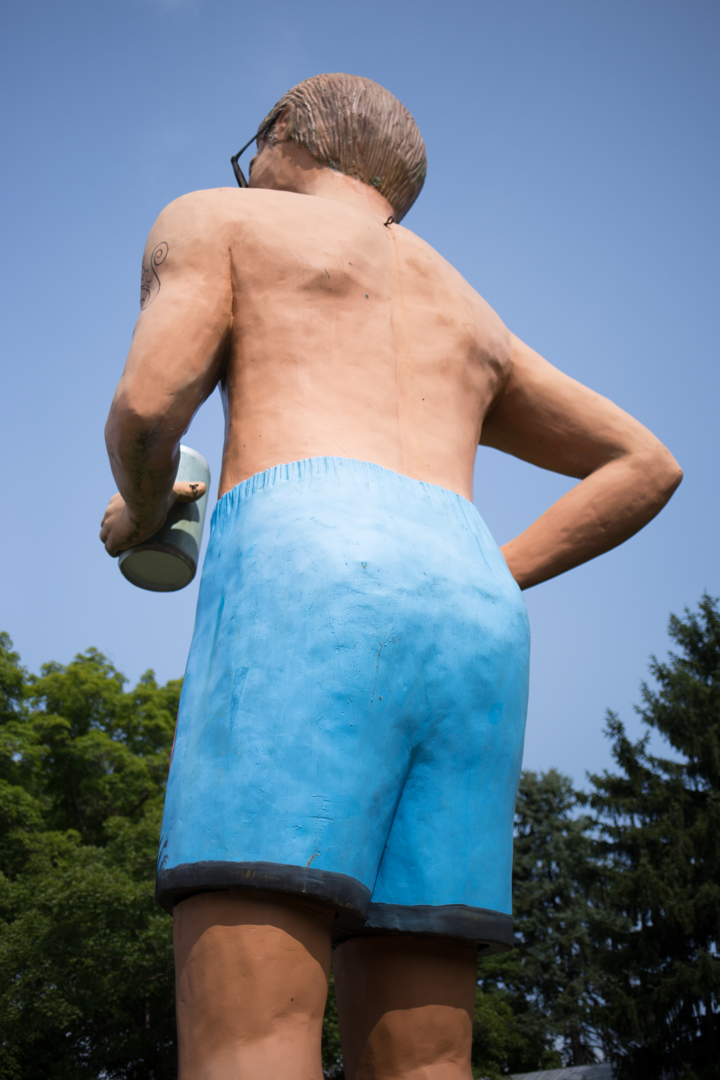
It turns out that rural West Virginia is the perfect place to have a strange collection, "You live in West Virginia and you have no zoning—nobody can say anything!" George says. "So we can get away with it and nobody cares." In 2005 they came across Brian, a "beach dude" statue for sale in Cincinnati. He so big—taller than the 25-foot-tall Muffler Men—that he was moved to the Farnham's property in pieces, on two flatbed trucks.


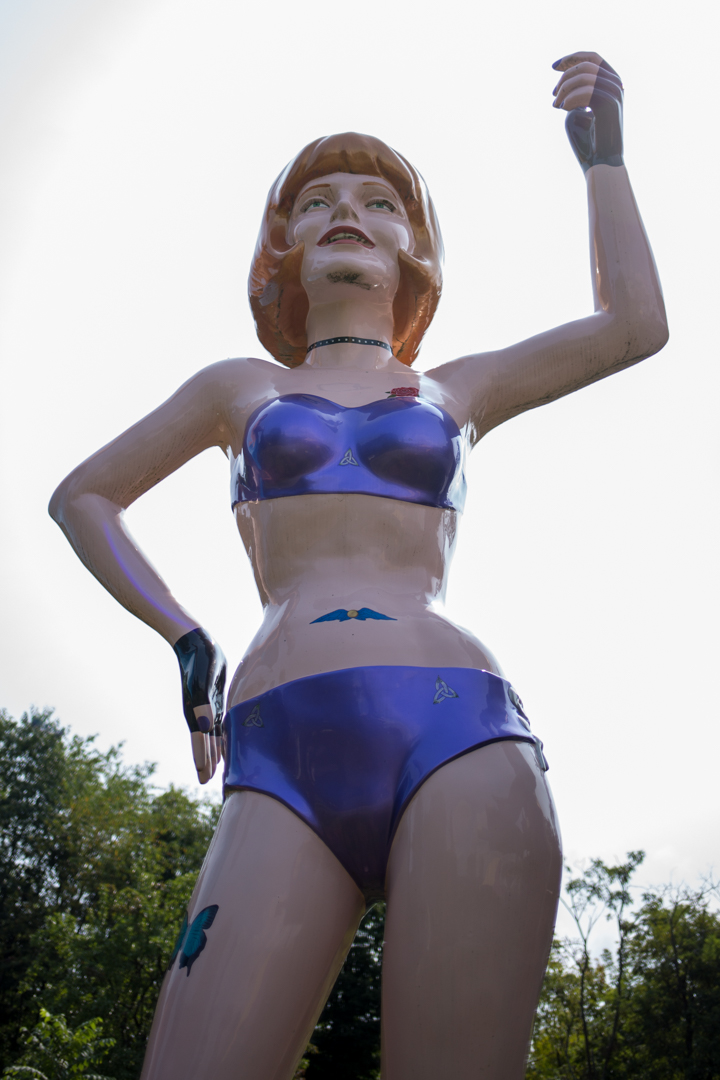

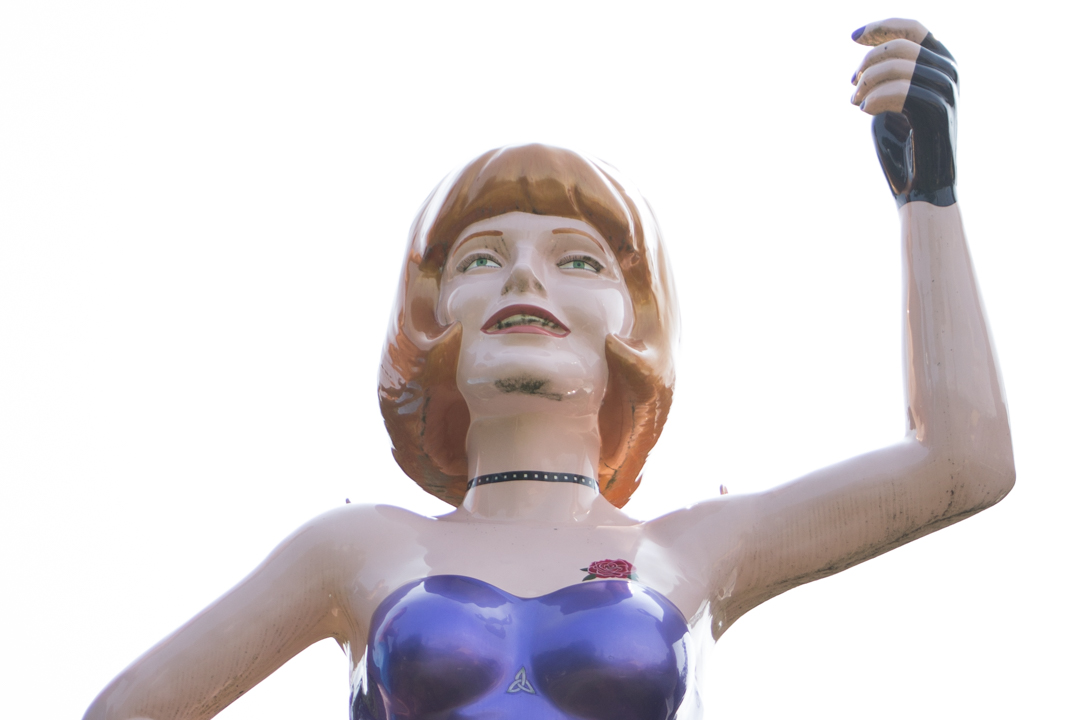

They added a Big John statue soon after the Brian was delivered, and a (questionably styled) UniRoyal Gal (the sixth I’ve seen) joined their family in 2008. Michelle Sommers, a local artist, works with the Farnhams to restore some of the statues and periodically gives them a fresh coat of paint (her handiwork is particularly noticeable on the totally woke Big John, the second of only a handful remaining that I’ve seen).


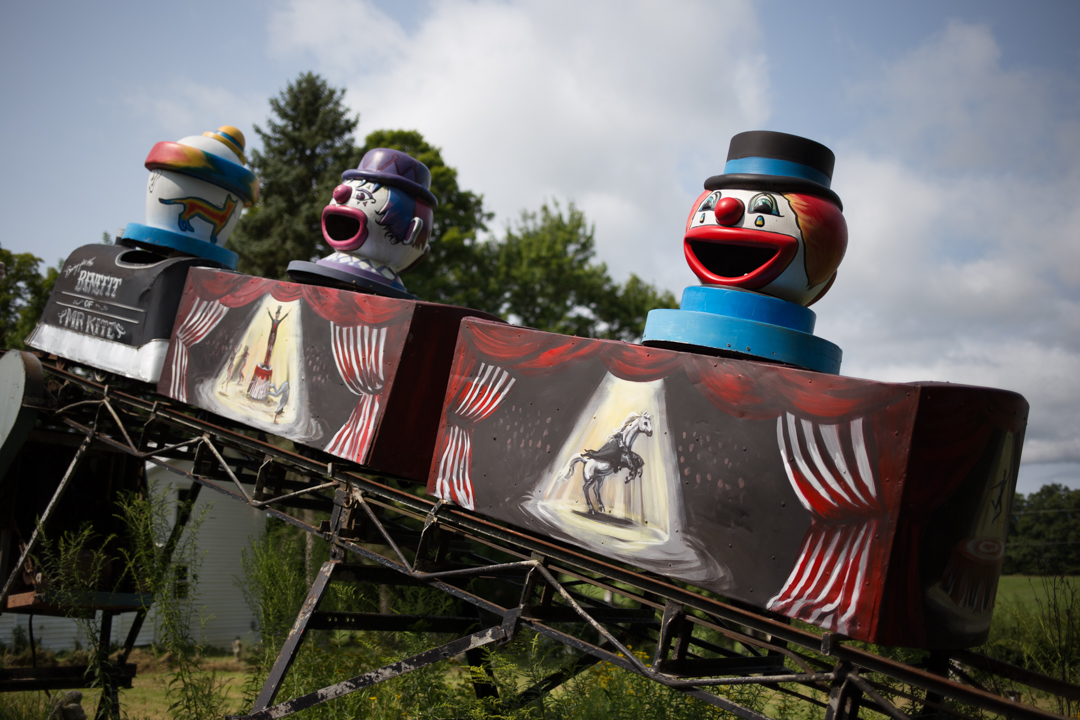
The Muffler Men—yes, they have another one in the back of their yard, a plaid-wearing Bunyan with visible chest hair like the Camp Bullowa Bunyan—are anchored in concrete so they’ll be in Unger for a while. On the other side of the house are even more statues, including a roly poly hamburger guy, a train full of Simpsons characters, a small dinosaur, seahorses, a shark and several clown heads.



The Farnham Colossi is probably not a main destination for many people, but it’s a total goldmine if you seek out Muffler Men and other big, fiberglass statues like I do (even if the sun was in an awful position for photos when we arrived). Unfortunately, the Farnhams weren’t home when we visited but, according to a neighbor, they love visitors—which is the only logical position to take when you have such a large, whimsical collection.
The Farnham Colossi
14633 Winchester Grade Road,
Unger, West Virginia 25411
The most fantastic thing about the New York Botanical Garden’s annual Orchid Show is the orchids themselves