
Archive
- Abandoned
- Alabama
- Arizona
- Bahamas
- Books
- California
- Cemetery
- Climate
- Colombia
- Connecticut
- Diner
- Egypt
- Feature
- Florida
- Friday Fun
- Georgia
- Holidays
- Illinois
- Iowa
- Italy
- Kentucky
- Louisiana
- Maryland
- Massachusetts
- Mississippi
- New Jersey
- New Mexico
- New York
- North Carolina
- Novelty Architecture
- Ohio
- Pennsylvania
- Personal
- Peru
- Project 365
- Protest
- Rhode Island
- Roadside Attraction
- South Carolina
- Tennessee
- Texas
- Travel Guide
- Virginia
- Walks
- Washington DC
- West Virginia
- Wisconsin
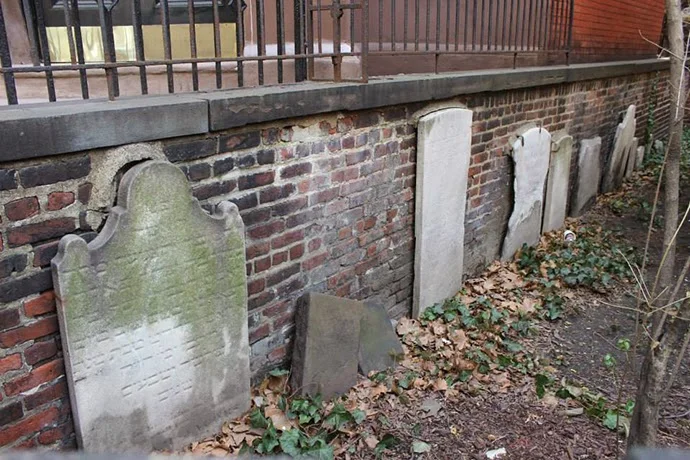
The Smallest Cemetery in New York

Two weekends ago I spent a wonderfully beautiful Saturday wandering around Manhattan. I've mentioned before that these ambling days usually turn out to be some of my favorites, and this was no exception. After starting off my day at the Square Diner, in TriBeCa, I made my way to Greenwich Village to see the smallest cemetery in Manhattan.


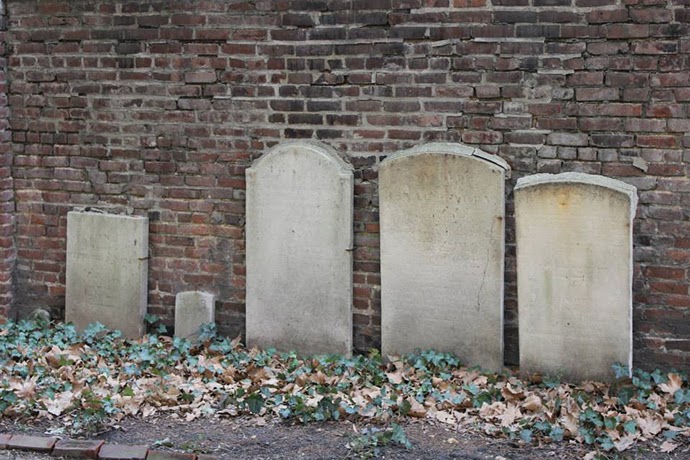
In case you haven't noticed, I've been on a cemetery kick lately, so it was only a matter of time before I made it to the tiny, triangular cemetery on West 11th Street. Unfortunately, the gates were closed, but it's such a tiny piece of land that you can pretty much see it all just from peeking through the fence.


The Congregation Shearith Israel was America's first Jewish Congregation and was founded in 1654. The 11th Street Cemetery is actually its second, and was active from 1805-1829. It was used "primarily to bury victims of communicable diseases like yellow fever and malaria, as well as for those Jews who passed away in New York but were not members of the Congregation [source]"
Over the years, the expansion of the neighborhood has forced many of the remains to be re-interred elsewhere, but a few worn tombstones remain. Most of the stones have been fastened to the brick wall surrounding the cemetery — notable residents include the painter Joshua Cantor (that's his obelisk in the middle) and Revolutionary War hero Ephraim Hart.
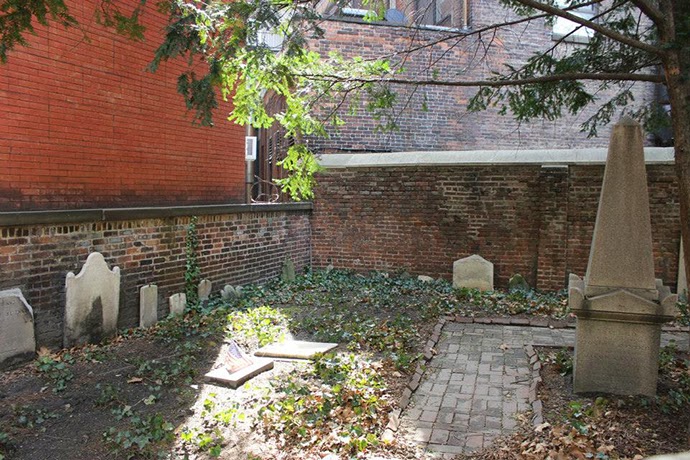

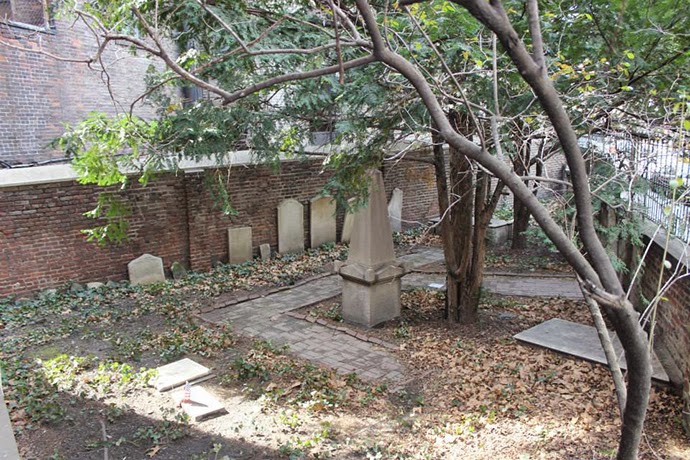
It's probably quite easy to walk right by the cemetery without even noticing it, which I'm sure I've actually done a few times in the past. I am very familiar with the area, and I have no idea why I didn't visit it sooner. A co-worker of mine said she took a ghost tour that started in this cemetery, so I'm wondering if I'll ever be able to get inside of the gates — I would love to take a closer look at some of the headstones and feel what it's like to be in such a tiny oasis in the middle of the city.
As I was walking away I noticed that I could get an overhead view of the entire cemetery by climbing a few steps up to the stoop of a neighboring apartment building. While I was standing there, I noticed a flyer posted on the door of the building advertising an available apartment: a two-bedroom, two-bath apartment (cemetery adjacent!) could be yours for the "low" price of nearly $7k/month, if you want to be neighbors with the quiet residents of the smallest cemetery in New York.

Friday Food: Square Diner
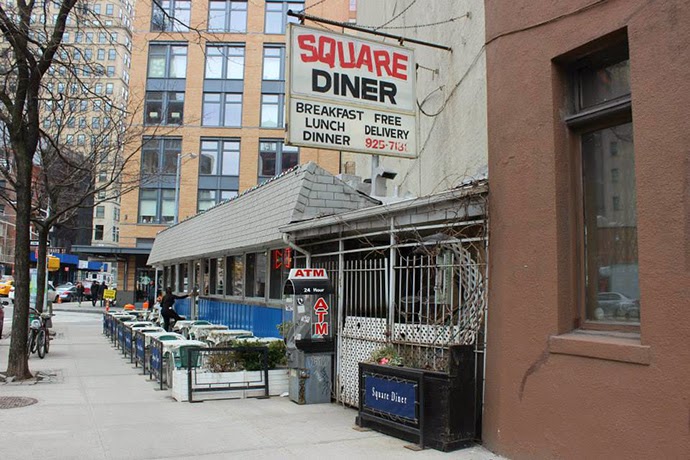
On Saturday, I checked another stand-alone diner off of my list when I went to the Square Diner in TriBeCa. Although I live uptown, the Square Diner is directly off the 1 train so it's a straight shot for me, and it's literally steps away from the subway station.
Like the Pearl Diner, the Square feels very out of place for its neighborhood, which makes it all the more remarkable that it's survived the popularity surge and celebrification of the surrounding areas (aka, all of New York). It wasn't very busy when I arrived at about 11 am, but it was full when I left an hour later. There is ample seating outside, which is another quirky and somewhat unexpected perk not usually associated with diners, and I'd love to go back when (if) the weather finally gets warmer.


The inside doesn't seem to have changed much in years (the outside definitely has), from the faded pink vinyl booths and bar stools to the wood panelling and stainless accents, it's classic diner décor through-and-through.

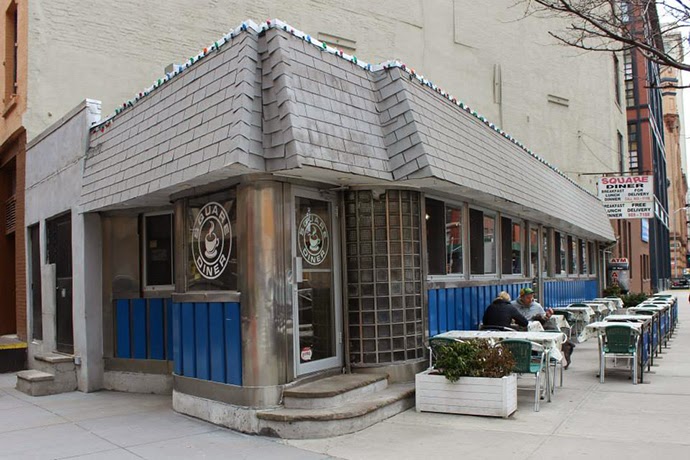
The thing I love most about the Square Diner is that the building is actually triangular, which makes for some awkward spaces where the sides narrow to a point. They even have a circular logo — in fact, the only thing square about the Square Diner is it's name.
I ordered a waffle, and while it was perfectly acceptable it wasn't anything spectacular. It's a little bit more pricey than other diners I've eaten at, but probably a lot cheaper than some neighborhood alternatives. The service was fast if not entirely friendly, so it was a pretty typical diner experience in an above-average space.
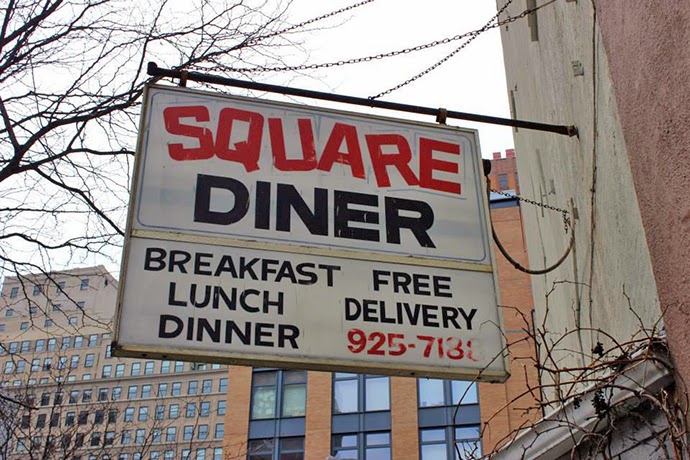

I would put the Square Diner above the Pearl Diner in décor and architecture (although the Pearl has a better sign), but below the Empire, which I have a feeling will remain on top. The food was comparable at both the Square and Pearl — I got waffles at both — and I'll have to go back to the Empire for breakfast if I want to see how it stacks up in the waffle department (my guess is fantastically).
I still have two more stand-alone diners in Manhattan on my list, and then I guess I'll have to start on the outer boroughs. There are definitely more stand-alone diners/dining cars left outside of Manhattan and I see a lot of waffles (and diner coffee) in my future (not mad about it).

NYBG: Orchid Show-Part One
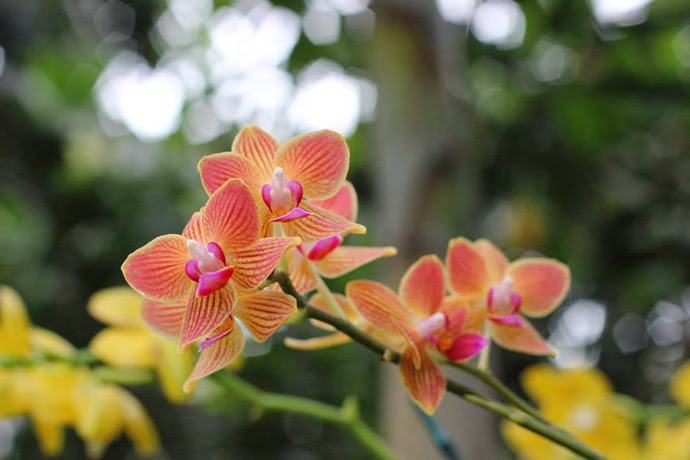
On Sunday Trent, Jim and I went to the annual Orchid Show at the New York Botanical Gardens in the Bronx. The Orchid Show was my first experience at the NYBG last year (I went with my uncle) and having since been to other shows throughout the year —Kiku: Japanese Garden and the Holiday Train Show— I can say that the Orchid Show is definitely the best (not that the others are bad, but orchids are just awesome).
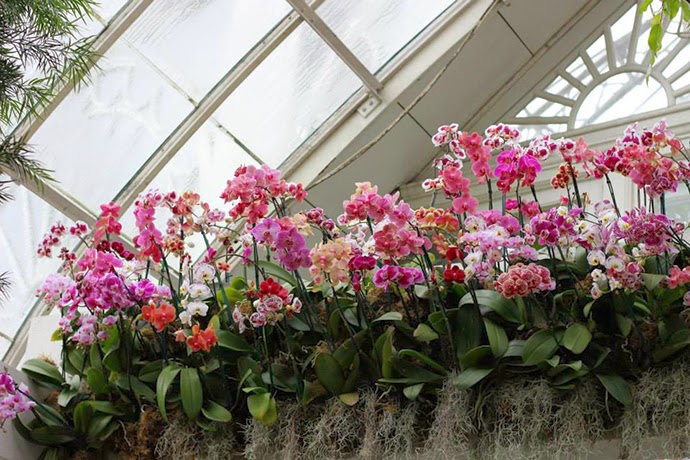



That being said, I think last year's show was better than the current show; it seemed as if there were less flowers this year, which I can't know for sure if there was, but something about it felt more sparse. Maybe it was just that a bit of the novelty has worn off since I recognized a lot of varieties from last year, which is totally understandable. It was still a great escape from the cold, never-ending winter, and we all got in free because I'm a NYBG member.


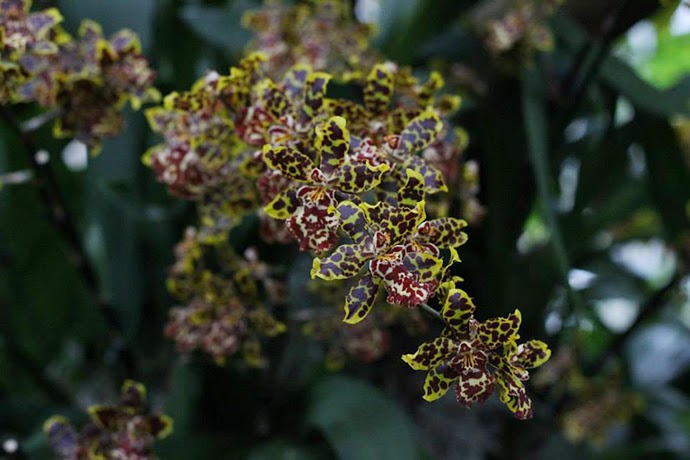

There is a seemingly infinite variety of orchids on display, from ones that smell like chocolate to ones that look like slippers or giraffes or ladies in ruffled skirts. Jim read that there are orchids you can cook with chicken and that blue is the rarest color. I found myself being especially drawn to the darker varieties — maybe the fact that they're rare makes them feel particularly special. There's always been something about a really dark flower that I love. Flowers are such a happy, beautiful thing that they aren't usually associated with darkness or dark, somber colors. It should come as no surprise that I go to a flower show and end up falling in love with the most morbid ones I can find.
I also really loved the green orchids, once again because green is not generally a flower color. It's actually quite odd to see a green flower and they almost didn't even look real.



The show was a great place to continue playing with my new camera and my 50mm lens was basically made to take a million close-up photos of weird-looking plants, so that's what I spent my time doing. The flowers are so beautiful on their own that I didn't have to try too hard to get a good photo and each one was so different that I couldn't help myself from trying to capture them all.
Becoming a member of the NYBG was one of the best investments I've made and I've gotten more than my money's worth just a few months into my year membership. Although it's currently fucking-freezing degrees outside (this is an exact measurement of temperature now) the orchid show was a wonderful taste of spring — even if we may never again get to experience actual spring in New York.
Friday Food: Yonah Schimmel Knish Bakery
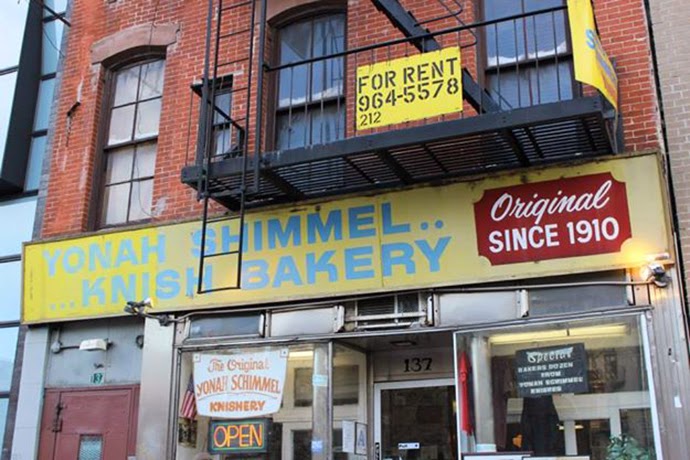
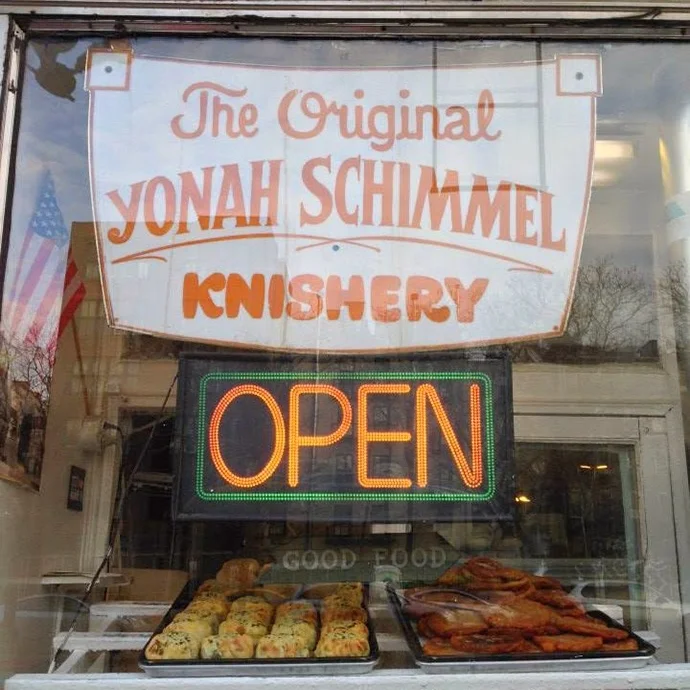
After we toured the Tenement Museum, Jim and I continued to party like it was 1910 and headed over to the Yonah Schimmel Knish Bakery. Neither of us had ever had a knish before, and I wasn't even entirely clear on what they were. I'm still foggy on how you pronounce the word (ka-nish? nish?), but after eating one I can tell you exactly what is in them: not much.
Their sign says "since 1910," but Wikipedia claims that Yonah Schimmel has been serving knishes from their Houston Street location since 1890. Either way, they've been there a very long time, and the inside of the bakery looks the part. They aren't too far from the Tenement Museum, and they're right down the street from Katz's Deli— if you wanted to do right but the Lower East Side, you could do worse than spending the day eating your way down Houston Street with a tour squeezed in somewhere between meals.
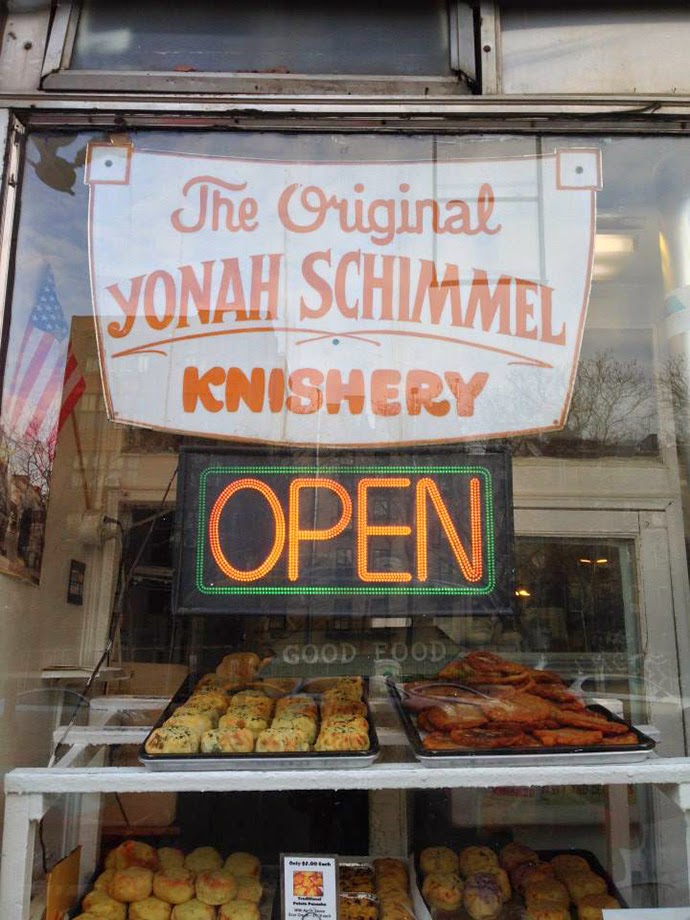
They have table service, so we sat down and ordered — Jim opted for the plain potato and I went rogue with the jalepeño/cheddar/potato knish special. Jim also ordered his first-ever egg cream, which, despite my warnings, he actually enjoyed. Not wanting to ruin the old New York theme of our meal, I ordered a Cherry Lime Rickey, which I've had before and always love.
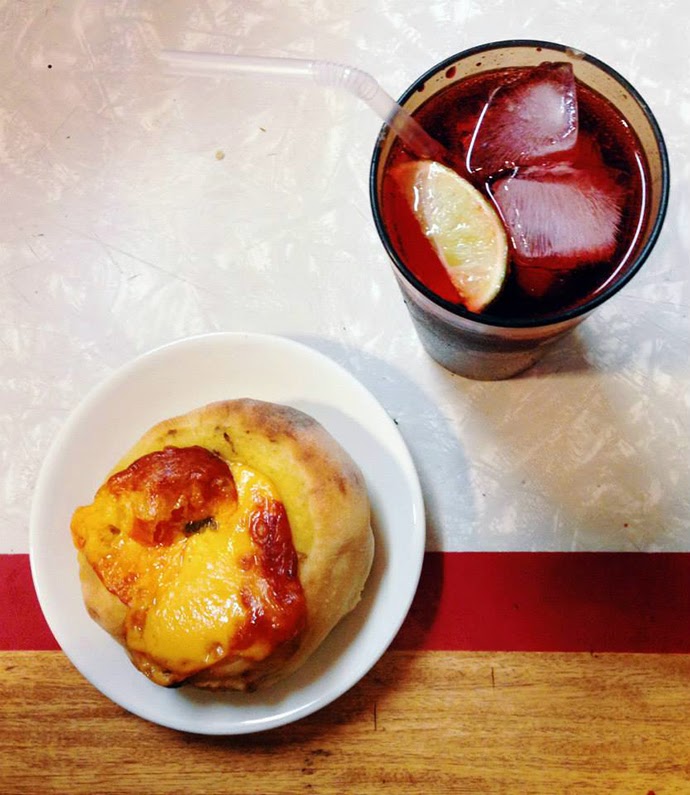
When the knishes came, we didn't have silverware at our table so we assumed you ate them with your hands. We were almost done eating before the waitress realized we didn't have cutlery (or maybe we just looked like animals) and apologized profusely. Apparently the knish is most definitely a knife-and-fork endeavor, but if you want to look like a totally clueless tourist than there's no better way than to attack your knish with using bare-hand method.
As for how they tasted, well... They weren't bad, per se. But I don't think I'm going to actively be craving knishes anytime soon. Mine tasted exactly how you would expect dough filled with mashed potatoes and topped with cheddar to taste. It was a bit bland, very, very dense (it was crazy heavy, which I know since — did I mention? —we ate them with our hands) and extremely filling. We both agreed that if we were ever in need of a cheap ($3.50) and lasting meal that you can't go wrong with a knish.
I think the cheddar and jalapeño was a welcome addition to the plain potato, and dipping it in mustard (there were bottles on every table, so we took the hint) helped as well. For dessert we were so full that we decided to split a cherry/cheese knish, which was delicious and more than enough for two. Jim likened the cheese knish crust to pizza crust, which is pretty accurate, and the filling was cream-cheesy and sweet but not overwhelmingly so.
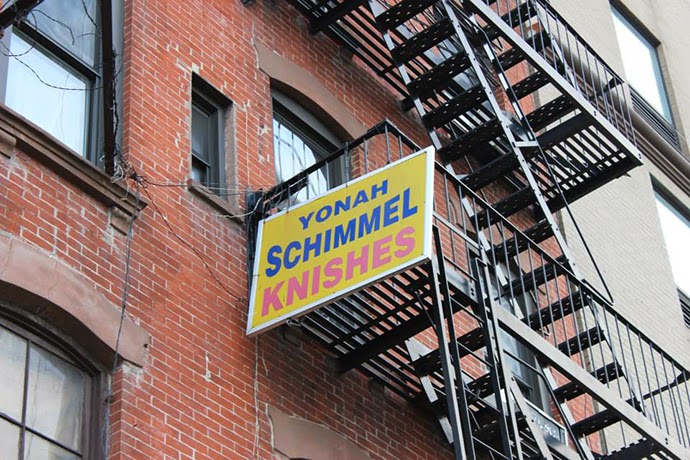
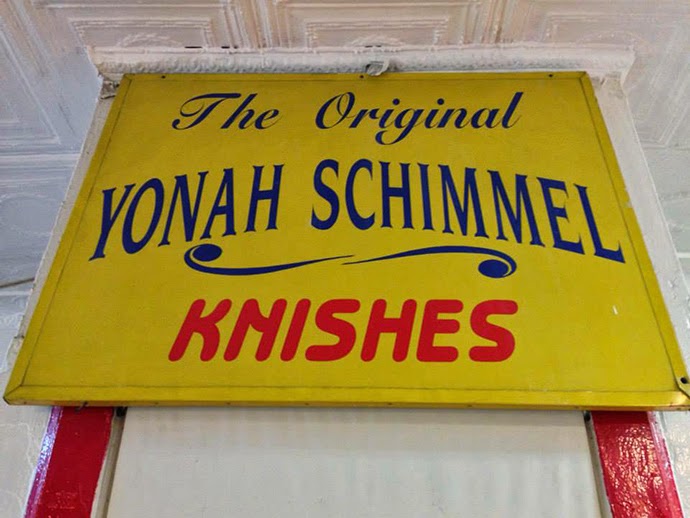
The interior of the bakery is a total time warp, right down to the old man sitting behind us reading the newspaper. If the entire place wasn't so obviously authentic I would have sworn that he was an actor paid to add faux charm, he was so perfectly old New York.
I love all of their hand painted signage and mis-matched décor, and I appreciate their authenticity — they're not trying too hard (or trying at all) to be hip because they don't have to. They've managed to stay in business for more than 100 years and I hope they make it as least 100 more.
Recent Reads
I have a total love/hate relationship with my library card. I'm still amazed that I can leave the library with a purse full of great books at absolutely zero cost to me (except when I can't finish them and end up paying overdue fees) but lately the hold system has been causing me anxiety. I get excited and start requesting a lot of books, and suddenly they all become available at the exact same time. Most of the books have been new releases or popular titles, meaning I only get them for two weeks (instead of three), with no option to renew.
I've tried to increase my reading speed and efficiency to keep up with the constant influx of new material, which is definitely a positive effect, but I've had to let a few gems pass by because I just couldn't fit them into my rotation. I'm totally the dad in About Time, who used his time traveling ability just to get in more reading time. There are so many amazing books in the world that it makes me sad to think that I will never have the time to read them all.
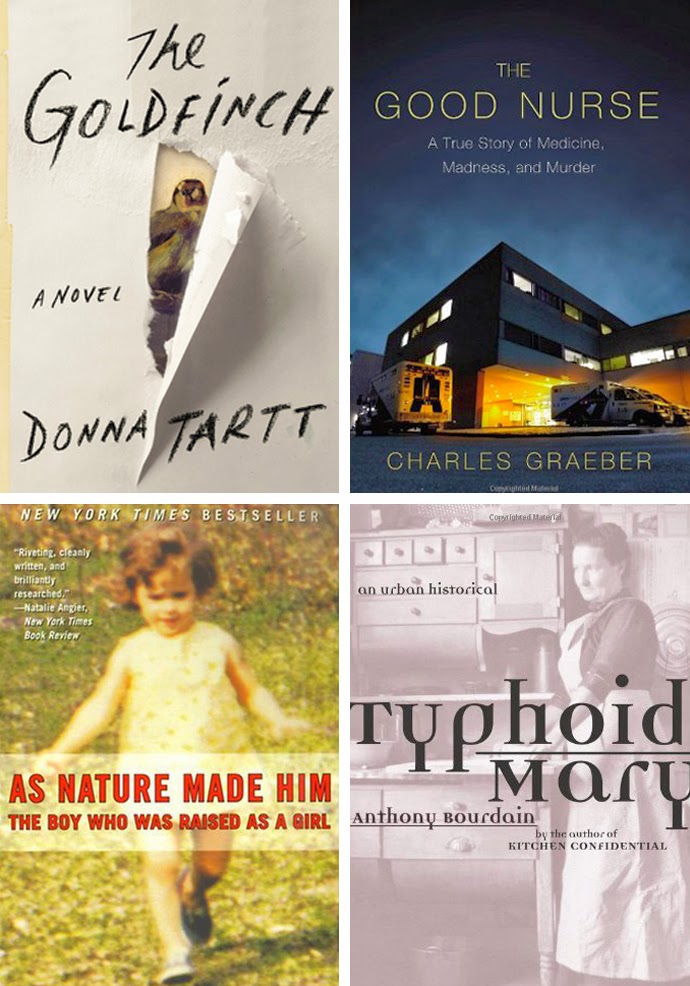
Here are a few recent books that made the cut, all of which have been from the library:
The Goldfinch, by Donna Tartt
The Goldfinch is the most extreme example of my recent reading-induced anxiety: I had exactly two weeks to read all 748 pages, and I actually finished with a day to spare. And then I started a new job and didn't know when I would be able to make a library run, so I kept it a few days overdue and had to pay fines anyway :| Oh well, it was definitely worth it — there are worse things to spend my money on than a good book. This book was on every "best of 2013" list that I saw, and deservedly so. I have been much more into non-fiction lately, and this huge, sprawling novel was a great change of pace. The New York parts were my favorite (for obvious reasons), although the MET Museum bombing hit a little too close to home — I'll never look at that building the same way again. I definitely related to Theo's obsessive love of the stolen Goldfinch painting and there were nights when I just couldn't put the book down (and not only because I was on such a strict timetable). There are portions of the middle that drag a bit, but overall it's definitely worth the time investment.
The Good Nurse: A True Story of Medicine, Madness and Murder, by Charles Graeber
With a subtitle like that, how could I NOT love this book? The Good Nurse is the true story of Charles Cullen, a nurse that may have killed as many as 300 people while working at various hospitals and care facilities on the east coast. Charlie's story is so fascinating (and very terrifying) that there's pretty much no way this book could have been bad. Sometimes the narrative style was a little too illustrative for me (there's no need to embellish here, the truth is crazy enough), but I think I got used to it after a while. It's actually terrifying to think that he was able to kill so many people and yet it took nearly 16 years before he was finally caught — and even then it wasn't an easy conviction.
As Nature Made Him: The Boy Who Was Raised As a Girl, by John Colapinto
The story of David Reimer, who was born a boy and after essentially losing his penis to a botched circumcision was then raised as a girl, is pretty famous but I had never heard of it before reading this book. Someone familiar with the story might find this account to be redundant, but it was all completely new to me. The subjects of gender identity, medical and psychological issues are all fascinating to me, and this book covered all three in the telling of Reimer's story. The author was very sympathetic to Reimer (and no so much his doctors), but I don't think that's a bad thing, or that there should be any doubt that it was a mistake in every way to make such a drastic decision.
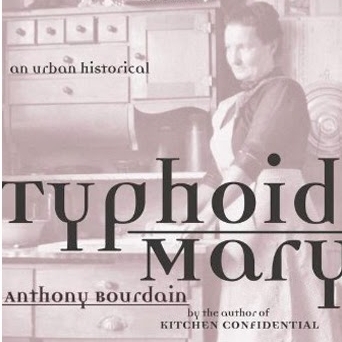
Typhoid Mary: An Urban Historical, by Anthony Bourdain
I'm not going to make many friends reading books with titles like "Typhoid Mary" while I'm eating lunch, but I can't help that I find the creepy/gross/weird side of life to be vastly more interesting than "mainstream" subjects. I didn't have high hopes for this book since I very much judge books by their covers and this one was sort of terrible. It is a stubby little book with a weird cover, written by celebrity chef Anthony Bourdain, yet it was everything I could have hoped for from a book about Typhoid Mary. I didn't know too many details about her story, but Bourdain chronicled them very well, oftentimes from the point of view of a fellow chef (Mary Mallon was a cook by profession). The whole Typhoid Mary affair is a great piece of New York history that I'm glad I am now more knowledgable about, and I even learned that Mary is buried right here in New York, in St. Raymond's Cemetery in the Bronx. I immediately put it on my list of must-see places, along with North Brother Island (where she was exiled) if I can ever figure out how to actually get there without being arrested (any takers?).

Little Red Lighthouse / Walk MS
On Saturday, after I was done exploring Trinity Cemetery and Mausoleum, I texted my friend Alisha to see if she wanted to grab dinner. She suggested that we go to Chipotle, and I counter-suggested that she meet me up north and we not only get Chipotle, but we walk over to Fort Washington Park. Being the great friend that she is, she played along and agreed to meet me at 168th/Broadway, where we bought our dinners and took them to go.
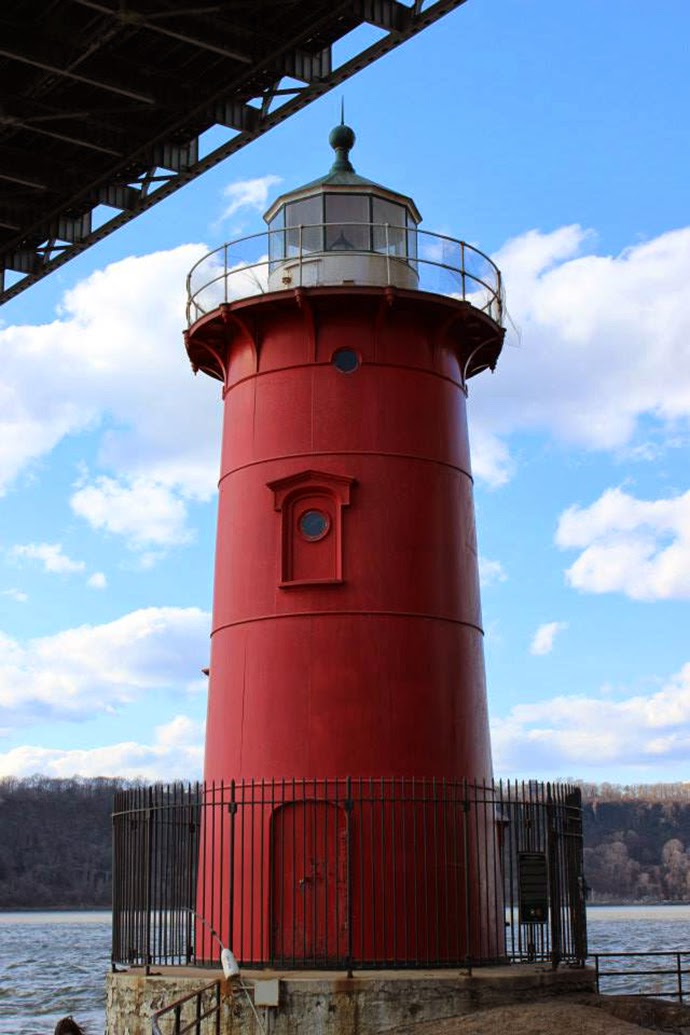
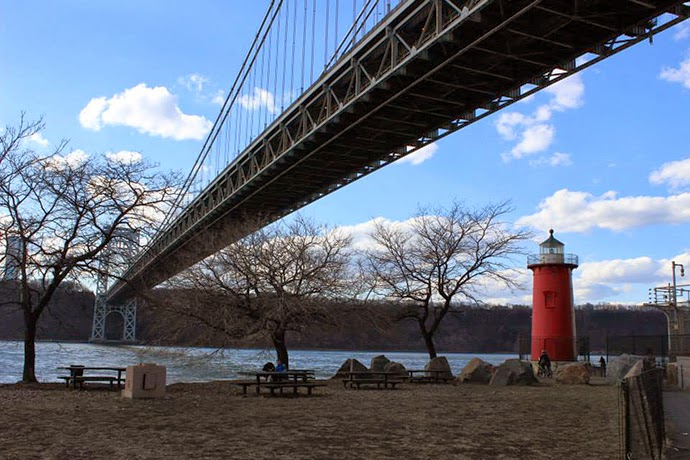
I assured her it was a short walk, but anyone that knows me well has long ceased to believe me when I designate something as a "short" walk. About 20 minutes later, we finally arrived at the park, after taking a very indirect, extremely windy and sometimes stabby-feeling roundabout route, Chipotle bags in hand. Fort Washington Park has amazing views of the George Washington Bridge (it runs right under it) and is home to the Little Red Lighthouse. Made famous by a 1942 children's book, it's the last remaining lighthouse on the island of Manhattan.

This is pretty much how it goes with all of my adventures. I have the best of intentions, but somewhere along the way they get out-of-hand, and I end up walking two or three times as much as I originally intended. Luckily for me, I love walking. I actually adore walking. I've run one continuous mile only once in my entire life, but I could walk for days and days (sometimes it feels as if I have).
In fact, walkability is one of the top things I love about New York, and as much as I also love the subway system, if I can walk to my destination then I'm as happy as can be. When I got a new job on the Upper East Side, I was initially bummed that I would have to ride the bus, but ecstatic when I discovered that walking across Central Park took me just about the same amount of time as a bus ride. You see so much more of the city when you walk and it's a sneaky and endlessly entertaining way to exercise without really feeling like you're doing much.
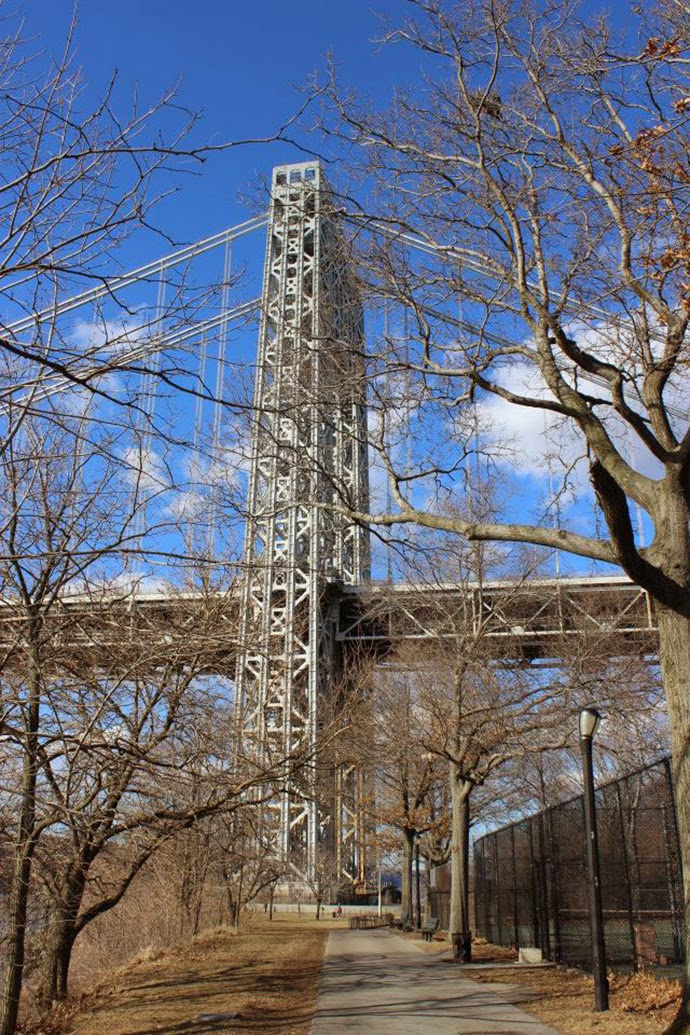
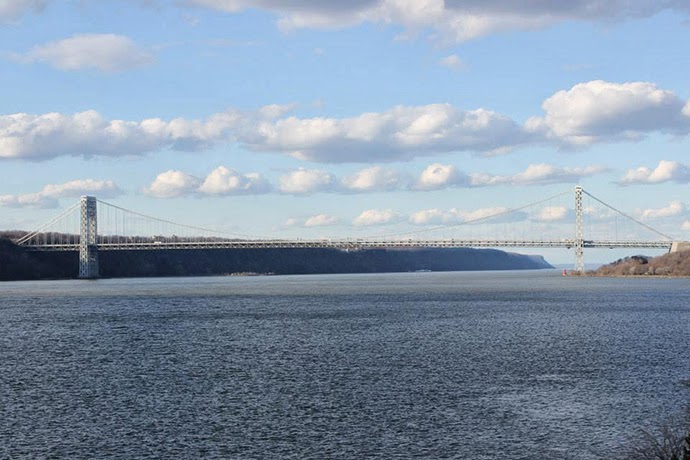
I am grateful every single day for my two, strong and capable legs and for all of the adventures that they take me on. That is why I have decided to draw upon my love of walking to help raise money for the National MS Society. Multiple Sclerosis affects millions of people, some of which no longer have (or live in fear of losing) the luxury of taking a leisurely walk.
My mom and I will be participating in the New York City Walk MS event on May 4th, and I graciously ask for your help in meeting my fundraising goal of $250. This is the first time I've ever done a charity event, and I'm embarrassed it took me this long to start giving back, but I'm excited to help such a worthy cause. If you can spare anything at all, just visit my personal page and click the "donate to Alexandra" link on the right-hand side — my legs and I really, really appreciate it!
Trinity Cemetery and Mausoleum

Last week I went to the original Trinity Church and burial ground in Lower Manhattan, and when I did some research, I found out that there were actually two other cemeteries affiliated with Trinity. I had been to the one at St. Paul's Chapel (not far from Trinity Church), but I never knew that the one in Hamilton Heights/Washington Heights even existed. It turns out that it's actually the only remaining active cemetery in Manhattan, and only a few stops on the 1 train away from where I live.


Trinity Cemetery and Mausoleum spans between West 153rd and 155th streets, from Riverside Drive to Amsterdam Avenue, with Broadway splitting it into two halves. I feel sort of stupid that I wasn't aware of its existence until recently, but I'm so glad I went exploring on Saturday. It was a warm day, although it was very, very windy and the dead leaves swirling around the headstones added an extra level of creepiness.
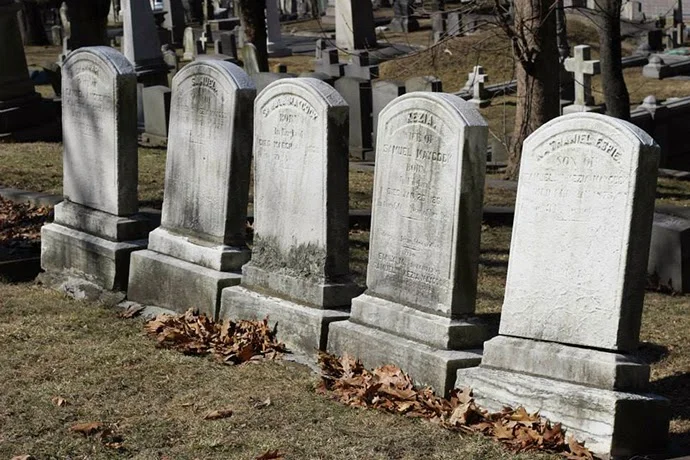
The western half of the cemetery sits atop a steep hill, which slopes down toward the Hudson and provides great views of the river and the George Washington Bridge. As usual, I basically had the entire cemetery to myself, and I only saw three other people the whole time I was there. The western half is more tightly packed, and I'm assuming older, than the eastern half and has more of the old, crumbling tombstones that I love so much.

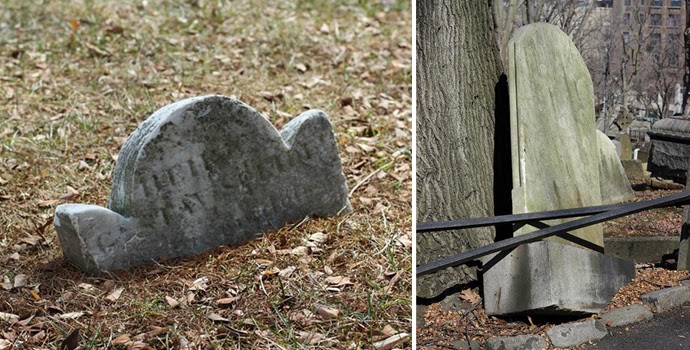


While the grounds seemed well-maintained in general, I saw more knocked over or broken tombstones than I have at any of the other New York cemeteries I've been to. There were others that were being pushed over by growing trees, some that had almost sunk into the ground entirely and some that I couldn't possibly figure out how they had even broken in the first place.
I recently attended a lecture about urban cemeteries (because I'm 100-years-old) and learned all about the weathering patterns of various headstone materials. The older stones made from brownstones, limestone and even marble fair much worse than the newer ones made from granite, which will pretty much last forever. I really dislike the way modern headstones look, and while I understand the appeal of longevity, there should be a way to maintain a classic aesthetic while still using heartier materials. The rounded shapes and simple typography and engravings will always be preferable, to me at least, to the photographic etchings and tacky clipart that adorns most modern stones.

Because I'm also sometimes five-years-old, I couldn't help but be delighted when I found a plot for the Ham family and, shortly after, one for the Burger family — is it too much to hope that they were friends in real life, or at least the afterlife? Unfortunately they weren't located next to each other, but they were still in the same cemetery, so that was enough to at least make me laugh.


Of course this is prime real estate, so Trinity has its share of famous residents, including the Astors, Jerry Orbach (whom I couldn't find) and former New York Mayor Ed Koch, who was only buried early last year. Ralph Waldo Ellison and John James Audubon are also buried here, although I wasn't able to find their plots and the office was closed so I didn't have access to a map. I did recognize a few other famous New York names like Schermerhorn (a subway stop) and Jumel (of the Morris-Jumel mansion) and there are a lot of important congressmen, mayors and businessmen buried at Trinity.


There were a lot of family plots, designated by decorative cast iron gates and fences, which I love. The saddest tombstone I saw, however, was definitely the double one for Henry Coulter, who died in 1882 and seemingly never found anyone willing or worthy enough to be buried next to him. The sight of a blank half of a tombstone so clearly made for two breaks my heart every time I think about Henry spending eternity completely alone, when he so obviously — and perhaps too optimistically — had hoped not to be.

On the eastern side is a plaque marking the spot of some of the "fiercest fighting of the Battle of Washington Heights," which occurred in 1776. I love stumbling on these little bits of history sprinkled in every corner of the city, and I never know when I'm going to be surprised by one.

There must have been a very recent addition to the mausoleum because a panel had been removed and there was super creepy red velvet curtain hung over the opening. This isn't something I've ever seen in the old, out-of-commission cemeteries that I'm used to visiting. It made me wonder just how hard it is to actually get a spot in Trinity Cemetery — New York is the most expensive place to live in the US, and I would expect that final resting places, especially as beautiful as this one, are no exception.
Staten Island / Snug Harbor
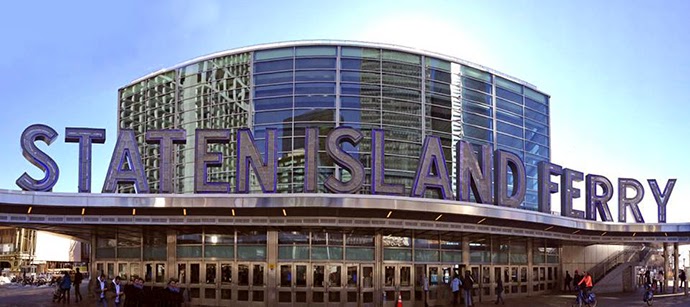
A few weeks ago the weather finally got warm (albeit temporarily) so Jim and I decided we wanted to take an adventure. He had never been to Staten Island, so I proposed that we go to Snug Harbor. I had been once before, but I wanted to see it in the winter, especially since the last of the snow was rapidly melting.
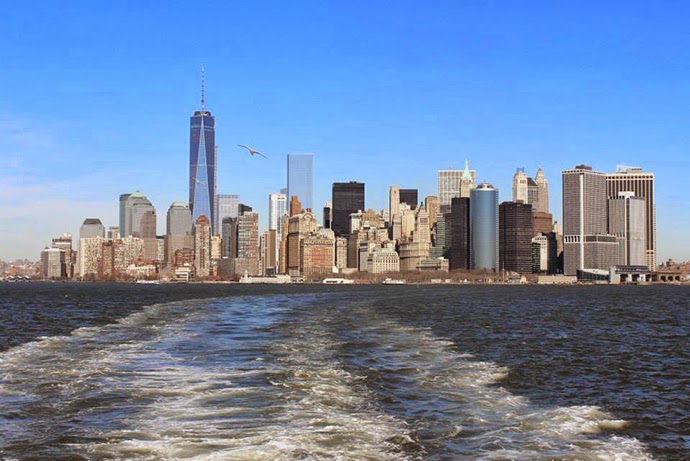
We took the Staten Island Ferry, which is a wonderful adventure just by itself. We couldn't figure out how to get on an upper, outside deck but it ended up not mattering so much because we found our way to the rear of the ferry, and the view did not disappoint. I'm still amazed every time I take one of the ferries (Staten Island, Governor's Island, Ikea...) that such a novel mode of travel is absolutely free. New York is a city of extremes; we pay absurd prices for things like apartments and lattes, but we also get things for free that probably should be expensive. It all has a way of balancing out in the end — at least that's what I prefer to think every month when I mail my embarrassingly large rent check.
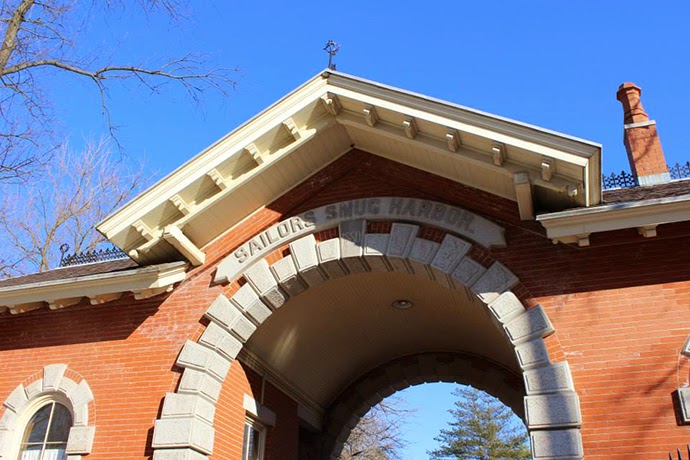
We decided to walk to Snug Harbor, which I chickened out of doing my first time there, and I still don't highly recommend it. It's a long walk, but more than that it's kind of a sketchy one, and apparently one that doesn't get much attention from anyone with a snow shovel. We walked along Richmond Terrace, for the most part, and it's definitely not the most pedestrian-friendly route that I've been on.
We walked back to the ferry a different way — through neighborhoods — although I don't really recommend that either. There is a bus that takes you directly from the terminal to the entrance of Snug Harbor and I'll definitely be taking that on any return trips.
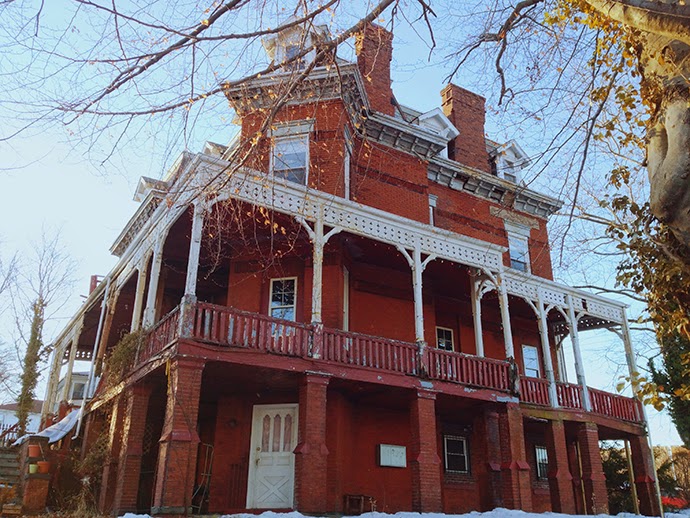
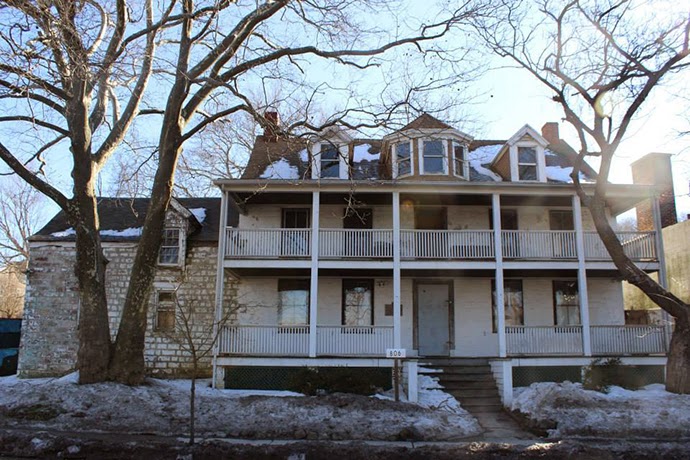
We tried, relatively unsuccessfully, to find Staten Island's historical district, but we did happen upon some beautiful, although mostly neglected, historic homes. Right next to the entrance to Snug Harbor is the Neville-Tysen house, which I hadn't noticed on my previous visit. While there is some dispute over when it was built — some say it's pre-Revolutionary, some say it's post — the house is one of the oldest houses in New York City and received landmark status in 1967.
I'm not sure what the current status of the house is, but a recent owner was critically injured in 2012 when she fell through a weak spot in the floor into a well below. It appears to be boarded up now (definitely haunted?) and in a state of decay, but I hope that people haven't given up on it just yet.
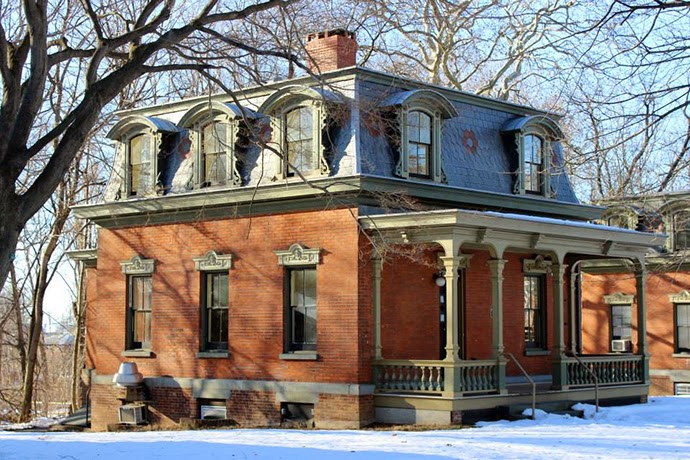
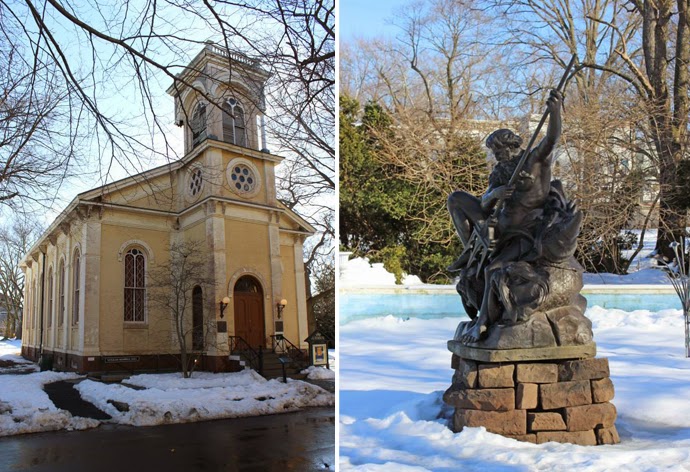
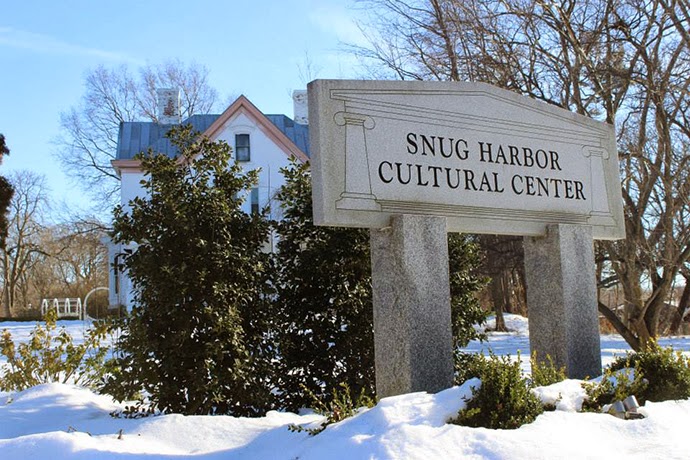
Snug Harbor was just as weird, beautiful and desolate as the first time I went, but it was nice to be able to show someone else around. The cottages are still one of my favorite parts of the campus — five of which are now home to artists via a live/work residency program (a total dream).
Everything looks even more enchanting (and abandoned) when it's covered in snow, and although it was warm there was still enough snow on the ground to make this visit feel completely different than when I went in the sweltering heat of July. The fountains were turned off, and the Chinese Scholar Garden appeared to be closed, although the general grounds are open year-round from dawn to dusk.
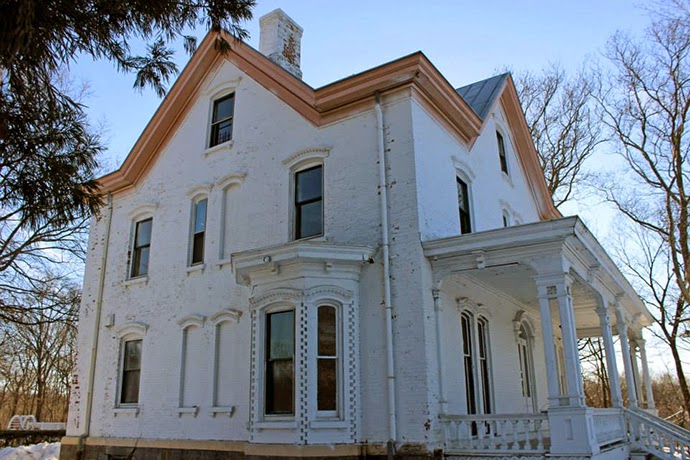
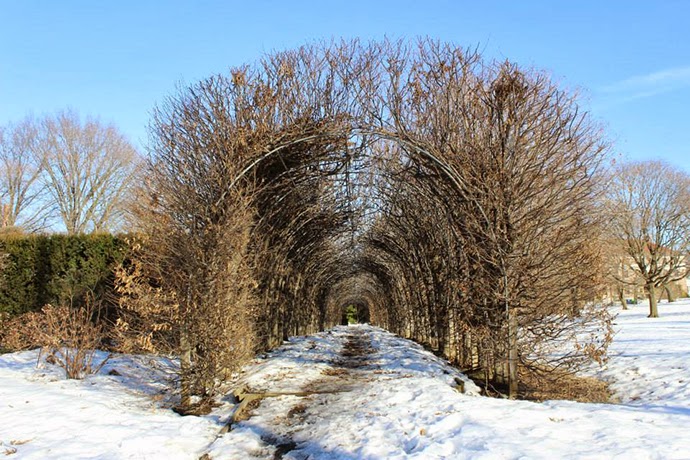
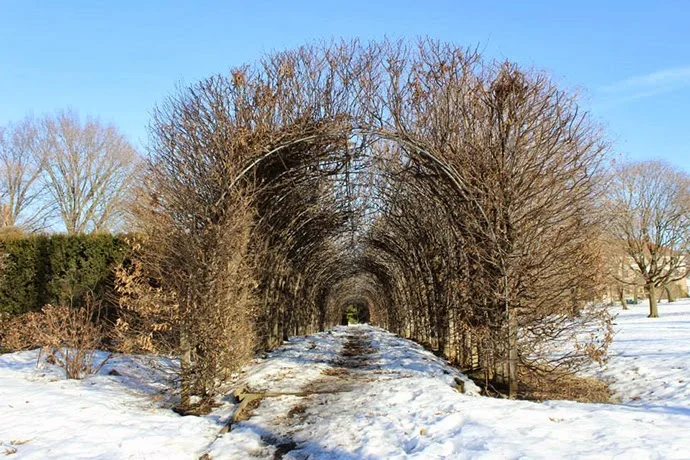
The Governor's House is just as creepy as ever (definitely haunted.) and the allée is only slightly less enchanting without the greenery. We also made a point to check out the Snug Harbor Cemetery, which I somehow neglected on my first trip, despite my intense love of all things funereal.
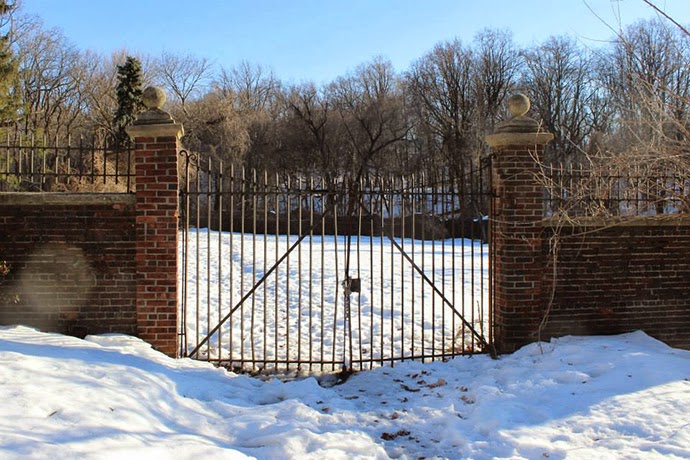
What we found was not exactly a cemetery, but more of a burial ground, with no visible headstones or markers of any kind. The only indication that it even existed was a brick wall surrounding a field, with a gate that was locked. I don't know if it's ever open, but it's basically in someone's back yard now which I think has to be pretty creepy for them (definitely, definitely haunted). Apparently more than 9,000 seamen — who spent their last days at Snug Harbor — are buried here, but all of the nameplates have been removed to prevent people from stealing them for scrap.
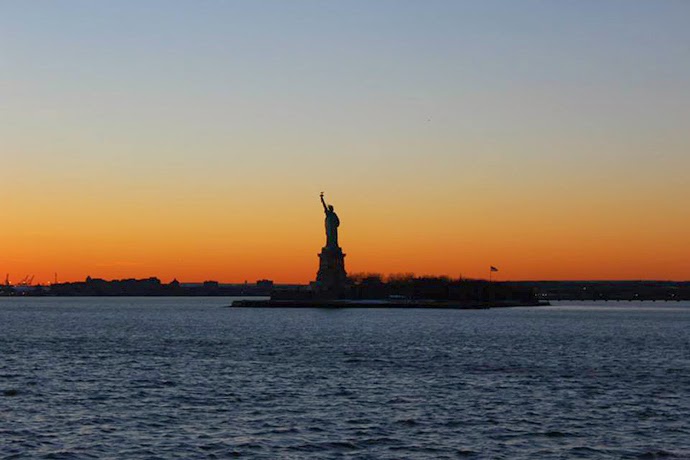
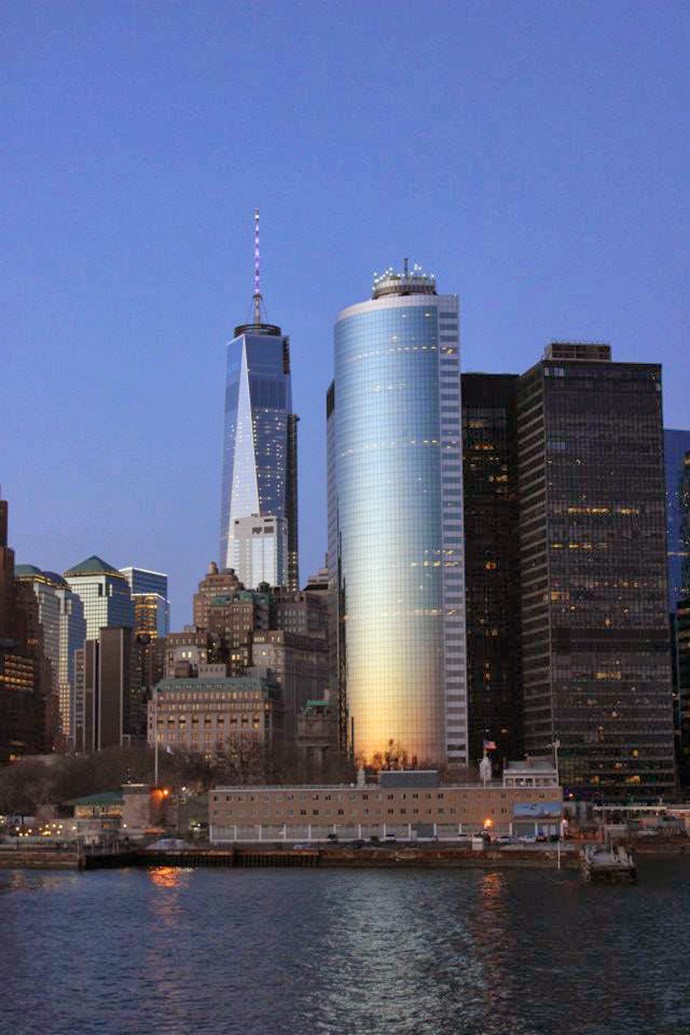
Our last stop in Staten Island was a Dairy Queen (the only one in New York!) in the ferry terminal for Blizzards (necessary) before boarding the ferry back to Manhattan. We ended up hitting the time exactly right to catch a crazy beautiful sunset over the Statue of Liberty, and the light sparkling off of the buildings in Lower Manhattan was just perfect. It was the perfect adventure-filled day, and all it cost us was the price of a (well-deserved) Blizzard.
Friday Food: Ladurée

A few weeks ago I went to Trent's apartment to watch the Oscars with him and Alisha. Trent was planning to make a jalepeño popper grilled cheese, and Alisha was bringing brie and making guacamole. I reprised my role as bearer of the dessert from our similar Golden Globes party a few weeks prior and picked up cannoli because I was near Little Italy for the Chinese Lunar New Year Parade. For the Oscars, I wanted to bring something even fancier and a little special, so I decided on macarons.
Even though they're super trendy right now, I didn't have my first macaron until a little over a year ago. I haven't had one since, but I've been wanting to try Ladurée ever since I first found out that they had a store on the Upper East Side. They've also recently opened another shop in Soho, but I decided to walk across Central Park to the original on Madison Ave.


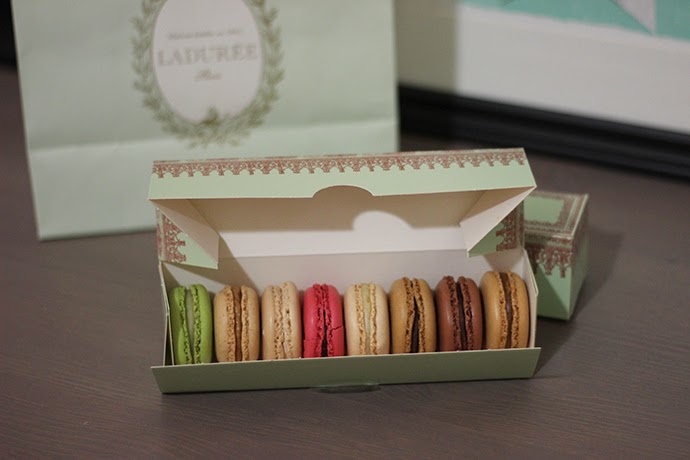
Ladurée was founded in Paris in 1862, and they make the quintessential macaron. They actually ship all of their macarons directly from Paris, so I'm assuming it's the best you can possibly get without actually going to Paris. I wouldn't say that macarons are my absolute favorite dessert, and some of the flavors that people come up with sound downright disgusting. I will say, however, that they are interesting, and completely unlike anything I've ever really had before.
The first time I had them the novelty factor was very high, but this time I knew more or less what to expect. The shop is very, and kind of absurdly, fancy— gloved men very carefully put your chosen macarons into crazy expensive gift boxes one at a time, handling them as if each were a precious newborn baby. The experience of it all is half the fun, but believe me, you pay for it. Each macaron at Ladurée is $2.80 and that adds up quickly.

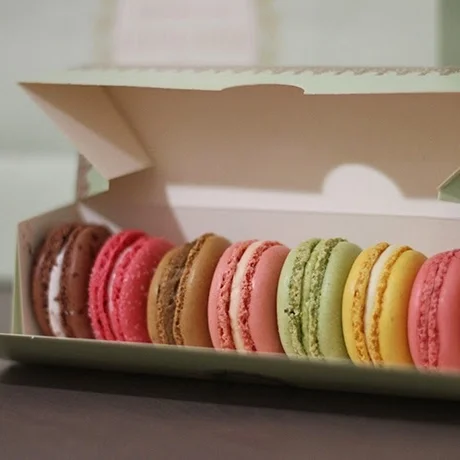
If you don't need a souvenir box then you can get the less sturdy pastry boxes (free), which was totally fine for transporting them across the city. I got one of each flavor they had that day (minus the orange since I only wanted 16) and some were incredibly delicious (pistachio) and some were kind of awful (rose). It was fun to try a variety, but there were definitely some that I need not ever eat again. The lemon was okay, but I was most excited for that one so it didn't really live up to my expectations. I remember the first lemon macaron I ever had wasn't great either, so maybe lemon is a flavor that just doesn't translate well into a macaron.
So was it worth trekking to the east side, waiting in a ten-minute line and paying $2.80 per macaron just to say I had my first Ladurée experience? Probably not, but that doesn't mean they weren't a delicious, fancy and incredibly beautiful treat, which is exactly what I wanted for the Oscar party.
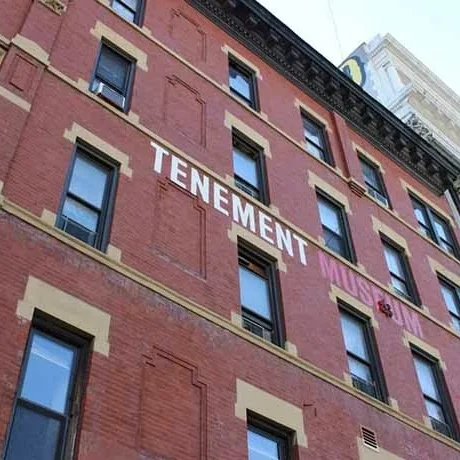
Lower East Side Tenement Museum
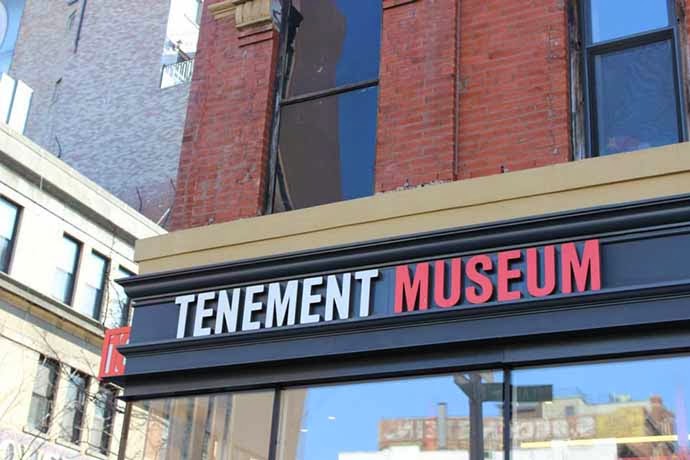
On Saturday my friend Jim, his roommate Erica and I went on a tour at the Lower East Side Tenement Museum. It had been on my list for a while, but it's pretty pricey ($25) so it had been pushed aside a few times for cheaper activities. We were kind of torn on what tour to take since there are several (and no "main" one), but we finally settled on "Sweatshop Workers." I do wish they offered one general tour, since having to choose just one kind of stressed me out, but I guess that just means we'll have to go back and take the others (something tells me this is exactly how they want me to feel).
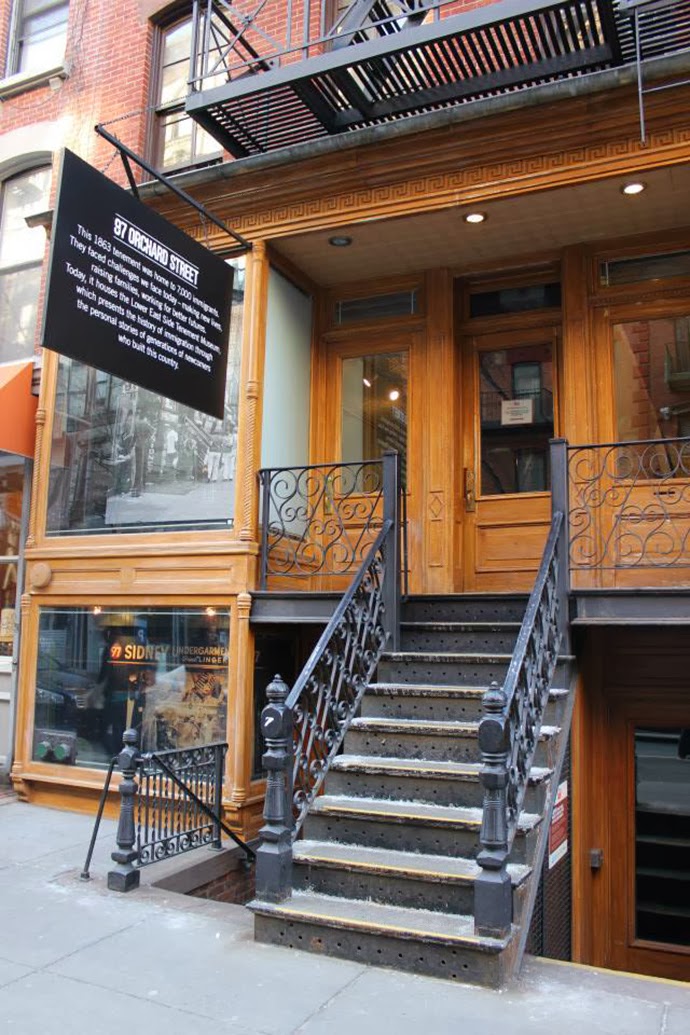
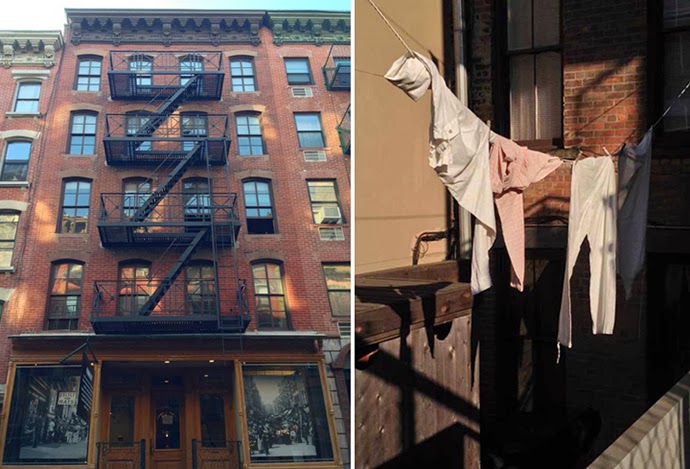
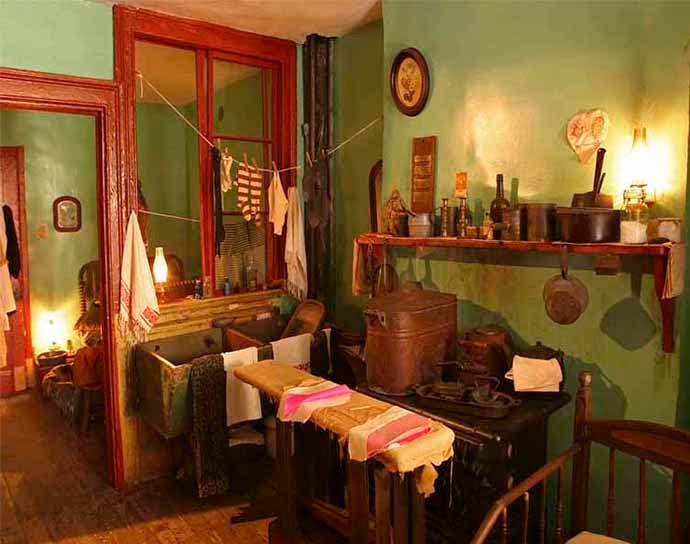
Our tour took us to the 3rd floor of 97 Orchard Street, an apartment building a few doors down from the main building and gift shop on the corner of Orchard and Delancey. Built in 1863, 97 Orchard Street was home to over 7,000 working class immigrants before being vacated and boarded up in 1935 because the landlord couldn't afford to make the improvements required by law. It was discovered by the founders of the museum in 1988, and they've since restored 6 apartments, where the tours take place.
[source]
Our tour took us into two different apartments: the Levine family's home/garment workshop and the slightly more modern home of the Rogarshevskys'. It's one thing to read about tenements, immigrants and unfair working conditions, but it's a whole different experience to actually stand in the environments while you hear their stories (photos aren't allowed inside).
The apartments are actually pretty nice, and would be comfortable today as one bedrooms for a single person or a couple, which is what I thought when we first entered into one. But then they tell you that, on average, ten people — a husband, wife, five kids and various relatives or boarders — lived in each one and you start to realize just how rough it must have been. With no running water the women were constantly walking up and down flights of stairs carrying buckets of water, and four outhouses were shared by everyone in the building (150-200 people). Even after the indoor plumbing was installed, there were still only two toilets to be shared amongst four apartments on each floor.
Immigrants working in the garment industry would work 14-hour days, six days a week, making 75 cents for a dress that would retail for about $15 (which is also what they paid per month in rent). It really is hard to even imagine what life must have been like back then, and although I always try to be grateful for how wonderful my life is, the tour definitely reinforced just how lucky I actually am.

It feels a little strange to complete a tour like the one we took, and then walk through the Lower East Side today. The area bears little resemblance to its former life as a neighborhood of tenements and squalor and its new identity as the "cool" place to be feels weirder and weirder the more you learn about its history.
I'm not saying that I think it should still be filled with tenements and horrible living conditions, but I just wonder how the Levines or the Rogarshevskys would feel knowing that I spent $4.50 on a small latte directly across the street from where they, and thousands of other people used to call home.

Greenpoint / Pulaski Bridge

On Presidents' Day, I had the day off and I decided to explore Greenpoint, Brooklyn. Despite the fact that it was bitterly cold (20 degrees at the most with wind chills in the single digits) it was crazy sunny and I wanted to get outside.
I had never been to Greenpoint before, and in the same way I begin most of my adventures, I picked a starting point: Five Leaves on Bedford Ave. I had read rave reviews about their brunch and I thought I would chance it, hoping it wouldn't be super crowded since it was a weekday. Well, all of Brooklyn must have also had the day off because it was absolutely packed. All of the outside tables were even full, and like I said it was cooooold. I wasn't in the mood to fight the crowds (and upon seeing the type of crowd, I know I'm definitely not cool enough to even really be there) so I kept on walking further into Greenpoint.
A friend of mine had once raved about Peter Pan donuts, so I decided to head there for lunch instead. The shop is super cute and a total time wrap, but it was also full so I had to take my donuts to go. I got a chocolate iced and lemon cream, and headed to the waterfront.


I am a sucker for a great skyline view, and the one from WNYC Transmitter park is a definitely worth seeing. It's a small park, but there is a nice pier jutting out into the East River — although I found out later that right next door is where the East River Ferry pier had mysteriously collapsed a day earlier (yikes).
I stood on the pier and ate my donuts as I basked in the sunshine, and thought that there was pretty much no better way to spend a day. Of course the wind blew powdered sugar all over my coat and my hands were borderline frostbitten after five minutes, but the view was so nice and the donuts so delicious that it was hard to be grumpy about anything.


I wandered around Greenpoint for a while longer, slowly making my way to the Queens/Brooklyn border. The area is very industrial and desolate, and I found a lot of great graffiti and beautiful, old buildings to photograph. I would love to go back when the temperature is more hospitable now that I have my new camera and just focus on taking photographs, but I managed to snap a few in between hand-warming sessions.


I eventually ended up at the Pulaski Bridge, which I decided to walk over to Long Island City, in Queens. It's a small bridge that links the two boroughs, with a pedestrian walkway on one side. It's not much to look at, aesthetically, but the views of Manhattan are pretty spectacular.


There are also welcome signs into each borough, although the one into Brooklyn definitely wins in the copywriting department. While the Pulaski is the least exciting (and shortest) bridge I've walked, it was nice to be able to cross another one off of my list. It was a long walk — about 3 miles from the Bedford L to Queens — but I try to go at a leisurely pace and there's always something fascinating to look at.
I ended up at Sweetleaf in Long Island City, which is quickly becoming my favorite coffee shop due to their insanely delicious iced Voodoo Child drink and cozy atmosphere. It was the perfect end to the perfect day off and I'm so glad I wasn't deterred by the cold (or the hipster mob at Five Leaves). Winter in New York is vastly preferable to the winters I've spent elsewhere, since there's rarely been a day where I haven't been outside at least for a little while. Spending the day outside in the sunshine can go along way towards eradicating the winter blues, or at least holding them at arm's length. Even though I'm totally ready for spring, this winter has been so amazing that I won't look back on it with anything but fond memories — even if I'm still finding powdered sugar on my coat from my donut-in-the-wind break.
Trinity Church Cemetery
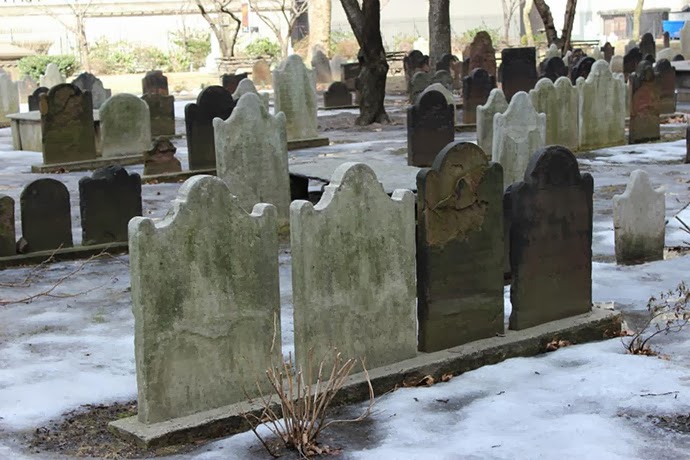
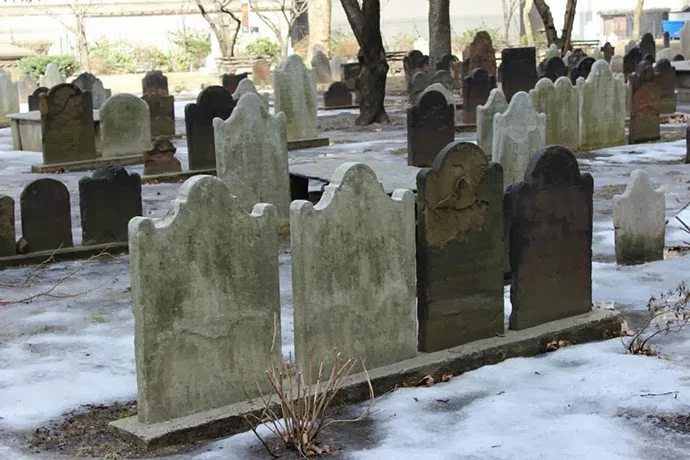
Saturday was an absolute gorgeous day (sunny and in the 50s — finally!) and I didn't have plans until the afternoon so I headed out to wander around downtown. I'm still having fun getting to know my new camera, so my first stop was Trinity Church cemetery to take some photos.
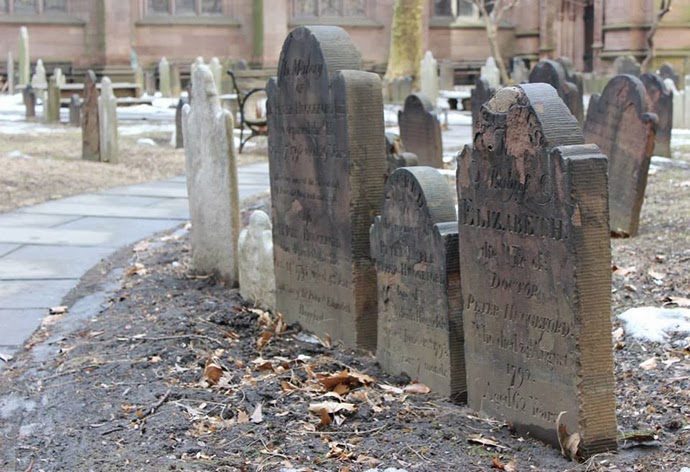
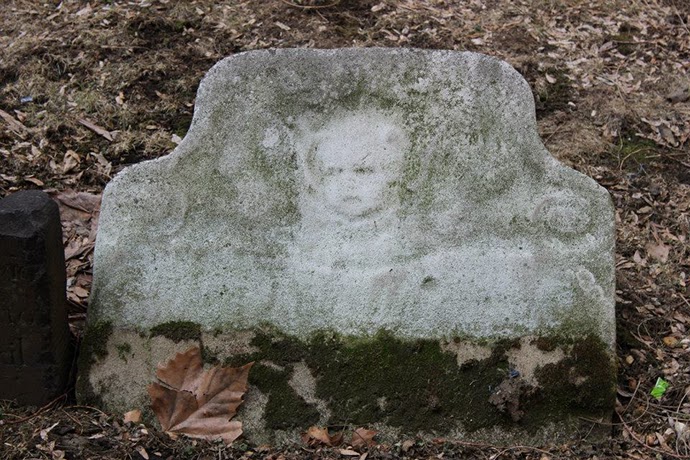
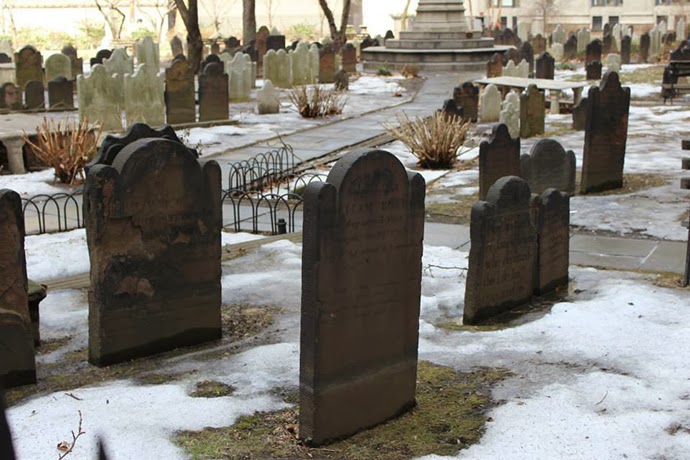
Aside from just loving everything about cemeteries, they make wonderful places to take photos, especially for someone like me who is just getting acquainted with a new camera. They're not usually crowded and there is always something visually interesting to focus on.
I've been to Trinity Church (and its cemetery, which surrounds the church) many times and it's definitely my favorite Manhattan cemetery. The churchyard cemetery (there are two others associated with Trinity, one on Riverside Drive and one at St. Paul's Chapel) opened in 1697 and as I've said about cemeteries, the older the better.
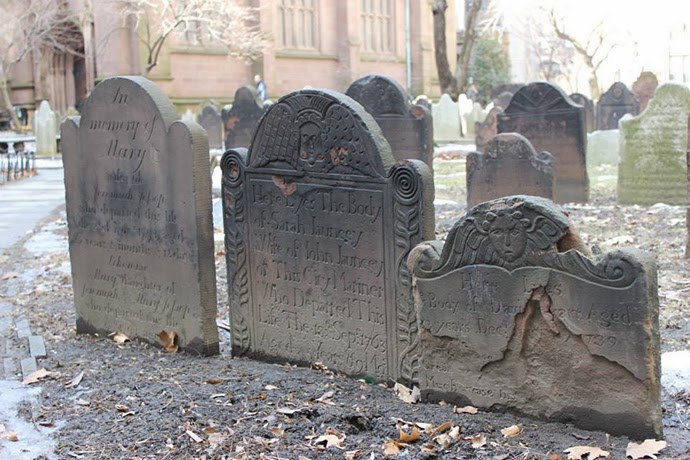
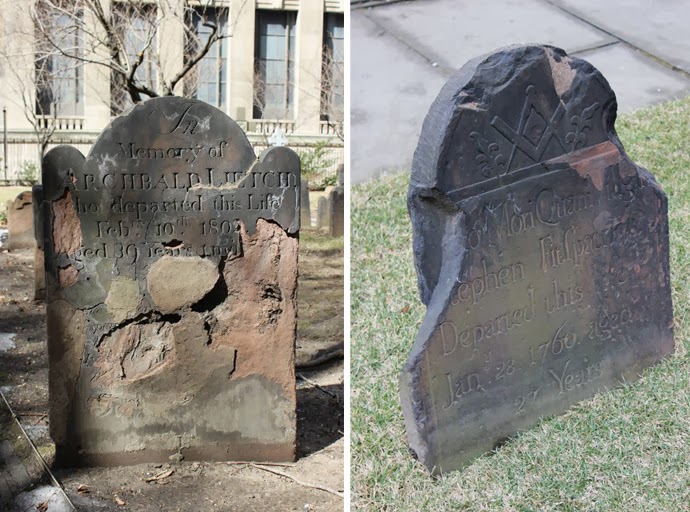
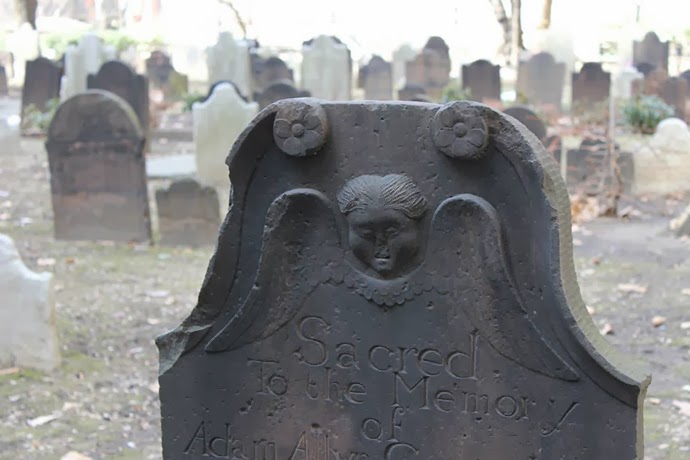
There are many important people spending eternity here, including signers of the Constitution and the Declaration of Independence, delegates to the Continental Congress, US Senators, Representatives, Revolutionary War heroes and Alexander Hamilton and his wife.
There are even a few tombstones carved withe the symbol of the Free Masons, and if you've seen National Treasure you might get as nerdy excited about that as I did. This is the church under which they end up finding the treasure. No matter how cheesy the movie (or unbelievable the plot), I still love seeing famous filming locations in person and I'd be lying if I didn't say that was one of the reasons I love Trinity so much.
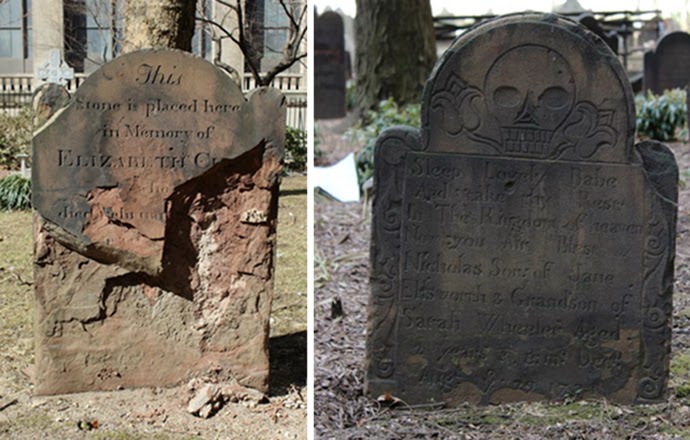
I am totally obsessed with the old, crumbling tombstones and I think they are leaps and bounds above the tacky marble headstones that we have today. The skull, bones and angel carvings are so incredibly beautiful to me, and the typography is pretty much perfect.
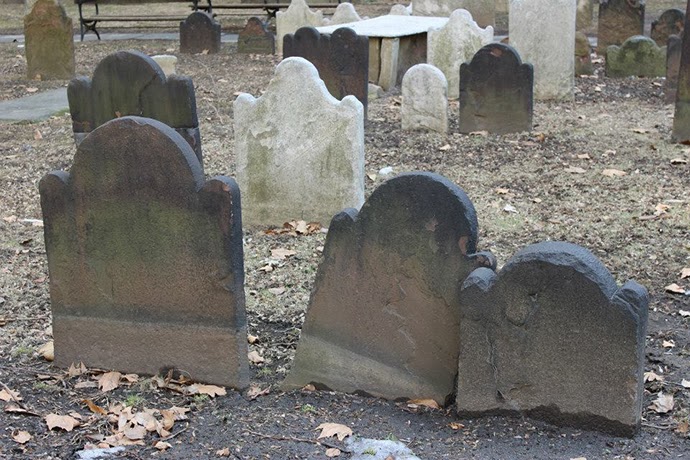
Trinity Churchyard might actually be one of my very favorite places in all of New York and despite being in a very tourist-heavy area of the city, it's usually quite peaceful and nearly empty. I love that through all of the changes to the area in the past 317 years, it has not only endured but remained in great condition. Although some of the tombstones are in pieces, a large number of them are in surprisingly good shape. One of my very favorite things to spot at an old cemetery like this is a tombstone gently leaning on the one next to it — I can't help but think that they belong to a husband and wife who just couldn't spend all of eternity being separated, and my heart simultaneously breaks and warms whenever I see a pair of leaning stones.
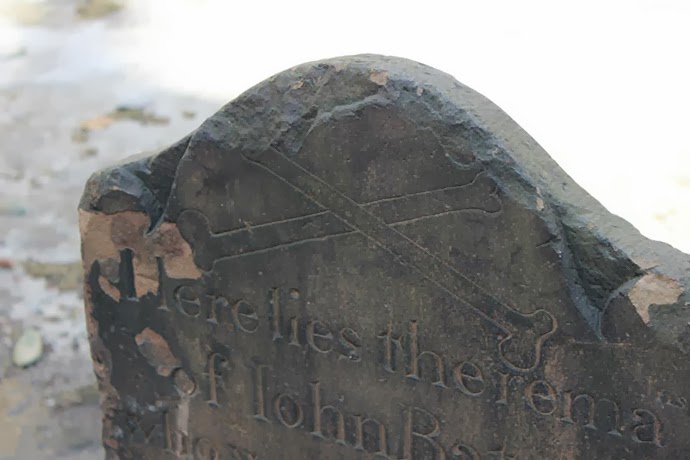
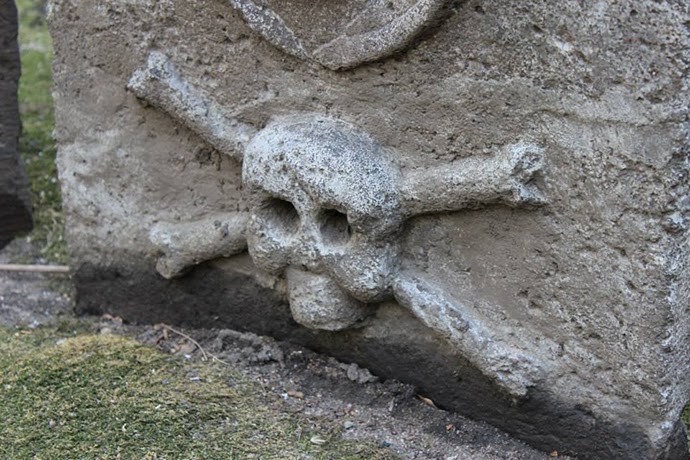
I also think we really need to start bringing back the carved crossbones-style tombstones, because what is cooler than that? (nothing).
Friday Food: Stand-Alone Diners Parts 1 + 2
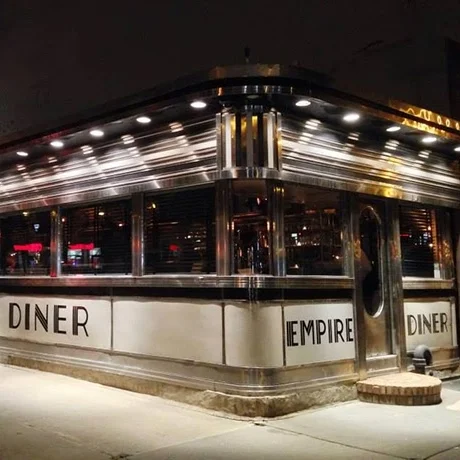
After reading this Scouting New York post about the last five stand-alone diners left in Manhattan, I immediately added them to my Google map of New York to-dos. It was only a few days after they went on my list that I checked the first one off. Jim and I had a movie to see a few weeks ago on a weeknight, and were looking for a relatively quick meal. I suggested that he pick from one of the diners, and he chose the Empire Diner on 10th Avenue.
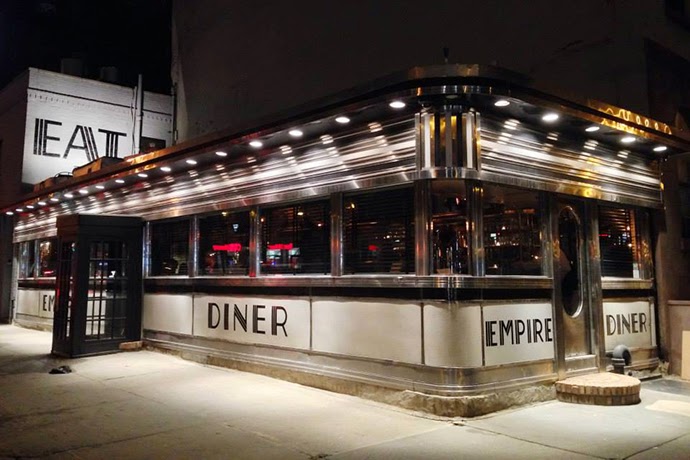
I'm pretty sure we started with the best, because you can't get more iconic than the gleaming Art Moderne dining car, which opened in 1946. It has been a few different restaurants through the years and the latest one just opened a few months ago. You may recognize the Empire from various movies or TV shows, and while I watching Home Alone 2: Lost in New York this Christmas for the ??th time I made a mental note to check it out. Unfortunately the metal Empire State Building replica is no longer on its roof (where did it go??), but all of the signage and exterior still looks remarkably the same.
The structure and decor are really the only things that say diner — the food is more upscale, a little pricey and actually really delicious. We had the french onion soup and shared the ouzo mac n' cheese, and each was above-average (decent portion sizes too).
Their branding is also completely on-point, down to the striped napkins that I seriously considered "dropping" in my purse (I didn't, but that doesn't mean I didn't want to). I would love to go back during the day when it's light so I can really bask in the kitschy interior and I wouldn't mind basking in a stack of buttermilk pancakes, either.
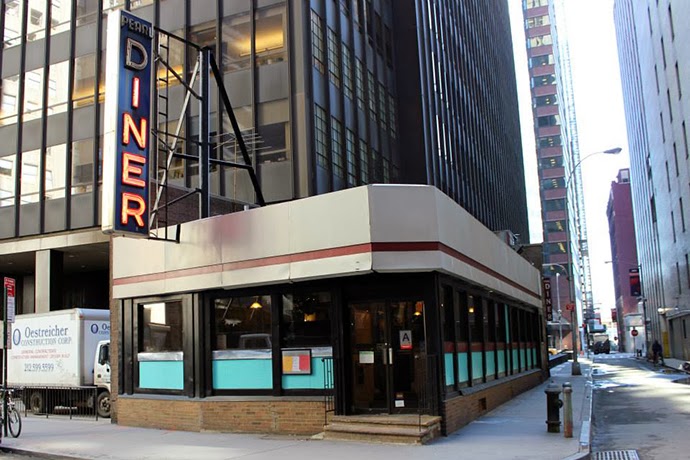
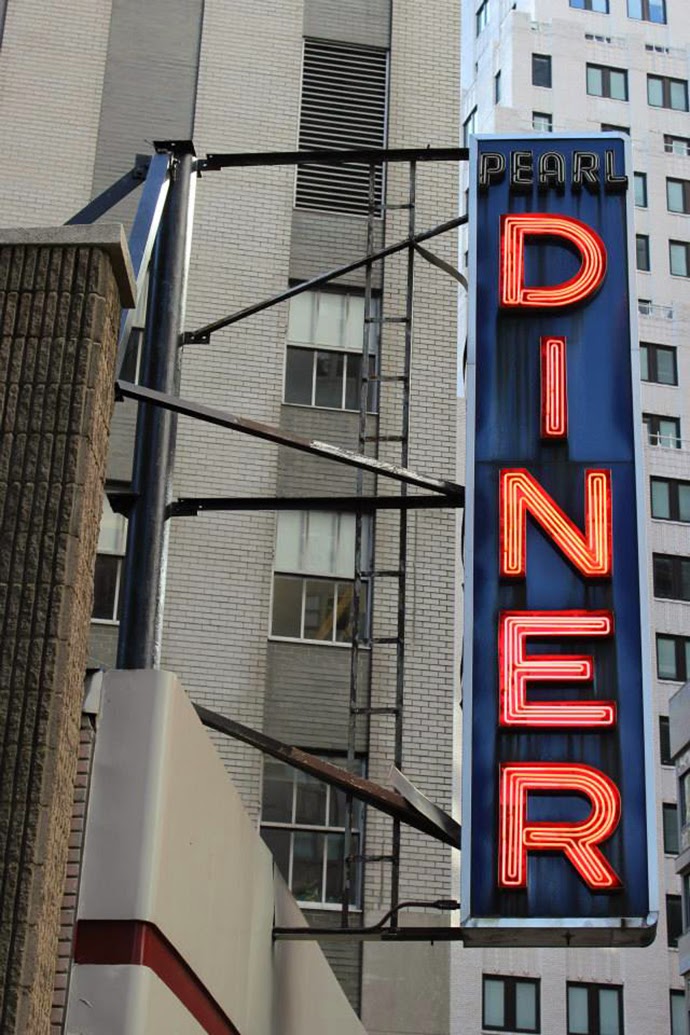
A few days later, before we caught the Staten Island Ferry for a day of adventures, we checked another diner off the list when we ate breakfast at the Pearl Diner in the Financial District. The Pearl Diner isn't as beautiful or iconic on the outside (or inside) as the Empire, but it does have another crucial diner characteristic: a fantastic neon sign.
There aren't many (affordable) restaurant options in the area, especially on the weekends, which makes the Pearl Diner that much more of an anomaly. In a neighborhood of towering office buildings that basically drip money, a good, old fashioned diner seems completely out of place. I got a waffle that was about half the price you would expect to pay in New York, and every bit as good as any I've had. Their diner coffee was delicious and the refills came frequently, which is always appreciated.
In addition to being the second stand-alone diner to be crossed off my list, the Pearl Diner also holds the distinction of having one of the teeny tiniest bathrooms that I've ever been in. We're no stranger to tight spaces in New York, but their restroom was as minuscule as they come. Upon returning to the table, I remarked that I had been in Port-a-Potties that were roomier and that is no exaggeration.
I adore old-school diners and I'm so glad that I'm making an effort to check out more of them. Although it may seem as if they're everywhere, they're a dying breed in a city that is all about the glitz, glamour and whatever happens to be trendy at the moment. Sometimes the best things in life really are simple, like a cup of diner coffee (no triple-mocha-venti- bullshit allowed) and a plain stack of pancakes. Until they figure out that whole time machine thing, visiting businesses that haven't changed in 60+ years is one of the closest ways to feel as if I've actually travelled back in time. Two stand-alone diners down, three more to go...
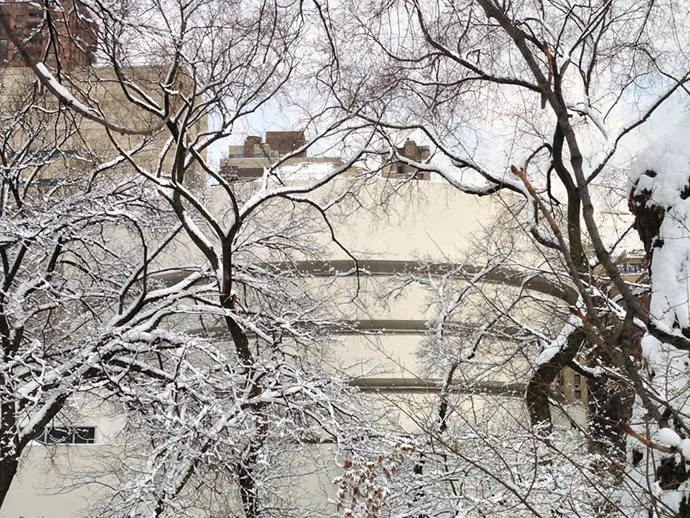
The Solomon R. Guggenheim Museum
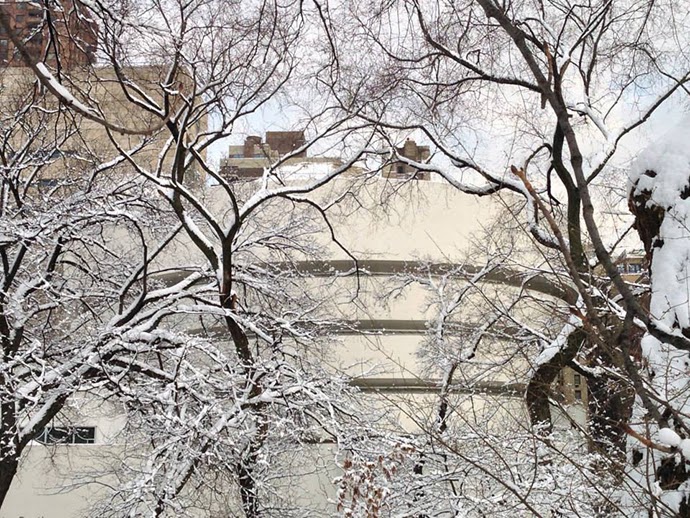
Two weeks ago I met my friends Katie and Jim at the Guggenheim Museum on a Saturday night. It is pay-what-you-wish from 5:45-7:45 every Saturday night and unlike other suggested donation museums like the MET or Natural History, the Guggenheim has a set admission price ($22/adults). The museum was under extensive renovation when I first visited, and the outside was completely covered in scaffolding (from 2005-2008). The building, of course, is the reason to go to the Guggenheim, so I was overdue for another visit.
I used to feel really guilty paying less than the suggested admission prices at museums, but being a resident and frequent visitor has almost cured me of that guilt. I've been slowly decreasing the price I'm comfortable paying, and finally had the courage to offer up a single dollar to the Guggenheim. Of course I love and appreciate all of the museums in the city, and I hope one day to be well-off enough that I don't have to be so cheap, but I figure that I go often enough to not feel that horrible about my measly contribution. Some museums (I'm looking at you, MET) will try to basically guilt you into paying the entire suggested amount but I'm a hardened New Yorker now, and I need all the money I can get so I can continue to be a New Yorker. The pay-what-you-wish line was so long, and the admission process so fast and hectic, however, that they just grabbed my dollar and threw me a ticket without any time to throw me the least bit of shade.
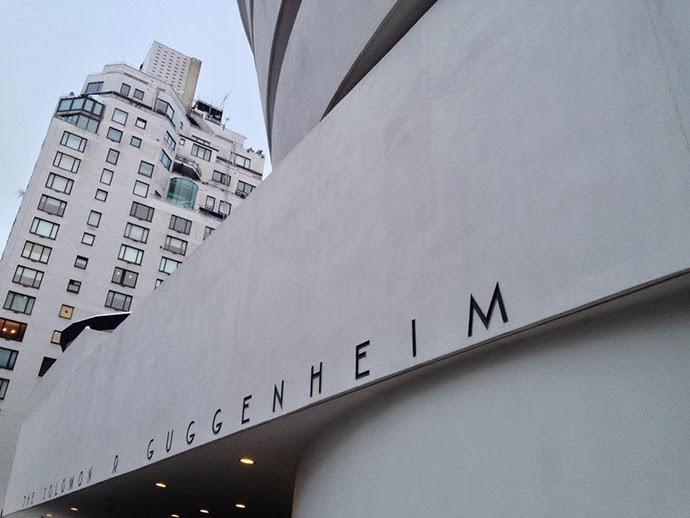
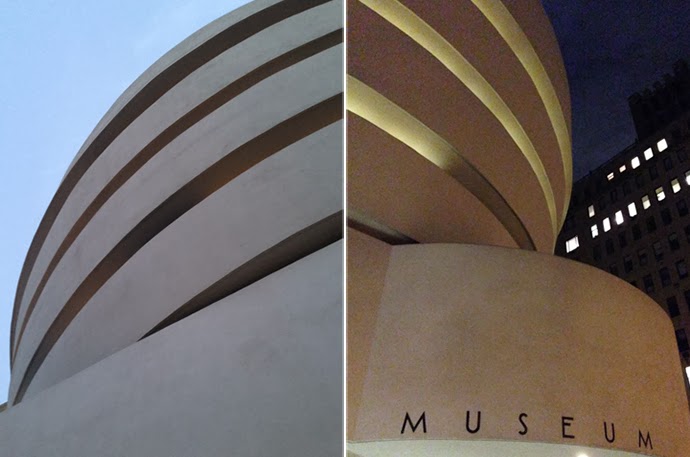
Any remaining traces of guilt were erased a few minutes later when we found out that all of the ramps were closed off due to an in-process show installation. The ramps are the main part of the museum, and really the best way to experience the building and its art.
There are few floors of side galleries that house the permanent collections, which is all we were able to see, unfortunately. It's not that the permanent collection is bad (it isn't), but the galleries themselves are nothing special. They are also quite small, and we saw everything in about an hour.
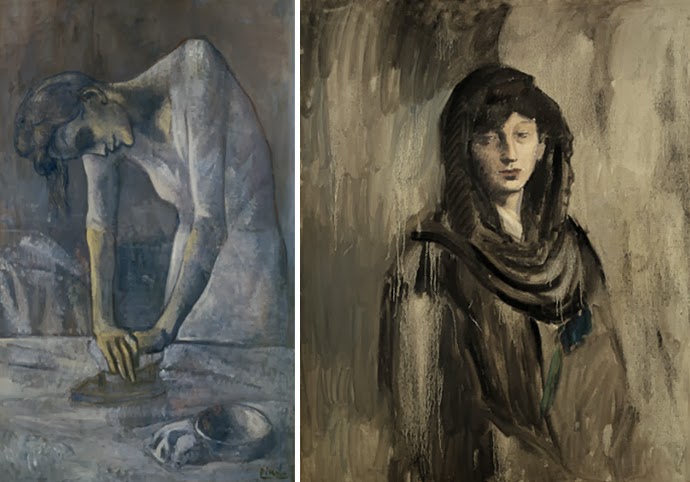
My favorite pieces were two from Picasso's early days: Woman Ironing and Fernande with a Black Mantilla, the latter of which I had never seen before. I'm not a huge Picasso fan as far as his more famous Cubism paintings go, and it's even more of a shame when you see where he began.
Fernande is one of the most hauntingly beautiful paintings I've seen in a long time, and it stuck in my mind long after I left. I guess my tastes trend more toward the dark and depressing (German Expressionism is probably my favorite art movement), which is why Fernande really struck a chord with me.
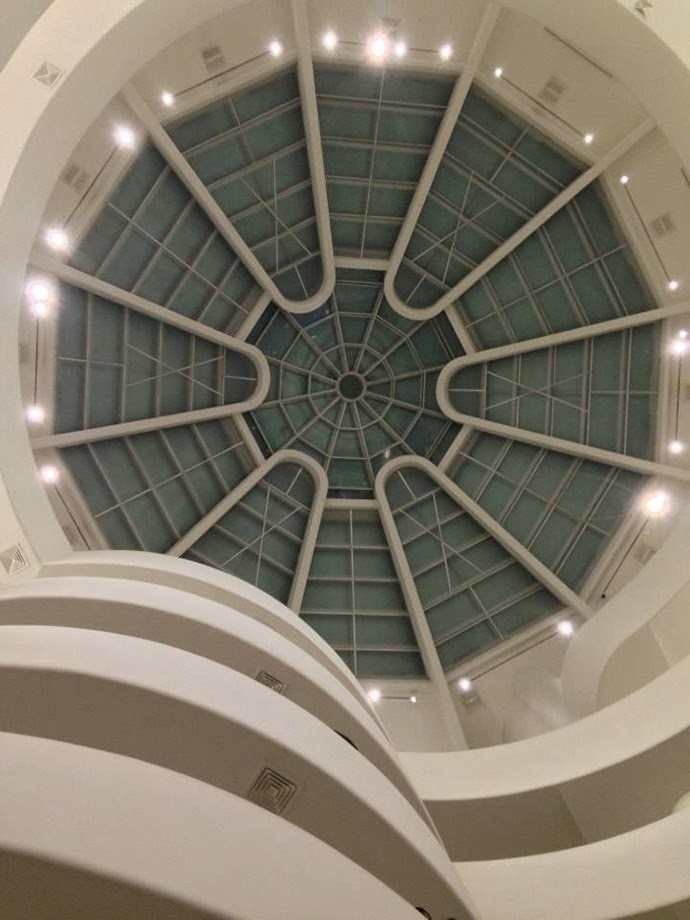
There wasn't much more in the permanent collections that really moved me, but as per my $5 rule, I can't complain considering I paid even less than that. The gorgeous lobby of the museum is worth a dollar alone, and there are a ton of fun, quirky building details that make the whole experience different than any other museum.
There is an Italian Futurism exhibit going on right now that looks interesting (even if it was the reason the ramps were closed for us), but I don't necessarily need to go back to the Guggenheim again for a while. I will always love walking by it on my lunch breaks now that I'm working on the Upper East Side, and it's even more breathtaking as seen through the snow-covered trees in Central Park. It's definitely worth checking out at least once (make sure the ramps are open though if you only plan on going once) and it's definitely one of the better things you can buy with a dollar.
The Mini Meg Ryan Restaurant Tour
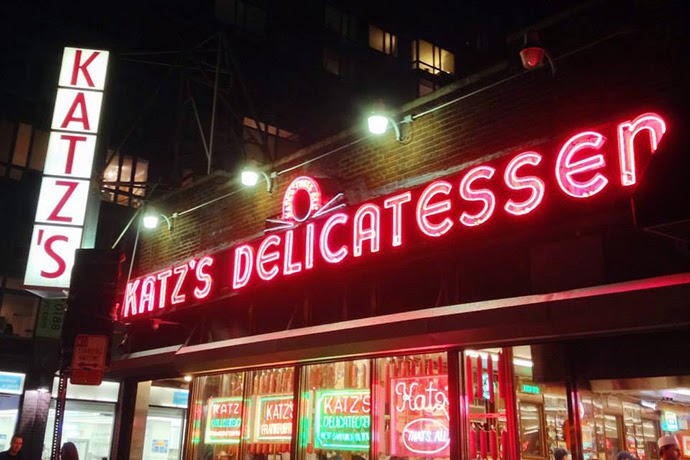
I'm always that annoying person pointing out obscure movie or TV filming locations to people that mostly don't seem to care. It's cool, I get that not everyone will be as thrilled with my "Home Alone 2: Lost in New York" tour as I think they should be, but I never want to not point something out that could potentially be of interest.
Recently my friend Jim — who is relatively new to the city like I am, and therefore still excited about mildly touristy things — suggested that we go to Katz's Deli on the Lower East Side for dinner. Established in 1888, Katz's is probably as famous today for its role in When Harry Met Sally as it is for its enormous pastrami sandwiches.
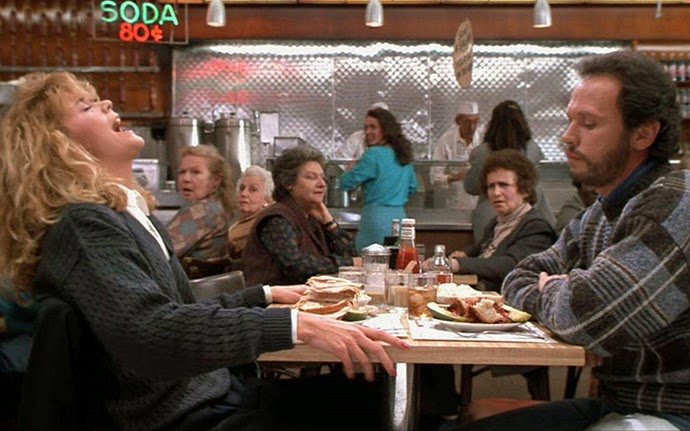
Katz's is, of course, where Meg Ryan, aka Sally, famously (and very loudly) goes through the motions of faking an orgasm, prompting a fellow diner to deliver the famous line "I'll have what she's having." It's actually an enormous restaurant, especially by New York standards, and I can't imagine a scenario where you wouldn't be able to find a table. We went at 7 on a Wednesday night and only about a fourth of the tables were taken.
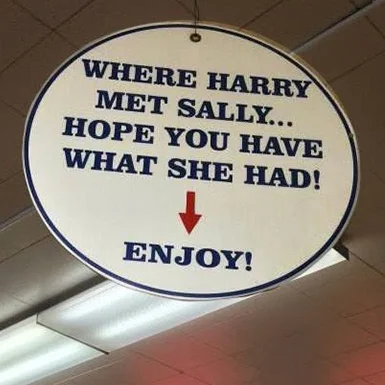
The exact table where Meg and Billy sat, however, is usually occupied, and although I'd been to Katz's twice before I had never been able to sit there. There is a big sign hanging above the table so there is no question as to which table it is — we lucked out and it was actually available when we went.
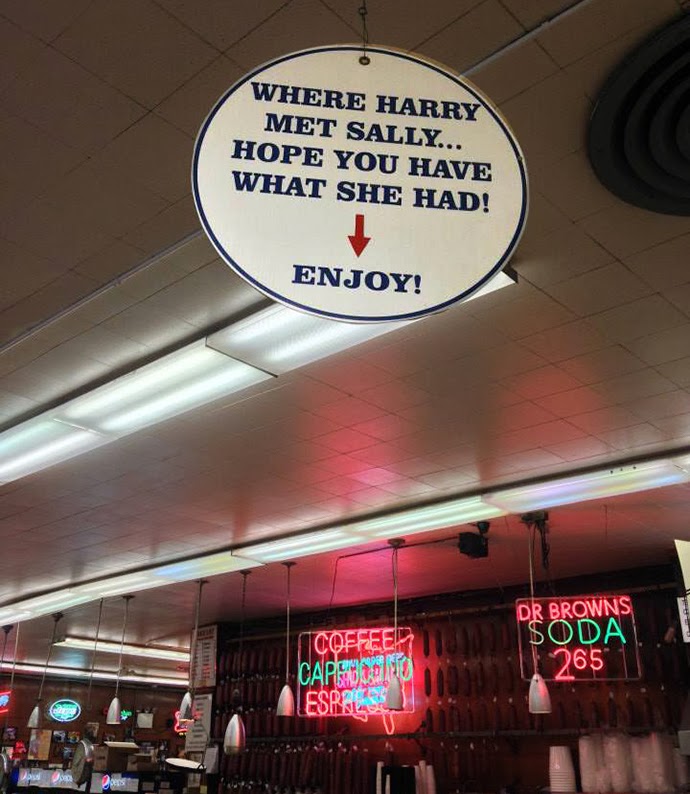
Because I'm a nerd, it annoys me slightly that the sign declares that this was the spot "where Harry met Sally," because that's not technically accurate. I get the point, of course, but I wonder if that's ever bothered anyone else (probably not)?
We actually watched the scene on my phone while we were eating, and the great part about Katz's is that it pretty much looks exactly like it did 25 (!) years ago, and probably 25 years before that. I did notice that the soda sign has changed from 80 cents (in 1989) to $2.65, proving that not everything can stay the same forever.
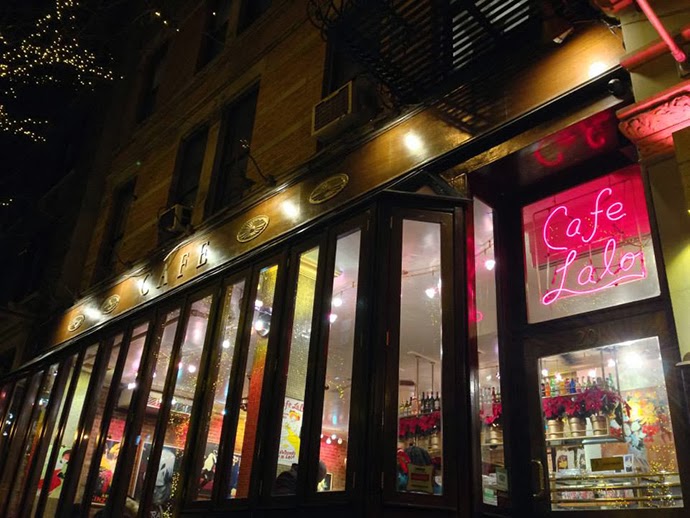
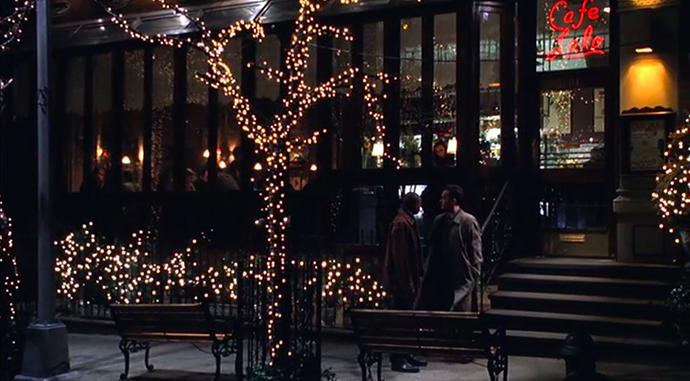
A few weeks earlier my friend Grace suggested that we go to Cafe Lalo for dinner, which I'd never heard of until she added that it was the cafe from You've Got Mail. Speaking of Meg Ryan romantic comedies, You've Got Mail is definitely my favorite of the bunch, so of course I said yes.
Cafe Lalo is on West 83rd Street between Amsterdam and Broadway and it's an absolute dream. It's very obvious why it was chosen as a filming location, and it looks even more magical in person than it did on film. The floor-to-ceiling windows look like they open, and I imagine that it's even more wonderful in the summer, although it was a great place to warm up on a brutally cold night.
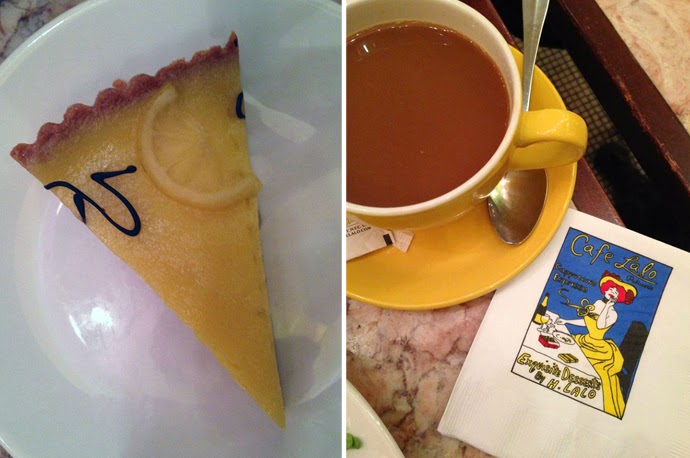
They have a very large menu, but you only have to glance at the bakery case to know that pasties and baked goods are their specialty. I had a piece of lemon tart that was a delicious as it was beautiful, and a cup of coffee, which came with an adorable mini piece of Toblerone chocolate. The interior has changed slightly in the 16 (!!) years since You've Got Mail came out but I still felt a thrill waiting for Grace to arrive like I was Kathleen Kelly and she was Joe Fox. What I wouldn't give to step inside of Kathleen Kelly's Upper West Side dream life — but being able to have a coffee and pastry at Cafe Lalo anytime I wish isn't a bad way to start.

My Eighth Month as a New Yorker

Spoiler alert: I did a lot in February. I know I've been saying this every month since I moved here eight months ago, but holy crap. I have no idea how I even fit all of this into the shortest month of the year, and if you're my friend on Facebook or follow me on Instagram you know that I did even more than what I've recapped below. I probably would have even managed to fit in a few more things if I hadn't spent the last four days of the month quarantined inside of my apartment — sick for the fifth time since I moved to the germ-infested cesspool that is New York City.
Thankfully I'm starting to feel better, just in time for the beginning of March and yet another big snowstorm. Speaking of snow, February was the second snowiest February that New York has ever had, and we're on track to have one of the snowiest (fourth or second —but probably not first — depending) overall winters on record. You won't hear any complaints about the snow from me, in fact my morning walks to work through the winter wonderland of Central Park have been some of my favorite times since I've moved here. I only fear that I have become impossibly spoiled this winter, since it's unlikely that we'll have another one like it anytime soon (that is, if this one ever ends).
A "few" more highlights from my very full February (you might want to grab a snack, this might take a while):

Trent and I received a private tour of the Hamilton Grange house, toured City College's gorgeous gargoyle-filled campus and drooled over the beautiful houses in Hamilton Heights and Harlem / I braved Chinatown for the Chinese Lunar New Year Parade, which was far superior to last year's Firecracker Festival / I brought cannoli from Little Italy to a Superbowl (aka eat snacks and watch commercials) party / The first of many February snowstorms transformed the city streets into a wintery wonderland.

In a rare display of (lingering) affection, Mozart sat on my lap and I had to pee so bad but I refused to get up until she did (it was a very LONG time) / Central Park iced over and I walked on top of eight inches of snow without leaving a footprint / Katie, Jim and I had one of our regular dinners at Sardi's (my first time), where we shared a beautiful baked Alaska / I spotted "love" on the Upper East Side minutes before a little boy threw a snowball right at me / After years of walking by it to go to John's Pizzeria, Jim and I had margaritas at the Caliente Cab Co. and took home these super classy souvenir glasses.

I spent a lazy Saturday exploring Downtown Manhattan and walked by the icy Hudson and paid my respects to Philip Seymour Hoffman (RIP) / I got into the Guggenheim for a dollar (pay-what-you-wish is the best) / A snowy morning walk to work through Central Park is far preferable to riding the stinky bus / Grace introduced me to Cafe Lalo, aka the cafe from You've Got Mail and I've been there three times since / I was the only crazy person walking through Central Park during a(nother) snowstorm that wasn't walking a dog.

I made chocolate-covered strawberries for a Valenfriends Day party, where we sipped grapefruit margaritas and exchanged store-bought Valentines / My Valentine's Day present from the city was another snowstorm / Mozart was my Valentine whether she knew it or not / I died of happiness spending three hours at a Strand warehouse sale where you could stuff a whole bag full of books for only $15, which I then carried a mile in (another) snowstorm / I took two good Ohio friends on a (snowy) tour of Central Park including the beautiful Ladies' Pavilion.

After weeks of seeing this mystery bag everywhere, finally finding out it was Longchamp and resigning myself to never getting it (because $$$) my mom surprised me with it / I spent my Presidents' Day off walking around Greenpoint, Brooklyn where I got Peter Pan donuts, ate them by the waterfront and walked the Pulaski Bridge to Queens / I finally bought a "real" camera and tested it out on my two favorite subjects.

Jim and I ate at Katz's Deli, but we didn't have what she had / We also ate at the Empire Diner, the first on my list of the last five remaining stand-alone diners in Manhattan / I learned the meaning of "zero visibility" on a foggy lunch walk along the East River / I finally bought Hunter boots and walked in puddles just because I could / I walked past a rose-petal-covered median / One of the first designs I worked on at my new job got printed.

Diner #2 — the Pearl Street Diner — down, three to go / Jim and I took the Staten Island Ferry on a very beautiful and warm Saturday / We visited the weird and wonderful Sailors' Snug Harbor (my second time there), caught a gorgeous sunset on the way back to Manhattan and ended the night with cheese and wine at the oldest bar in Manhattan, Fraunces Tavern (est. 1726), which is right by the US Stock Exchange.

I took the subway to Queens and hiked to the gorgeous Calvary Cemetery, where I spent a long time searching for Vito Corleone's gravesite from the Godfather, only to find it a few feet from where I had been looking / I saw one of the creepiest tombs I've ever seen / I took my mom to a drag show, hosted by Japanese Fucking Bitch / I spent the last four days of the month sick in bed, eating nothing but ramen and watching Meg Ryan romantic comedies (You've Got Mail is always number one).
Whew. If you made it through all that and you aren't related to me, I thank you for your dedication. Although I'd probably be content if it just kept snowing forever and New York basically became Narnia, I'm still excited for the prospect of Spring, especially after the small taste of it we had last week. I'm mostly looking forward to taking the exact same photos of the exact same things I've photographed hundreds of times before — but with my new camera and hopefully a few hints of greenery in the distant future.
Hamilton Heights / Harlem
Although I'm convinced that New York is actively trying to kill me — I am currently sick for the fifth time since I moved here 8 months ago — I still spend most of my days just completely in awe of the wonderful (and seemingly endless) delights that this city has to offer.
A few weeks ago, somewhere in between taking a "private" tour of Hamilton Grange and gargoyle hunting on the campus of City College, my friend Trent and I took a mini tour of some notable sights in Hamilton Heights and West Harlem. I have found it to be true that you can find something interesting, historical or just nice to look at in almost every neighborhood in the city if you look hard enough.
Usually I'm the one dragging my friends around to obscure filming locations or nerdy National Parks tours, but Trent was actually the one who led me around and showed me things I had never even heard of before. As much as I enjoy doing things by myself, it was definitely nice to have a willing and enthusiastic guide for a change.
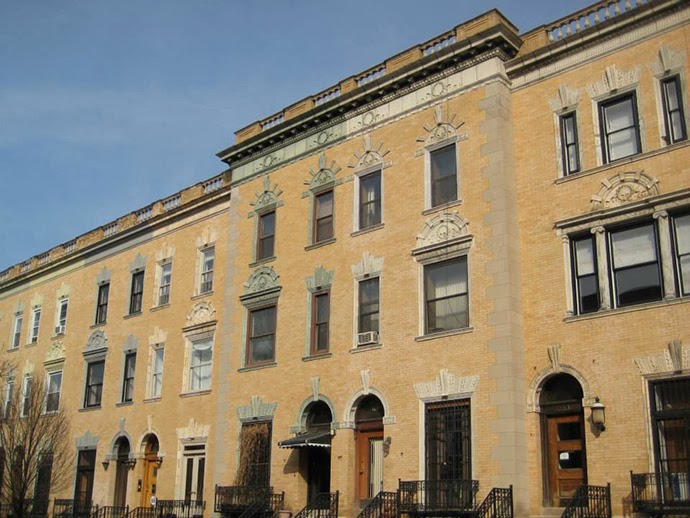
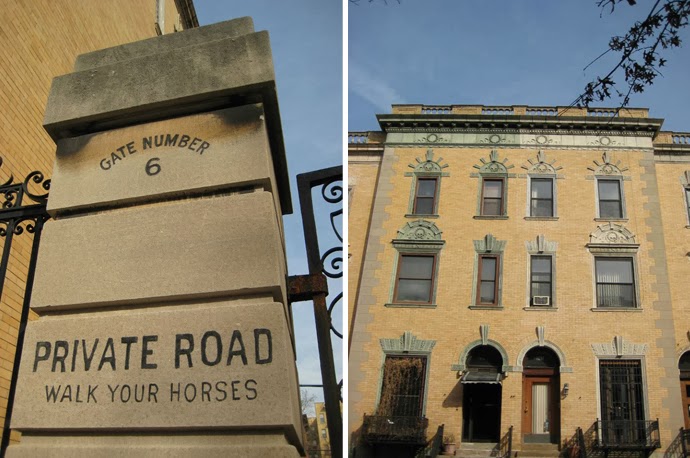
The first place we went was Strivers' Row in West Harlem. This was definitely one of those times where we both wished we had done more research beforehand because we actually ended up only seeing one of the "rows" of townhouses, not knowing there were two more.
Constructed between 1891 and 1893, the houses sit back to back and share rear, gated courtyards. The rows were designed by three different architects: McKim, Mead and White, James Brown Lord, and Price and Luce. We ended up only paying attention the Price and Luce row, and I would definitely like to go back now that I know more about what I should be looking for.
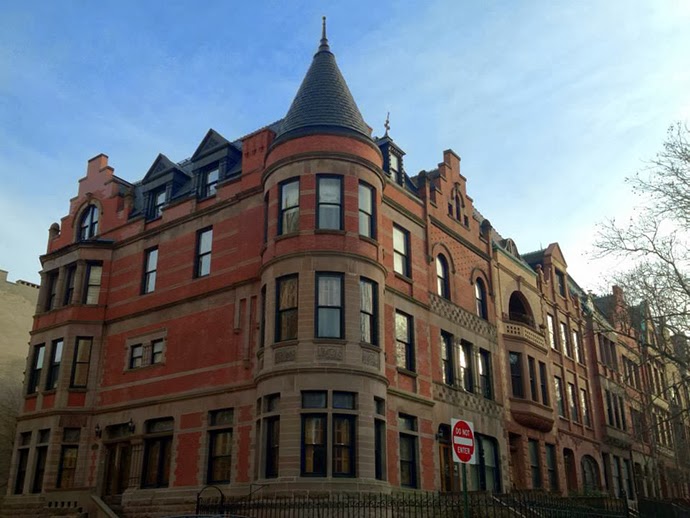
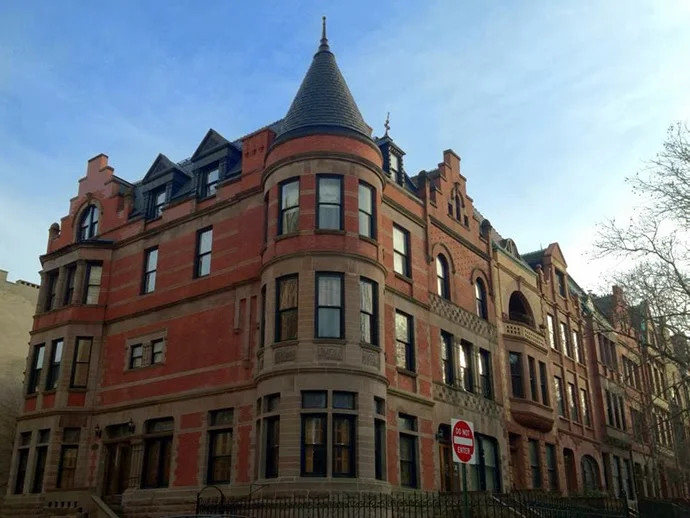
Next up was the Royal Tennenbaum house at the corner of w144th Street and Convent Ave. in Hamilton Heights. Convent runs right into City College and is lined with some of the most beautiful houses I've seen in the city. I've never been a die-hard Wes Anderson fan, but when Trent pointed out the house I have to admit it was exciting to see it in person.
I went home and watched the Royal Tennenbaums after reading that they actually did a majority of the filming inside of the house. I love re-watching movies or TV shows with the new perspective of having just been to the location, especially when it's so immediately recognizable.
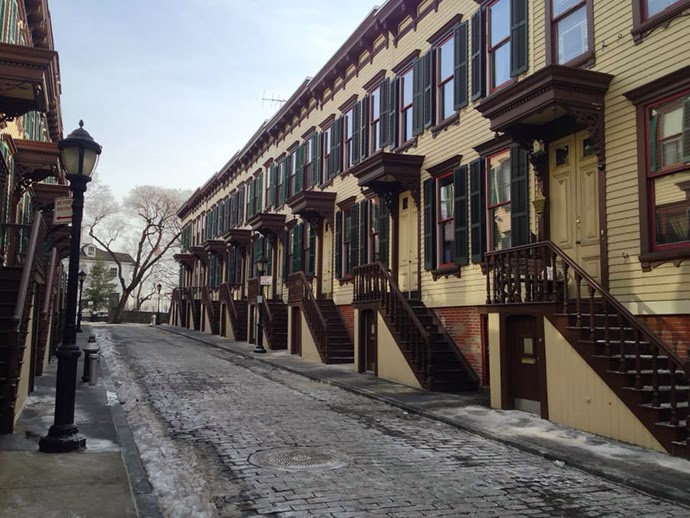
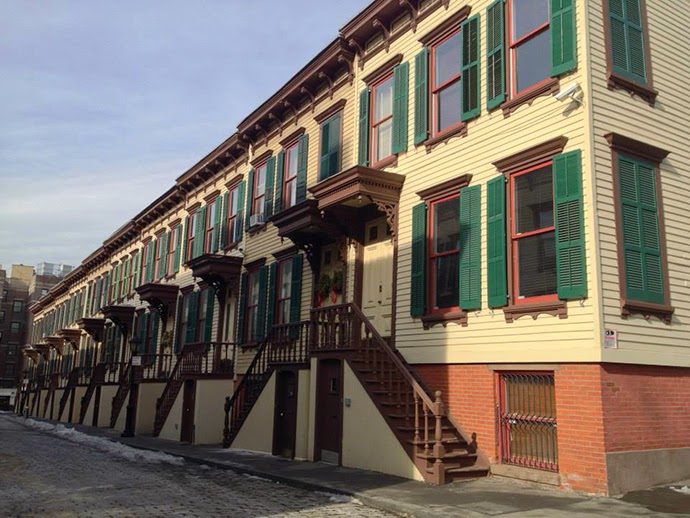
The next place we went was a tiny, cobblestone street called Sylvan Terrace. Originally a carriage pathway leading to the Morris-Jumel Mansion, in 1882 20 uniform, wooden row houses were built. In the 1960s the houses fell into disrepair, but had been fully resorted by the 1980s. Today they look basically brand new — in fact the whole street feels like it's straight out of a Hollywood backlot.
The fact that these still exist is incredible, even more so that 20 lucky people (or families) get to call this street "home." Sylvan Terrace is one of those quiet, sneaky New York places that not many people know about, and that makes you feel as if you're light years away from the city and/or the present day.
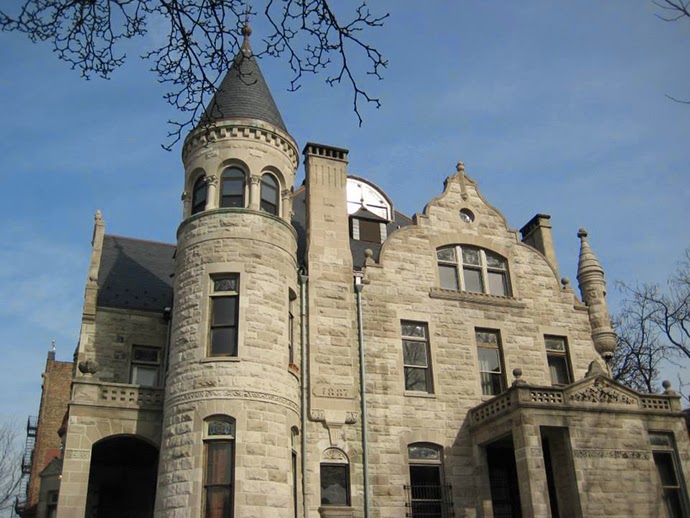
One last place that Trent pointed out on our walk was the James Bailey house at the intersection of 150th and St. Nicholas Place in Harlem. The castle-like house was built from 1886-1888 for James Bailey, the business manager of the Barnum and Bailey Circus. It has stained-glass windows designed by a cousin of Louis Comfort Tiffany, and was turned into a mortuary in the 1950s.
I would love to be able to walk through the inside of what has been referred to as the "Grey Gardens of Manhattan," but I'll probably have to settle for this video of the interior. It was recently put on the market for $6.5 million, and ended up selling for a mere $1.4 million — which is 75% off the original asking price and despite the necessary repairs, still an incredible steal.
I have still yet to do much exploring in the northern portion of Manhattan but after such a great experience I'll definitely be back. There is so much history around this city and I'm grateful that so many of these great buildings are still around, even if I can only dream of one day owning one.
Calvary Cemetery

I finally got a real deal camera (aka not a point-and-shoot and not my iPhone) last week, and I couldn't think of a better place to break it in than a cemetery. I adore cemeteries (the older the better), and I've already been to Woodlawn and Greenwood, in the Bronx and Brooklyn, respectively.


I recently found out about Calvary Cemetery in Queens, and it seemed like the perfect place for a Sunday stroll. The weather was absolutely beautiful this weekend, so Sunday I headed out to Queens via the 7 train. It was a bit of a hike to Calvary, but I definitely didn't mind the sunshine.
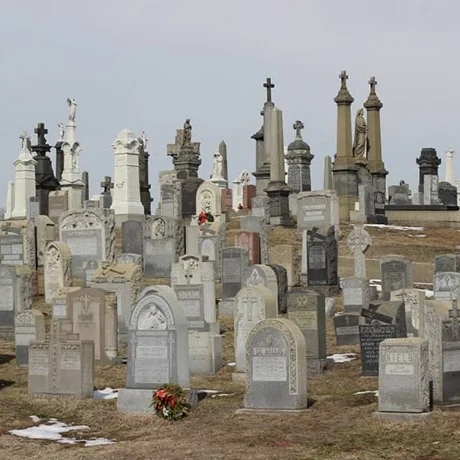
Calvary was the first major cemetery to be established outside of Manhattan, and dates back to 1848. It's an enormous spread, especially by New York standards, and I spent a few hours just wandering around, taking it all in. It's definitely the "tallest" cemetery I've ever been to, meaning that most of the headstones are very vertical in nature and a majority have some sort of figure or cross on top.


The hilly landscape makes for sweeping views, and the Manhattan skyline peeking out over the headstones is pretty perfect. I hardly saw anyone on my visit and I love when I feel as if I have a place all to myself. Cemeteries are such beautiful and peaceful places and I find them infinitely fascinating. The designer in me loves the variety in lettering and decoration, and I love the huge expanse of history covered in such a small area.


Calvary has a few mausoleums, but it's definitely the tall headstones that make the most impact. The more vine-covered and crumbling a cemetery is, the more I love it, and although Calvary has its share of decay it's still a very well-kept place. There was also something about the partially snow-covered ground that made the landscape even more striking and I bet it is unbelievably amazing after or during a big snowstorm.
Calvary is definitely my favorite of the New York cemeteries I've been to thus far and I can't think of a better way to spend all of eternity (or at least a sunny Sunday) than in such a peaceful place, with a view that's hard to beat.
The most fantastic thing about the New York Botanical Garden’s annual Orchid Show is the orchids themselves