Archive
- Abandoned
- Alabama
- Arizona
- Bahamas
- Books
- California
- Cemetery
- Climate
- Colombia
- Connecticut
- Diner
- Egypt
- Feature
- Florida
- Friday Fun
- Georgia
- Holidays
- Illinois
- Iowa
- Italy
- Kentucky
- Louisiana
- Maryland
- Massachusetts
- Mississippi
- New Jersey
- New Mexico
- New York
- North Carolina
- Novelty Architecture
- Ohio
- Pennsylvania
- Personal
- Peru
- Project 365
- Protest
- Rhode Island
- Roadside Attraction
- South Carolina
- Tennessee
- Texas
- Travel Guide
- Virginia
- Walks
- Washington DC
- West Virginia
- Wisconsin

Recent Reads: Climate Crisis
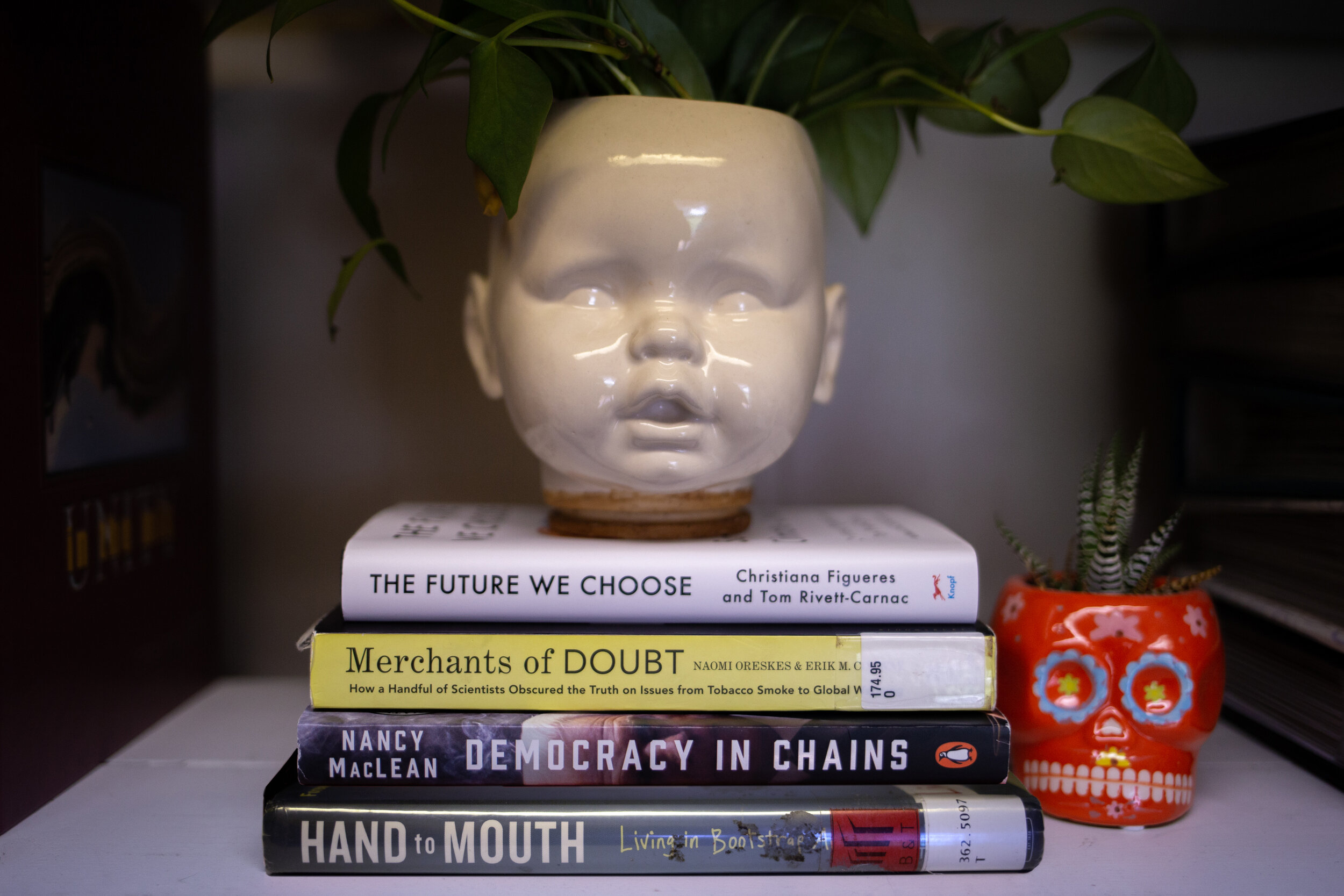
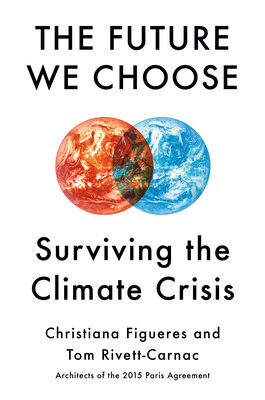
The Future We Choose: Surviving the Climate Crisis, by Christiana Figueres and Tom Rivett-Carnac
I understand that the climate crisis is a huge, dire issue but my biggest critique of some of the books I’ve read are that they are strictly doom and gloom—I like to feel as if there is at least something I (or others) can do to help stave off the worst of it. The Future We Choose was a welcome mix of terrifying facts, yes, but also realistic solutions. Figueres and Rivett-Carnac led negotiations for the United Nations during the Paris Agreement of 2015, so they definitely know what they’re talking about. Even so, this was an easy read, but I highlighted so much of it to read again and again, especially when I get caught in a doom spiral (which happens more and more these days).
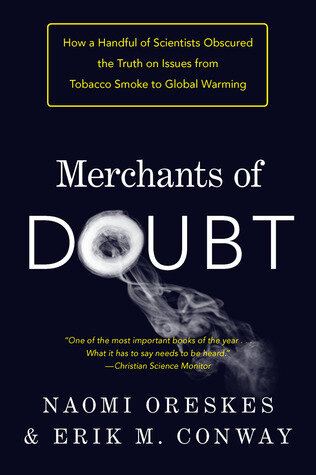
Merchants of Doubt: How a Handful of Scientists Obscured the Truth on Issues from Tobacco Smoke to Climate Change, by Naomi Oreskes and Erik M.M. Conway
This book should be required reading for literally everyone. Oreskes and Conway manage to make a pretty dense and complicated story detailing decades of deceit extremely readable. Merchants, which shows how a handful of key players sowed the seeds of doubt in a very strategic (and unfortunately, successful) way—on everything from second-hand smoke to acid rain to climate change—reads like a thriller and I couldn’t put it down.
Democracy in Chains: The Deep History of the Radical Right's Stealth Plan for America, Nancy MacLean
Speaking of terrifying and dense books, Democracy in Chains was a bit too academic at times (I would read entire pages without having a clue what I read), but the overarching message will stick with me forever. If you have asked yourself “How did we get here?” anytime over the last 30—or even 50—years, this is a must-read. There’s nothing optimistic about MacLean’s assessment of the current state of our democracy, but an understanding of just how we got to where we are now (and who was/is behind it) is crucial if we’re to have any hope of turning things around for the better.
Hand to Mouth: Living in Bootstrap America, by Linda Tirado
Tirado’s memoir is an easy and eye-opening read about what it’s actually like to be poor in America. Tirado exposes the pull-yourself-up-by-the-bootstraps myth as just that, a myth, and shows how easy it is to plunge into poverty—and how nearly impossible it can be to get back out. It’s easy to blame people for what may seem like poor choices, but Tirado explains some of her own in a way that is both simple and revelatory. Hard work is a tent pole of the American Dream, but as Tirado shows, some of the hardest workers in America are the most perpetually undervalued.
This Changes Everything: Capitalism vs. The Climate, by Naomi Klein
There is some overlap between This Changes Everything and Klein’s latest climate book, On Fire, but her message is so important—and her writing infinitely readable—that I would gladly reread both. It’s impossible to address the climate crisis without taking a sledge hammer to the system that created the problem, and there’s no better time to examine that system (i.e. capitalism) than now. As we’re in the midst of another round of historic bailouts and a huge global reset, Klein’s analysis of the 2008 bailouts—and Obama’s failure to hold the companies accountable for their environmental impact—feels eerily prescient.

Recent Reads

Secrets: A Memoir of Vietnam and the Pentagon Papers, by Daniel Ellsberg
I didn’t know much about the specifics of the Vietnam war before reading Ellsberg’s memoir, but even if you think you do, I can’t recommend this one highly enough. Ellsberg is best know for leaking the Pentagon Papers, but this memoir covers much more than that, including his time spent actually in Vietnam, observing the conflict firsthand. His thoughts and his transformation from scholar to staunch anti-war activist are inspiring, and the painful lessons learned from examining how and why the war continued for so long are just as—if not more—relevant today.
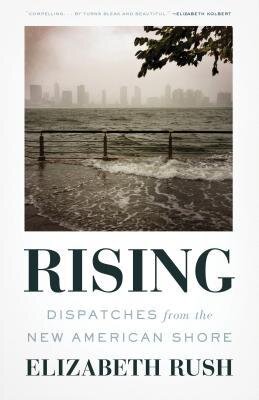
Rising: Dispatches from the New American Shore, by Elizabeth Rush
Rising was not quite what I expected from a book examining climate change, but Rush is a powerful storyteller and her subjects—climate refugees and people living in especially vulnerable coastal communities—offer a compelling look at the human toll of climate change. Sometimes she strayed a bit from the universal message and got a bit too personal for my tastes, but her reflections on the very real impacts of the climate crisis—and the complicated life of a solo, female journalist—will stick with me.
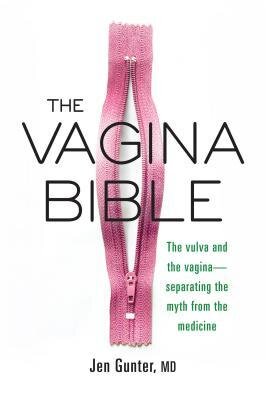
The Vagina Bible: The Vulva and the Vagina—Separating the Myth from the Medicine, by Jen Gunter, MD
I expected to be wowed by the wonderful—and woefully under-studied—world of female genitalia, but unfortunately most of this information seemed pretty obvious to me. Maybe that’s a good thing—that I know more than I thought I did—but I do wish I had read this book as a teen, when it would have demystified and countered a lot of the misinformation and general confusion that comes with being a woman in a world built for, and by, men (also an A+ for cover design).

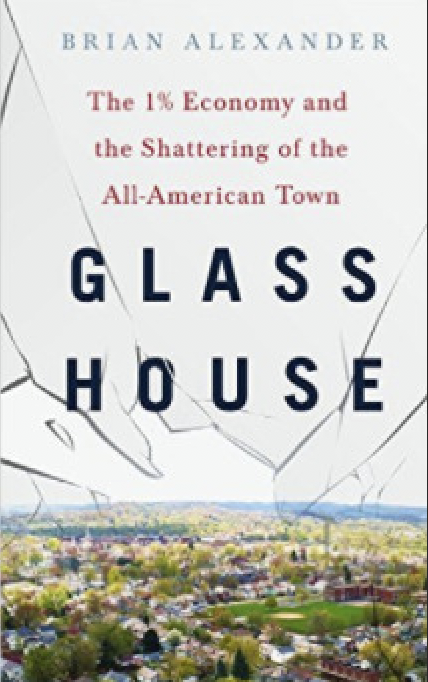
Glass House: The 1% Economy and the Shattering of the All-American Town, by Brian Alexander
My eyes glossed over a lot of the nitty gritty details in Glass House—particularly those dealing with complicated corporate politics and policies—but I’m fascinated by “rural” America and the detritus of the rise and fall of mid-century capitalism. I will never pretend to understand the ins and outs of hostile takeovers, stocks, or other mundane (and often nefarious) business practices, but I grew up in Ohio and have witnessed the decline of the “ideal American town” firsthand. What happened with Anchor Hocking is not unique to Lancaster, Ohio, unfortunately, but the lessons gleaned from examining its history and present state are crucial to building a more sustainable future.
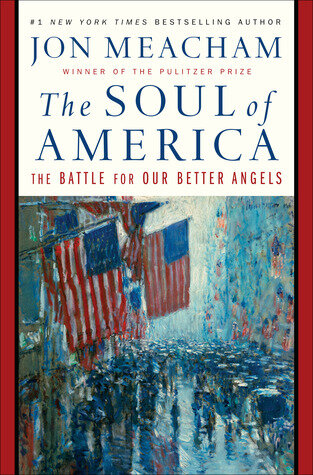
The Soul of America: The Battle for Our Better Angels, by Jon Meacham
Jon Meacham examines our current political situation through the lens of history, drawing comparisons to other times of progress which were followed by a seemingly inevitable backlash. Somehow just knowing that we’ve been here before—and likely will be again, in the future—made me feel oddly hopeful. Meacham argues that we’ve survived periods of tumult only to emerge stronger and better, and that it’s not only possible but probable that we will do so again (and again)—proving MLK’s observation that “the arc of the moral universe is long, but it bends toward justice.”

Recent Reads

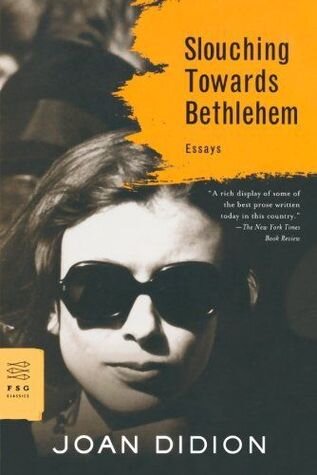
Slouching Towards Bethlehem, by Joan Didion
Joan Didion is a literary legend, and everything she writes is undeniably a classic. I LOVED half of the essays contained within Slouching Towards Bethlehem, but the other half was just OK. Of course with Didion, “just OK,” is still pretty fucking great. I would devour Didion’s thoughts on almost anything, but maybe the East Coaster in me just couldn’t fully appreciate this California-centric collection.
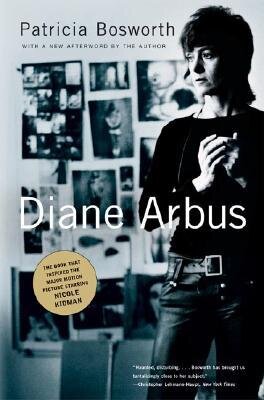
Diane Arbus: A Biography, by Patricia Bosworth
Sadly, Patricia Bosworth died recently of complications from COVID-19, but she leaves behind an impressive body of work that includes acting alongside Audrey Hepburn and biographies on Jane Fonda, Montgomery Clift, and Diane Arbus. I picked up my copy of Arbus’ biography on a whim at a thrift store but I’ve always been in love with her photography. She led a notoriously reclusive life, but Bosworth makes the most of what information she was able to gather and paints a compelling portrait of a complicated and fascinating woman.
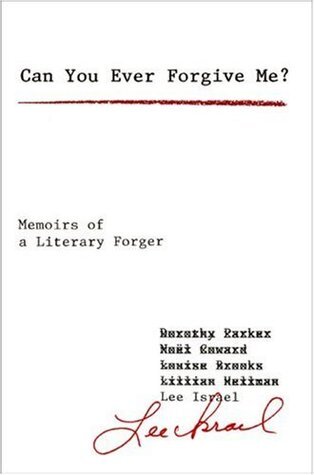
Can You Ever Forgive Me?: Memoirs of a Literary Forger, by Lee Israel
I first heard of Lee Israel through Melissa McCarthy’s incredible turn portraying the down-and-out author in a movie based on Israel’s autobiographical account (it’s so good, seriously check it out). Israel is an intriguing woman, but the book didn’t offer much more than the movie—I don’t usually recommend watching a movie over a book, but in this case I think the former is, perhaps ironically, a better format for Israel’s unique tale (and it heavily features one of my favorite New York City bars, Julius’).

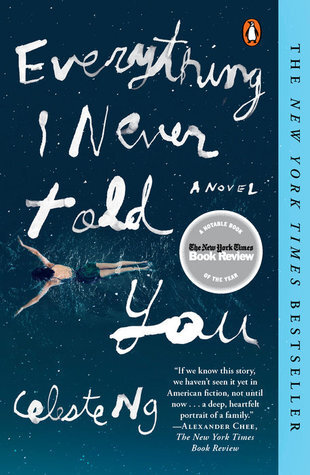
Everything I Never Told You, by Celeste Ng
Everything I Never Told You was my first book by Ng, and it was an easy, compelling read, if not a super memorable one. After a child’s body is found in the lake, her family struggles to come to terms with her death—was it accidental, or on purpose, and if so, why? Everything takes place in Ohio in the 70s, which was appealing to me, but it ultimately felt more like a melodramatic YA novel than a grand literary acheivement.
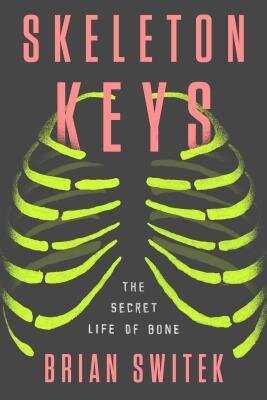
Skeleton Keys: The Secret Life of Bone, by Brian Switek
Maybe I’ve reached my saturation point with authors who do deep dives on specific medical topics, but Skeleton Keys was average, at best. Bones themselves—and most of the intricate systems contained within the human body—are fascinating and this was a short, easy introduction to the many reasons why that left me wanting more. But I absolutely love the cover design, which I still insist is a valid reason to choose one book over another.

Recent Reads

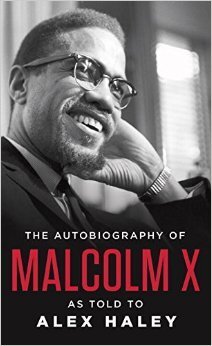
The Autobiography of Malcolm X, as told to Alex Haley
I’ve lived in Harlem for years, but I didn’t know much about Malcolm X beyond vague highlights of his infamous life (and death). His autobiography is a fascinating account of an incredibly complicated and interesting man, who never stopped learning, changing, and trying to spread his message. His premonitions about his own violent death are still chilling even more than 50 years after they came true, and his theories on race, America, and humanity in general have changed my perspective forever.
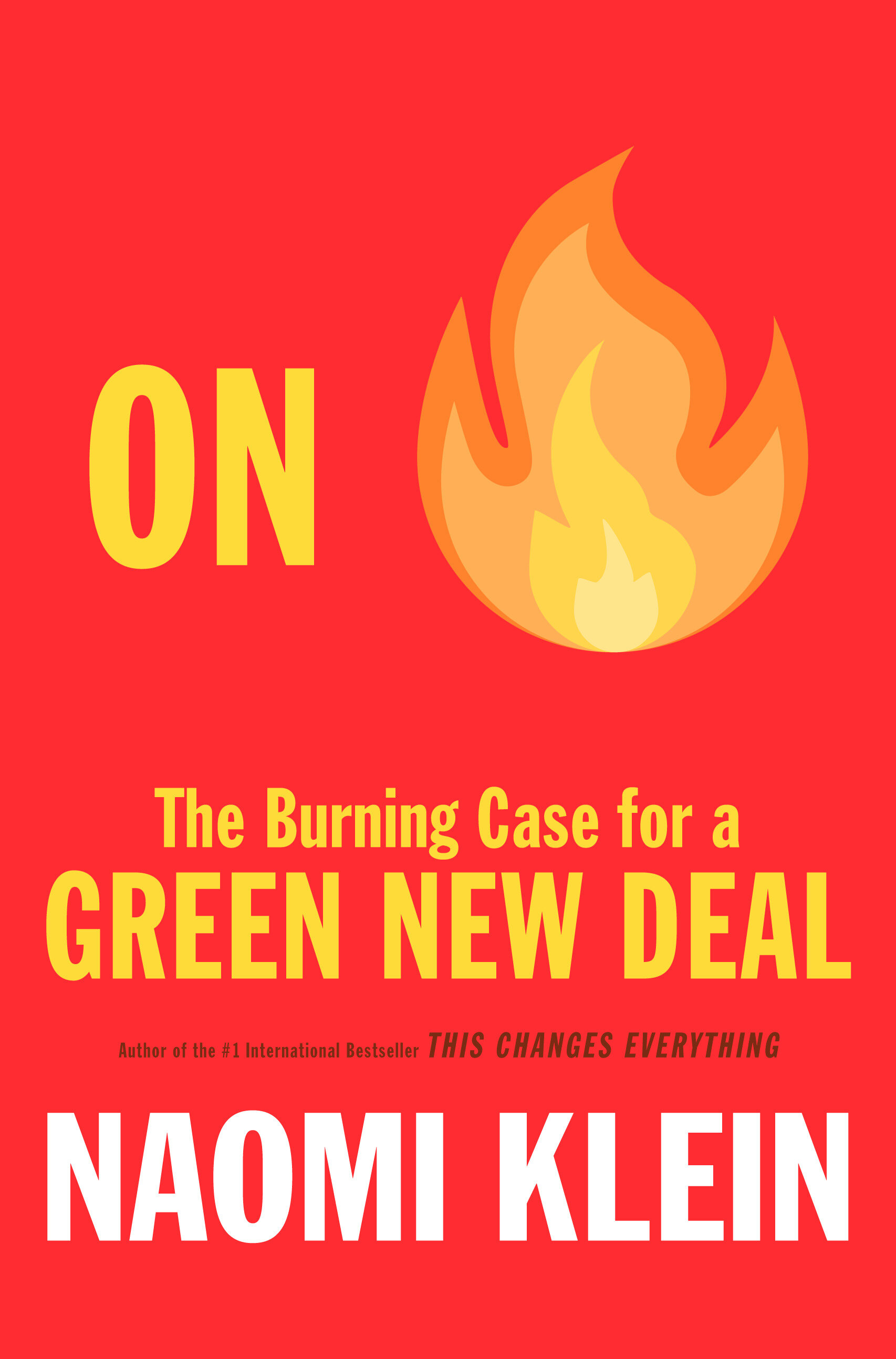
On Fire: The Burning Case for a Green New Deal, by Naomi Klein
This is the book that inspired Jane Fonda to move to Washington, D.C. and start Fire Drill Fridays to educate people about the urgency of the climate crisis. I devoured this book in a few days and it was immediately obvious to me why Fonda was moved to action by Klein’s dire warnings. The more I read and learn about the climate crisis, the more terrified I become—but Klein also has hope that we can turn things around if we organize, mobilize, and demand that our leaders follow suit.
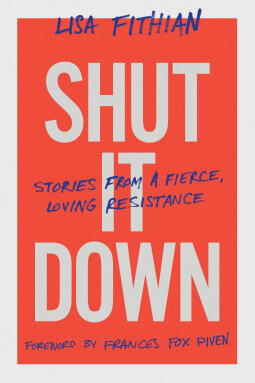
Shut it Down: Stories From a Fierce, Loving Resistance, by Lisa Fithian
Lisa Fithian was one of the 30+ other women who got arrested along with me (and Jane Fonda) for civil disobedience during a climate change rally on November 1. I had no idea at the time, but Fithian is an activist legend. She has participated in or helped organize some of the major social justice movements around the globe, including Occupy Wall Street and Standing Rock. My first-ever arrest sparked me to want to learn more about activism and if you’re a newbie like me this book is an essential read. Protests and marches may not always have immediate outcomes, but Fithian is great at providing perspective and her hopeful outlook—even after fighting the system for decades—is inspiring.
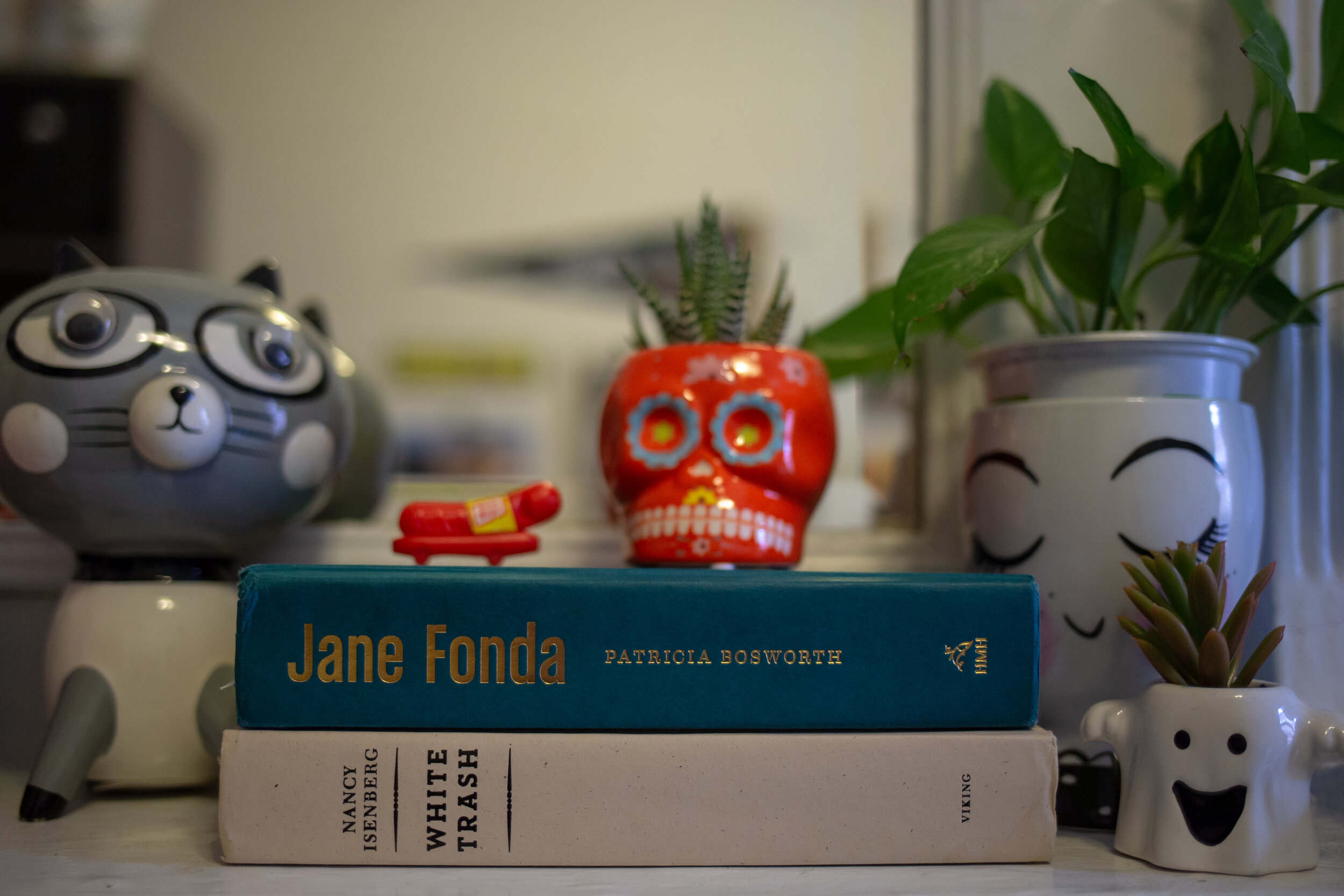
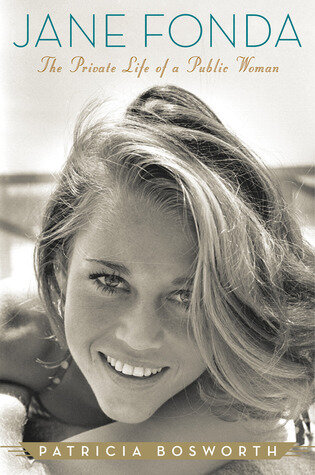
Jane Fonda: The Private Life of a Public Woman, by Patricia Bosworth
I’ve read two books written by Fonda herself, but there are a few less-than flattering details in this biography (authorized by Fonda, who has known Bosworth since the ‘60s) that made it worth wading through some of the duplicate information. I’m deep into my Fonda “damage” so I didn’t even mind revisiting the facts of Fonda’s fascinating life—my only complaint is that the biography, which was published in 2011, ends rather abruptly. Fonda divorced Ted Turner in 2001 but Bosworth barely touches on their ten-year relationship, which I think is equally as interesting—and deserved as much coverage—as Fonda’s earlier relationships.
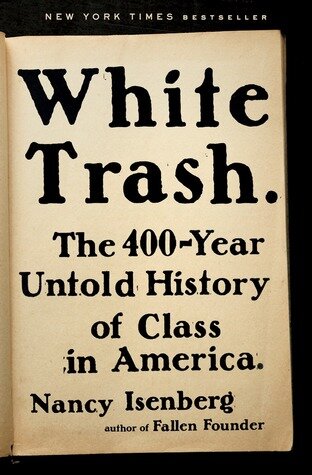
White Trash: The 400-Year Untold History of Class in America, by Nancy Isenberg
I’ve just begun my quest to try my best to understand AMERICA (a tall order, I know), but White Trash was as good a place to start as any. There is a lot of fascinating history in this book but my main takeaway was that America was basically started as a repository for all of Britain’s “less desirable” people—not exactly surprising. Also, the idea that the U.S. is a “classless” society is not only wrong but downright dangerous and plays a large part in the manipulation of those with the least by those with the most.

Recent Reads

Born on the Fourth of July, by Ron Kovic
In an effort to make sense of the world and my place in it, I’ve been trying to read more about people’s lives and the diversity of experiences that humans can have. I see many parallels between the current world and the ‘70s, including but not limited to: mass protests and Presidential impeachment drama, and I’ve become increasingly fascinated by the anti-Vietnam war movement. Kovic’s memoir isn’t a great work of art, but it’s an incredibly real and heartbreaking account of his very specific story. His descriptions of his life after the war—the time he spent in government hospitals and traveling the country as an anti-war activist—are just as, if not more harrowing than his passages about the war itself. The Vietnam War may be over, but Kovic’s story (and the on-going issue of how we treat our veterans) is just as relevant as ever.
The Truth Will Set You Free, But First it Will Piss You Off! Thoughts on Life, Love, and Rebellion, by Gloria Steinem
There is no doubt that Gloria Steinem is an absolute legend but this book just reinforces why. A compendium of her most famous quotes, interspersed with longer essays on feminism and other topics, this book is a short read but one worth revisiting over and over again whenever you’re in need of inspiration. I’m embarrassed to admit that this is my first time reading a book by Steinem, but it certainly won’t be my last.
Prime Time: Love, health, sex, fitness, friendship, spirit; Making the most of all of your life, by Jane Fonda
I’ve been voraciously working my way through anything I can get my hands on related to Mother Fonda, and this book was even better than I expected. Part memoir, part self-help and part instruction manual, Prime Time contains a lot of essential information for anyone who intends to get older (i.e., everyone, if we’re lucky). Fonda has been remarkably candid about her struggles through the years, but there’s no denying that she’s done a lot of things very right—and if you’re looking for a role model on how to age gracefully and thoughtfully, look no further than Queen Jane.

Giovanni’s Room, by James Baldwin
This was my second time reading a Baldwin book, and it should go without saying that he’s an absolute literary treasure. Giovanni’s Room is a queer classic, but anyone who has ever struggled to fit in or grappled with the existential questions presented but just being alive should be able to identify with Baldwin’s heartbreaking and heartwrenching words.
Rubyfruit Jungle, by Rita Mae Brown
Rubyfruit Jungle appears on almost every list of essential queer literature books, and it’s not hard to see why. The story of a woman’s (mostly) unapologetic attitude toward her attraction to other women was groundbreaking when it was published in 1973 and it felt no less revelatory when I read it nearly 50 years later. I wish I had discovered this book when I was a teen, but it was also immensely helpful to me this summer when I finally decided to embark on a similarly liberating journey.


Recent Reads

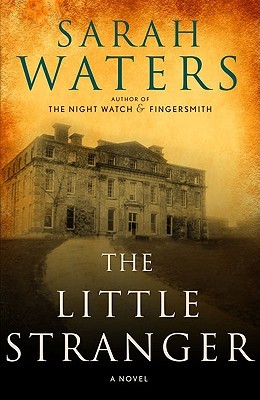
The Little Stranger, by Sarah Waters
I picked up several of Waters’s books during the time that I worked at Penguin, and I randomly chose The Little Stranger as my introduction to her work. I expected this book, described as a “gothic page-turner,” to be suspenseful or as engrossing as Rebecca, but unfortunately it was neither. The book has all the elements of a winner: a crumbling grand old mansion, family secrets, romance, an alleged ghost, and plenty of tragedy, but it was at times a painfully slow read.
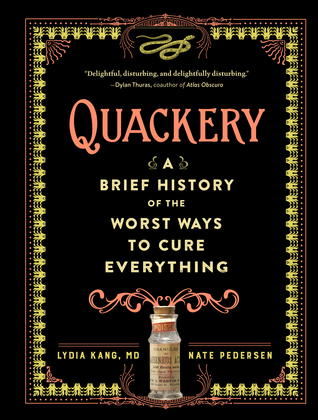
Quackery: A Brief History of the Worst Ways to Cure Everything, by Lydia Kang, MD and Nate Pedersen
On the surface, this beautifully-designed book was made for me: with chapters on lobotomies, corpse medicines and poisons, I should have loved it. But I quickly realized that I had already read entire books on most of the subjects covered here, so I found very little new-to-me information. If you’re just dipping your toe into the world of strange medicine and creepy cures, this book may be perfect for you. If you’ve already read everything there is to read about leeches and arsenic, you can skim or skip this one altogether.
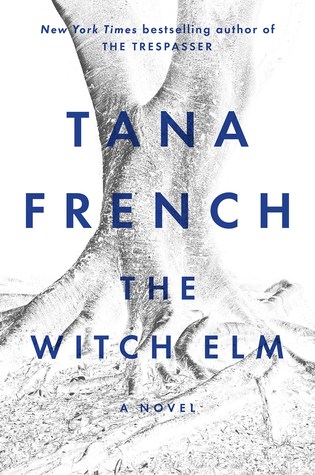
The Witch Elm: A Novel, by Tana French
Toby, recovering from a home invasion, goes to stay with his uncle in a big, old family home. When a skull is discovered in the trunk of a tree, things get complicated. I have a love/hate relationship with crime thrillers—I hate not knowing what’s going on, but they feel like brain candy to me in between some of the heavier non-fiction books I read. Unfortunately, I never really connected with any of the characters in this book and the ending felt rushed. The resolution wasn’t satisfying and ultimately I was just sort of mad I invested so much time into this story with so little payoff.

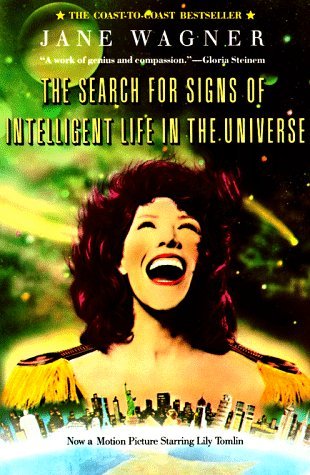
The Search for Signs of Intelligent Life in the Universe, by Jane Wagner
Plays are meant to be performed, and I would be pay anything to go back in time and see Lily Tomlin on stage in a production of Jane Wagner’s extraordinary The Search for Signs of Intelligent Life in the Universe (either during its original 1980s run or the early 2000s revival). I can’t do that, of course, but I did finally see the film version, which was wonderful. Tomlin’s ability to portray a dozen characters without the aid of costumes or props is legendary—but while she is the more visible half of the Tomlin-Wagner partnership (personally and professionally), Wagner’s words are what make The Search so memorable. This infinitely quotable work is nothing less than life-changing, and I find myself thinking about it almost daily since I first read (and immediately re-read) it a few months ago.
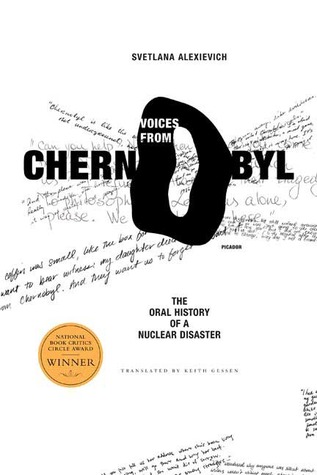
Voices from Chernobyl: The Oral History of a Nuclear Disaster, by Svetlana Alexievich
I reserved this book long before the spike in Chernobyl interest due to HBO’s miniseries (which is excellent), and if you’re interested in first-hand accounts of the disaster this Nobel Prize-winning book is a great place to start. The basic facts of Chernobyl are widely known, but there’s no substitute for hearing the stories of people who were actually there. More than 30 years after the disaster, the long-term effects of radiation are still being debated but there’s no doubt that thousands of people’s lives were never the same—in often brutal and heartbreaking ways.

Recent Reads

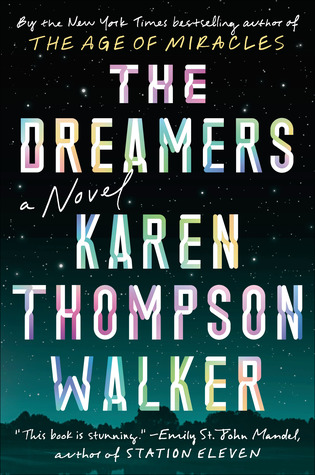
The Dreamers: A Novel, by Karen Thompson Walker
When I heard comparisons between The Dreamers and Station Eleven, I knew I had to check it out. Station Eleven is one of my favorite books—despite my somewhat baseless assertions that I don’t like “science fiction” or post-apocalyptic stories—and I loved The Dreamers almost as much.
As a mysterious sleeping sickness spreads from a college campus into a Southern California town, the residents react to the terrifying situation in various ways. I was impatient to know how the story resolved but in the end that wasn’t really the point—like most great books, the journey is the destination and The Dreamers sent me on a journey that I was reluctant to end.
Where the Crawdads Sing, by Delia Owens
It was impossible to miss this book when I worked at Penguin. It was a New York Times number one bestseller so many weeks in a row that I lost count—and every week that it stayed at number one, the sales team was rewarded with bagels (that I was never allowed to eat, sadly). It is so popular that I had to wait months to get my copy from the library, but thankfully it more than lived up to all of the hype.
Owens’s first novel is the lovely, touching story of Kya, a girl who is left to fend for herself when she is very young. She makes her home in undesirable marsh lands and is more comfortable among the wild things—where the crawdads sing—than with people or in town. There’s also a murder mystery interspersed with Kya’s life story, but it’s the marsh girl who steals the show. I sobbed through about two-thirds of this book and as much as I wanted to know the ending, I was equally sad to leave this beautiful world behind.
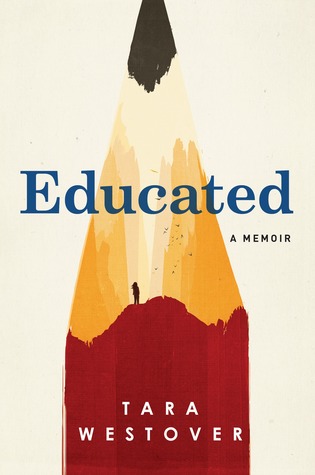
Educated: A Memoir, by Tara Westover
Like Where the Crawdads Sing, Educated was inescapable during my time working at Penguin. Unfortunately, I was a bit let down by this memoir. Westover grew up with survivalist-Mormon parents in rural Idaho. She was isolated and uneducated, violently abused by one of her older brothers and suffered more than her fair share of physical ailments including two nearly-deadly car accidents. She overcame great odds to enroll in BYU and then programs at Cambridge and Harvard, eventually earning her PhD. Those details sound like irresistible memoir fodder, but Westover’s storytelling just didn’t connect with me.

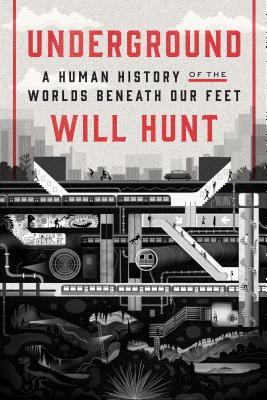
Underground: A Human History of the Worlds Beneath Our Feet, by Will Hunt
I’m alternately interested and terrified of underground spaces—I love exploring abandoned places, but I think I would have a claustrophobic freakout if I spent any real time in tunnels. Hunt has explored his share of cool places—caves, catacombs and train tunnels—and his descriptions of his adventures were gripping. He did focus on spirituality and the mental toll of darkness a bit more than I would have liked, but if it’s people you’re interested in, I would skip this and read the Mole People instead.
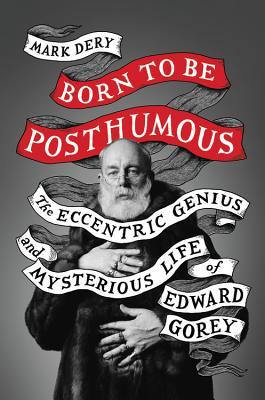
Born to Be Posthumous: The Eccentric Life and Mysterious Genius of Edward Gorey, by Mark Dery
Edward Gorey was a fascinating and extremely talented eccentric and his life’s story is definitely worthy of a proper biography. He was also secretive and fiercely private, which means that Dery struggles to fill his book, resorting to long-winded recaps of every single thing Gorey every wrote. 200 of the 400+ pages are great—Gorey was every bit as strange as his illustrations suggest, but I very much identified with all of his quirks and lifestyle choices (and especially his love of Cape Cod and cats). But the other half, full of speculation regarding Gorey’s sexuality, feels disrespectful, exploitative and mostly just unnecessary.
Recent Reads

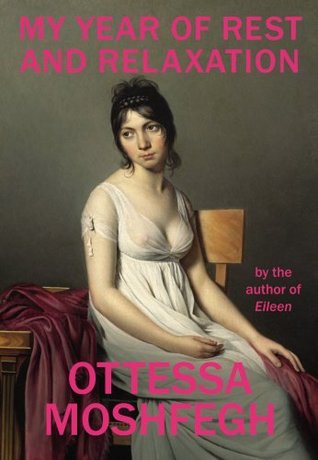
My Year of Rest and Relaxation, by Ottessa Moshfegh
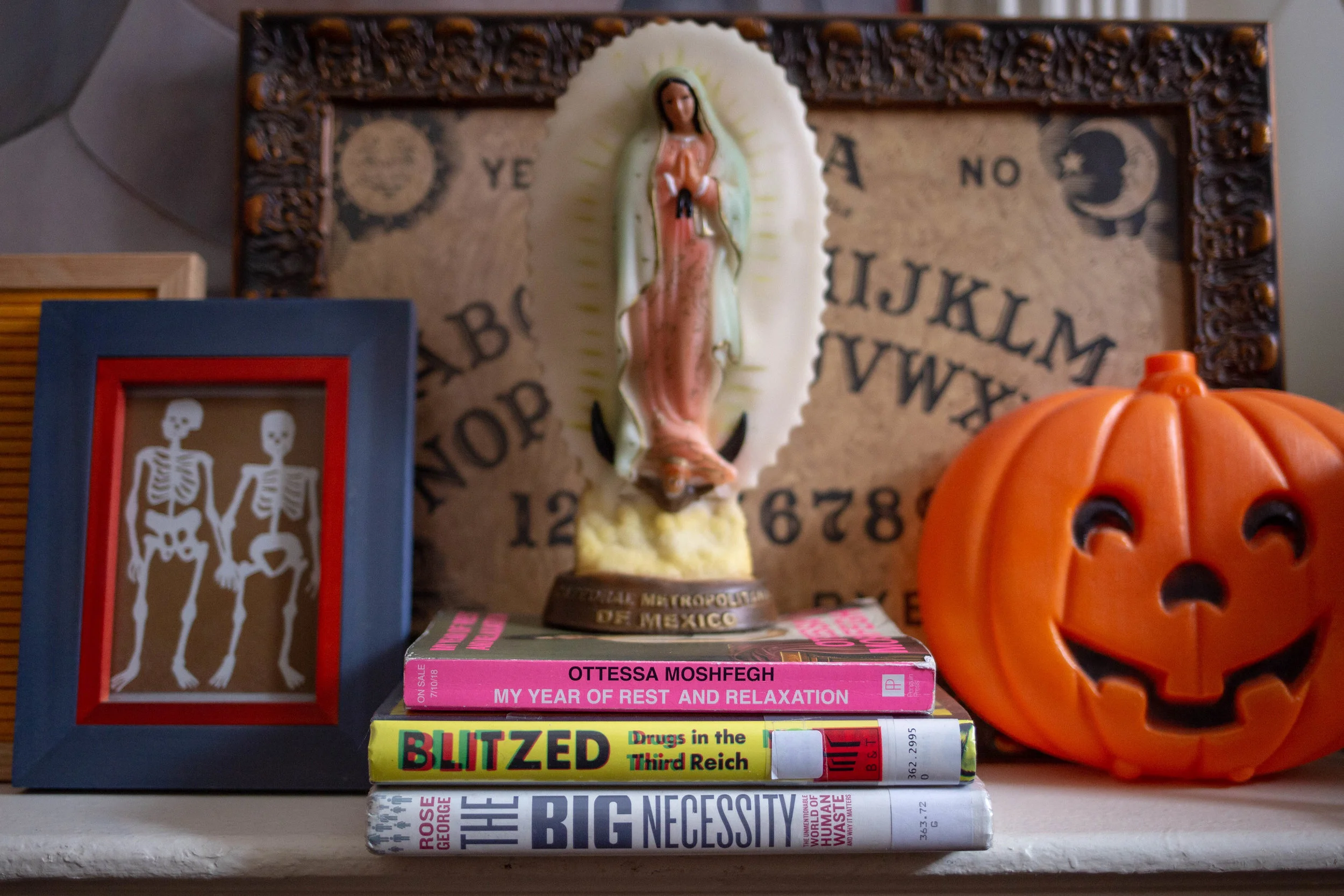
I can understand why this book would be off-putting to some people, but I loved this strange and morose tale of one woman’s fucked up life. The narrator, who seemingly has it all, decides to take a year off and self-medicates herself (with the help of one seriously awful psychiatrist) into hibernation. Of course life still happens anyway, and although she gives you absolutely no reason to root for her, I still did. Because I still very much judge books by their cover, I was glad to find that I loved this book as much as I loved its arresting cover, which I think is one of the best that I’ve seen recently (and in my brief time working at Penguin Random House, I was lucky enough to grab this off of a take shelf).
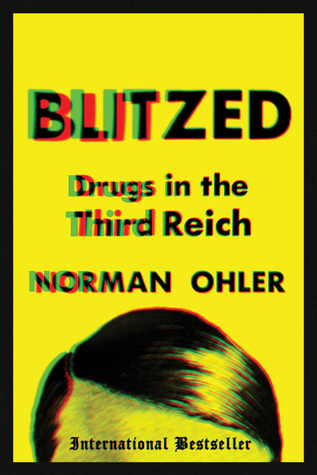
Blitzed: Drugs in the Third Reich, by Norman Ohler
There is definitely no shortage of information out there about Hitler and the Third Reich, but Blitzed narrowly focuses on the various drugs that made their way into the German’s bloodstreams during the war, including the supposedly-sober führer himself. Ohler details Hitler’s rapidly declining health—due in no small part to opioid withdrawal—mirrored by the decline of the German army as a whole. Hitler’s personal physician, Theodor Morell, is almost as fascinating as his famous patient, although Ohler constantly referring to him as the “fat doctor” feels unnecessarily cruel, even if he was a Nazi and a close confidant to one of the most evil men in history.
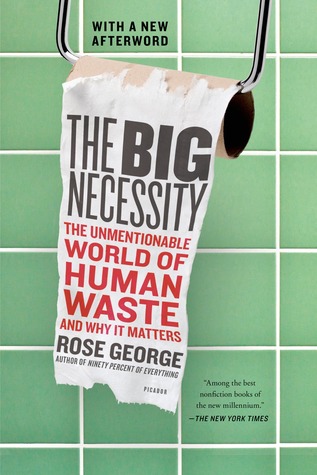
The Big Necessity: The Unmentionable World of Human Waste and Why It Matters, by Rose George
After loving George’s most recent book, Nine Pints, I knew I wanted to read everything else that she had written. George now ranks alongside Mary Roach and Jennifer Wright as one of my favorite science writers, women who manage to be both hilarious and informative about seemingly ordinary topics. The Big Necessity is, to put it bluntly, about shit—and urine—products everyone makes daily but dares not speak or think about what happens after the flush. George explores sanitation (or lack thereof) around the world and I will definitely be thinking about this eye-opening book the next time I’m searching for a clean bathroom or considering flushing a pair of underwear (but seriously, what is up with people flushing anything but toilet paper??).

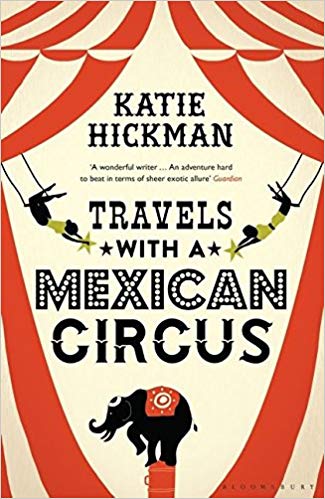
Travels with a Mexican Circus, by Katie Hickman
I’ll admit that choosing this book based on cover alone was a bit of misstep this time (it’s usually a cliche that never fails me) as the most interesting thing about this book turned out to be the cover art. This part-memoir, part-travelogue by a 30-something British writer and her husband about their time spent living with (and performing in) a Mexican Circus wasn’t terrible, it was just a bit of a slog. Maybe it’s because I read it in tiny pieces over two months (I usually have a “weekend” book that is smaller/lighter to take with me when I’m out all day) but I was never fully invested in the author or the other members of the circus she meets and describes in great detail. Maybe I’m just tired of the “circus” genre but if you’re interested, I’d skip this one and read The Electric Woman instead.
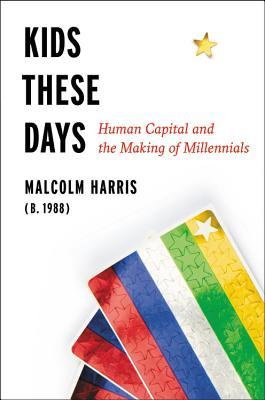
Kids These Days: Human Capital and the Making of Millennials, by Malcom Harris
I discovered this book after reading this mind-blowing article about burnout. There are countless stories floating around about the selfish millennial and how we’re systematically killing industries while expecting participation trophies and I’ll admit that even I (born in 1985, solidly a millennial myself) bought into this negative narrative. But Harris does a great job of presenting some of the major factors that got us here—productivity, technology, stagnant wages, the erasure of the middle class, education standards, student loan debt and policing policies—and I think this book should be required reading for anyone ragging on the most productive and least-compensated generation.

Recent Reads
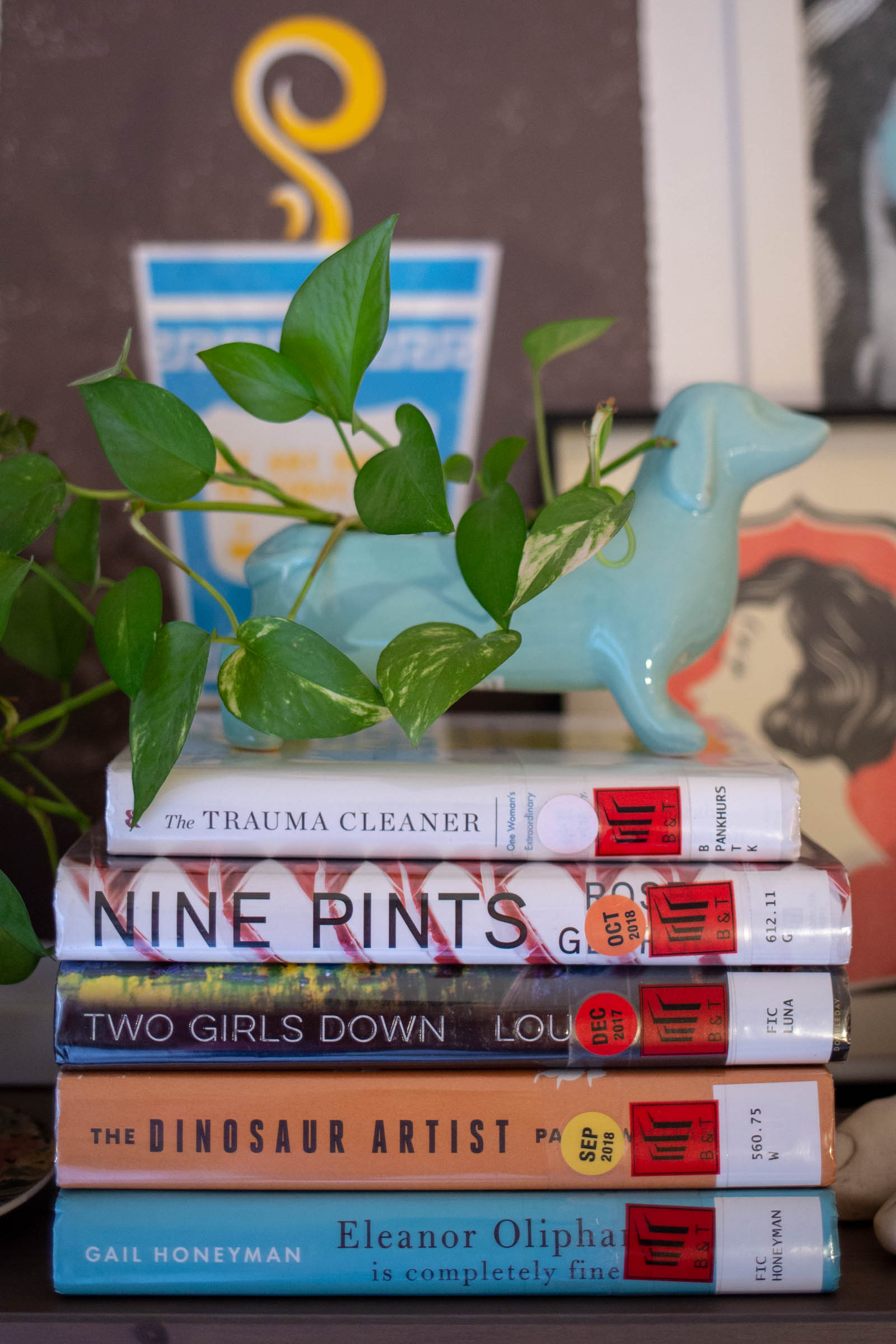
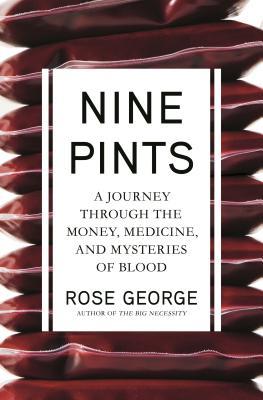
Nine Pints: A Journey Through the Money, Medicine and Mysteries of Blood, by Rose George
I love deep dives into common subjects that people know surprisingly little about, and this book about blood has been one of the most interesting of that genre that I’ve read. We all have blood (nine pints, usually) but I hadn’t ever really considered how extraordinary it is until reading about the history of transfusions, menstruation, leech therapy, HIV/AIDs and all of the other ways that blood sustains and confounds us. George has a wonderfully engaging writing style that was never boring, often funny and always easily informative.
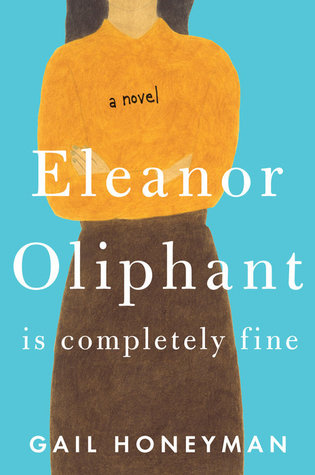
Eleanor Oliphant is Completely Fine, by Gail Honeyman
Wow, I LOVED this book and its titular character, the awkward but infinitely lovable, Eleanor Oliphant. Miss Oliphant, as she prefers to be called by strangers, is completely fine with her routine of work-grocery store-home, until a few people and circumstances force her to reexamine her current life and traumatic past. I can’t remember loving a fictional character as much as I loved Eleanor and I found myself completely relating to her comments and confusion on social interactions. Her inner thoughts made me simultaneously laugh while also breaking my heart. I didn’t mind the somewhat controversial ending as much as I was just deeply sad to leave Oliphant’s world. Good news for anyone who felt similarly attached: Eleanor Oliphant is being developed into a movie by Reese Witherspoon’s production company, Hello Sunshine.

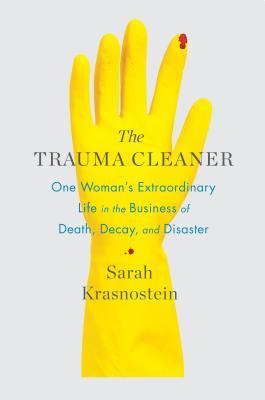
The Trauma Cleaner: One Woman’s Extraordinary Life in the Business of Death, Decay and Disaster, by Sarah Krasnostein
This book was a bit different than I expected but it was a fascinating look at an extraordinary woman. Sandra Pankhurst is the titular “trauma cleaner,” the owner of a cleaning business that cleans and organizes houses that come under her care due to a variety of grim circumstances including years of hoarding, natural deaths, murders and grisly suicides. Pankhurst, who also happens to be transgender, has led a traumatic life herself and the narrative alternates between telling her back story alongside the stories of her clients. I could have done without some of the author’s personal commentary and attempts at colorful storytelling, but only because Pankhurst is a character in her own right with no need for further embellishment.
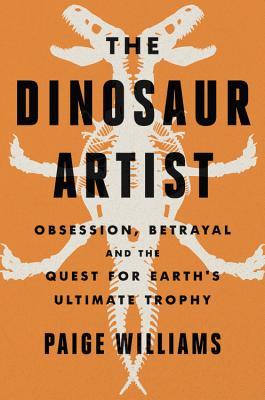
The Dinosaur Artist: Obsession, Betrayal and the Quest for Earth’s Ultimate Trophy, by Paige Williams
I was afraid I wouldn’t be able to make it through this nearly 300-page book by my library due date, but I needn’t have worried. I couldn’t put this one down, and if you’re a fan of dinosaurs, passionate collectors or The Orchid Thief, you’ll love this account of the people who hunt, and collect fossils (including a brief mention of everyone’s favorite financially irresponsible celebrity, Nicholas Cage).
In 2012, a nearly complete Mongolian T. bataar skeleton (a close relative of the American T-Rex) appeared in a New York auction catalog and Williams does a deep dive into all of the players who helped get it there, from the Florida man who imported and mounted it all the way to the Mongolian government (who, spoiler alert, eventually got their skeleton back). Comparisons to Susan Orlean’s tale of obsession and the dark world of specimen collecting are inevitable, but well-deserved and I hope Williams continues to write more behind-the-headlines sagas which continually prove that fact is often just as strange—or at times, even more so—than fiction.
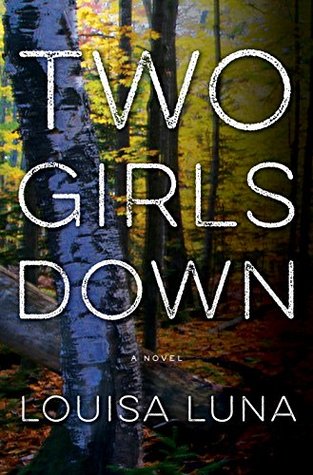
Two Girls Down, by Louisa Luna
I love a good whodunnit thriller, and this story of two missing sisters and the private investigator and ex-cop who are searching for them was an easy read. The story veers into some pretty dark places, but it felt true to life and never exploitative. Try as I might I didn’t guess any of the twists before they came, but I read it quickly enough that I didn’t need to flip ahead to calm my anxiety that comes when I feel like I’m in the dark. I wasn’t invested in the main characters—Alexa Vega, a no-nonsense bounty hunter and Max Caplan, a disgraced ex-cop—enough to hope for another installment, but I think of books like this as a brain cleanser in between all of the educational nonfiction I read, and Two Girls Down definitely served that purpose.
This post contains Amazon affiliate links. If you click on a link, I may receive a ~very small~ commission in return, which I will probably use to buy more books because I have a book hoarding problem.

Recent Reads

As Always, Julia: The Letters of Julia Child and Avis DeVoto, edited by Joan Reardon
This was the first book I read after I completed my 2018 reading challenge, so I really dug in and allowed myself to savor every single delicious page. Incidentally, I have had this book on my shelf for years—I bought it back when I lived in Ohio—and had tried to read it before, but for whatever reason it didn’t grab me at the time. This time, however, I was immediately drawn into the endearing trans-continental correspondence of two dynamic and fascinating women.
What began innocuously over a fan letter that Child wrote to DeVoto’s husband—one that Avis herself answered—developed into a decades-long friendship, during which the women refer to themselves as “soulmates.” This compilation of letters never feels disjointed, reads almost like a novel and is mostly concentrated during the years when Child is abroad, wrestling doubts while working on Mastering the Art of French Cooking. I already knew I loved Julia Child—whose late-in-life renaissance is my life inspo whenever I’m feeling lost—but the real surprise here is how much I fell in love with Avis DeVoto, who is more than a match for Child in warmth and wit.
I was so eager to pass on my copy to a friend, I forgot to snap a photo but you can see the cover below.
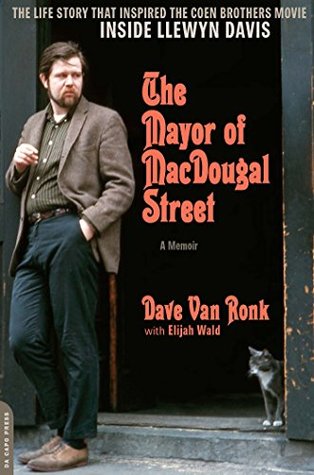
The Mayor of Macdougal Street: A Memoir, by Dave Van Ronk
After a recent repeat viewing of the wonderful Coen brothers’ movie, Inside Llewyn Davis, I decided it was time for me to finally read Van Ronk’s memoir, which served as the brothers’ inspiration when making their film. Van Ronk was a instrumental pioneer in New York’s burgeoning folk scene in the ‘50s and ‘60s, and by all accounts he should have been as famous as his friends at the time, which included Bob Dylan, Joni Mitchell and Art Garfunkel.
Van Ronk’s story, written mostly by him but finished after his death by a close friend, is always entertaining and several of his anecdotes are laugh-out-loud funny. Van Ronk talks about a time in New York that I’ll always be sad I wasn’t able to experience first-hand, but he also wisely posits that everyone who moves to New York—even him—thinks they arrived ten years too late.
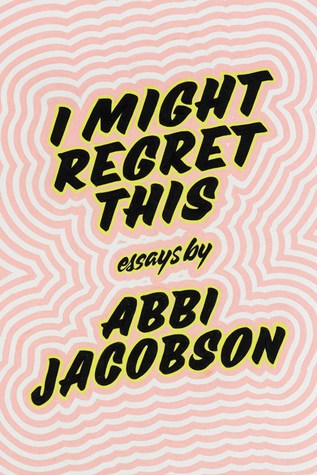
I Might Regret This: Essays, Drawings, Vulnerabilities, and Other Stuff, by Abbi Jacobson
I’m a huge Broad City fan, and the premise of taking a cross-country road trip to find clarity after a break-up was irresistible to me, but unfortunately I didn’t love this collection of essays, lists and illustrations by Jacobson. There were some good parts but mostly it was a bit boring, which is surprising considering Jacobson’s obvious humor and observation skills. Overall this was a quick read, and I did appreciate the parts relating to her sexuality and her behind-the-scenes look at how Broad City came to be, but I was left wanting more.

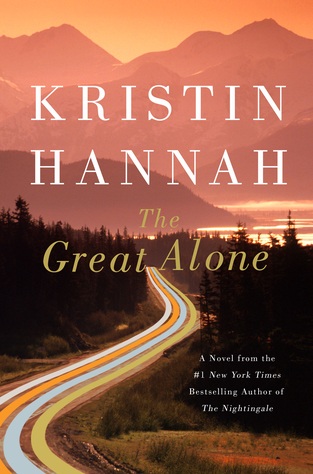
The Great Alone, by Kristin Hannah
I had a few issues with how this book was written—Hannah, who has written more than 20 novels, repeated a lot of phrases such as “it was bigger inside than it looked from the outside” and “buttery light” (ew)—but I couldn’t put this book down and raced through the more than 400 pages in just a few days. The story of Leni, fourteen when the book starts, and her parents as they embark on a new life in rural Alaska was riveting (if a bit overly dramatic at times) and by the end of the book I was sobbing. I’ve always been fascinated by Alaska, and Hannah’s descriptions of its wild beauty only made me more eager to visit (a friend of mine currently lives in Fairbanks, so I might just have to go).
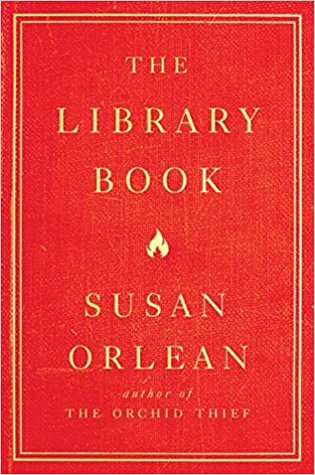
The Library Book, by Susan Orlean
I love anything by Orlean (The Orchid Thief is one of my all-time favorites) and I love libraries, so it’s no surprise that I loved Orlean’s latest, The Library Book. She weaves together a whodunnit story of the 1986 Central Library fire in LA—a fire that raged for 7.5 hours, completely destroying 400,000 books and damaging 700,000 more—with the history and inner-workings of libraries in general.
Because I’m a total nerd, I actually teared up reading a play-by-play of the fire and Orlean’s musings on what books, and of course, libraries, mean to the world were genuinely touching. Although some people might claim that the Internet rendered libraries outdated and even useless, Orlean (rightly) presents an entirely different future—where libraries are not only still around, but more vital than ever.

This post contains Amazon affiliate links. If you click on a link, I may receive a ~very small~ commission in return, which I will probably use to buy more books because I have a book hoarding problem.
I’m hoping to read 65 books in 2019—follow along and let’s be friends on Goodreads!

Best of 2018: Books

I’ve already mentioned it several times—and I don’t wish to keep bragging—but I read 61 books in 2018. Last year, after reading 52 books, I set my Goodreads Reading Challenge a bit higher. I was apprehensive that I’d get burnt out on reading or feel too much pressure to read quickly, but luckily I never felt anything but joyful about reading so much. This was an arbitrary goal I set for myself, and I would have had no qualms about abandoning it if I ever felt negatively towards the challenge. I read the books I wanted to read without regard for length and while sometimes I would finish several in one week, other books demanded a more leisurely pace.
I know that I am happier when I’m reading, so I make time for it. I know 60 books seems like a lot, but I don’t want anyone to feel bad about their own reading pace (unless you’re Donald Trump, in which case fuck you, read a book). Trust me, there are tons of things I “should” be doing—exercising, eating healthier, saving more for retirement, working on my design portfolio—that I feel woefully inadequate about on a daily basis. So please keep in mind that just because I happen to make time for reading (taking public transit is the number one reason why I can read so much), that doesn’t mean I have it all together.
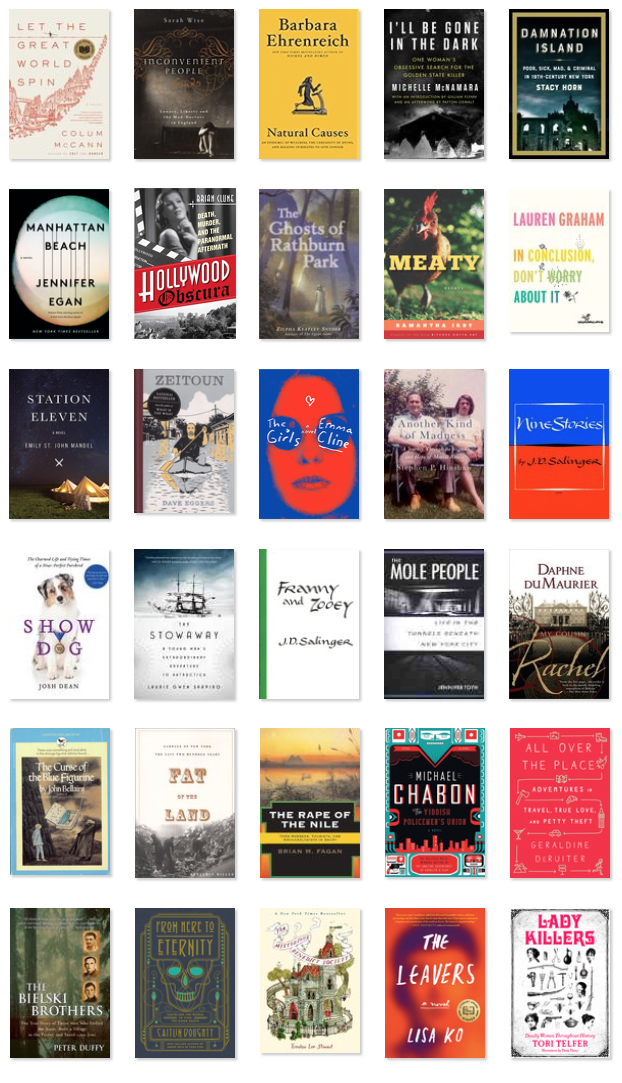
According to Goodreads, I read 19,367 pages in 2018 (3,052 pages more than 2017). The shortest book I read was In Conclusion, Don’t Worry About It, by Lauren Graham and the longest was Broadway: A History of New York in Thirteen Miles, by Fran Leadon. The most popular book was Jurassic Park, by Micheal Crichton, the least popular was Hollywood Obscura, by Brian Clune and the highest rated was The World Only Spins Forward: The Ascent of Angels in America, by Isaac Butler.
🏆 BEST OVERALL 🏆
As Always, Julia: The Letters of Julia Child and Avis DeVoto, edited by Joan Reardon
This collection of letters isn’t even included in the 60 books of my reading challenge—it’s the 61st book I read this year, and also happens to be the best. I couldn’t have asked for a better way to end 2018 than blanketed in the warm and fascinating correspondence between two extraordinary women.
Full review to come.
📗 BEST FICTION 📗
Station Eleven, by Emily St. John Mandel
Although I tend to gravitate towards non-fiction, nothing sticks with you like a really great novel. Honoring a recommendation, I started Station Eleven reluctantly, not expecting the post-apocalyptic storyline to really grab me. I was completely wrong, and eight months later I’m still thinking about this haunting story.
📓 BEST NON-FICTION 📓
Dopesick: Dealers, Doctors, and the Drug Company that Addicted America, by Beth Macy
This was the category for me with the most competition this year, and Zeitoun, The World Only Spins Forward and I’ll Be Gone in the Dark are all contenders. But I think that Dopesick was the most eye-opening and maddening book I read this year, and it should be required reading for any American struggling to understand the opioid epidemic.
🔬 BEST SCIENCE 🔬
Natural Causes: An Epidemic of Wellness, the Certainty of Dying, and Killing Ourselves to Live Longer, by Barbara Ehrenreich
I didn’t read as many death-related books this year as I have in the past—maybe because the world is depressing enough. But this book was a fascinating look at the health and wellness industry from someone who knows it well. Ehrenreich holds a PhD in cellular immunology and now that she's in her 70s, has decided that she is "old enough to die," meaning that she has chosen to forgo any unnecessary medical treatment and preventative screenings—a concept that is revolutionary and potentially life-changing no matter how old you are.
👨🏻 BEST MEMOIR 👨🏻
I Must Say: My Life as a Humble Comedy Legend, by Martin Short
Short’s memoir is just as funny as you’d expect it to be—he is the creator of one of the best characters of all time, Jiminy Glick, after all—but it’s also surprisingly heartfelt and inspirational. Short has suffered more than his fair share of real tragedies throughout his life, but he remains infectiously optimistic.
😂 BEST HUMOR 😂
Meaty: Essays, by Samantha Irby
Last year I picked Irby’s second essay collection, We Are Never Meeting in Life, for this category. This year I finally tracked down her first book, Meaty (which has since been re-released) and it’s just as good as everything I’ve ever read by Irby—including her Instagram and Twitter feeds, which are worth a scroll through—which is to say it’s laugh-out-loud hilarious. Irby also somehow manages to be extremely insightful about some really heavy topics in between the laughs and although she’s already made it quite clear that it’s not happening, I still dream of one day becoming her friend in real life.

Gift Guide: Book Lovers
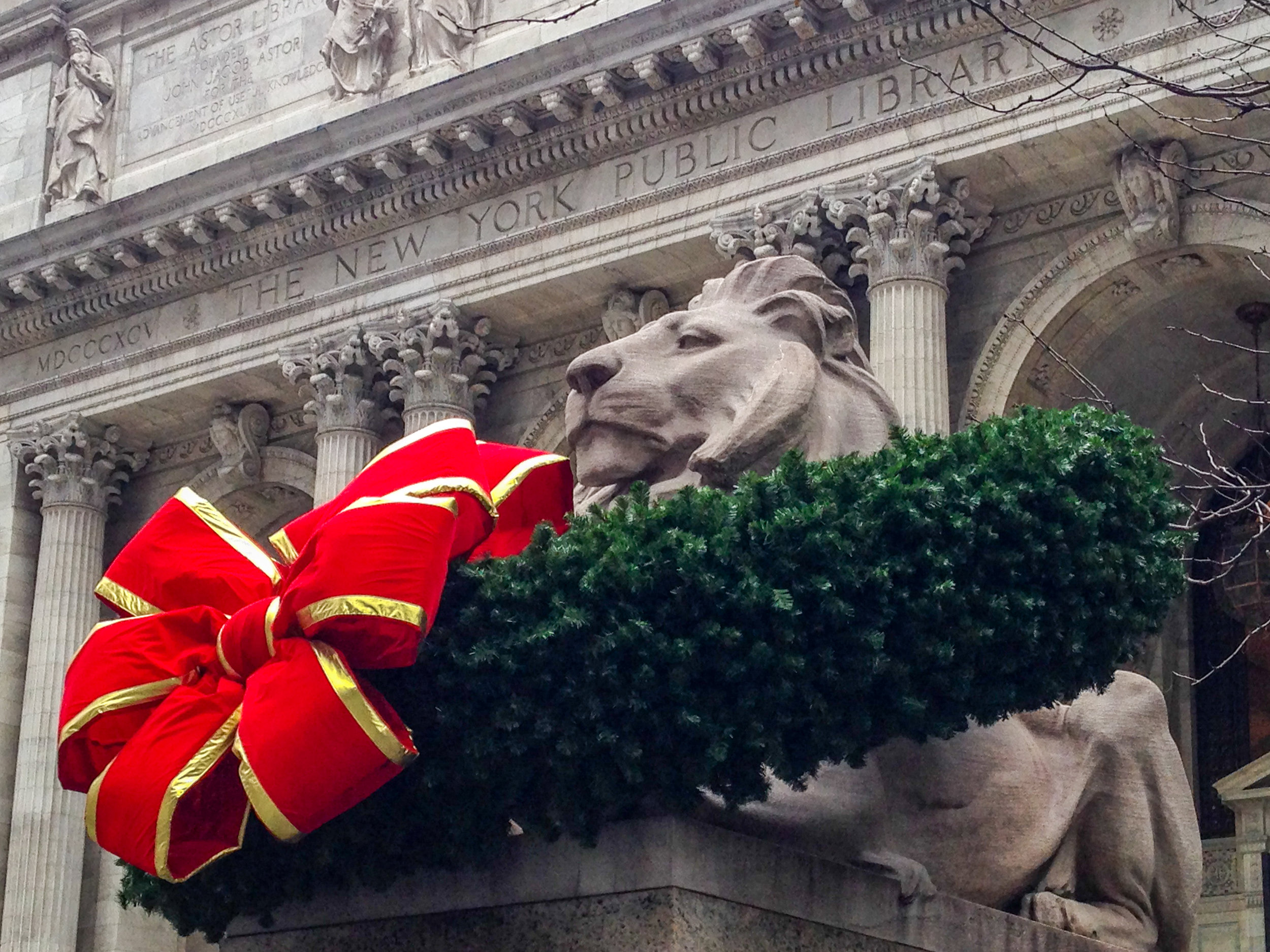
I have always been an unabashed book nerd. I used to salivate over the Scholastic Book flyers and I earned more personal pan pizzas at Pizza Hut through the Book It program (which is still going on??) than any kid should ever eat in one lifetime. I have very vivid memories of spending a significant portion of my childhood in the library, and I was once a member of the Wishbone fan club. There were some years as an adult that I barely read, and looking back I know now that I’m my happiest when I’m reading voraciously. This year I’ve read 61 books and I’m looking forward to keeping up the pace next year. So grab your library card and a book light and browse this gift guide for the book lover in your life.

1 / Most days, I use one of my many Strand totes as my main bag and I just can’t stop buying more. They’re constantly debuting new designs and it’s impossible to just pick one.
2 / Christmas cards for the book obsessed.
3 / Wear your favorite quote literary quote.
4 / Hang this mini version of a famous NYPL lion on your tree—will you get Patience or Fortitude?
5 / I don’t know why I love gnomes so much, but everyone is cuter when they’re reading.
6 / A pack of bookmarks for the person who is always marking her place with an old receipt.

1 / A tiny, wearable bookmobile.
2 / Mozart is always laying on my stuff so this pin is a good depiction of my life.
3 / 4 / 5 / 6 / 8 / 10 / Some of my favorite books that anyone should love: Nothing to Envy, We Are Never Meeting in Real Life, The Westing Game, The Road to Jonestown, As Always, Julia and A Gentleman in Moscow.
7 / I’m old enough to remember the physical cards in library books, so I love these socks.

1 / Keep a reminder of the beloved Strand dollar racks with you at all times.
2 / Very true.
3 / The titles of notorious banned books are revealed when you fill this mug with warm liquid.
4 / I’m also old enough to remember physical card catalogs, so I love this notecard set.
5 / I was gifted this NYPL tote this year and it’s so well-made and beautiful in person.
6 / Not sure if this Old Books candle actually smells good, but I do love the smell of actual old books.
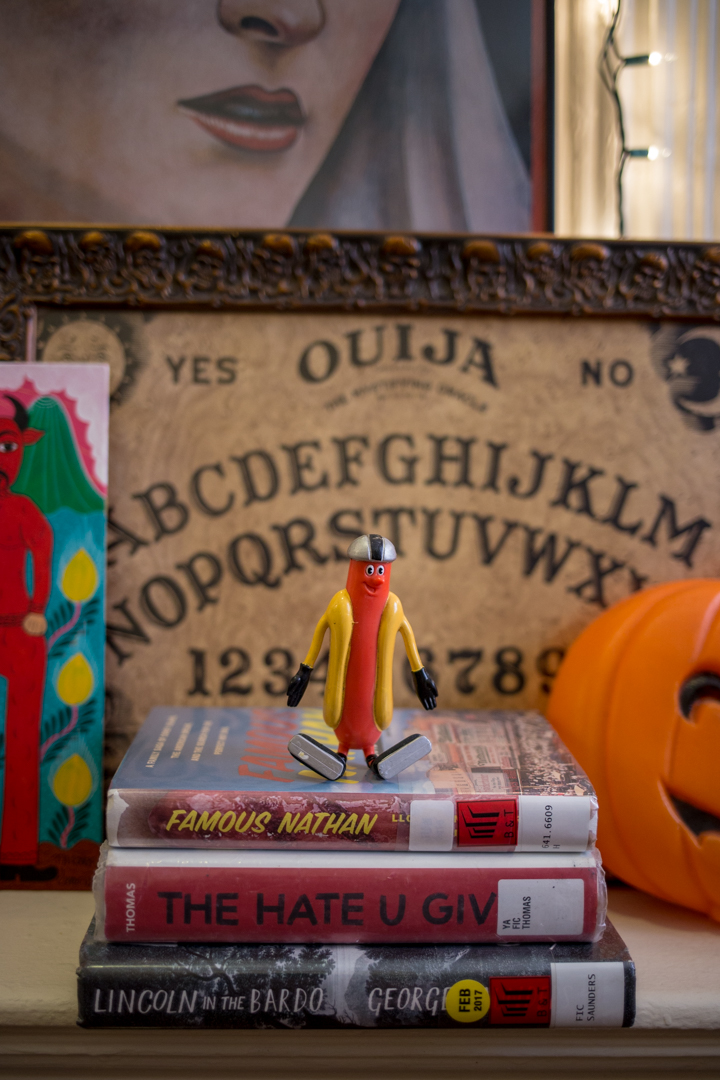
Books just might be the very perfect holiday gift—they’re cheap, easy-to-wrap and the very best ones are life-altering. Also, if you’re a last-minute shopper, most books can be purchased on Amazon with two-day shipping or—even better—head down to your local bookstore. Physical bookstores don’t only have books, but usually sell a large selection of totes, cards and other cute little tchotckes that make great gifts.
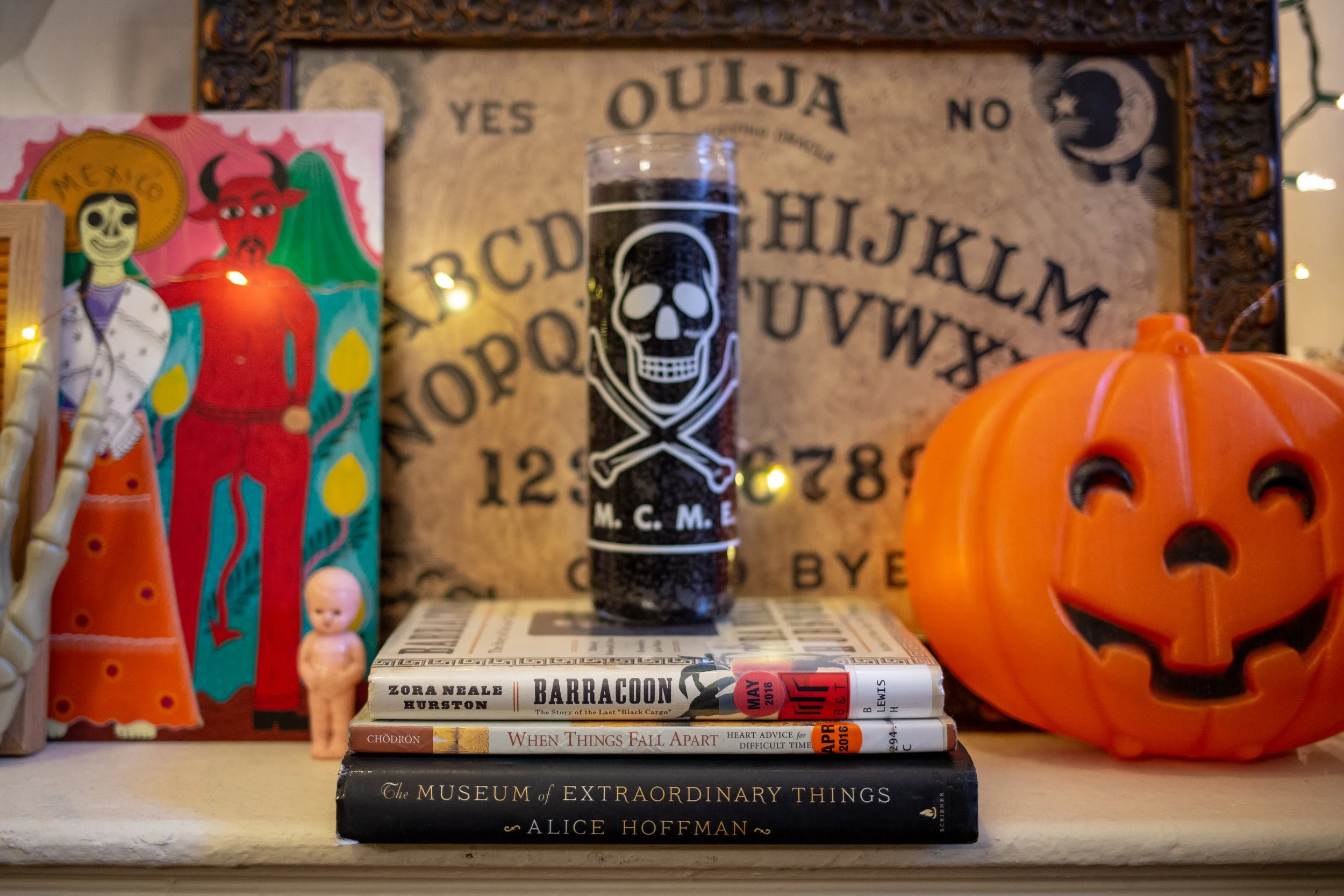
Some of the best books I read this year: Dopesick / Let the Great World Spin / The Museum of Extraordinary Things / I Must Say: My Life as a Humble Comedy Legend / The Hate U Give

Recent Reads

I’m happy to report that I have officially completed my 2018 Goodreads Reading Challenge an entire month early! The Museum of Extraordinary Things was the 60th book I read this year, but I think I can squeeze in a few more before the year ends. Every time I post about finishing yet another book, I feel kind of strange for “bragging” but I really just love talking about, looking at, shopping for and reading books (I work at Penguin Random House and I’m still not sick of books).
I frequently get asked how I find the time to read so much, but here’s the thing: I just love reading, so I make time for it. Things I don’t make time for: real exercise, clothes shopping, working overtime or cooking. In fact, the night that I finished my 60th book, I had a bowl of cereal and a bowl of chips for dinner. We’re all doing the best we can with the time we’re given, and I personally feel bad when I see people running marathons, so whether you’ve read one book or 100 this year, you do you (but really, reading is awesome I promise).
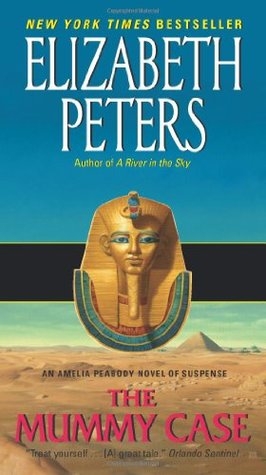
The Mummy Case: An Amelia Peabody Novel of Suspense, by Elizabeth Peters
I saw this book at a gift shop on our last night in Cairo and I put it on my library hold list as soon as we returned. Amelia Peabody is a thinly veiled parody of famous Egyptologist (and author of the excellent travelogue A Thousand Miles Up the Nile) Amelia B. Edwards, so The Mummy Case was an especially fun read because I had just finished A Thousand Miles. This is the third in the series of Peters’s Peabody novels, but I didn’t feel at a disadvantage having not read the others.
The Mummy Case follows Peabody and her husband, a fellow archeologist, as they travel back to Egypt with their young son, Ramses, in tow. When they’re denied permission to dig at the pyramids of Dahshur, they think their excavations in the middle of nowhere will yield nothing. But when an antiques dealer is murdered, Peabody and her (reluctant) husband begin to investigate. Mystery books are like brain candy to me—a palette cleanser in between all of the medical, poison and death industry books that I usually gravitate towards—and this one was even more fun now that I’ve actually been to some of the places Peters writes about.
The Poison Squad: One Chemist's Single-Minded Crusade for Food Safety at the Turn of the Twentieth Century, by Deborah Blum
I had loved Blum’s previous book in the “poison” genre, The Poisoner’s Handbook, so I was excited about her new book about food safety. Half of the book I loved—her descriptions of unsanitary factory conditions and suspicious food ingredients are not for the squeamish—and half of the book was a bit of a slog through the government bureaucracy of legislation and the battle with food industry lobbyists. I don’t read food labels as much as I should, but I was shocked at how dangerous and unregulated foods used to be—and at how far we still are from winning the battle for transparency and consumer safety in the food industry.
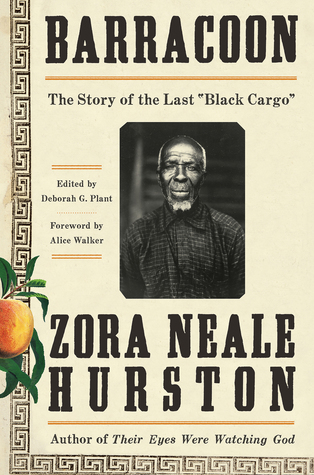
Barracoon: The Story of the Last "Black Cargo," by Zora Neale Hurston
Barracoon was published this year, 87 years after Hurston conducted her interviews with then 86-year-old Cudjo Lewis, who at the time was the last surviving African to come to America on a slave ship. Lewis was captured and brought to America when he was 19, just before the Civil War. He relays the story of his journey, from carefree boy to his capture, from his time as a slave to his life as a free man in the post-Civil War South. His story is told simply and in his own words, but it’s a heartbreakingly complex commentary on the African (and African-American) experience in America and it’s just a relevant today as it was then.
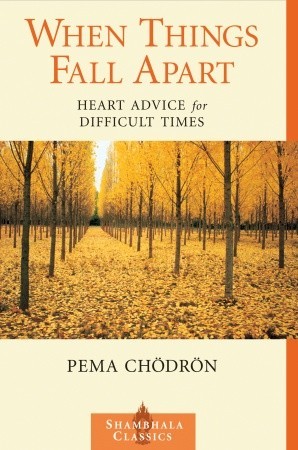
When Things Fall Apart: Heart Advice for Difficult Times, by Pema Chödrön
The universe has a way of giving you what you need sometimes, and this book became available at the library exactly when I needed it most. I wouldn’t call myself a Buddhist, but the more I read about Buddhist philosophies, the more I feel that they align with how I’m already trying to see the world. This book is at times a bit cultish for my tastes—and heavily pushes meditation, which I don’t do but could probably benefit from—but there is a lot of valuable wisdom packed in between. Chödrön emphasizes the benefits of embracing change, not running from groundlessness and advises that instead of avoiding pain, we should “lean into the sharp points.”
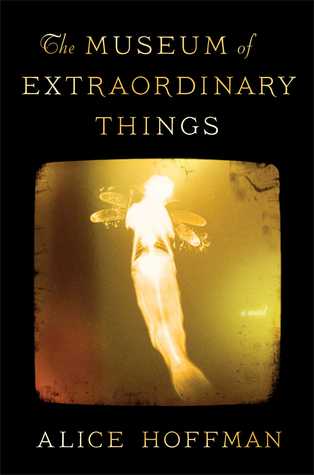
The Museum of Extraordinary Things, by Alice Hoffman
I bought this book at a thrift store and then actually read it not too shortly afterwards, which is surely some sort of record for me. I usually buy used books only to get distracted by my library list, but I’m so glad I didn’t let this one languish on my shelf. I picked up The Museum of Extraordinary Things because it hit on so many of my interests: turn of the century New York, Coney Island, curiosity museums, photography, etc.—in fact, this book seemed tailor made for my interests. It also turned out to be a beautifully written story about love, obligation and finding your place in the world. I loved every second of Hoffman’s gorgeous prose—even unspeakable tragedies like the Triangle Shirtwaist Factory fire, the Dreamland fire and sexual abuse are described vividly but respectfully.

Recent Reads

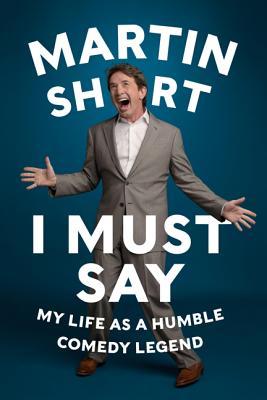
I Must Say: My Life as a Humble Comedy Legend, by Martin Short
I’ve loved Martin Short since I was a strange teen, at home watching late night reruns of Primetime Glick on Comedy Central while my friends were out partying. This summer I bought tickets to Martin Short and Steve Martin’s variety show, An Evening You Will Forget For the Rest of Your Life, and it was worth every penny. Martin Short is an underrated comedy legend and a National Treasure, and reading his hilarious and heartfelt memoir just reaffirmed my love for him. His positivity and humor in the wake of experiencing some real, visceral tragedies in his life is admirable and his interest in the absurdities of life is infectious. He endlessly name-drops celebrities, but instead of feeling obnoxious it just makes sense that so many people would want to bask in his light, myself included.
See What I Have Done, by Sarah Schmidt
I had high expectations for this book, a fictionalized retelling of the murders of Andrew and Abby Borden. It was helpful to be able to imagine the layout of the Borden house while I was reading, but the writing style was ultimately disappointing—unnecessarily wordy, overly descriptive and repetitive. I have a personal aversion to writers describing smells and Schmidt seemed to delight in trying to gross out the reader with her descriptions of body odors, rotting meat and strange tastes. Lizzie’s story is still intriguing more than a hundred years after the murders, but unfortunately there was nothing new or interesting about this version.
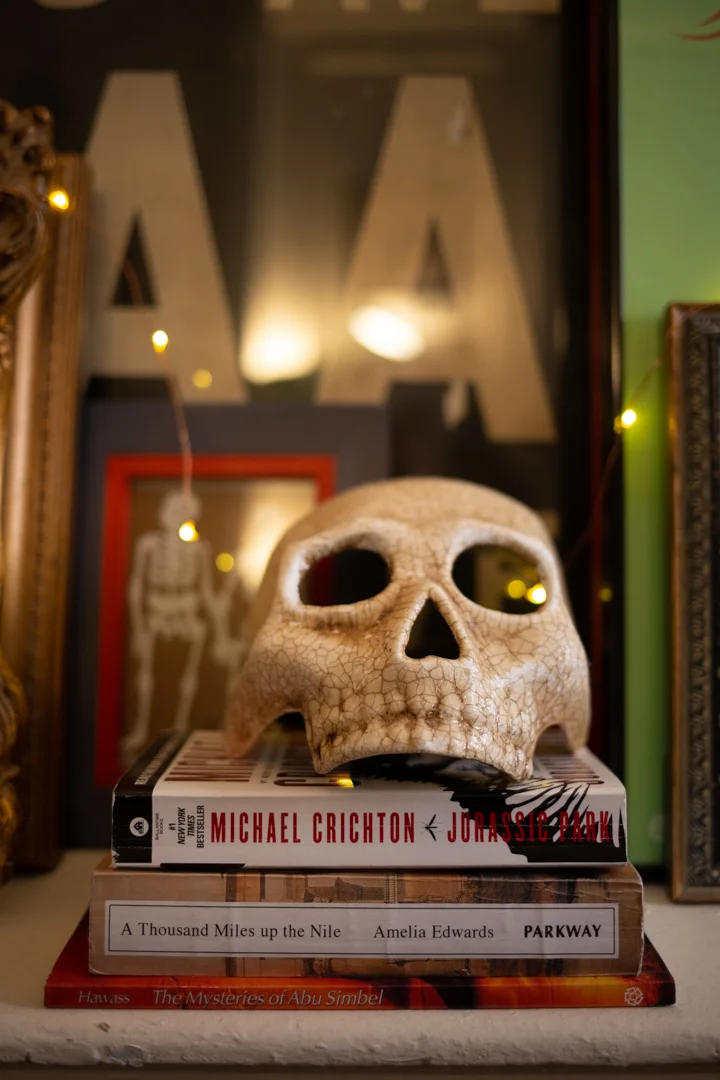
Jurassic Park: A Novel, by Michael Crichton
I took this book with me to Egypt, and it’s the perfect vacation read. I’ve been a huge fan of the movie ever since its 1993 release, and I finally treated myself to a copy of the book for my birthday. I usually prefer the book over its movie counterpart because books aren’t limited in the way that movies often are—however, in some cases (like Crazy Rich Asians) the movie manages to actually improve upon the source material. I think this was true of Jurassic Park, and while the book does differ from the movie in some significant ways, it had enough of the same characters and similar scenes to satisfy me.
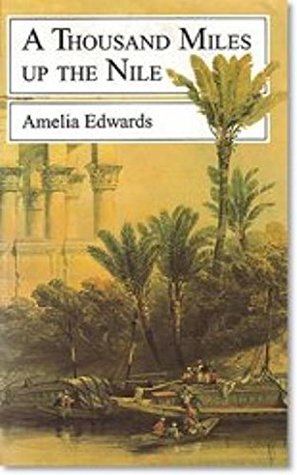
A Thousand Miles Up the Nile, By Amelia B. Edwards
My uncle recommended that I pick up a copy of this classic travelogue before we went to Egypt, but I couldn’t easily find a copy. When we walked into a bookstore in Aswan and I spotted it, I snatched it up and began reading it the next day. Amelia Edwards traveled through Egypt in the late 1800s, but many of her descriptions of temples, tombs and the Egyptian landscape could have been written just yesterday.
Despite my predilection for spoilers, I prefer to read about places after I’ve experienced them in person so I can have a mental picture of what is being described. Edwards certainly has a way with words and her observations on camels, crocodiles and Egyptian customs are laugh-out-loud funny and on most occasions mirrored my own. There is no better way to read A Thousand Miles Up the Nile than while actually cruising up the Nile with a wine glass in hand, but Edwards’s words have the power to transport you there, wherever you may be joining her from.
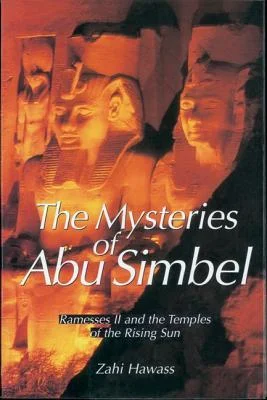
The Mysteries of Abu Simbel: Ramsses II and the Temple of the Rising Sun, by Zahi Hawass
My uncle sent this to me before our trip, but I brought it along to read in the days leading up to our visit of Abu Simbel. Dr. Zahi Hawass gave a few lectures during the course of our trip, so I couldn’t resist also getting him to sign my copy. It’s a quick read full of photos, but it was a good crash course on what I was about to witness in person. Egypt is full of incredible temples and monuments, but Abu Simbel is a true wonder amongst wonders.



Recent Reads

Crackpot: The Obsessions of John Waters, by John Waters
I love John Waters so much but I feel like there's so much of his work that I've yet to experience. I really need to get serious about seeing more of his movies (especially the ones starring Divine) but I made a tiny dent recently in his oeuvre by reading Crackpot, my first of several of his books. Crackpot was originally released in 1986, but the copy I read had a few updates made as recently as 2003. It still feels a little outdated and there were a lot of pop culture references that went completely over my head (I was born in 1985), but I would listen to Waters talk about almost anything. He's hilariously irreverent and cranky when discussing everything from fashion to death row inmates to celebrity, and surprisingly levelheaded as well—in an essay titled "If I Were President," Waters replies to the question of "what would you outlaw" with "guns and New Age crystals" making it even more painfully obvious that we elected the wrong celebrity President.
I Can’t Date Jesus: Love, Sex, Family, Race and Other Reasons I’ve Put My Faith in Beyoncé, by Michael Arceneaux
Occasionally I am so charmed by the author of a memoir or essay collection that I fantasize about becoming their real life friend—I have a running list in my head that includes Samantha Irby (ironically?), Lindy West, Phoebe Robinson, Mara Altman and now Michael Arceneaux. Arceneaux’s collection of essays is mostly about his life as a gay, black man from Houston—none of which I can really relate to personally, but one of the greatest joys of reading is the luxury of being able to dive into someone else’s experience for a brief time.
The Strange Case of Dr. Couney: How a Mysterious European Showman Saved Thousands of American Babies, by Dawn Raffel
This book has a strange structure and is oddly written at times, but the story of Martin Couney, a doctor of questionable provenance that ended up saving an estimated 7,000 premature babies by exhibiting them in sideshow-type pavilions at World’s Fairs and Coney Island is fascinating material. Not much is known about Couney’s life—he changed his name several times and wasn’t respected in the medical community. It’s hard to even grasp that there was time in the not-so-distant past that premature babies were seen as lost causes and incubators weren’t widely used or trusted. That countless people and their thousands of descendants are alive today because of this one extraordinary man and his crazy “baby ovens” just proves that the truth is often times stranger than fiction.
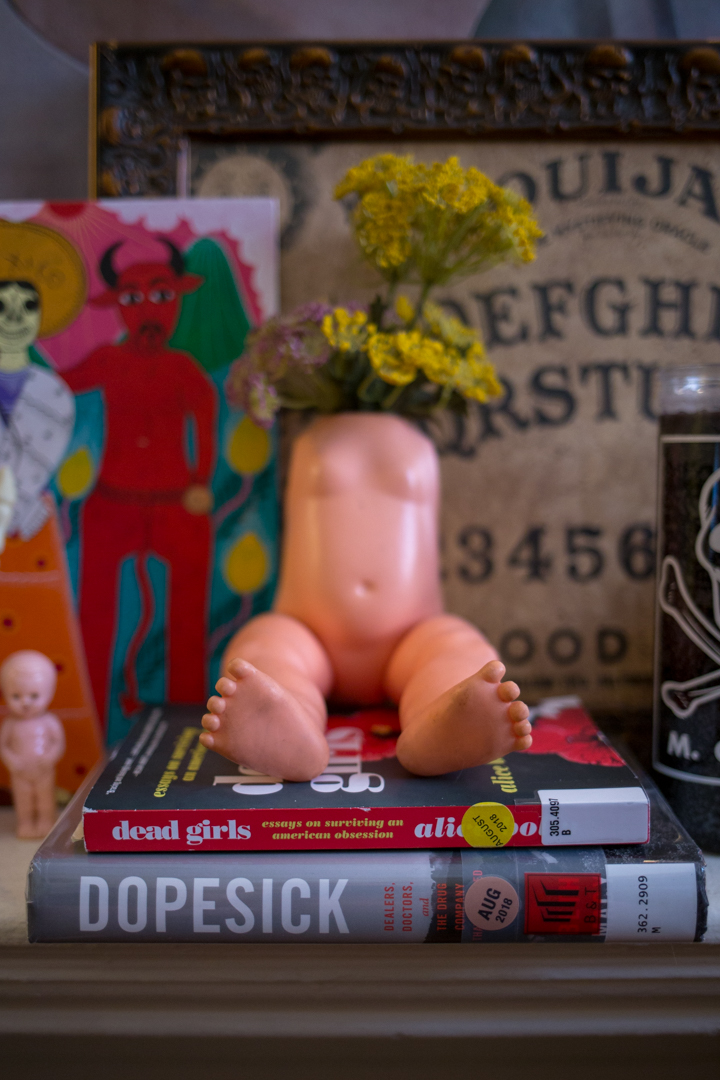
Dead Girls: Essays on Surviving an America Obsession, by Alice Bolin
I should have paid more attention to the negative reviews of this book by people who felt misled by the title, since I ended up becoming one of them. Dead Girls isn’t so much about the dead girl trope in TV and movies as it is a rambling book comprising disjointed essays on LA, Joan Didion and the author’s various struggles with depression, shitty roommates and rootlessness. When Bolin does discuss dead girls the book briefly lives up to its promise, but unfortunately not for long.
Dopesick: Dealers, Doctors and the Drug Company that Addicted America, by Beth Macy
I had already read (and loved) Dreamland—also about the opiate epidemic—so I was concerned that I wouldn’t find much new information in Dopesick. Thankfully this was untrue, and Dopesick was an informative and highly readable account of how we got to where we are now, and who is to blame for the crisis (pretty much everyone). If you’re not infuriated and heartbroken after you read this book, then you’re not paying attention, and I think this should be required reading for every American.


Recent Reads

Famous Nathan: A Family Saga of Coney Island, the American Dream and the Search for the Perfect Hot Dog, by Lloyd Handwerker
Even though I know that hot dogs are garbage food, nothing says New York summer to me like a hot dog from Nathan's at Coney Island. I loved this little book about the history of Nathan's (written by one of his grandsons, Lloyd Handwerker), once a humble hot dog stand selling frankfurters for a nickel (while every other restaurant in Coney Island sold them for ten cents).
The ending is a bit sad—Nathan's two sons could never get along long enough to steer the business like Nathan hoped—and today Nathan's might no longer resemble the business that Handwerker started, but the rags to riches tale of an immigrant in America is as irresistible as a Nathan's hot dog and an order of crinkle-cut cheese fries.
The Hate U Give, by Angie Thomas
After seeing a trailer for the movie adaptation, I reserved this YA novel from the library. I was immediately drawn into the world of Starr, a 16-year-old girl who watches her friend get shot by a police officer during a routine (but not-at-all justified) traffic stop. This is a powerful book that doesn’t shy away from some heavy topics, and Starr’s world—her school, her family, her thoughts and her words—feels so very real.
I think it’s true that you’ll never understand someone fully until you walk a mile in their shoes and reading stories that differ from our own is often the best way we can do that. Starr’s story is an essential one—at times heartbreaking, frustrating and funny like all teenagers’. It’s hard enough being a teenage girl, but Starr’s experience is one that a lot of white America (myself included) will never fully understand unless we really start paying attention.
Lincoln in the Bardo, by George Saunders
I’ve never had such a wild turnaround when reading a book before like I did with Saunders’s first full-length novel. The narrative is described as “experimental,” which would have been helpful to know before I started reading (encouraged to do so by a friend who has been spot-on so far in his recommendations). The book comprises sections cobbled together from historical sources to set the scene—the very real story of Abraham Lincoln’s son Willie, who died from typhoid—along with a fictional narrative laid out like a play (with the name of the speaker appearing after his dialogue).
I hated this book so viscerally when I started it that I was physically angry at it—but once I figured out the unconventional structure, I immediately fell in love with Saunders’s haunting words. The story takes place over one night, in the graveyard where Willie is taken after his untimely death. The Bardo—a sort of Buddhist purgatory—is populated with so many characters it was hard to keep them straight but it didn’t matter much in the end. Saunders’s words on life and death will stick with me for a long time and I now understand why this book garnered so much praise.

Advice for Future Corpses (and Those Who Love Them): A Practical Perspective on Death and Dying, by Sallie Tisdale
This book was a no-brainer for me, someone who devours anything I can get my hands on about death and dying. I hate surprises and secrecy, so I think it’s ridiculous and damaging to ignore the fact that every single one of us (and every one we know) is going to die. About half of Advice for Future Corpses details how to care for a dying loved one, and half is about what physically happens to a body as (and after) it dies. As the excellent title implies, this book is literally for everyone and I think it—and similar books Being Mortal and How We Die—should be required reading for anyone currently residing inside of a future corpse.
Gross Anatomy: Dispatches from the Front (and Back), by Mara Altman
Memoirs by millennial women that address taboo topics in humorous ways are my not-so-guilty pleasure. Every topic that Altman discusses—body hair, sweating, digestive issues, odors, genitalia, etc.—are things I worry and wonder about every single day trying to survive in this strange and confusing world of womanhood. It’s immensely helpful to know that you aren’t alone in your struggles with the human body, but it’s also frustrating to know that we’re all worrying about things that are completely normal and unavoidable.
I’m thankful for people like Altman for writing about these things with humor and grace. We could all benefit from being a little kinder to ourselves and to others who are just doing the best we can in dealing with these strange and unpredictable bodies of ours.


Recent Reads

Nickel and Dimed: On (Not) Getting by in America, by Barbara Ehrenreich
After I read Ehrenreich's latest book, Natural Causes, a few people recommended that I read Nickel and Dimed. Not too long after, I was browsing the dollar section at the Strand and found a copy. I'm fascinated by the income gap in this country and I think everyone should read anything they can to educate themselves on extreme income inequality and the struggles of the working poor—but at times I was frustrated with Ehrenreich's privileged viewpoint and the somewhat shallow nature of her "experiment." I also worked at McDonald's for 4.5 years so I'm no stranger to low wage work, but it's still shocking and devastating to read about just how impossible it can be to just live for so many hardworking people in this country.
Electric Woman: A Memoir in Death-Defying Acts, by Tessa Fontaine
Tessa Fontaine's mother has a devastating stroke, and while she's still in recovery Tessa decides to join the last traveling sideshow in the country. Fontaine goes back and forth between her mother's struggle (past and present) and amusing anecdotes from the sideshow life. I've always been fascinated by sideshows and Fontaine's observations as a newcomer and outsider never seem exploitative. The parts about her mother are heart wrenching and I teared up while reading on more than on occasion. The relationship between mother and daughter is messy and raw but ultimately transformative, mirrored in her season spent on the road learning to eat fire, handle snakes and swallow swords with the sideshow.

All The Lovely Bad Ones: A Ghost Story, by Mary Downing Hahn
Mary Downing Hahn wrote some of my favorite YA books—Stepping on the Cracks, December Stillness and Wait Till Helen Comes—so when I saw this book in a free box on the curb I grabbed it. None of the YA books I've read as an adult by authors that I cherished as a child have had the same impact on me, but they are still fun, quick reads. I have such vivid memories of reading Hahn's books (over and over again) and she is no doubt one of the reasons why I fell in love with reading. I know that if I had read All The Lovely Bad Ones as a kid, I would have loved it just as much as the others.
Bad Ones is a ghost story (like most of Hahn's books) featuring a brother, a sister, a grandmother and a haunted inn. When I was a kid I would have identified with the younger sister, but now I found myself more on the side of the adults who booked a night in the historic inn just to catch a glimpse of the alleged ghosts.
Crazy Rich Asians, by Kevin Kwan
With all the hype surrounding the movie adaptation, I thought I should read the book before I saw the movie. I almost always like books more than their big screen counterparts, but that's not the case here because I didn't love Crazy Rich Asians (the book). It started off promising—and I was hooked into the story from the very beginning—but the more I read the more I became frustrated with the stilted dialogue, shallow characters and just plain bad writing. I wasn't expecting CRA to be great, highbrow literature, but I also wasn't expecting it to be so poorly written.
I did finish the book just to see what happened to Rachel and Nick (the only characters I really cared much about), but the ending felt rushed and saddled with one too many surprise plot twists—that is, if you can even consider the last page of this book to be an ending. I won't be reading the next two in the series, but I am looking forward to seeing the movies—I think this may be the rare exception where you can skip the book and just catch the movie instead.
The Secret History of Magic: The True Story of the Deceptive Art, by Peter Lamont and Jim Steinmeyer
I almost didn't pick this book up at the library when it became available so soon after I finished Steinmeyer's somewhat underwhelming biography of Howard Thurston, The Last Greatest Magician (you can read my review of that one here). Out of the two, this was the better book and I would recommend it if you have an interest in the art of magic itself. They don't say too much about individual magicians (which I was glad for), but rather try to pin down the somewhat mysterious history of how magic has been presented and received throughout the years and around the world.
Certain phrases were repeated often throughout the book—sometimes multiple times on the same page—which I suppose was done for emphasis but just struck me as bad writing. Maybe the biggest lesson that I learned from reading nearly 700 pages about magic is that, while I love the vintage show posters and all ephemera from that era, I'm just not all that interested in the magic tricks themselves.


Recent Reads

Let the Great World Spin: A Novel, by Colum McCann
This book was recommended to me by Lindsey, and it continues my tradition of having never received a bad book recommendation from someone I like. I loved Let the Great World Spin so much that I tried to read it slowly and savor every word. It's loosely based around Philippe Petit's 1974 tightrope walk between the Twin Towers of the World Trade Center, and the interconnectedness of several New Yorkers in the days before and after his famous walk. I cared about each of the characters almost instantly, and I was interested to see how all of the storylines would come together in the end—some do neatly, other connections are a bit vague, but McCann's writing had me hooked until the very last word.
The World Only Spins Forward: The Ascent of Angels in America, by Isaac Butler and Dan Kois
I had seen the HBO version of Angels in America many times and read the play, but this oral history of how Angels came to be was so engrossing that I booked tickets to the Broadway production just a few days after starting it. I'm so glad I did because by the time I finished the book I was itching to see it on stage, and knowing the backstory made it even more enjoyable to watch. If you're not familiar with Angels in America, it was basically the Hamilton of the early '90s. It is undoubtably a masterpiece, and I have an even deeper appreciation for the story after reading about its origins. Sometimes I find oral histories to be confusing and disjointed, but this one was entertaining, fascinating and never hard to follow.

Putting Makeup on Dead People, by Jen Violi
I plucked this novel out of the dollar section at the Strand based on the title and its synopsis, but I didn't realize until I started reading that it's a young adult novel. This isn't necessarily a bad thing, but I was hoping for more gritty funeral business details—instead I got a light, easy-to-read coming-of-age novel about Donna, a girl adrift a few years after her dad's death. She finds her calling within the local funeral home (and pursues an education in mortuary science) with a little teen drama—an impossibly cool new friend, a scumbag college guy, a little bit of light witchcraft, a new boyfriend for her mom, etc.—along the way.
The Last Greatest Magician in the World: Howard Thurston versus Houdini and the Battles of the American Wizards, by Jim Steinmeyer
This book never quite lived up to my expectations and after reading nearly 400 pages about Howard Thurston's life, I'm skeptical of his standing as "The Last Greatest Magician in the World." Thurston isn't nearly as well-known today as his rival Harry Houdini—and this book does a good job of showing why (probably not Steinmeyer's intent). The evolution of different tricks and magic trends is interesting, but I just never cared much about Thurston or how he got to be one of the most famous magicians in the world at the time. Even the design of his beautiful stone lithograph posters—arguably the most interesting thing about him—was inherited from Harry Kellar, Thurston's predecessor and somewhat reluctant mentor.
Broadway: A History of New York City in Thirteen Miles, by Fran Leadon
If you're a New York history nerd like me, you'll love this book about Broadway, one of the most famous streets in the world. Leadon travels north on Broadway one mile at a time and all of the great New York characters make an appearance—Robert Moses, PT Barnum, Boss Tweed, etc. I wish that there had been more recent history included—most of the stories are from the 1800s—but I plan on doing my own research by walking all 13 miles of the Great White Way sometime soon.